


National Security Strategy – Verbal cosmetics and no change of policy (Part II)






Representative text analysis of the National Security Strategy 2025
In the following, we will cite and analyze representative quotes from the strategy paper. They do not follow any particular system, but rather follow the paper chronologically. The quotations deal with basic political and strategic statements and planned political measures and goals. If you read them carefully and thoroughly, it becomes obvious that this is a continuation of the previous agenda, i.e., a continuation of the Wolfowitz Doctrine, which was formulated at the end of the Cold War in the 1990s.
The old and new first paradigms of American foreign policy
The very first sentence of the introduction to NSS 2025 is a declaration of the continued pursuit of global supremacy:
To ensure that America remains the world’s strongest, richest, most powerful, and most successful country for decades to come, our country needs a coherent, focused strategy for how we interact with the world.
National Security Strategy of the United States of America, November 2025, page 1, first sentence
This will be substantiated in the following.
Peace Through Strength
– Strength is the best deterrent. Countries or other actors sufficiently deterred from threatening American interests will not do so.
(NSS, p 8/9)
“American interests” does not refer to the United States within its borders and the interests contained therein. It refers to all those things that extend far beyond American borders, things that are actually located within the borders of other countries or in their immediate vicinity. This is not a retreat to the “Western Hemisphere.”
Of course, the Monroe Doctrine still applies. No one is allowed to do business in the “Western Hemisphere” unless the US agrees. But the US will also do ‘business’ everywhere else in the world. If anyone tries to prevent us from doing so, “peace through strength” applies. We will prevent anyone else from threatening our interests. In other words, we will take action against these nations and prevent them from doing so. We will threaten them so much that they will not even dare to defend themselves.
That is what the entire deterrence strategy toward the island province of Taiwan is all about: preventing China from asserting its internationally recognized sovereignty over Taiwan. Its sovereignty over Taiwan, which even the United States recognizes through its One China Policy and which is undisputed under international law. A glance at the map shows that this is not happening in the Western Hemisphere.
Predisposition to Non-Interventionism
– In the Declaration of Independence, America’s founders laid down a clear preference for noninterventionism in the affairs of other nations and made clear the basis: just as all human beings possess God-given equal natural rights, all nations are entitled by “the laws of nature and nature’s God” to a “separate and equal station” with respect to one another. For a country whose interests are as numerous and diverse as ours, rigid adherence to non-interventionism is not possible. Yet this predisposition should set a high bar for what constitutes a justified intervention.
(NSS, p 9)
Who would disagree that “all men are endowed by God with certain unalienable rights”? This postulate in the Declaration of Independence is sacred in the US—almost as sacred as the Ten Commandments. Many Americans voted for President Trump because they support non-interventionism. “All nations are equal and have a right to their own sovereignty and the protection of their own interests.”
But unfortunately, “our interests” as America are so numerous and diverse and extend so far beyond our own borders that strict adherence to non-interventionism is simply not possible for us. The functioning of the modern American empire requires that we be present everywhere and impose ourselves on everyone, and we will continue to do so. That is what they are making clear here.
How else could this be interpreted? And then there is this: “However, this inclination should set high standards for justified intervention.” In reality, the Trump administration, like the Biden, Obama, and Bush administrations before it, is openly fabricating a pretext to start a war with Venezuela, has already fabricated a pretext for a war against Iran, and continues to lie about nations such as Russia and China, North Korea, and all others that refuse to capitulate and submit to the United States.
Flexible Realism
– U.S. policy will be realistic about what is possible and desirable to seek in its dealings with other nations. We seek good relations and peaceful commercial relations with the nations of the world without imposing on them democratic or other social change that differs widely from their traditions and histories.
(NSS, p 9)
Wonderful! Who could possibly object to “good relations and peaceful trade relations”? But what do they really mean here? Are they talking about Russia and China? Should we be hostile toward Russia and China just because they have a different perspective and govern their countries differently? Hardly.
No, they are talking about all the extremists they have supported, promoted, and brought to power, especially in the Middle East, and how President Trump has built a large part of his support base on Islamic extremism.
The White House is trying to explain why President Trump and his entire administration created this bogeyman and are now openly doing business with him. Why they have an al-Qaeda leader in the White House who embraces President Trump shortly after a $10 million bounty was placed on him and he led an organization that was listed as a foreign terrorist organization by the US State Department.
“Flexible realism” is a real contradictio in adiecto (logical contradiction between noun and adjective – like “eloquent silence” or a “black mold”). You could also call it an oxymoron: "I know we told you they were evil, and we scared you and manipulated you by making them out to be the bogeyman, but they are our bogeyman, and we have to do business with them. We simply don't have time to keep pretending anymore. We have our backs against the wall. We are running out of time to assert ourselves globally. We have to use these terrorists, no matter how bad it looks."
Primacy of Nations
– The world’s fundamental political unit is and will remain the nation-state. It is natural and just that all nations put their interests first and guard their sovereignty. The world works best when nations prioritize their interests. The United States will put our own interests first and, in our relations with other nations, encourage them to prioritize their own interests as well.
(NSS, p 9)
This also sounds soothing to peace-loving minds: “It is natural and just that all nations should put their interests first and preserve their sovereignty.” Off to the promised land! The phrase “it is natural and just” is not coincidentally borrowed from the ecclesiastical context. It is a short formula that fits well with Paul's teaching on natural law, especially in Romans 2. It is often used in sermons, theological texts, or philosophical interpretations. Honi soit qui mal y pense.
And what is the reality? For Ukraine, for example: just keep fighting our endless proxy war against Russia until the last Ukrainian is dead. That is clearly in your best interest. Or for Europe: Increase your NATO spending from 2% of your GDP to 5% of your GDP, neglect your economy and your social system. This is clearly in your best interest in order to wage America's proxy wars and maintain America's dominance over the globe, including Europe. Or for Japan: Take a more aggressive stance against your largest and most important trading partner, China. Or for the Philippines: Do the same. Tear down all the infrastructure that China helped you build and instead invest in missile bases to aim our missiles, which we sell to you at a profit, back at your largest trading partner, China.
That is the reality, in contrast to the fairy tale they are painting here. “The primacy of national sovereignty applies to me, but not to thee.” That is what you are really saying.
Balance of Power
– The United States cannot allow any nation to become so dominant that it could threaten our interests. We will work with allies and partners to maintain global and regional balances of power to prevent the emergence of dominant adversaries.
(NSS, p 10)
Supposedly, the aim is to prevent the emergence of a “dominant player.” But wait a minute: who is the “dominant player” anyway? The United States already dominates all these regions. So do they really want to prevent themselves from continuing to do so—as the “dominant player”? Probably not. Rather, they want to prevent someone else from surpassing the United States and displacing the United States from regions of the planet that are literally on the other side of the world from an American perspective. As I said, this is a rehash of the Wolfowitz Doctrine. And so it goes on:
This does not mean wasting blood and treasure to curtail the influence of all the world’s great and middle powers. The outsized influence of larger, richer, and stronger nations is a timeless truth of international relations. This reality sometimes entails working with partners to thwart ambitions that threaten our joint interests.
(NSS, p 10)
So we will not sacrifice blood and treasure for this. Our “partners” will do that. This already heralds the network for burden sharing.
Burden-Sharing and Burden-Shifting
– The days of the United States propping up the entire world order like Atlas are over. We count among our many allies and partners dozens of wealthy, sophisticated nations that must assume primary responsibility for their regions and contribute far more to our collective defense.
NSS, p 12)
This is actually an extension of what US Secretary of Defense, now Secretary of War, Pete Hegseth outlined in February 2025 regarding the ongoing proxy war between the US and Russia in Ukraine. It is the instruction that the US has communicated to Europe:
You're going to continue the US proxy war against Russia and Ukraine for us. You will divert more resources into doing so. You will even send European and non-European troops into Ukraine to force a freeze on Russia. Minsk 3.0 essentially. And we are going to pivot to China in the Pacific recognizing the reality of scarcity and making the resourcing trade-offs to ensure deterrence does not fail. We can establish a division of labor that maximizes our comparative advantages in Europe and Pacific respectively.
(Pete Hegseth in Brussels, summary by Brian Berletic)
When they talk about “our collective defense,” they mean the American interests that the US has imposed on all these other nations.
For example, they talk about how this war in Ukraine has ruined Europe's relations with Russia and that “we” need to fix that. But who ruined Europe's relations with Russia? Before 2014, Europe worked closely with Russia. Europe and Russia both benefited from this. It was the United States, including under the first Trump administration, that ruined all of that. Continuing with the quote:
President Trump has set a new global standard with the Hague Commitment, which pledges NATO countries to spend 5 percent of GDP on defense and which our NATO allies have endorsed and must now meet.
(NSS, p 12)
So the US does not want NATO to expand? Well, except where we are massively expanding NATO in material terms. And further:
Continuing President Trump’s approach of asking allies to assume primary responsibility for their regions, the United States will organize a burden sharing network.
(NSS, p 12)
Remember this term, it will play a role later on: “burden-sharing network.” That is QUAD (Quadrilateral Security Dialogue, a security alliance between the US, Japan, India, and Australia). That is NATO. That is the US, bringing all of this together into a global burden-sharing network. They take all these nations and get as much out of them as possible so that they do as much as possible for the US to prevent the US itself from being overstretched.
Essentially, it is a matter of establishing, directing, and supporting this network, which is precisely what the US is doing in its proxy war with Russia in Ukraine. They are hiding behind Ukraine and, to a certain extent, behind the Europeans. Without the commitment and capabilities of the US, this war could not be waged. It would be over very quickly. They are hiding in the background while pushing all their proxies forward, thus maintaining the illusion of plausible deniability or a certain distance between themselves and the war they are waging against Russia. And that is exactly what they are doing in a global burden-sharing network against Russia, China, Iran, and everyone else everywhere else.
This approach ensures that burdens are shared and that all such efforts benefit from broader legitimacy. The model will be targeted partnerships that use economic tools to align incentives, share burdens with like-minded allies, and insist on reforms that anchor long-term stability.
(NSS, p 12)
So you insist on reforms in these other countries immediately after talking about the primacy of nations. Do you believe that the US actually wants to recognize the primacy of all nations and not just its own at the expense of the sovereignty of all others?
... insist on reforms that anchor long-term stability. This strategic clarity will allow the United States to counter hostile and subversive influences efficiently while avoiding the overextension and diffuse focus that undermined past efforts.
(NSS, p 12)
The US must oppose Russia, China, Iran, and all other nations investing in multipolarity and keep them in check. They cannot do this alone. They must compel their allies to spend much more and make much greater sacrifices in order to enforce US foreign policy goals at the expense of their own interests in the name of the US.
The Wall Street Journal reported that the NSS 2025 no longer considers China and Russia a threat. [See also: here and here] Even from the little we have already gathered here, it is clear that this is not true.
Retreat to the Western Hemisphere and revival of the Monroe Doctrine
When the White House talks about the Western Hemisphere and builds on the Monroe Doctrine, it is talking about nothing less than American dominance over the entire hemisphere:
3. The Regions
A. Western Hemisphere: The Trump Corollary to the Monroe Doctrine
We will deny non-Hemispheric competitors the ability to position forces or other threatening capabilities, or to own or control strategically vital assets, in our Hemisphere.
(NSS, p 15)
The US will therefore not allow any competitor outside the Western Hemisphere to operate in the Western Hemisphere to any significant extent. It will dictate to Latin American nations with whom they may do business, namely with us and only with us, and how they must do business so that it serves our interests and only our interests.
This is diametrically opposed to the idea that the US would turn away from seeking global dominance. On the contrary, it is denying Russia and China the opportunity to develop partnerships and cooperation in Latin America. What right does the US have to do this? It is completely contrary to international law. It is even completely contrary to the principles set out in the NSS 2025 itself with regard to the primacy of nations. The announcement could have come directly from the Mafia, which was also a protective force only for paying vassals:
We will expand by cultivating and strengthening new partners while bolstering our own nation’s appeal as the Hemisphere’s economic and security partner of choice.
(NSS, p 16)
It's clear: there is no other choice but us. We will expand by gaining and strengthening new partners. That's another word for “regime change.” That's exactly what they're trying to do in Venezuela. What are Russia and China and other partners doing in “our” hemisphere? Get out!
Non-Hemispheric competitors have made major inroads into our Hemisphere, both to disadvantage us economically in the present, and in ways that may harm us strategically in the future. Allowing these incursions without serious pushback is another great American strategic mistake of recent decades.
The United States must be preeminent in the Western Hemisphere as a condition of our security and prosperity — ...
(NSS, p 17)
However, this does not only apply to the Western Hemisphere. From an American perspective, for example, China must not be allowed to dominate the Asia-Pacific region. The US must also be and remain dominant in the Asia-Pacific region.
So once again: regional hegemony for me, not for thee. The Wolfowitz doctrine revisited.
Asia
Many believe that NSS 2025 heralds the withdrawal of the US from the Pacific region or Asia because it now wants to focus solely on the Western Hemisphere and no longer considers Russia or China a threat. However, the NSS 2025 devotes an entire, lengthy section to this topic, which deals with encircling and containing China.
B. Asia: Win the Economic Future, Prevent Military Confrontation
(NSS, p 19)
Prevent military confrontations? What imperialist military confrontations is China planning? There is not the slightest indication of this. Rather, the sole aim is to prevent nations such as China from defending themselves against the constant encroachments, encirclement, and containment attempts by the US. That is what the NSS 2025 actually seeks to prevent. That is what the US has always meant by it.
Nor does it need to be explicitly stated that China is recognized as the greatest threat and competitor (according to the original proposal by the Rand Corporation, see above). However, what is actually proposed undoubtedly implies that China poses the greatest threat to the United States, and not in terms of national security. The problem lies elsewhere entirely:
The Indo-Pacific is already the source of almost half the world’s GDP based on purchasing power parity (PPP), and one third based on nominal GDP. That share is certain to grow over the 21st century.
(NSS, p 19)
Oops: The economic powerhouse is not located in the Western Hemisphere, but far beyond the Pacific!
Which means that the Indo-Pacific is already and will continue to be among the next century’s key economic and geopolitical battlegrounds. To thrive at home, we must successfully compete there — and we are.
(NSS, p 19)
As I said, no one in the Western Hemisphere can compete with us, but we also have to compete and be successful on the other side of the world, right off China's coast. And this is how we plan to do it:
President Trump signed major agreements during his October 2025 travels that further deepen our powerful ties of commerce, culture, technology, and defense, and reaffirm our commitment to a free and open Indo-Pacific.
(NSS, p 19)
Sounds good: “Free and open.” Or is there a catch? Perhaps it's only “free and open” for the United States and those whom the US allows?
And then there's this:
Importantly, this must be accompanied by a robust and ongoing focus on deterrence to prevent war in the Indo-Pacific.
(NSS, p 20)
Why should there be a war in the Indo-Pacific region?
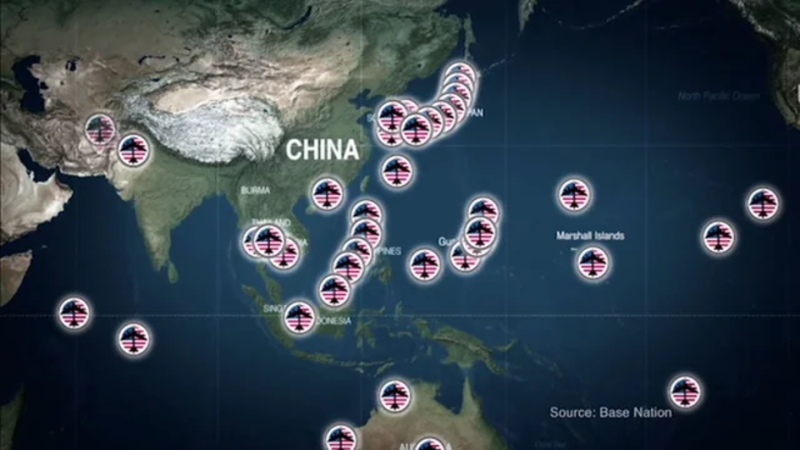
Because the US has stationed tens of thousands of soldiers closer to the Chinese coast than to its own. It is establishing proxy governments throughout the region, just as it did in Ukraine, in order to use them against Russia. It is now doing exactly the same thing in the Indo-Pacific region.
There are numerous documents from several decades about this blockade and isolation of China. As an example, we refer here only to this document from 2018 about a maritime oil blockade against China. It contains a map showing all the locations the US wants to control.
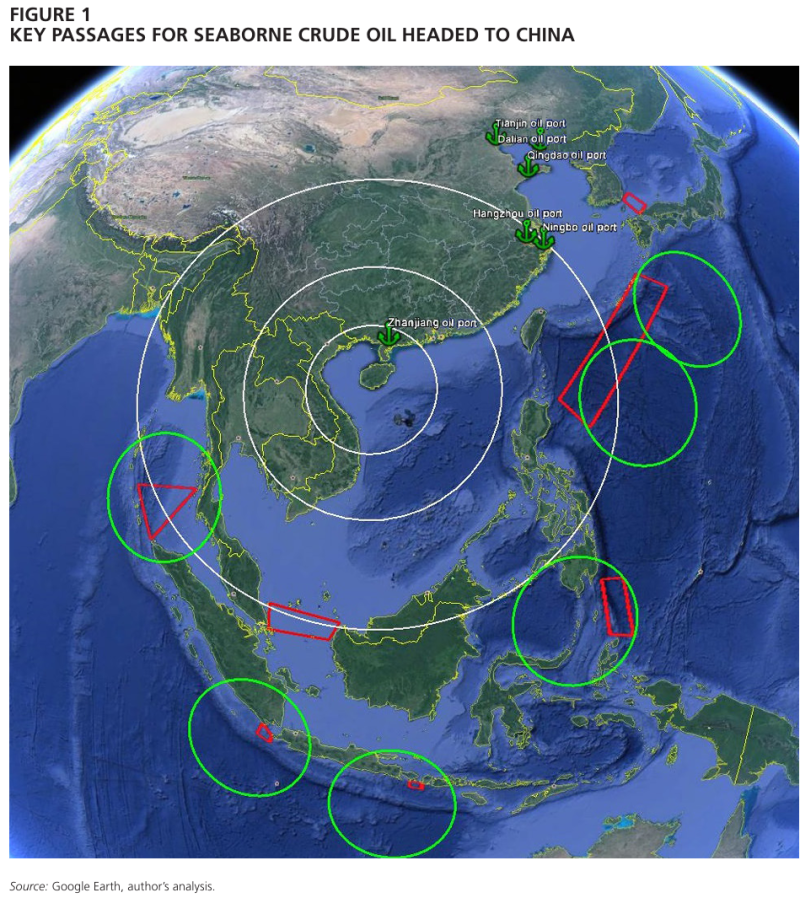
This is referred to as a distant blockade because these bottlenecks are blocked to prevent anything from leaving China or returning to China, but they are far enough away from China that China's military capabilities would not be sufficient to reach them. This shows how important Japan, the Philippines, and the Chinese island province of Taiwan are for all of this. And, of course, the South China Sea. This is where all of China's traffic from China to China and back runs.
Incidentally, all countries in this region consider China to be their largest and most important trading partner. So all of these countries' trade takes place mainly between them and China.
A war in the Indo-Pacific region would only break out if the US were to strangle China to such an extent that China felt its very existence was threatened and therefore had to try to break through the containment architecture that the US is building right off its coast. The US calls this deterrence—deterrence against what? Against any challenge to its own dominance in the region.
This combined approach can become a virtuous cycle as strong American deterrence opens up space for more disciplined economic action, while more disciplined economic action leads to greater American resources to sustain deterrence in the long term.
(NSS, p 20)
“Disciplined economic measures” are those that the US can control – well outside the Western Hemisphere, mind you. No one else in the Western Hemisphere is allowed to compete with the US. But this should also apply to the Pacific region.
This is clear, because “more disciplined economic measures lead to greater American resources to maintain deterrence in the long term”. The more the US can control and dominate the Asian economy, the more opportunities it has to exercise its power in the region and dominate all nations in the region.
China, the largest and most powerful nation in the region, the largest economy with the largest population and the largest industrial base, must not be the dominant power in Asia from the US perspective. That must be the United States. Okay? Does that sound reasonable?
Would the US accept someone drafting a national security strategy and imposing it on the US in the Western Hemisphere? Certainly not. The US would try to break through such a containment architecture. China is trying to break through the US containment architecture—currently without waging war. So the US does not want to prevent an unprovoked war that China might start. It wants to prevent China from defending itself against this containment strategy.
Let's now return to the NSS 2025.
We must continue to improve commercial (and other) relations with India to encourage New Delhi to contribute to Indo-Pacific security, including through continued quadrilateral cooperation with Australia, Japan, and the United States (“the Quad”).
(NSS, p 21)
QUAD is essentially a de facto NATO for the Asia-Pacific region, and it is intended to contain China in the same way that NATO serves to contain Russia in Europe.
Moreover, we will also work to align the actions of our allies and partners with our joint interest in preventing domination by any single competitor nation.
(NSS, p 21)
The aim is not to prevent anyone (including the US) from gaining dominance and to establish a genuine balance of power, but rather to prevent another competing nation from gaining dominance. China is not explicitly mentioned, but it is obviously what is meant.
Those who conclude that the US has abandoned its confrontation with Russia and China have obviously not read the paper to the end. However, if you do so, it becomes clear that they still regard Russia, China, Iran, and anyone else who opposes American dominance anywhere on the planet as their greatest threat, which they intend to continue fighting. And they lay out their plan quite openly on these pages.
To be clear once again:
In the long term, maintaining American economic and technological preeminence is the surest way to deter and prevent a large-scale military conflict.
(NSS, p 23)
Dominance where? In Asia and across the entire planet.
A favorable conventional military balance remains an essential component of strategic competition. There is, rightly, much focus on Taiwan, partly because of Taiwan’s dominance of semiconductor production, but mostly because Taiwan provides direct access to the Second Island Chain and splits Northeast and Southeast Asia into two distinct theaters. Given that one-third of global shipping passes annually through the South China Sea, this has major implications for the U.S. economy.
(NSS, p 23)
Whose shipping traffic is this? Is this “global shipping traffic”? Is it American or European shipping traffic? Or could it possibly be Chinese shipping traffic?
Here is the US government-funded think tank CSIS, which has presented an entire presentation on this topic.
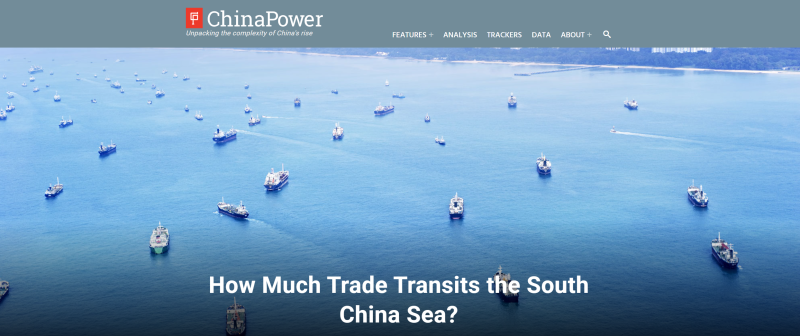
Here you can see how much trade is conducted via the South China Sea.
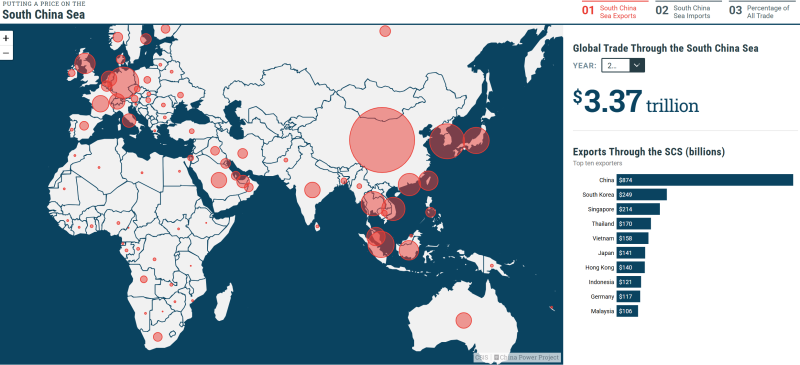
This huge red dot indicates that most of the shipping traffic through the South China Sea goes to and from China. And once again: all of these countries see China as their largest trading partner in terms of exports and imports. Their entire trade therefore passes through the South China Sea to China and back again. So it is predominantly Chinese shipping traffic that crosses the South China Sea.
Do we really believe that the US is present in the South China Sea to protect Chinese shipping traffic through the South China Sea, or are they there to threaten and ultimately disrupt it, as they are already openly attempting to do with Russian energy exports? And what military threats are we talking about here?
Deterring Military Threats
(NSS, p 23)
The aim is to prevent China from defending itself against America's gradual salami tactics of containment and strangulation. Here is another great quote:
We will build a military capable of denying aggression anywhere in the First Island Chain.
(NSS, p 24)
Let's take another look at the map. “Everywhere in the first island chain.” They are referring to right here, just off the coast of China.
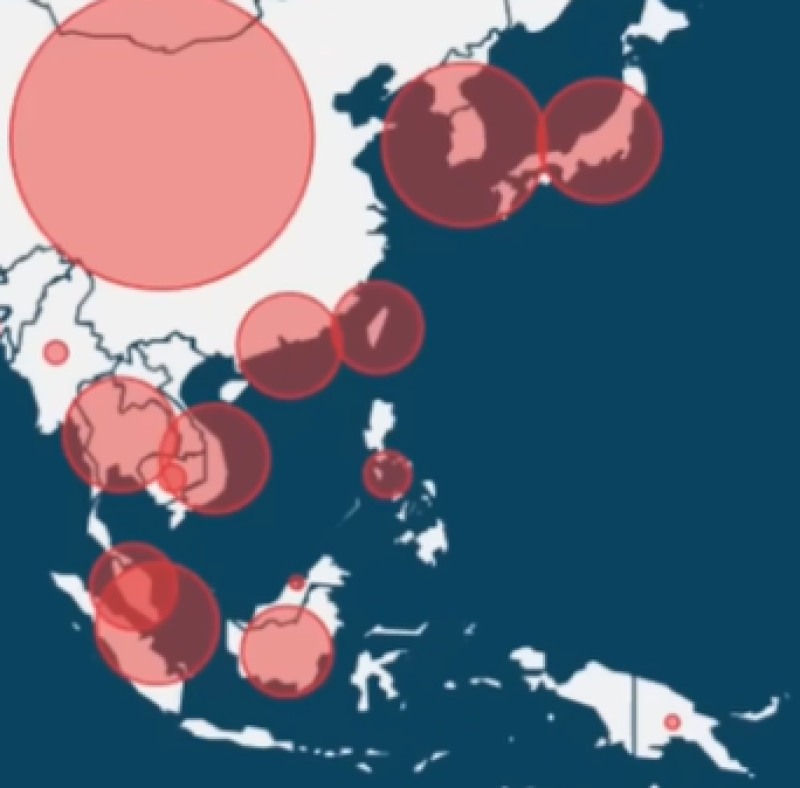
That is where the first chain of islands is located. Directly off the coast of China.
What would happen if China were to talk about repelling American aggression directly off the coast of America because the Chinese military has surrounded the United States around the Western Hemisphere and is trying to portray any attempt by America to break through this encirclement as aggression that must be repelled?
“This has a significant impact on the US economy,” says the NSS 2025. What interest would China have in disrupting global (essentially Chinese) shipping through the South China Sea – just to harm the American economy? Conversely, if the US could disrupt shipping in the South China Sea, it would help the American economy, which is currently unable to compete with China. Once again, weakening China is the only way for the US to remain the most powerful nation in the world.
That's why they need an additional $1 trillion for their war machine.
But the American military cannot, and should not have to, do this alone. Our allies must step up and spend—and more importantly do—much more for collective defense.
(NSS, p 24)
When the White House talks about these expenditures, it means that no infrastructure will be built in Japan or the Philippines. The money is to be used for American weapons so that they can act as proxies against China, just as Ukraine does against Russia. And they always refer to this as “collective defense.” But here, too, it is obvious that all this is intended solely to underpin American hegemony in Asia.
America’s diplomatic efforts should focus on pressing our First Island Chain allies and partners to allow the U.S. military greater access to their ports and other facilities, to spend more on their own defense, and most importantly to invest in capabilities aimed at deterring aggression.
(NSS, p 24)
One final word on Asia before we move on to Europe:
Given President Trump’s insistence on increased burden-sharing from Japan and South Korea, we must urge these countries to increase defense spending, with a focus on the capabilities—including new capabilities—necessary to deter adversaries and protect the First Island Chain. We will also harden and strengthen our military presence in the Western Pacific, while in our dealings with Taiwan and Australia we maintain our determined rhetoric on increased defense spending.
(NSS, p 24)
Why does the US have to pressure other countries to do this? If these nations were facing such a major threat, they would spend money on defense themselves. And how can the US pressure other countries to do this without violating its own “principle of national sovereignty”? Once again, this is simply about maintaining US supremacy, coercing and controlling other nations. As I said: the Wolfowitz doctrine revisited.
To be continued
The second part of this analysis dealt with the White House's propaganda meme that the US no longer considers Russia and, above all, China to be enemies, that it is relinquishing its global dominance and retreating to the Western Hemisphere. In the following third part, we will delve deeper into the text analysis of the NSS 2025 and show how the US intends to shape relations in Europe, the Middle East, and Africa in the future.
«National Security Strategy – Verbal cosmetics and no change of policy (Part II)»