


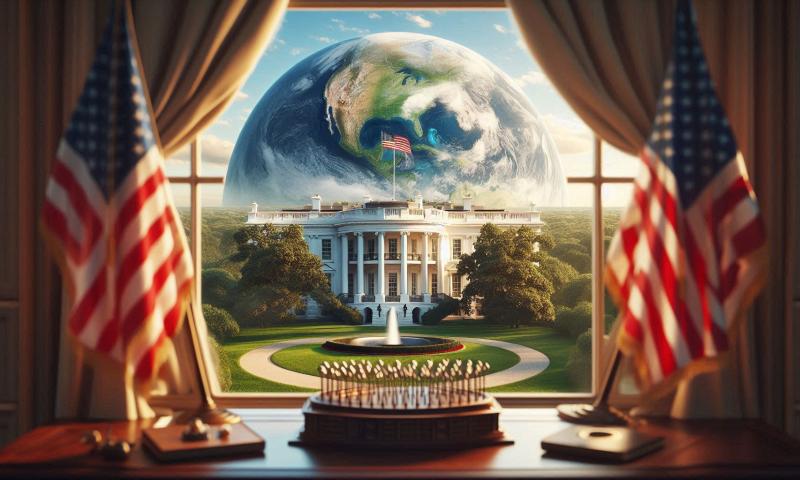
National Security Strategy – Verbal cosmetics and no change of policy (Part I)






It had already become apparent
2025 National Defense Strategy (NDS)
Under the headline “Pentagon plan prioritizes homeland over China threat,” POLITICO reported on September 5, 2025, on the draft of a “2025 National Defense Strategy (NDS)” that Secretary of (then still) Defense, Pete Hegseth, had commissioned the Under Secretary of Defense (now: “of War”) for Policy, Elbridge Colby, in early May 2025. According to the draft, the focus of the Pentagon's military activities should be shifted, at least verbally, away from “enemies” such as Beijing and Moscow to regional and domestic theaters. Comments on the matter even suggested that the US would now withdraw to “Fortress America” in light of its ignominious retreat from the Houthis, the embarrassing outcome of the USrael war against Iran, and the disastrous course of the war in Ukraine for the West.
It was expected that a new global assessment would lead to US military resources being relocated from Europe and probably also from Asia back to the United States. However, this has not happened yet. The new NSS 2025 sais why, as we explain below.
Rand Corporation: “Stabilizing the U.S.-China Rivalry”
On October 14, 2025, the Rand Corporation published a strategy paper entitled “Stabilizing the U.S.-China Rivalry,” which suggested that economic cooperation between the US and China for mutual benefit was a dream worth pursuing.
To this end—the development of a “certain modus vivendi” with China in various areas, which would extend over at least three to five years—the paper recommended that the US “clarify its goals with language that explicitly rejects absolute versions of victory and accepts the legitimacy of the Chinese Communist Party” (emphasis added). This already hinted at the verbal cosmetics that are now being taken to extremes in the NSS 2025.
The Rand Corporation's recommendation also contained several general principles that should be agreed upon to “stabilize rivalry” (six “broad initiatives”) and proposed more specific strategies for three areas of relations that are considered more difficult: Taiwan, the South China Sea, and competition in science and technology. Recommendations such as “restoring multiple channels of trusted communication between senior officials” are undoubtedly useful. (This now sounds very different in the NSS 2025.)
But even this strategy proposed by the Rand Corporation at the time contained the axiomatic premise that there are no fundamental common interests between these two great nations, so that “preserving limited areas for coordination” and “managing rivalry” to reduce the risk of crisis was the best that could be hoped for.
“Our goal in developing a stabilization agenda was limited. We do not believe that cooperative coexistence is possible today.”
Rand Corporation, October 2025
The end of utopia – and even this document has since been withdrawn by the Rand Corporation “for further review”.
However, the fact that such a strategy paper was published at all shows that the Rand Corporation (i.e., certain circles in the Pentagon and the State Department and their financiers) felt compelled to make certain propagandistic adjustments to the general narrative – the difference to the tenor of the 2019 paper entitled “Extending Russia: Competing from Advantageous Ground” is certainly striking.
The Anchorage thaw interlude
Prior to this, on August 15, 2025, Presidents Donald J. Trump and Vladimir Putin had met at the US military base Joint Base Elmendorf–Richardson in Anchorage.
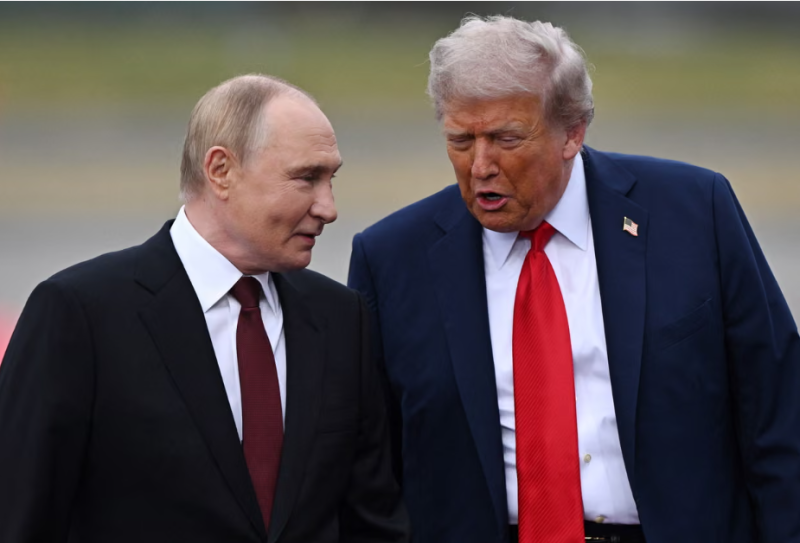
The details of what the negotiating teams discussed remain unclear. Afterwards, both sides issued a joint statement—information remained vague, and no concrete agreements were mentioned. However, there were clear signs that the Trump team—contrary to the positions of the idealistic school of US foreign policy (liberal internationalism, Wilsonianism) of the Biden administration—is moving closer to certain positions of the realist school (realism) in its propaganda. However, there are still no signs of a genuine rapprochement in US foreign policy towards Russia or even China, although Russia did declare itself willing to make “certain compromises” in Anchorage.
NSS 2025: An update of the Wolfowitz Doctrine of 1992
Essentially, the new National Security Strategy of the White House under Donald Trump is a linguistically and propagandistically modified reissue of the old Wolfowitz Doctrine.
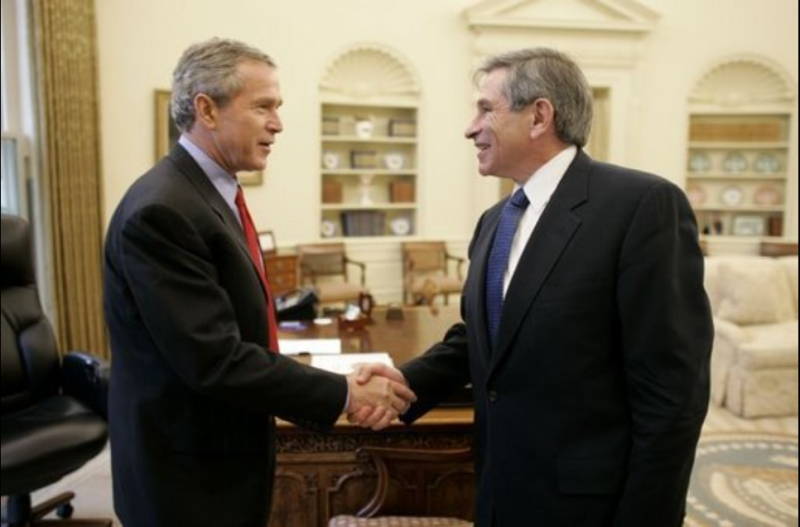
Neoconservatives Paul Wolfowitz (then Under Secretary of Defense for Policy and thus the highest-ranking political planner in the Pentagon under Defense Secretary Dick Cheney) and Lewis “Scooter” Libby (then Principal Deputy Under Secretary of Defense for Policy, i.e., Wolfowitz's most important deputy) drafted the American Defense Planning Guidance (DPG) in 1992. This paper redefined the strategic orientation of the US after the end of the Soviet Union. The most important points of the draft were:
The US should prevent the emergence of a new superpower anywhere in the world that could compete with it.
The US should secure its global military superiority and maintain a unipolar world order.
The US should also be able to act unilaterally, i.e. without the consent of other states, in cases of doubt.
Regional conflicts should be influenced in such a way that no hostile powers can benefit from them. Alliances are desirable, but must not significantly restrict the US's freedom of action.
The Wolfowitz Doctrine therefore states that the political and military mission of the US in the post-Cold War era will be to ensure that no rival powers can emerge in Western Europe, Asia, or the territory of the former Soviet Union—in essence, anywhere in the world. The aim is to fundamentally reject a collective approach. The US does not want any nation or confederation of states to undermine its global dominance.
Although the original version was never officially adopted, it subsequently had a significant influence on American foreign and security policy, for example through the documents of the Project for the New American Century (PNAC) at the end of the 1990s (source here), the US National Security Strategy of 2002 under President George W. Bush (source here), and the arguments surrounding the Iraq War in 2003, etc., etc.
So why is this slow seller now being prominently brought back to the fore and given a new polish? The reason is that, in view of the lost kinetic wars, the lost economic wars, and the considerable danger that people are beginning to use their own minds despite the relentless wave of propaganda, the war for people's minds is coming to the fore.
Cognitive warfare
The battle for people's minds is thus being turned into a separate warfare technique, with the declared aim of making people themselves an independent, official NATO theater of war. This means that every individual is at the center of this state-of-the-art psychological warfare at all times.
Jonas Tögel in Forum Geopolitica on September 28, 2025
Control over the dominant narrative of societies
That is the purpose of NSS 2025. And the methodology of this strategy paper follows well-known psychological manipulation methods. The entire treatise is deliberately full of contradictions, citing throwaway quotes and then explaining in detail that the exact opposite is actually the case. This deliberately creates a state of cognitive dissonance.
Creating cognitive dissonance
When a text emphasizes a brief statement (“we will do X” – for example, turn away from the unipolarity of geopolitics) and then explains in detail why exactly the opposite of X is planned and will be implemented (we will remain dominant in all areas), this creates a state of tension for the reader. “You say A, but show B.” “Which is it?” People don't like internal contradictions. So they try to resolve the dissonance – and this is where the tactic comes in. In the end, many accept interpretation A, which is closest to their own (depth psychologist Alfred Adler spoke of biased apperception: you hear and see what you want to hear and see according to your own life plan, even if it clearly does not correspond to reality) and emotionally ignore the contrary facts that have been communicated, pushing them into the background of their memory and thus suppressing their original intuition.
By deliberately incorporating contradictory mini-statements, a kind of argumentative framework is created. The brief statement of hope is reassuring (“it's not so bad” or “finally, we've been waiting for this!”). The detailed contradictory description that follows and the events that actually unfold are reinterpreted internally or ignored mentally and emotionally. The reader then resolves the dissonance by preferring the explanation that is closest to their hopes—it seems more “logical” to them.
Reducing dissonance strengthens persuasiveness
Once someone has accepted the interpretation offered, the initial dissonance actually strengthens their attachment to this explanation: those who invest effort in understanding the contradiction subsequently consider the solution found to be particularly plausible. This is a well-known psychological effect. The more cognitive effort you invest, the more you believe in the result. The worm of doubt is numbed.
Dissonance management – used strategically
The authors of NSS 2025 therefore use contradictory statements to protect their narrative: short, emotionally appealing headlines (we are disarming and are in favor of peace) serve as an alibi and convey the actual desired message (in order to maintain peace, we must be dominant everywhere in the world, otherwise there will be war again). Anyone who mocks the “alleged” internal contradictions of the paper misunderstands the methodology and the seriousness of the situation.
In short, the tactic works because it deliberately creates cognitive dissonance and then channels it. The reader is forced into a train of thought that ultimately leads them more likely to the desired interpretation.
A whole potpourri of well-known PR strategies and psychological tactics
In addition, a whole range of other well-known PR strategies and psychological tactics can be identified in the NSS 2025, in particular gaslighting (in PR: “institutional gaslighting” – presenting a statement that appears to clarify something and then providing a detailed explanation that suggests the opposite), doublespeak/doublethink (from Orwell's terminology: language is used in such a way that it asserts two contradictory things at the same time with the aim of controlling the narrative by distorting reality linguistically), inoculation technique (a weak, superficial statement, the “throwaway quote,” is made to anticipate criticism and then ‘thoroughly’ refuted to steer readers toward the “correct” interpretation), Framing and contradiction resolution (a seemingly balanced, neutral statement is first placed, “both-sides-ism,” which is then reinterpreted through detailed framing so that the authors still push through their actual position), Covering the tracks/hedging (short contradictory statements are used to deflect later criticism [“We did say that...”], even though the overall impression conveys the opposite).
The methods described are a mixture that deliberately exploits contradictions to make the desired narrative appear more credible, while creating confusion or a semblance of objectivity.
We document this methodology below using representative text examples. (We are very grateful to Brian Berletic for his excellent preliminary work on this presentation in his “Deep Dive” – here.) But first, we will show how this tactic seems to work – at least in some cases?
Fallen into the trap?
The Western press
Here is a typical quote that shows how the Western press faithfully conveys the White House's propaganda meme in accordance with instructions and orders.
The document articulates what US strategy is—for example, a focus on the Western Hemisphere and a “Trump Corollary” to the Monroe Doctrine. And it addresses what US strategy isn’t: continued pursuit of a post–Cold War goal of “permanent American domination of the entire world,” which the NSS describes as a “fundamentally undesirable and impossible goal.”
Atlantic Council, December 5, 2025
Russian state media
This comes from the Russian state media, RT:
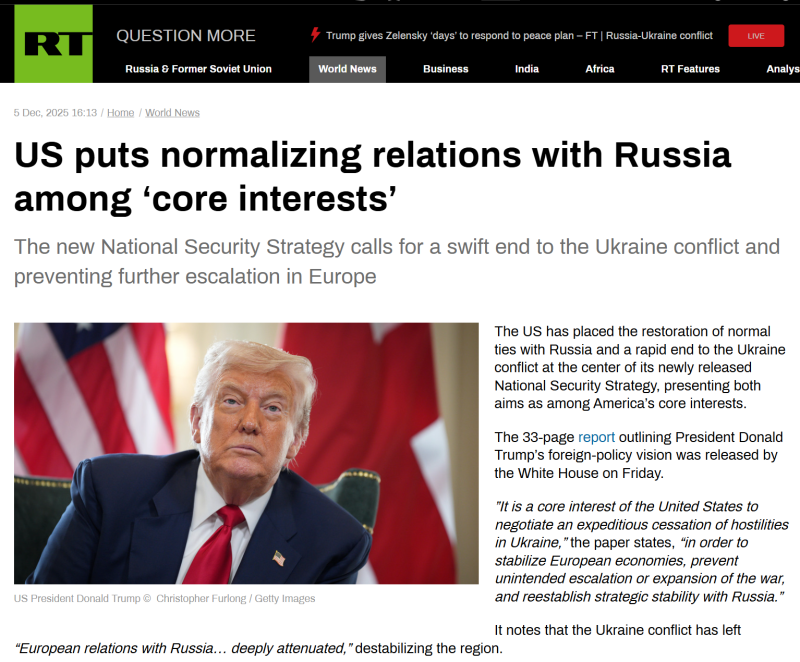
The US considers the normalization of relations with Russia to be one of its core interests.
The new national security strategy calls for a swift end to the conflict in Ukraine and the prevention of further escalation in Europe.
RT, December 5, 2025
No, it does not. We will discuss this below.
In contrast to the US national strategy during Trump's first term, which prioritized competition with Russia and China, the new strategy shifts the focus to the Western Hemisphere and the protection of the homeland, borders, and regional interests. It calls for resources to be diverted from distant theaters to challenges closer to home and urges NATO and European countries to take primary responsibility for their own defense.
RT, December 5, 2025
RT adopts the propagandistic headlines of the NSS 2025 without mentioning the detailed contradictory statements that follow, and also propagates this central falsehood of the NSS 2025:
The document also calls for an end to NATO expansion...
RT, December 5, 2025

If this state media portal presents it this way, we believe that there are political reasons behind it. In view of the threatening global situation, Russian foreign policy clearly wants to maintain every opportunity, no matter how small, for further constructive dialogue with the US—knowing full well that a solution to the conflict with the West will ultimately have to be military and that certain siren songs from the White House cannot and should not be relied upon.
NATO expansion: what NATO expansion?
The propagandistic core of the statement about the “end of NATO expansion” refers to possible territorial shifts. But the paper makes no mention of the possibility that the most recent territorial shifts (Sweden, Finland) could be reversed. Furthermore, what is the power of NATO? It is more likely to be the effort made to remain dominant. This aspect of “enlargement” is verbally “swept under the carpet” and the public is being hoodwinked.
The reality is as follows: The accompanying letter from US President Donald J. Trump to the presentation of the NSS 2025 shows how, on the very first page of the document, he boasts about how he personally has expanded (“strengthened”) NATO in less than a year since his return to office and strengthened “our Armed Forces” (which is the core of NATO) with investments of $1 trillion.
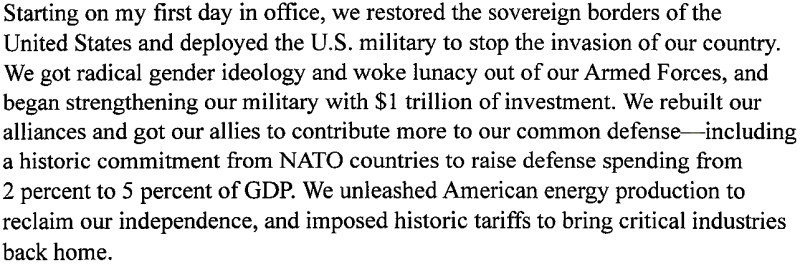
Is it really necessary to spend an unprecedented sum of $1 trillion—more than any other single investment in the US military—to retreat to the Western Hemisphere and mind one's own business? Certainly not. So, at first glance, the idea that NATO will not be “expanded” and that the US will retreat to the Western Hemisphere and not continue or expand its quest for global dominance falls apart.
What else does Trump boast about in the letter?
“We have rebuilt our alliances and persuaded our allies to contribute more to our common defense, including a historic commitment by NATO countries to increase their defense spending from 2% to 5% of their GDP.”
Trump, accompanying letter to NSS 2025
Has the US reduced its contributions to NATO? No. It has simply persuaded European and non-European NATO members to spend more on NATO themselves. All key NATO countries are being called upon to prepare themselves for war in order to be able to wage war against Russia. There can be no talk of an “end to NATO expansion.”
To be continued
The first part of this analysis dealt with the White House's propaganda meme that it was heralding the “end of NATO expansion.” In the following second part, we will delve deeper into the text analysis of NSS 2025 and show how the US intends to maintain or reestablish its dominance in all global arenas with the help of its vassals.
«National Security Strategy – Verbal cosmetics and no change of policy (Part I)»