


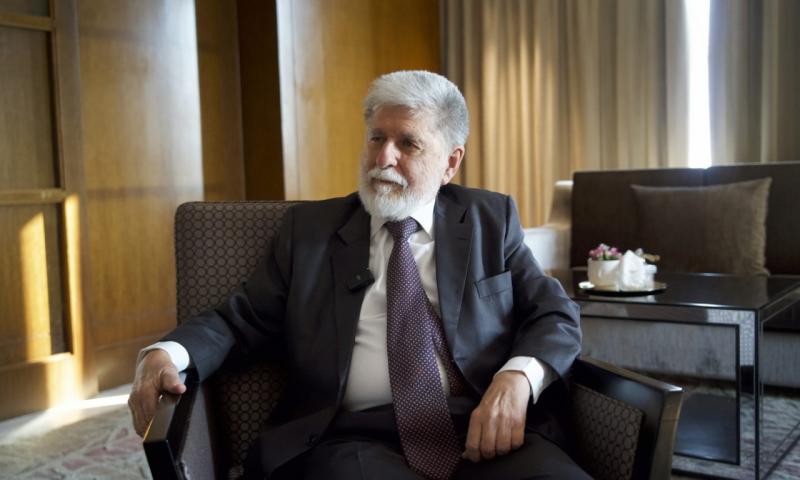
Brazil must develop a deterrent capability, according to Lula's top diplomat






Editor’s Note: This article is published with the express permission of the authors, Marco Fernandes and Sergey Monin (Brasil de Fato).
Celso Amorim, Brazil's foreign minister, took part in the 2026 International Security Forum, which was held in Moscow from 26 to 29 May. In addition to meeting with some of the Russian government’s top officials, Amorim gave an exclusive interview to Brasil de Fato in which he discussed current conflicts and issues of Brazilian sovereignty.
The issue has been the subject of much discussion in recent days, ever since Washington designated the Primeiro Comando da Capital (PCC) and the Comando Vermelho (CV)—Brazil’s two main criminal organizations—as terrorist organizations. Mr. Amorim was one of the first to respond to this decision on behalf of the Brazilian government.
In a speech, the advisor stated that “another serious threat to [Brazilian] security is the growth of organized crime. The Brazilian government is taking decisive action to dismantle criminal networks, including by increasing legal penalties and working closely with local authorities to strengthen their capabilities. Organized crime must be combated with the utmost energy and determination. Equating organized crime with terrorism, however, is not helpful. Understanding the motivations is essential for effectively combating all types of crime.”
In an interview with Brasil de Fato regarding the current state of relations with the country, he believes there is a warming of ties, but “I also spoke frankly with the Russians. Brazil’s largest trade deficit is with Russia. So, that has to change.” On the other hand, politically, “there is a major rapprochement. For 11 years […] there had been no high-level meeting [of the Brazil-Russia High-Level Commission].”
Regarding Washington’s various attacks around the world, Amorim expressed the Brazilian government’s condemnation of the invasion of Venezuela and the war against Iran, and expressed deep concern about the situation in Cuba: “I believe that a military solution will not work and will result in many deaths and much suffering.”
Amorim recalled, in detail, the Brazilian and Turkish attempt to mediate a nuclear agreement with Iran in 2010, at the request of then-U.S. President Barack Obama, and lamented that an agreement was not reached at the time: “They could have created a commission to monitor compliance with the agreement, should any doubts arise, but everything we were asked to do regarding Iran was achieved.”
Finally, the foreign minister during President Lula’s first two terms and defense minister under President Dilma Rousseff raised a fundamental debate for Brazil—amid Washington’s imperialist offensive and the remilitarization of countries like Germany and Japan—about what is needed to defend our sovereignty: “You have to have a deterrent capability. I think that’s the bare minimum for you to operate in international relations. It’s great to be a pacifist, it’s great to seek dialogue, but you need a little backup when push comes to shove.”
Interview
Brasil de Fato: In June of last year, shortly after the first U.S. bombings against Iran during the Twelve-Day War, you gave a live TV interview and said: “The international order is over.” Since then, we’ve seen extrajudicial killings of people on fishing boats in the Caribbean, the invasion of Venezuela, another war against Iran, and Cuba could be next. How is Brazil reacting to this?
Celso Amorim: President Lula’s approach is based on the idea of dialogue. You just saw that, despite everything that happened before, he received an invitation to the United States. He went there, talked, we’re talking about trade, we can talk about other aspects.
I think President Trump was very respectful in his dialogue with us. That’s a positive thing. Now, unquestionably, we condemn what happened in Venezuela and we are very concerned about Cuba, very concerned indeed. I mentioned something, I think to Lavrov: “We are here in Moscow. Communist Cuba has existed for almost as long as the Soviet Union did. And the Soviet Union is the defining feature of the 20th century.” So, it is a very dramatic situation.
They’ve tried everything—boycotts, embargoes. I don’t know what else they can try. I think it will be very difficult to achieve something [like in Venezuela]. I also didn’t expect what happened in Venezuela to happen, but I think it’s even harder in Cuba.
I think that, although there may be dissatisfaction with the economic situation, and with other aspects as well—I’m not defending the system—Cuba could evolve, but I think a military solution won’t work and will result in a lot of death and suffering. And I think Cuba has a symbolic significance in Latin America, even for countries that don’t agree with the regime.
There’s also no perception that they’re over-extending—not their military capacity, which everyone knows is enormous, but even their political capacity for mobilization. There’s a movie I saw when I was a kid; it was an American film called “A Thread of Hope.” It was about a plane that was in danger. So, when there’s a thread of hope, we have to work and go for it. In the past, I used to talk about “openings,” but today those openings are already very narrow, so we have to go with a thread of hope.
And did President Lula discuss Cuba with Trump during his last visit?
He mentioned his concern. I wasn’t at the meeting, so I don’t know. I didn’t ask either. But from what he said, I think he expressed his concern.
How do you assess Brazil’s position today in the war that the U.S. and Israel have provoked against Iran? Because Brazil has been trying to mediate this conflict between the West and Iran for many years, as you recount in your book “Tehran, Ramallah, Doha,” right?
All these issues depend heavily on the circumstances. For example, today, the one actively involved in this is Pakistan, which used to only look out for its own interests. I think this is very positive, and I even praised it in my speech. Of course, it also participated in the UN and the G77. I’m not trying to downplay its importance, but it had never positioned itself as a mediator in these conflicts. It has its own issues there, as we know, especially with India.
Now a moment has arisen where they are talking. I think Qatar is returning to the table, which is also very important. Obviously, I don’t know the details, but I think this offers some hope. Let’s hope it works. You know, it doesn’t have to be Brazil either. We are interested in peace.
In fact, in the case that President Lula always mentions regarding the Tehran Declaration [Brazil’s attempt at mediation alongside Turkey in 2010], it was Obama who asked. What I don’t understand is the Brazilian media saying: “Why did Brazil get involved?” Brazil didn’t get involved. Obama asked for it in three points, writing: 1) The biggest problem in the world today is Iran’s nuclear program; 2) I extended my hand and it wasn’t reciprocated; and 3) I need friends who can talk to those I can’t talk to.
Those three sentences were enough, right? And, to leave no doubt, he sent Bill Burns [who would later become Obama’s Deputy Secretary of State] to talk to me, and who later served as CIA Director under the Biden administration. I was Minister of Foreign Affairs. Later, [Mahmoud] Ahmadinejad [Iranian president at the time] visited Brazil. We kept the conversation going, building trust. And, in the end, there was doubt.
There was a moment when I myself said: “President, I don’t think it’s going to work, because we had a meeting there in Washington, with the Turks as well, that went very badly.” Then, when I got back to Brazil, we had a BRICS meeting. The next day, I opened a copy of Obama’s letter to Lula, reiterating exactly the same points. Then I said: “Now we have to try.”
Of course, there was still a small difference in the amount of enriched uranium, but it was discussed and resolved. The French also appealed to us, because there was a French woman in prison. We had a conversation with President [Nicolás] Sarkozy, perhaps in Manaus—because they also consider themselves part of the Amazon [French Guiana is a “French overseas department,” a sort of French colony]—and he said: “But I can’t talk to Iran until they release her.” So I said: “But when they release her, will you discuss the matter immediately? ” He said yes, but it took more than three months for them to talk.
By then, sanctions were already in place. Anyway, all that is in the past. But it shows that with goodwill, it’s possible to achieve something that isn’t easy, because, of course, countries are also divided. Sometimes one wants to do it, the other doesn’t.
But why didn’t it work out? Was it a U.S. boycott?
I think there was a division within the United States. I wrote about it at length. But that was a while ago. There were the midterm elections [for the U.S. House of Representatives and Senate]. The Secretary of State herself [Hillary Clinton] was a presidential candidate. I noticed a certain nuance, at least, between the Secretary of State and the president. Anyway, there were a number of factors. Iran wasn’t easy either. We’d make progress, they’d stall, we’d backtrack, and so on. But in the end, it worked out.
Now, I think there’s another factor that surprised me the most about the whole thing. Of course, what was decisive [for the failure] was the U.S. attitude. I mean, they had asked for it; they wanted it. But it surprised me, to tell you the truth, that all the permanent members [of the UN Security Council] voted in favor of the resolution imposing sanctions. And that’s when the idea stuck in my mind that certain problems, only they [can solve]. Especially in the nuclear area, because the P5 [the five members of the Security Council] are also the N5.
They are the five countries recognized as nuclear powers by the Non-Proliferation Treaty. There are others that have them, but aren’t recognized. That’s India, Pakistan, North Korea, and Israel.
Israel doesn’t acknowledge that it has them, right?
It’s ambiguous, isn’t it? But everyone knows it has them. If you bring it up, they don’t deny it.
I think they consider, in a way, that the nuclear issue is their monopoly. I think so. It’s the only explanation I have. Because they gave Russia a little leeway, China a little leeway, they allowed oil exports from Iran to China and Russia, and they even allowed the completion of a nuclear power plant—but not an enrichment facility—in Bushehr. Only Brazil and Turkey voted against it. It was the only time Brazil voted against a resolution that passed in the Security Council. And Lebanon abstained.
What year was that?
2010. A month and a half after the declaration.
The first thing I did when I left was speak briefly with Lavrov, call Tehran, and the first long conversation I had was with Hillary. She had asked. “Oh, it’s no use; we’re going to proceed with our request for sanctions.”
I think that was a disaster. I don’t mean to say that Brazil could have done better, or that someone else could have stepped in to supplement it, because there are always doubts, right? You sign an agreement, but you’re not sure how it will be implemented. They could have created a commission to monitor compliance with the agreement, should any doubts arise, but everything that was asked of us regarding Iran was achieved.
But what about the conflict situation today?
I don’t know what will happen, but I think the goals initially announced by the United States—at least rhetorically—to “send Iran back to the Stone Age” won’t come to pass. Iran is an ancient civilization, one of the oldest. I always mention that the earliest surviving Greek play begins with a line about Persia.
No one is going to bomb a country so that it becomes a democracy. It doesn’t work that way. It’s through conversation, discussion, and understanding cultural differences. Of course, we too, in certain respects, are critical. We would be critical, but while respecting the self-determination of peoples. Every people has its own evolution. Look at Brazil 50 years ago—how indigenous people, Black people, and others were treated—would that justify bombing Brazil? No, we have to evolve.
You mentioned the issue of the UN Security Council, and how Russia even supports Brazil’s entry as a permanent member. Do you believe there has been a greater convergence of the multilateral agenda between Russia and Brazil since Donald Trump?
I hope so. I met with several people. In fact, everyone I was interested in meeting, with the exception of President Putin—whom I didn’t ask to meet, but I left a letter from President Lula for Putin regarding Bachelet.
I think there is a convergence. Now, I also spoke frankly with the Russians. Brazil’s largest trade deficit is with Russia. So, that has to change. I know that the war led to increased self-sufficiency; they used to import meat and now they don’t. We import diesel and fertilizers. In fact, they’re getting more and more expensive.
It’s not their fault, but, in any case, they’re more expensive. And we’re exporting very little.
From a political standpoint, there’s a major rapprochement. For 11 years—that is, since Dilma’s administration—there had been no high-level meeting [of the Brazil-Russia High-Level Commission], [led] by the [Russian] prime minister and our vice president. Our vice president has now stepped down from the [Ministry] of Industry and Trade—it was a major portfolio. And President Lula himself attended the luncheon to show his support. Shortly after, there was already a technical-political meeting; their Minister of Development visited Brazil and met there with our acting Minister of Foreign Affairs.
So, I think this is a very opportune moment for dialogue. Lavrov himself recalled that, when Venezuela was invaded and [President Nicolás Maduro] was kidnapped, it was President Lula who called for a BRICS meeting.
I think this is a good moment in our bilateral relationship. We are advocates of multipolarity, but we are also advocates of peace. We recognize that, historically, NATO’s expansion has rattled Russia’s nerves—perhaps rightly so, or at least understandably—but we also do not want a solution that results in the deaths of many civilians.
That is why Brazil and China proposed a solution through dialogue. Before Trump took an interest in this issue, we proposed and created the Group of Friends of Peace. Perhaps now is the time to make use of that? Now, obviously, with attention focused on Iran, and, if necessary—which I hope is not the case—on Cuba, everything also becomes difficult, because we are already living through a world war today. I mean, it’s not a world war in which all weapons are being used, but there is no region left untouched.
Not even Latin America, which is so calm. There was an invasion of Venezuela. And we don’t know what’s going to happen in Cuba. This is extremely worrying. And Brazil has to defend its sovereignty. We can’t just stand by and watch this, thinking, “Oh, that will never happen to us, because Brazil is peaceful.” That’s not how it works. I was Minister of Defense. The day they need it—whomever it may be, I don’t want to accuse anyone—we have to have a deterrent capability. The legacy left by the military government created a very strong resistance, but they know that.
This is an issue that is making a strong comeback in Brazil. We’re seeing the case of Iran. Many analysts agree that the United States is losing the war, but Iran has spent nearly 40 years preparing for this, developing defense capabilities, deterrence, missiles, and drones. Is it time for Brazil to return, for example, to discussing nuclear weapons or other deterrence capabilities?
Brazil enshrined [the ban on nuclear weapons] in the Constitution. And I think that, nowadays, of course nuclear weapons are important—no one denies that—but I believe there are significant deterrents that Brazil can possess. Sometimes people have a misconception: “Oh, you won’t go to war with country A or B because you’ll lose the war.” That’s not it. It’s about having the capacity to create, let’s say, an impact, a pain that is sufficient to deter.
Because back then, when a German and a British ship were sunk, [Winston] Churchill [former Prime Minister of the United Kingdom] would say that 200 British people died, but, on the other hand, 300 Germans died.
It’s not like that today. It’s totally different, because when the body bags start arriving, it doesn’t matter that you’re winning the war.
If you count how many Vietnamese died or how many Americans died, there’s no comparison. But who won the war?
So, here’s what I think: we have to have a deterrent capability. We have to be able to say something like: “I don’t want this, and you’re not coming by force. Let’s talk, let’s have a dialogue.”
This could be about critical minerals; it could be about any other issue. We have to have it. And it’s not about a specific country—it’s anyone. It’s because people are more used to the United States dominating there, but it could be anyone tomorrow. It could happen. You have to have a deterrent capability. I think that’s the bare minimum for you to operate in international relations. It’s great to be a pacifist, it’s great to seek dialogue, but you need a little backup when push comes to shove.
China stopped Trump with rare earths: “We’re not selling to you anymore.” Trump backed down immediately.
Now Iran has stopped the United States—a massive imbalance. So that’s it: raising the cost of an interventionist adventure.
«Brazil must develop a deterrent capability, according to Lula's top diplomat»