


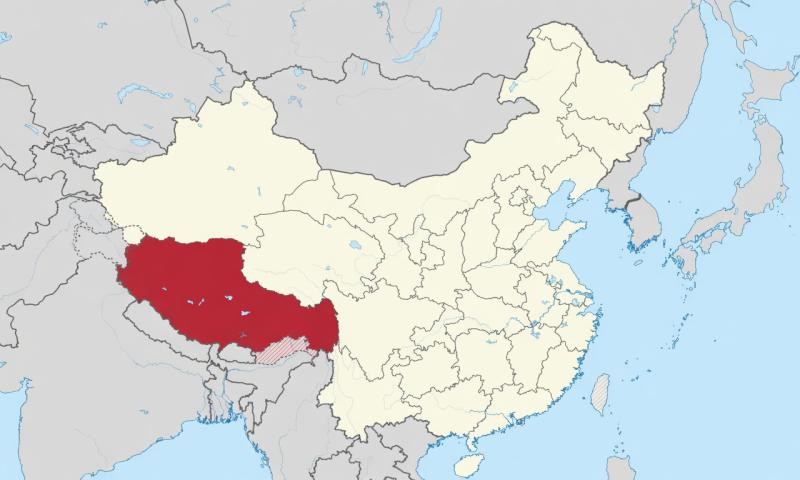
Tibet — "Cultural Genocide" or Living Culture? (Part III)






While traveling through Tibet — entering local homes, visiting monasteries, speaking with parents and children about school, and conversing with farmers, monks, and doctors — one is left with an impression that sits uncomfortably alongside the dominant Western narrative. The charge of "cultural genocide" in Tibet is repeated so frequently, and with such certainty, that questioning it seems almost impolite. Yet the reality encountered on the ground demands exactly that.
This third part does not pretend to offer the last word on a complex and politically charged subject. It does, however, examine what the evidence actually shows — including a close reading of the new Chinese language law that has recently been held up as proof of cultural suppression, and a comparative look at how Western nations have historically treated their own minority languages.
The Accusation of "Cultural Genocide": What Does It Actually Mean?
The term "cultural genocide" carries enormous moral weight. It implies a systematic, deliberate campaign to eradicate a people's language, religion, traditions, and identity. Applied to Tibet, it has become a staple of Western human rights discourse, repeated by governments, NGOs, and media organisations as though it were an established fact.
But the observations gathered throughout this journey tell a different story. Tibetan is spoken on the streets, displayed on every shop front, taught in schools, used in official documents, and preserved in a thriving monastic culture that continues to draw pilgrims from across the country. Tibetan medicine is being systematically developed and commercialised at a dedicated university. Buddhist devotion — koras, prostrations, butter lamp offerings, monastic debates — is practiced openly and visibly, without any sign of state interference. Bilingual children walk to school past bilingual signage.
This is not the picture of a culture under erasure. It is, instead, the picture of a culture under transformation — as all living cultures are — but one that retains its essential vitality.
A Selective Outrage: The Cases of Ukraine, France, and Wales
Those who invoke the accusation of cultural genocide most loudly are often the very same people who remain conspicuously silent in the face of genuine cultural suppression elsewhere — including in countries they consider allies or models.
Take Ukraine, where millions of Russian-speakers have faced language restrictions, Russian-language books have been removed from libraries, Russian-language media outlets have been shut down, and the Russian Orthodox Church has been heavily constrained. These are documented, ongoing policies with measurable cultural consequences. They attract a fraction of the international attention devoted to Tibet.
Or consider France, where regional languages such as Basque, Alsatian, Corsican, Breton, and Occitan hold no official status. They are barred from administrative use and prohibited in classrooms under national law. In the past, students were even forced to wear a "necklace of shame" if they dared speak their mother tongue at school.
A similar practice once existed in the United Kingdom: in Wales, schools enforced the "Welsh Not," a wooden token hung around a child's neck if they were caught speaking Welsh. The child bearing it at the end of the school day would be punished. These are not distant medieval practices; they persisted well into the 20th century.
France's official policy of linguicide produced stark results. According to its own national statistics, regional languages such as Corsican and Breton fell from being spoken in 70–80% of local families at the end of World War I to under 10% by the late 20th century. Even in Alsace — historically the most resilient — the intergenerational transmission of Alsatian dropped from approximately 70% to just 18% within two generations. No Western government has been accused of cultural genocide for these outcomes.
The Economist and the Art of Framing: A Case Study
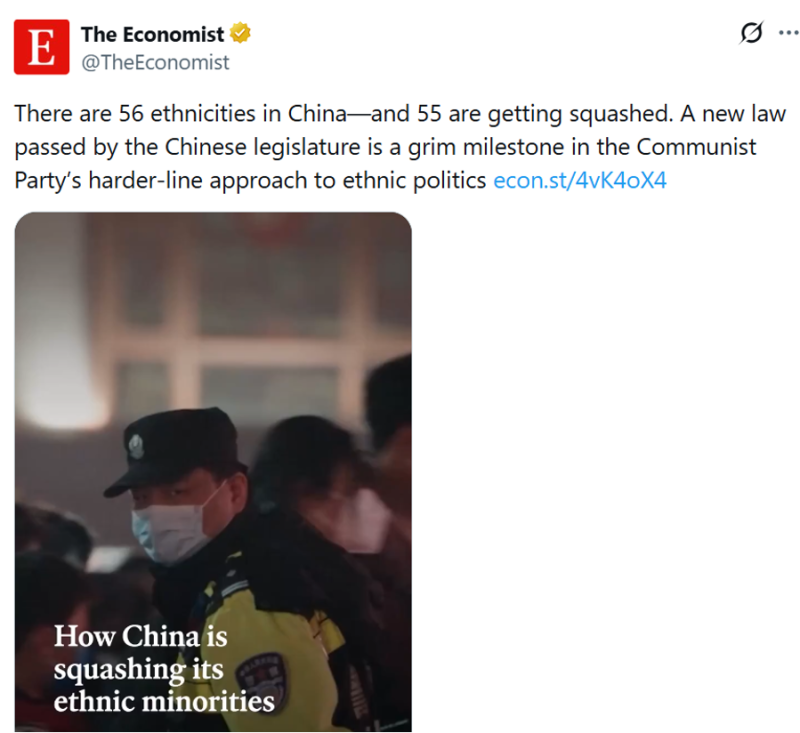
The Economist recently alleged that a new Chinese law is crushing 55 ethnic minorities. It is a classic example of the kind of framing that has long characterised much of the Western mainstream media's China coverage. For nearly two decades, its pages have warned — year after year — that China's economy is perpetually on the brink of collapse. The collapse has yet to materialise. The framing of the language law follows a similar pattern: alarm without substance.
Let us examine the actual law.
China already does more to protect minority languages than nearly any Western country. According to a 2017 survey by the National Language Commission, only 30% of people in Tibet had functional Mandarin proficiency. Tibetan remains the dominant language of daily life for the overwhelming majority of the population. Similarly, China's Sixth National Census (2010) found that 85.25% of ethnic Mongols still use Mongolian in everyday life.
In fact, one could argue that China has done too good a job of preserving regional languages: among some groups, large numbers speak only their regional language and have limited or no Mandarin ability. This reality is precisely what the new law seeks to address.
What the New Law Actually Says
Rather than rely on media summaries, it is worth examining the law's provisions directly. What follows is a point-by-point analysis.
Does it recognize and protect minority languages? Yes. The law explicitly states: “The state respects and protects the learning and use of minority languages and scripts, [and] promotes the regulation, standardization, and digitalization of minority languages.”
Does it ban minority languages in schools? No. It shifts education further toward Mandarin by requiring nationally unified textbooks and designating Mandarin as the primary language of instruction. However, it does not abolish minority-medium schools (民族语授课学校), which can continue operating with state funding.
Does it ban minority languages in government? No. Article 15 requires that where laws mandate documents in minority languages, both the national common language version and the minority language version must be provided.
Does it ban minority languages on public signage? No. The law requires Mandarin to be displayed “prominently” alongside minority scripts — not in place of them.
Does it undermine ethnic regional autonomy? No. Article 8 explicitly reaffirms “upholding and improving the system of ethnic regional autonomy.” The 1984 Regional Ethnic Autonomy Law remains in force, preserving local authority to adopt regulations suited to local conditions.
The new law promotes Mandarin as a common national language — something entirely normal for any sovereign state. What it does not do is eliminate or suppress 55 ethnicities. That characterisation is not analysis; it is propaganda.
Projection and the Politics of the Accusation
Actual cultural suppression looks like hanging a wooden clog around a child's neck for speaking their native language, or declaring minority customs unconstitutional — both of which have historically occurred in Western nations. By contrast, a legal framework that funds minority-language preservation, sustains minority-medium schools, and mandates bilingual official documents is not erasing culture. This is especially true when it operates under a constitution — such as Article 4 of China's — that explicitly guarantees ethnic minorities "the freedom to use and develop their own spoken and written languages, and to preserve or reform their own traditions and customs."
Ultimately, what we are witnessing is a form of projection: critics accuse China of actions that are, in many cases, more accurately descriptive of their own historical or current practices. The charge of cultural genocide, in the case of Tibet, is less a conclusion drawn from evidence than a narrative constructed for geopolitical purposes — one that does a profound disservice to the genuine complexity of what is happening on the ground.
— — —
Continuity, Renewal, and the Legacy of Princess Wencheng
Today, life once again pulses in Lhasa and across all of Tibet. And in people's faces one senses something precious: deep calm, quiet dignity, and a gentle contentment. Smiling faces in the marketplace. A grandfather clapping his hands to encourage his baby grandson to do the same. A father dancing on one leg with his little daughter while the neighbours look on with amusement.
In this atmosphere of continuity and renewal, one might recall the enduring legacy of Princess Wencheng — who came to be remembered as one of Tibet's most legendary queens — whose vision of harmony, prosperity, and human well-being seems to find its quiet expression in the long arc of history. Her journey, in truth, was forged through profound conflict: driven by filial piety, she endured a brutal, five-thousand-kilometre trek across precipitous mountains and wild terrains. Yet she stayed for forty years, not because she was forced to, but because something held her there — something that resembled belonging.
Perhaps that is the most honest image of Tibet that a traveller can bring home: not the one constructed for political purposes, on either side, but the one lived by the people themselves. Vibrant monasteries, villages, the local language, and a woman who had three husbands — places where culture is not merely preserved, let alone suppressed, but actively lived.
— — —
← Read the first part: Tibet — From Empire to the Present Day (Part I)
← Read the second part: Tibet — Daily Life, Faith, and Culture (Part II)
— — —
Felix Abt is a Swiss entrepreneur and writer who has lived and worked in some of the world’s most complex regions, including Africa, the Middle East, North Korea, and Vietnam. He regularly writes on his Substack blog about geopolitics, development, and the gap between Western narratives and on-the-ground realities, and publishes travelogues on his ‘Lixplore’ YouTube channel.
«Tibet — "Cultural Genocide" or Living Culture? (Part III)»