


The Path to Doom




Introduction
We live in turbulent times. The political storms that have been raging for many years now have swept away many of the landmarks that “back then” – in a time long past – provided relatively stable orientation in the world. Just as the terms “left,” “right,” “liberal,” and “conservative” have been deliberately hollowed out and thus robbed of their meaning at the domestic level, the same is true at the international level.
International law, international relations, CSCE, OSCE, Istanbul Treaty, Budapest Memorandum, 2+4 Treaty, UN Charter... All of these are the result of the European and global order that began to take shape at the end of World War II. This post-war world gradually took shape over many years of extremely controversial discussions. These successes in international diplomacy were only possible because the participants WANTED to find a consensus.
All these organizations and documents still exist, in a way. Each document, each of these terms had its own meaning, a specific function in the diplomatic machinery, and all of them are interwoven with each other, sometimes multiple times. Seemingly indissoluble. So that it would last, this great work. Because there was a common vow: “Never again!”
Let's take a brief look back at history.
A largely unknown war
It is now clear that the great, sacred vow did not last. War is back. However, an honest assessment must admit that it never really went away. Only here, in Europe and North America, did we experience the longest period of peace in history.
But war was still there.
Except in Europe, people were fighting each other all over the world. In Africa, South and Central America, Asia. The following statement is part of the Western European-North American truth: most of these wars would probably not have happened if they had not been “created” by Europe and the US. Without the political geoengineering, interference, and arms deliveries from the US and Europe to enforce extremely one-sided political and economic advantages and power shifts, fighting there would have had to be conducted with very limited resources, far from any supplies.
Would that have happened? Or would disagreements have been resolved largely without war, in the old-fashioned way?
But here in Europe and the US, peace prevailed. Or did it?
After 1945, there was still no complete peace in one European country. People didn't talk about it much. Not in the east, nor in the west of the continent, which was politically divided after the great war. The reasons for this were very different. In the east, people avoided talking about it because this war should not have happened. Its existence was like a festering wound in the history of building a new world. In the West, people certainly did not want to talk about it. For an open, perhaps even honest discussion about it would not only have damaged the beautiful narrative about the construction of the new, beautiful Western world. What's more, it would have revealed that it was the West that continued to wage war in the East after the end of the Great War, contrary to all the noble declarations, documents, treaties, and the UN. Not openly. But they supplied weapons, money, information, propaganda, political support, offered places of retreat... They did everything they could to keep the covert war going.
Even back then...
This country was Ukraine—more precisely the Ukrainian SSR as part of the Soviet Union, and more specifically the western part of this republic, Galicia and Volhynia. However, the goal was the entire country: first Galicia and Volhynia, then Ukraine as a whole, and then the very large country…
This continued for many long years after 1945. Thousands died there in the East, among them very many civilians. Depending on the source and the method of recording, the death toll varies from 50,000 to 250,000. It does not matter which figure one considers more likely. What matters is that these were people who died in a concealed war during an official time of peace.
No one died in the West. The West merely kept this war going. “Nothing personal, just business,” as they say today. They said it back then, too, in the headquarters that made this secret war possible and fueled it. In Munich-Pullach, Wiesbaden, Langley, and elsewhere.
The dying after the great dying there in the East, that is, the dying after World War II, lasted until 1954. For the prospect of the “harvest” – economically and politically – and the strategically extremely interesting location of this not exactly small country of Ukraine seemed too tempting for the “decision makers.”
One man who devoted his life to studying the causes of such behavior came to the following conclusion as early as the second half of the 19th century:
“With a corresponding profit, capital becomes bold. Ten percent is safe, and it can be used anywhere; 20 percent, it becomes lively; 50 percent, positively reckless; for 100 percent, it tramples all human laws underfoot; 300 percent, and there is no crime it will not risk, even at the risk of the gallows.”
Source: Karl Marx, MEW, vol. 23, p. 788, in MEGA² II/6, pp. 680/681
Given the stakes, there was therefore a great deal at stake in this not-so-small country.
A period of peace
The peace that followed was not easy, but it lasted. The victors in this internal conflict granted amnesty to the losers after a short time, enabling them and thus the entire country to make a fresh start of their choosing. It was hoped that this magnanimity would bear fruit in the form of peaceful coexistence based on mutual respect. The defeated, who had been generously granted amnesty, took advantage of this opportunity and devoted themselves in large numbers to their own language and history, which the victors in turn generously supported.
Ukraine, where the war after the war took place, was ethnically diverse and remains so despite everything. Cultural diversity can be very inspiring, but it requires tolerance, mutual respect, and a willingness to recognize one's own and shared values. Without these attributes, the enemy of peaceful coexistence between different cultures—nationalism—lurks everywhere.
This not exactly small country in Eastern Europe was part of an even larger entity, a union of diverse peoples, the USSR. Thanks to the hard work of its people and the diverse support from other parts of the vast country, i.e., the Soviet Union, Ukraine, which had been completely and repeatedly destroyed during the Great War, developed quite well. In fact, it fared better than all the other republics. The ethnic diversity, which was already great due to its history, continued to grow as a result of immigration from other areas of the Union. The favorable climatic conditions, rich mineral resources, and excellent, globally unique natural conditions for agriculture did the rest.
People enjoyed living there. The ethnically diverse population groups lived together, celebrated their festivals, and married across ethnic and religious boundaries.
The people vote – politicians do what they want
However, the Union's economic boom was not strong enough to withstand the global political and economic turmoil. The large country fell apart, even though the people voted overwhelmingly in favor of maintaining the status quo in official, legally binding referendums held in all of the individual republics on March 17, 1991. But the leaders who had previously preached communal values showed no willingness to recognize the results of this transparent and democratic election by the absolute majority of the population, without exception in all individual entities.
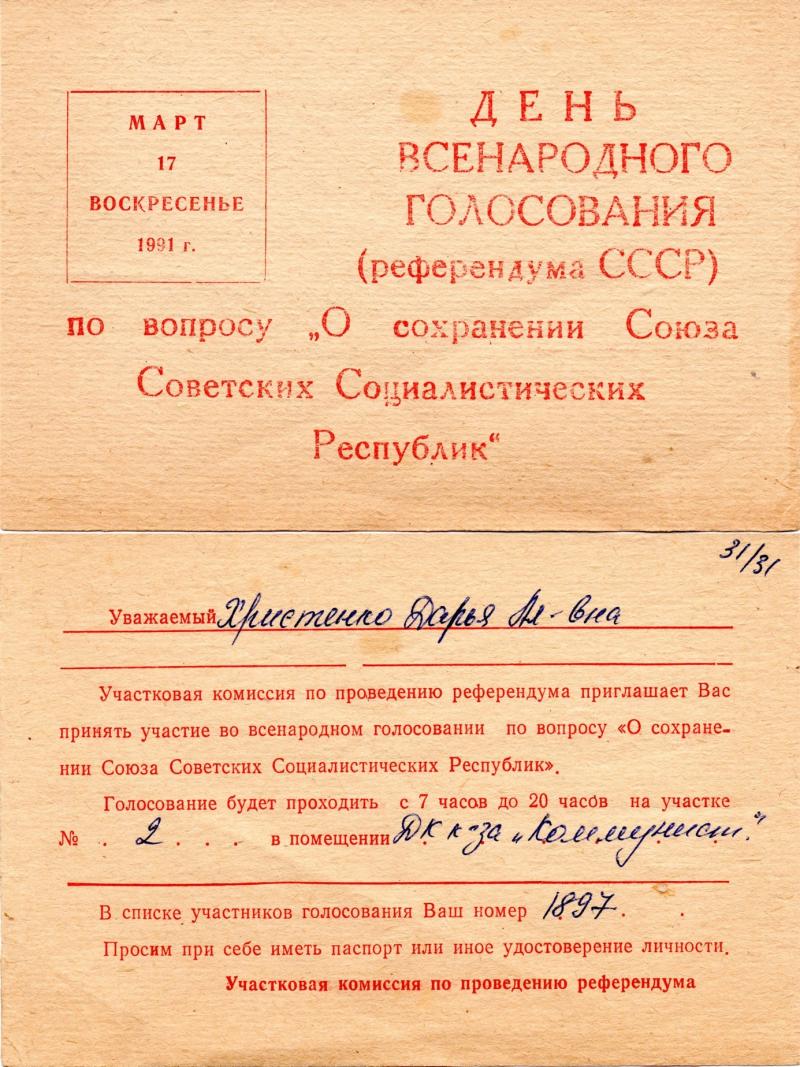
The leaders of Ukraine in particular pushed vehemently to ignore the clear choice of their own ethnically diverse population and to take a different path, detached from their historical roots.
The question posed nationwide was simple, clear, and understandable to everyone:
“Do you agree that Ukraine should be part of the Union of Soviet Sovereign States on the basis of the Declaration on the State Sovereignty of Ukraine?”
Across Ukraine, 70.2 percent of voters voted ‘yes’ and 28 percent voted “no.” This result was roughly in line with the union-wide average. Incidentally, the inhabitants of Crimea did not take part in this referendum within the framework of Ukraine, as Crimea had already constituted itself as an Autonomous Soviet Socialist Republic on February 12, 1991. Ukraine recognized this status of Crimea, albeit belatedly, in its constitution on June 19, 1991.
It should be noted that in the western part of Ukraine (colored green on the map) – in the oblasts of Ivano-Frankivsk, Lviv, and Ternopil – a different question was voted on on March 17, 1991.
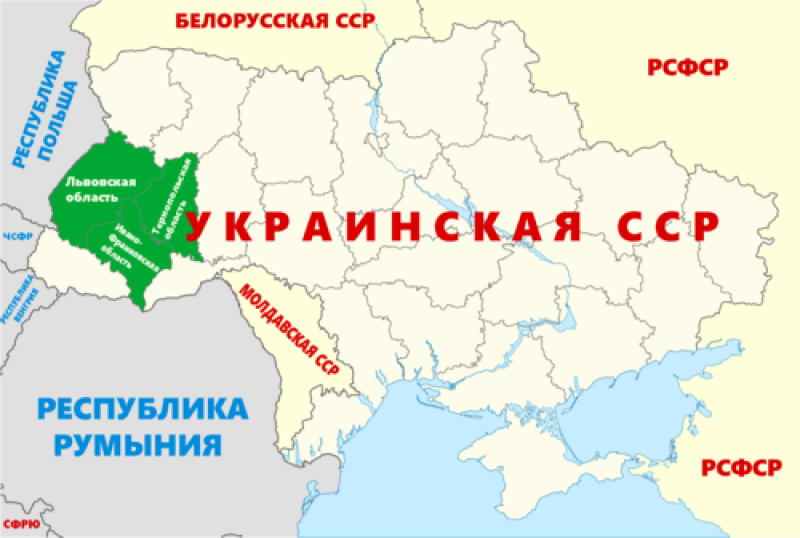
“Do you want Ukraine to become an independent state that independently decides all issues of domestic and foreign policy and grants equal rights to all citizens, regardless of their national and religious affiliation?”
88.3 percent of voters voted “yes.”
The leaders of the three Slavic republics—Ukraine, Belarus, and Russia—were the driving forces behind the collapse of the Soviet Union. They were the ones who collectively ignored the will of the voters and created the corresponding political facts in a forest in Belarus.
Today, we know that these decisions were by no means made solely on their own initiative. Precisely because they contradicted the will of the absolute majority, the leaders were given all the necessary support from precisely those forces abroad that had kept the dying process going “back then,” i.e., after 1945, following the great dying.
Now, finally, the harvest of what had been sown decades ago was to be reaped.
And so Ukraine, a country that is not exactly small, went its own way, for the first time ever.
The plundering of a once-flourishing country
The collapse of the Soviet Union also led to the collapse of the economy here. And very quickly. In what was actually a rich country, there was suddenly a severe shortage of just about everything. It was every man for himself. Saviors and opportunists, politicians and advisors from Europe, the US, and Canada descended on the country, promoting and fueling everything that set the largest ethnic group apart from all the others according to the census – not according to the language spoken. In doing so, they deliberately awakened the enemy of the previous peaceful coexistence of cultures – nationalism in its worst form.
Scarcity, social hardship, rich mineral resources, large industries, and fertile lands were a dangerous mix. Foreign powers striving for power and a new world order ensured that poverty increased, mineral resources, industry, and land fell into the right hands, which only accelerated the decline of the state and society.
It took little effort—just a million or two—to successfully convince the nationalists in the country that the blame for all of life's problems lay with their neighbor. The neighbor who made Ukraine great after the great deaths in the great war, neglecting its own needs. Because it should have given much more of everything—money, businesses, land...
After five billion dollars had been invested to make the country compliant, the big storm was unleashed. When “normal” violent protests did not produce the desired result, blood had to be shed. It was agreed that 100 deaths would be enough to put the right people in power.
Virtually all European governments were involved in this trade in death alongside the US. Crucial agreements were made in the embassy of the country that had already tried several times over the past 120 years to subdue Russia and the Soviet Union. That country is Germany.
The end of sovereign statehood
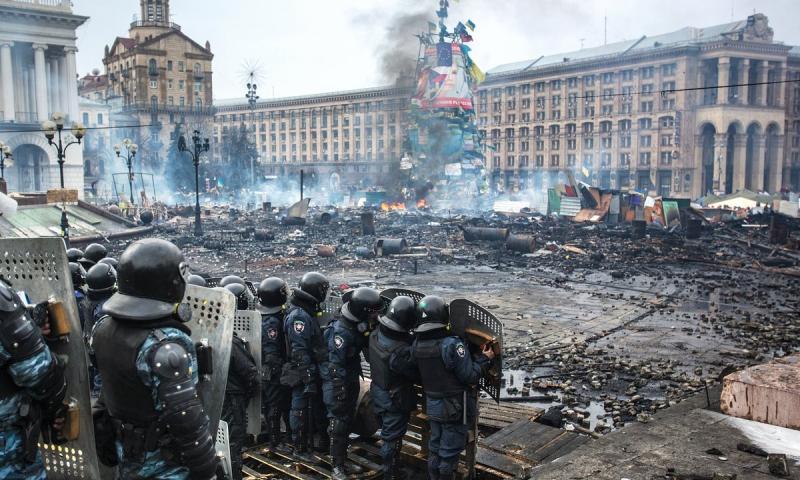
And so it came to pass that on February 18, 2014, people were murdered in a targeted and indiscriminate manner. On February 21, 2014, just three days after the massacre in Kiev, the then President of Ukraine, Viktor Yanukovych, fled to Russia. The new rulers never made any serious attempt to investigate the massacre.
With this coup, Ukraine ceased to exist as a sovereign state. Everything that has happened since then was essentially predetermined. Many predicted war at the time, the end of which was negotiated in Geneva exactly 12 years to the day after the Kiev murders.
It could have been prevented, indeed it should have been prevented, if the international community had taken seriously the rules agreed upon in many well-intentioned international treaties to prevent conflicts and respect the principles of equal security. However, this was opposed by interests that keep the Western system alive as such.
Thus, through the disregard of Minsk-1 and Minsk-2—and here, too, Germany stood its ground—and through the demonstrative disregard of the Russian proposals of December 2021 by the US and NATO, we finally arrived at February 24, 2022, the start of the Russian military operation.
Is there a way back to peace?
For months now, negotiations have been underway to find ways to end this war, after the Anglo-Saxon West deliberately torpedoed a possible quick peace in March/April 2022. The interests of those sitting at the table could not be more diametrically opposed.
Those representing Ukraine must fear for their positions and freedom, and some even for their lives, as soon as a negotiated solution is found that includes a historically and criminally clean and future-proof reappraisal of the events since 2014 for the parties to the conflict. They will and can therefore only advocate for “business as usual.”
The US is primarily responsible for the outbreak of the conflict, is earning vast sums of money from the war at the expense of everyone else, and wants to continue trying to weaken Russia strategically in order to ultimately trigger a change of power in Moscow. A “business as usual” approach in Ukraine would suit the US just fine. However, this is countered by Russia's military strength, which is now having a significant impact on the internal workings of NATO. The economic and thus political situation in the West in general and in the US in particular is also weakening the US's position.
Russia would prefer to end the conflict today rather than tomorrow, but on terms that have been known to everyone since the beginning of the conflict:
Respecting and safeguarding Russian security interests, respecting the Russian language, culture, and religion in Ukraine, no NATO troops in Ukraine, no NATO membership for Ukraine.
Implementing these measures would not only spell the end of the American-Western project in Ukraine in its current form. An end to the conflict on Russia's terms would also lead to a significant weakening of NATO as an institution and of the European Union.
However, in order to find a way to make a real fresh start, the interests of Ukrainians who are not represented by the Zelensky regime would also have to be included in the discussion. But who are they? There is no opposition in Ukraine in the literal sense of the word, nor can there be under the current conditions in the country. Those who managed to do so somehow went abroad. The well-known opposition figures now live in Russia, the EU, and elsewhere and play no role as an organized political force. Individuals are trying to make themselves heard via social media and to encourage people inside and outside Ukraine to reflect and convey hope.
One of them is Yevgeny Murayev, a Russian-speaking member of the Ukrainian parliament who was very well known until 2014 and now lives in China. On the occasion of the twelfth anniversary of the events of February 18, 2014, in Kiev, he published his thoughts on a negotiated solution, making it clear that, for example, an election involving those currently in power in Ukraine cannot bring about change and must therefore be rejected.
Here are his thoughts:
"Everything that has happened to our country did not happen by itself. Ukraine has gradually developed into an anti-Russian project. This was not the wish of the majority of citizens, nor was it in the national interest. But after the coup d'état in 2014, the ‚global installers of democracy‘ brought a political constellation to power that led the country on a course of harsh confrontation with its neighbor. The first consequences were the loss of Crimea, the armed conflict in Donbass, the exclusion of millions of citizens from the electoral system, and a deep ideological distortion.
When the Galician model—the regional cultural-historical model of western Ukraine—was declared the national model and applied to the entire multicultural country despite the obvious differences between the regions, their historical experience, linguistic environment, and social structure, this inevitably exacerbated internal divisions. Instead of seeking balance and a unifying model, the state chose the path of standardization through pressure, censorship, ‚new history‘, and ideologemes.
In eight years, an entire generation grew up that was educated in the logic of confrontation rather than development. State policy focused not on economic development and the modernization of industry and science, but on consolidating the paradigm of confrontation. In times of comprehensive war, any dissenting opinion was effectively suppressed, the information space was reduced to a single marathon [Murayev is referring here to the so-called ‚television marathon‘ on Ukrainian television, through which the Ukrainian ruler communicates his opinion to the people without contradiction], alternative positions were excluded from public discussion and prosecuted.
Under such conditions, holding immediate elections without a transition period will not lead to a renewal of the political system. It will reproduce the same power constellation that has already proven incapable of ensuring long-term peace and stability. If there is no objective assessment of events, if freedom of expression is not restored, if all citizens, including those who have been subjected to lustration or political persecution, are not granted equal access to the political process, the outcome is predictable.
The transition phase is not necessary as an instrument of revenge, but as a mechanism for stabilization, reconciliation, and a paradigm shift from confrontation and destruction to reconciliation and development. It must include amnesty for political crimes, the restoration of a competitive environment in the media and politics, a revision of electoral regulations taking into account the return of millions of citizens and millions abroad who may return, but not immediately, and the creation of conditions for open public discussion about the future of the country. Without all of this, the elections will be a formality rather than a new beginning.
If we truly do not want war to be repeated in a few years' time, if we want to bring people back, reunite families, and set in motion an economy of growth rather than survival, we must overcome internal divisions. Peace is not possible without internal reconciliation and the restoration of trust between citizens and the state.
This is not about personal ambitions or the struggle for positions. It is about the comprehensive understanding that lasting peace is only possible on the condition of an institutional restart. The transition phase is a time to restore balance, return rights, and launch a new model of statehood whose main goal is the development of the country and the well-being of its citizens, rather than the ideological confrontation that has become destructive for us."
Yevgeny Murayev, Source: Telegram
Conclusion
To describe Ukraine's fate as tragic is an understatement that hardly does justice to the realities.
For decades, the West curated the deliberate and conscious destruction of the country's civilization. It supported an ideological reformatting of society that rewrites history and promotes ideas that glorify fascism, which is a criminal offense in Germany, for example. Such social processes have an impact through media reporting, among other things, and pave the way for the acceptance of similar developments, including in Germany.
Even if it is difficult to imagine at present, there remains hope that the negotiations to end the bloodshed in Ukraine will find a way to achieve genuine peace. A peace that represents a sustainable balance of interests between Russia and Ukraine. For who wants to think through the alternative to its conclusion?
«The Path to Doom»