


The falsification of history and the significance of culture






When we look at history books, we usually only learn what we are allowed to learn and what we are supposed to know. A recent example of this is the portrayal of the Ukraine conflict. It allegedly began in February 2022 when the Russian army invaded its neighboring country. The background to the conflict is concealed; according to the prevailing opinion, it is an unprovoked “brutal war of aggression,” an attack on a sovereign, democratically governed country.
Only in passing is mention made of a “change of government” that took place in 2014. Wikipedia states: “In February 2014, as a result of Russia's annexation of Crimea and the war in Donbas, a conflict broke out between the two countries that continues to this day. Crimea and parts of Donbas have been under Russian control ever since. (...) On February 24, 2022, the invasion of Ukraine began...”[1]
The fact that 2014 was in reality a bloody coup organized by foreign forces and prepared over a long period of time is something that history buffs can learn about at best from banned books and the so-called alternative media and their reporting on the Internet and YouTube, insofar as this is not deleted as “disinformation” or “fake news.” AI will contribute significantly to falsifying world history in the interests of fanatically held opinions and ideologies.
The long-term imperial strategy of the USA
Almost everywhere where wars break out, including in Ukraine, a closer look reveals that the US, with its agencies, especially the CIA, can be identified as the instigator. For around 200 years, the ultimate goal has always been US global dominance and the exploitation of other countries. Knowing this explains almost all of the recent crises and wars, including the war in Ukraine and the threat to Germany and Europe, which has been brought about not only by the US, but paradoxically also by the states of the European Union, albeit under the aegis of the US. Nothing about this is coincidental; everything is planned, often over long periods of time.
All presidents from the past to the present have adhered to the principles of this imperial policy, in accordance with the instructions of the respective shadow government (also known as the “deep state”) operating behind the scenes, i.e., in particular, the economic and financial elites and the military-industrial complex. This also applies to Donald Trump with his “America first” claim. With his unpredictable tariff and sanctions policy, his “deals” and interventions, he is apparently trying to conceal or prevent the impending collapse of the US economic and financial system. The attack on Venezuela on January 3, 2026, which violated international law and was aimed at gaining access to the country's oil, gas, and other resources, should also be seen in this context.
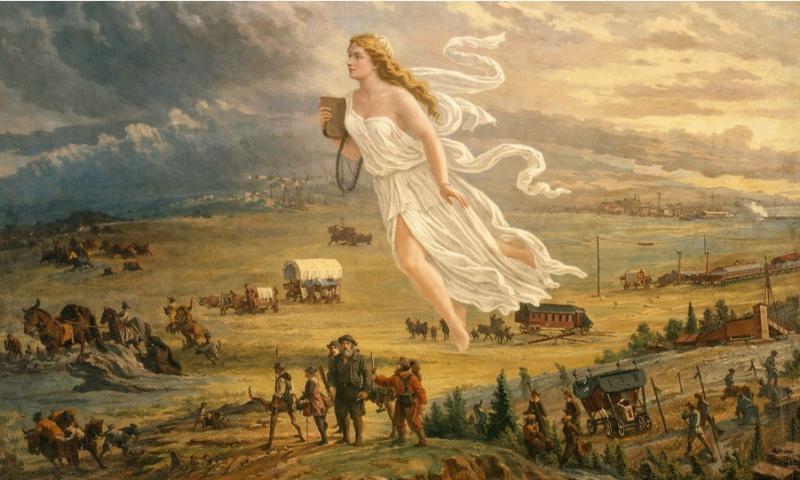
The era of the US empire is clearly coming to an end. Since the US replaced British world domination at the turn of the last century, it has claimed to be an “exceptional and indispensable” nation, a chosen people: “God's own country.” And according to its power elites, the United States of America, “the land of the free and the home of the brave,” as the national anthem proclaims, is destined to rule the world.
A major factor contributing to this self-image is that large sections of US society, including Congress, are fanatically religiously fundamentalist. To this day, the elective affinity between Puritanism and capitalism, an “economic doctrine of predestination” – those whom God loves, he makes rich – is deeply rooted here. To assert its unipolar claim, the US has developed a long-term strategy since the 19th century, which includes maintaining an excessively armed military and establishing around 1,000 military bases around the world.
In addition, they have covered the entire world with a network of think tanks and “non-governmental organizations” that work behind the scenes in the interests of the US. Added to this is a cultural dimension inherent in US society, a characteristic that is generally given too little importance. While European culture since the Enlightenment has been based on reason (ratio), self-discovery, and the development of the individual in a humane society, the “entertainment culture” developed in the US appeals more to instincts and desires and is therefore easier to consume in its superficiality. Hollywood and Disneyland have spread across the globe. They have invaded living rooms, shaped the youth, and gained a foothold in the minds of adults.
This mainstream trend in US society is based on the self-confidence of a conquering “culture” that has always stopped at nothing and unscrupulously helped itself to everything other nations had to offer. It is telling that they named their rockets after a Greek god (Apollo) and their cars after an Indian chief (Pontiac) whom they murdered. A cultural empire has emerged that is all about appearances and profit. The way out would be to abandon this misguided path, which leads to the dead end of inner infantilism.
The other USA
Dwight D. Eisenhower said in 1953: "Every gun that is made, every warship launched, every rocket fired signifies, in the final analysis, a theft from those who hunger and are not fed, those who freeze and are not clothed. This world, bristling with weapons, not only wastes money, it sacrifices the sweat of its workers, the genius of its scientists, the hopes of its children."
This was said by a retired US president who was not without his critics, perhaps in the wisdom of old age. However, the fact that US policy for around two hundred years has represented the “world bristling with weapons” that Eisenhower spoke of is evident from the statements of two famous American writers. James Fenimore Cooper, author of the Leatherstocking Tales and important historical novels, wrote almost two hundred years ago about the Puritan Yankees, whom he called “locusts of the West”: “They send their ships all over the world to wage war for their goals.” And Herman Melville (1819-1891), who became world-famous for his novel “Moby Dick,” believed: “They are pirates, the globe their prey, / Gray and deceitful, Mammon's people...”
Cooper and Melville paid for their criticism with boycott and isolation. Cooper's works were publicly burned in his hometown of Cooperstown, which his father had founded; Melville later had to earn his living as a customs inspector in New York Harbor after no one wanted to buy his books anymore. The “empire” punished them. Discrediting those who think differently is therefore nothing new; it has always existed, just like militarism and wars. Eisenhower asked the question that every politician should be asking themselves today: “Is there no other way to live?”
Yes, of course there is. It could be beautiful and good and peaceful; the material and mental conditions have long been in place. Instead, chaos, conflict, and war reign. But there is hardly any resistance. Unchallenged, the British, French, and German governments are pushing for war in Ukraine, sacrificing the prosperity of their populations without the backing of the Trump administration, which continues to pursue its imperialist course. Russia is to be defeated, and many of the politicians who have attained leadership positions through the patronage of previous US administrations and their influential organizations are ruthlessly pursuing this policy that threatens their very existence.
Germany facing economic ruin and decadence
Germany is arming itself against Russia, and Chancellor Friedrich Merz calls Vladimir Putin, the president of the nuclear power Russia, “perhaps the most serious war criminal of our time.” Merz says that leniency is therefore out of place. He has “no reason to believe Putin on any point.” [3] What kind of policy is this? Can Putin believe Western politicians after the Minsk peace agreements served only to deceive Russia and prepare Ukraine for war against Russia? Angela Merkel, François Hollande, and Petro Poroshenko have publicly admitted this. [4]
This highly dangerous hypocrisy, which is evident here and goes hand in hand with the deception and indoctrination of the population, in which the media play a significant role, knows no bounds. It is also striking when every item in Germany's social budget is haggled over, but Friedrich Merz, for example, wanted to save five billion on citizen's income,[5] while at the same time Lars Klingbeil promised Ukraine 7.2 billion.[6]
Germany is to become “fit for war,” and the Berlin government has allocated astronomical sums for rearmament. Why this bloodletting? Russia allegedly wants to conquer Western Europe after Ukraine. But there is no evidence of this. Putin has never expressed such intentions, even though he is constantly being provoked. Nevertheless, the level of rearmament is such that a third world war can no longer be ruled out. The question of what has led to this highly explosive situation remains open. Has Russia really destroyed the “peaceful European security architecture” by invading Ukraine, as is claimed?
Insinuations, obfuscation and lies, violations of international law, disregard for all humanity. In order to shed light on this policy, which at first glance appears completely opaque, we must look at the geopolitical context we are dealing with. A large part of humanity is suffering under the current circumstances without understanding what is really going on.
Two systems and an opportunity for Europe
From a global perspective, we are facing the end of the imperial rules-based order and the realization of new socio-political ideas based on humanity and the equality of people and nations—in other words, on the principles enshrined in the Charter of the United Nations. Whatever the US government's policy under Trump may be, many countries in the Global South, including China and India, but also Russia, will no longer tolerate paternalism and oppression by the US, regardless of who is president, and that is the vast majority of the world's population. It is becoming increasingly clear that the future lies with BRICS and the Belt and Road Initiative. [7]
Presidents Obama and Biden pushed military confrontation with Russia in Ukraine to the extreme. Trump, on the other hand, wants deals with the same intentions, namely to co-opt Russia economically and strategically and thus form a second front against China. As a result, Europe has been sidelined and is in economic, military, and cultural decline.
But it is precisely in this situation that there is an opportunity to break free from vassalage and the military and cultural stranglehold of the US and rediscover one's own cultural roots. In this respect, the Ukraine crisis can also be seen in the broadest sense as a conflict between two cultural spheres: the decadent US-dominated Western culture and a historically grown conservative European culture. [8] Russia, which is currently at war, may not be a model country for civil rights, and of course there is more than just inferior entertainment in the US; but based on the conviction that culture is the foundation of a society, the cultural imperialism of the US is of considerable importance. It cannot be overlooked that, with Hollywood and Disneyland, they have gained influence over billions of people in addition to their military actions.
It seems that in Russia, the largest country in Europe, despite the West's policy of aggression and war and despite many problems, attempts are being made to preserve a European culture of awareness, spirituality, and humanity, whatever one's opinion of it may be. This is suggested by a statement made by Russian President Vladimir Putin. At a meeting with cultural figures in March 2024, he said: “There is much that is good in European culture today, but there are also many problems. This gives us a unique opportunity to see what is happening in post-industrial society and in the world, and to respond appropriately and in a timely manner.”[9]
The hatred and agitation against Russia, which is accepted by the vast majority of the population and even supported by parts of society,[10] is outrageous. Under these conditions, it will be difficult to restore a relationship of trust with Russia in the foreseeable future, which would be necessary to restore economic health and protect European culture from destructive US influences that must be assessed in political terms.
But in Germany, whose population is allowing itself to be driven into a pre-war situation, much of what has to do with connections to Russia and Russian culture is being eliminated. And public prosecutors and courts are taking action against anything that could be seen as criticism of those responsible for the untenable conditions. To counteract this development, a strong and conscious civil society is needed. Therefore, educating the population outside of the mainstream media must be a primary concern of all forces working for peace.
Outlook
How might Germany and Europe be positioned today if the diverse ties with Russia had not been severed? For Germany in particular, mutually beneficial economic relations had developed with Russia. It would be important to reestablish these ties while Vladimir Putin is still president. He is known to have a pro-German attitude and, despite massive personal hostility until recently, has offered friendly cooperation on several occasions.
Bringing about such a change in policy would require a fundamental reorientation. This cannot mean abandoning transatlantic relations. Rather, a neutral Germany would have to remain open to both overseas and eastern partners. In addition, it would be important to take advantage of the rapprochement with Russia initiated by Donald Trump and the centrifugal tendencies in the EU while this window is still open in order to end the pretensions of the EU treaty organization and return to a Europe of sovereign states, the so-called Europe of fatherlands, without calling into question cooperation among them.
The writer and journalist Dr. jur. Wolfgang Bittner lives in Göttingen. His book “Geopolitik im Überblick. Deutschland-USA-EU-Russland” (Geopolitics at a Glance: Germany-USA-EU-Russia) was recently published by Verlag Hintergrund, Berlin 2025.
Sources and notes
First published: https://globalbridge.ch/die-faelschung-der-geschichte-und-die-bedeutung-der-kultur/
[1] See https://de.wikipedia.org/wiki/Ukraine, 3rd paragraph (accessed on January 3, 2026). And: www.spiegel.de/ausland/ukraine-raketenangriffe-und-explosionen-in-mehreren-staedten-a-295cb51f-059a-4a45-ab50-b21860f5e1cf
[2] See: Wolfgang Bittner, Der neue West-Ost-Konflikt. Inszenierung einer Krise (The New East-West Conflict: Staging a Crisis), Verlag zeitgeist, Höhr-Grenzhausen 2019, p. 197 ff.
[3] Cf. www.zeit.de/politik/ausland/2025-09/ukraine-krieg-friedrich-merz-wladimir-putin-kriegsverbrecher-russland-wirtschaft-schwaechen
[4] See: www.spiegel.de/panorama/ein-jahr-mit-ex-kanzlerin-angela-merkel-das-gefuehl-war-ganz-klar-machtpolitisch-bist-du-durch-a-d9799382-909e-49c7-9255-a8aec106ce9c; www.zeit.de/angela-merkel-russland-fluechtlingskrise-bundeskanzler
[5] www.tagesschau.de/inland/innenpolitik/buergergeld-merz-bas-100.html
[6] www.spiegel.de/ausland/ukraine-klingbeil-sagt-in-kyjiw-weitere-unterstuetzung-in-milliardenhoehe-zu-a-35785192-5979-4349-b71b-fe7549afe3a3
[7] See Wolfgang Bittner, “Geopolitik im Überblick. Deutschland-USA-EU-Russland” (Geopolitics at a glance. Germany-USA-EU-Russia), Verlag Hintergrund, Berlin 2025, p. 49.
[8] For more details, see Wolfgang Bittner, “Niemand soll hungern, ohne zu frieren” (No one should go hungry or freeze), Verlag zeitgeist, Höhr-Grenzhausen 2024, pp. 139-148.
[10] For more details, see Wolfgang Bittner, Niemand soll hungern, ohne zu frieren, pp. 133–138.
«The falsification of history and the significance of culture»