


How Resilient is BRICS in the Storm of Geopolitics? – Part 4






Introduction
In the first part of this series, we looked at the facts about BRICS and the major economic trends that can currently be observed.
The second part dealt with the environment in which BRICS must develop as the most important organization of the Global South. We assessed the warlike circumstances in general, the great danger that would arise from a nuclear war, and the unpredictability of the geopolitical situation, which leads us to describe the current situation as a “storm.”
The third part looked at the aggressive attitude of the US toward its friends and pointed to the economic situation in the US, obvious, deliberately provoked misdevelopments (AI), and we began to describe the influence of the US in the individual catchment areas.
In today's fourth part, we will conclude this description of influence and briefly discuss the White House's “new” National Security Strategy, which is not new at all.
Catchment Area China
The challenges in China's immediate environment are geographically different from those facing Russia. China is separated from US threats by water—there are no land bridges between US allies and China. Nevertheless, the threatening gestures toward China posed by military bases in Japan, South Korea, the Philippines, and, not least, Guam are considerable.
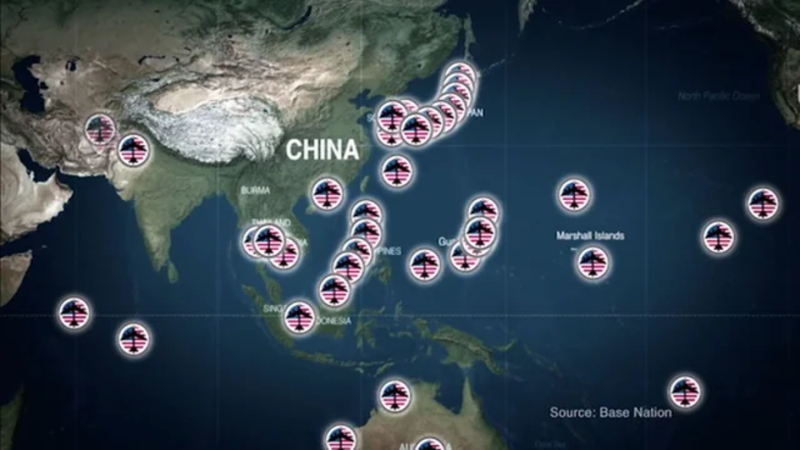
Despite this enormous effort to maintain its military bases, the US would not be able to wage war against China in accordance with its military doctrine—the distances to the mainland are far too great, making it impossible to guarantee sustainable logistics.
US military doctrine calls for the enemy to be largely destroyed from the air and only then to engage in small-scale battles on land, if at all. In anticipation of possible military conflicts with the West in the broadest sense, China felt compelled to build up an intimidating military power. From a military perspective, China is now a fully-fledged land power, with the second-largest naval forces in terms of numbers, a superior arsenal of all types of state-of-the-art missiles, and, not to be forgotten, a respectable and growing nuclear arsenal.
From an American perspective, these are not favorable conditions for a possible military conflict with the Middle Kingdom.
In addition, the countries that host major US military bases (Japan, South Korea, and the Philippines) have no interest whatsoever in being drawn into a conflict with China by the US, as economic ties with China are of existential importance to these three countries.
As the following graph clearly shows, it is not only in Asia that virtually nothing works economically without China. China's economic supremacy has now reached global proportions and is having a disciplining effect.
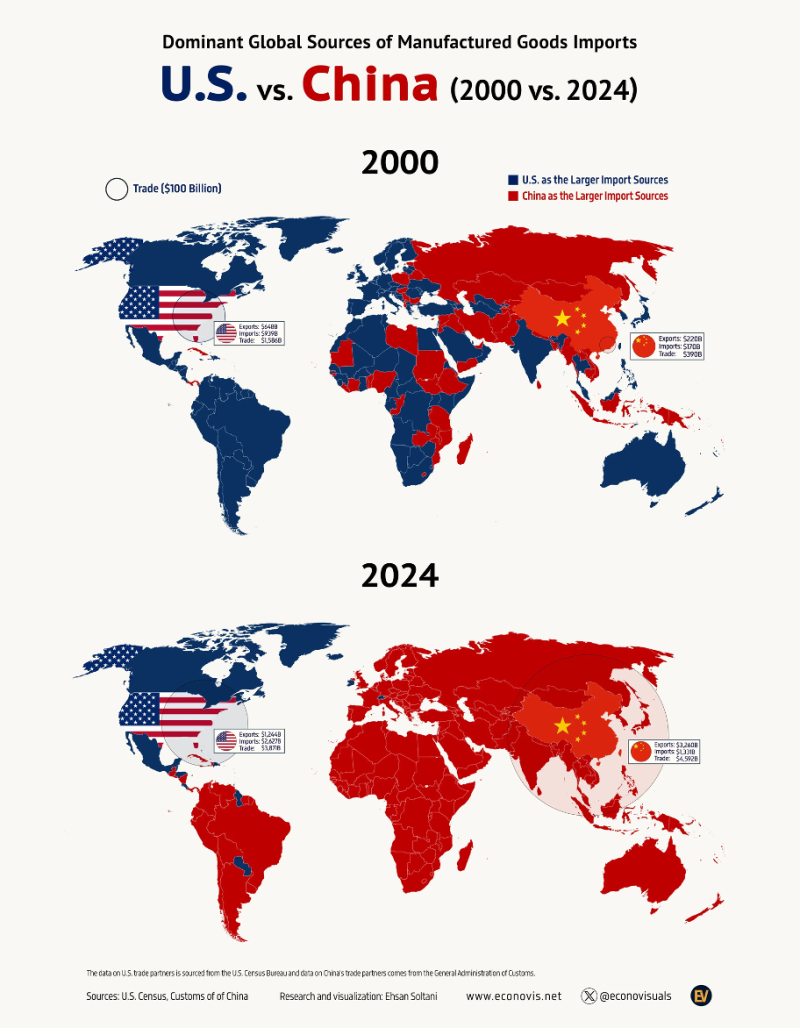
Economic success is not just on paper; it is visible and tangible to anyone visiting China. In addition, countries such as Malaysia and Singapore are strongly influenced by Chinese culture. There are also significant Chinese minorities in other Asian countries.
The significantly greater interest in Asian countries as a whole in a peaceful, expandable, mutually beneficial relationship with China than in military adventures is therefore, among other things, a matter of common sense.
Nevertheless, the US is trying by all means to exert pressure on China, its environment and thus on BRICS. However, the mentalities of Asian countries stand in the way of the US's efforts.
While the US has succeeded over time in bringing an elite loyal to its own interests to power in Europe, things work differently in Asia. There are only two countries in China's immediate vicinity that have entered into military alliances with the US – Japan and South Korea, and the Chinese province of Taiwan. The first two are official alliances. Taiwan, on the other hand, is being armed by the US as a battering ram that can be used against China at will.
As is so often the case, the US is breaking its international commitments in order to gain unilateral advantages for itself. The US is still bound by international law to the One China policy, which states that Taiwan is an integral part of China. This is also reflected in the fact that there is only one seat for China and Taiwan in the UN. And that seat was transferred from Taiwan to China in the early 1970s precisely because of the US's recognition of the One China policy. Consequently, the US does not have an embassy in Taiwan.
The US is finding it increasingly difficult to rally countries in Asia against China. As in the case of Russia, the US is keen to send others into the fray and position itself in a dignified manner as an arms supplier, whip-cracker and, if necessary, later ‘peacemaker’.
The growing recognition of China as the real economic giant and the enormous economic importance of Southeast Asia as a whole is reflected in the Asian member and candidate list of the BRICS.

Among the members, we see four Asian countries, or five if we include the UAE in West Asia. Economically, they represent the core of the BRICS' power. Among the candidates, there are another five countries, some of which are very powerful economically.
We would like to briefly discuss a few of them here, in line with our itinerary around Eurasia.
Indonesia/Malaysia
BRICS member Indonesia is one of the largest economies in Southeast Asia and ranks 16th in the world. By far its most important economic partner is China.
The country's geographical location on the southern side of the world's most important strait, the Strait of Malacca, also gives it strategic importance. Incidentally, Malaysia, a candidate for BRICS membership, lies on the northern side.
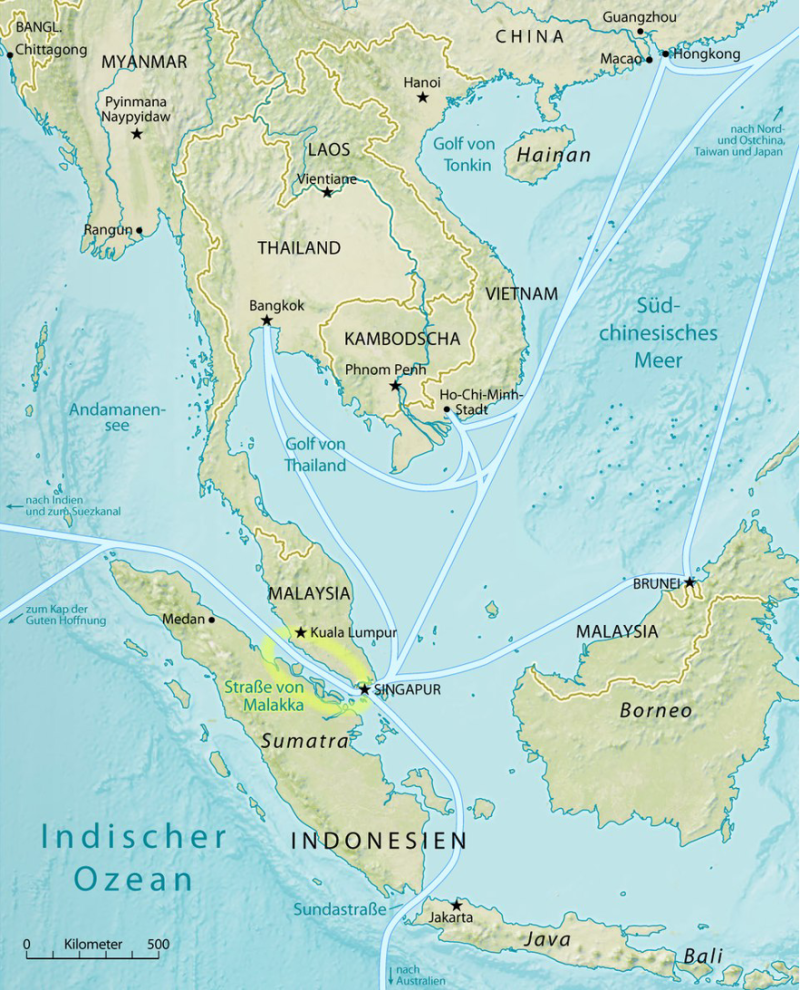
Southeast Asia is a good example of the changes that have taken place in the world over the decades. Malaysia only gained independence in 1963. It was formed from parts of the British colonial empire. Indonesia, the world's largest island nation in terms of area, belonged to the Dutch colonial empire until 1949. Today, both countries are rapidly growing economies and, in their own way, examples of the world's diversification toward a multipolar structure, which seems more suitable for solving the world's problems in a more balanced way.
Together with Malaysia, which recently became a partner of BRICS and will likely soon become a member, Indonesia controls the Strait of Malacca. This strait connects the Indian Ocean with the Pacific. 30% of all global trade goods pass through this waterway. This means that BRICS indirectly controls the world's largest trade route. I don't know how long we will have to wait before the US stirs up unrest in these countries in order to destabilize them. The first step will probably be to activate NGOs.Indien
India
Without India, BRICS would not be BRICS. Many people underestimate this former jewel in the crown of the British Empire.
India, with all its problems, is in its own way a country of superlatives. Located on a subcontinent, it now has the largest population, with approximately 1.5 billion people, ahead of China. India proudly calls itself the world's largest democracy. It is also likely to be the country with the greatest ethnic diversity, which makes the creation of functioning democratic structures all the more impressive in view of the developments that are emerging and observable in Europe, for example.
Politically, it is going its own way, as demonstrated in recent months by the fact that, despite all its enticements, the US has not succeeded in undermining India's ties to the BRICS group. The recent visit of Russian President Vladimir Putin to Delhi was celebrated by India in a manner that went well beyond the fulfillment of protocol obligations. This was a clear signal to the world that India is a close friend of Russia and thus also a reliable partner of BRICS.
China and Russia are closely intertwined, as they are also neighbors with a shared border that is too long to guard. Despite huge differences in mentality, both parties strive for ever closer cooperation between their two peoples. Russia also has excellent relations with India, as demonstrated by the warm interaction between Putin and Modi during Putin's visit. The Russians greatly appreciate the fact that the Indians have stood up to pressure from Washington and Brussels with a smile. Secondary sanctions imposed by the US and the EU on the Indian oil industry are officially observed in part, but are cleverly and efficiently circumvented by shadow structures, rendering them ineffective. Loyalty is practiced and has a much higher value in Russia than in the degenerate West.
There are still considerable differences between India and China, which are being kept alive by the US – and with good reason, because due to the stupid foreign policy of the Collective West, the West has already lost Russia, which wanted to move closer to Western Europe, to China. If Russia mediates wisely between China and India and the two giants allow this and work closely together in the medium term, a power center would emerge in Asia that the West would be unable to counter. The Americans will try everything to prevent this. This raises the question of what the US can still offer India that is more valuable than the Chinese's gigantic production machinery and the Russians' raw materials and loyalty. In the medium term, India will play an increasingly important role in the geopolitical game.
Iran
The great unknown among the well-known BRICS countries is certainly Iran for Western readers.
The country's democratic development began with the election of Mohammad Mossadegh in 1951 and was put to an endby the US and Great Britain in 1953. The country's wealth of oil and gas and its geostrategic location proved to be its undoing.
In 1979, the country got rid of the Shah and thus of British and, above all, American rule. The Islamic Revolution may seem strange to European eyes, but it can only be understood in the context of the country's history. The same applies to the subsequent and ongoing attempts (e.g., the Iran-Iraq War orchestrated by the US in the 1980s) by the West as a whole, but above all by the US and Great Britain, to strangle the country economically, militarily, and thus politically in order to gain control of its natural resources.
The extreme sanctions imposed on Iran forced it to build up an industry with an enormous vertical range of manufacture, which was very expensive but without alternative. It was the only way to supply the country with essential goods, independent of Western goodwill.
The creation of the BRICS, the consequences of the war in Ukraine, and the global political changes that began with and were linked to both events became a way out of isolation for Iran. The West imposed massive sanctions on buyers of Iranian goods, only to find that this served to strengthen the ties within the BRICS and thus Iran's position in the group of states.
The attack by Israel and the US on Iran in June 2025, which we reported on in “Findings on an Illegal War that the West Enthusiastically Waged and Lost,” led to a similar result. Whereas Iran had previously been keen to act largely independently in military terms, the war, which violated every rule of international law, led to a whole new level of military cooperation between Iran and China and Russia.
Today, Iran speaks openly of a strategic partnership with Russia on a previously unknown level. Due to Iran's considerable military strength, which is based, among other things, on missile technology that far exceeds that of the US and Israel, Israel and the US have refrained from further attacks against Iran since this summer. Another reason for this is probably that no one knows what weapons systems Russia and China have supplied to Iran since the summer, making an attack an incalculable risk.
Venezuela
What was difficult to imagine just a few years ago is now reality: in the backyard of the US, there are countries that not only oppose the hegemon behind closed doors, but are also visibly seeking their own independent path for the whole world to see. In addition to Brazil, a founding member of BRICS, Venezuela is particularly noteworthy here, as it is positioning itself as a candidate country for BRICS.
This country, with the richest proven oil reserves in the world, has long been on the US's menu. With the current threats of some kind of military strike against the country, combined with the sinking of its civilian boats, the demonstrative murder of their crews, and the capture of oil tankers off the coast of Venezuela, the Trump-2 administration is merely continuing the policies of Trump-1. And this, too, was merely a continuation of the extremely hostile US policy that has been in place since Hugo Chavez was elected president in 1998. Democratically elected, the Chavez government dared to do the same thing that Mohammad Mossadegh did in Iran from 1951 to 1953: nationalize the country's oil wealth in accordance with the law. In 2002, the US attempted for the first time to turn back the clock, as it had done in Iran in 1953 with a pro-American coup. It failed, prompting the US to resort to sanctions.
Hugo Chavez was later succeeded by Nicolas Maduro. The policy did not change, despite all the sanctions. The economy was repeatedly on the brink of collapse, yet the country stuck to its policy. Then, in 2019, during Trump's first term, there was an international showdown between Venezuela and the West as a whole, starting with the presidential elections. The West backed Juan Gaido, but the Venezuelan authorities declared Nicolas Maduro the winner. The West blocked the country's gold reserves in London – similarities in the behavior of the EU and the UK regarding Russian gold and foreign exchange reserves in Western Europe are not purely coincidental – and made them accessible to Guaido. Maduro remained. This was followed by a diplomatic blockade of the country by the West. Without success.
The penultimate act so far was the organization of the awarding of the “Nobel Peace Prize” to Venezuelan writer Maria Corina Machado, who – newly crowned – declared that her first act as president would be to move the country's embassy in Israel from Tel Aviv to Jerusalem. Israel celebrated her for this. Netanyahu repeatedly expressed his support for her Gaza policy, i.e., genocide. Later, she also declared her support for US President Trump in the event of a bombing of her own country with the aim of overthrowing President Maduro.
The fact that China and Russia support Venezuela in its quest for an autonomous, independent policy makes the situation all the more difficult for the US. China has already invested $62 billion in the country – primarily in the oil sector – more than in any other country in the region. Russia, for its part, supports Caracas in the military sphere.
The world is now waiting to see what US President Trump decides. Open military intervention in Venezuela, a large country that is geographically difficult to control, in order to divert attention from problems elsewhere and gain violent access to resources, is likely to end for the US in a similar way to Vietnam, Afghanistan, or Iraq. Backing down after weeks of sabre-rattling would not go down well, especially with Trump's sponsors. As elsewhere, the US has unnecessarily maneuvered itself into a difficult political situation. In this context, American journalist Max Blumenthal spoke of a “predictable disaster” in a highly recommended interview.
This concludes our short trip around the core countries of the BRICS, which is essentially a short trip around the “Heartland.”
BRICS is the “Heartland” of Mackinder
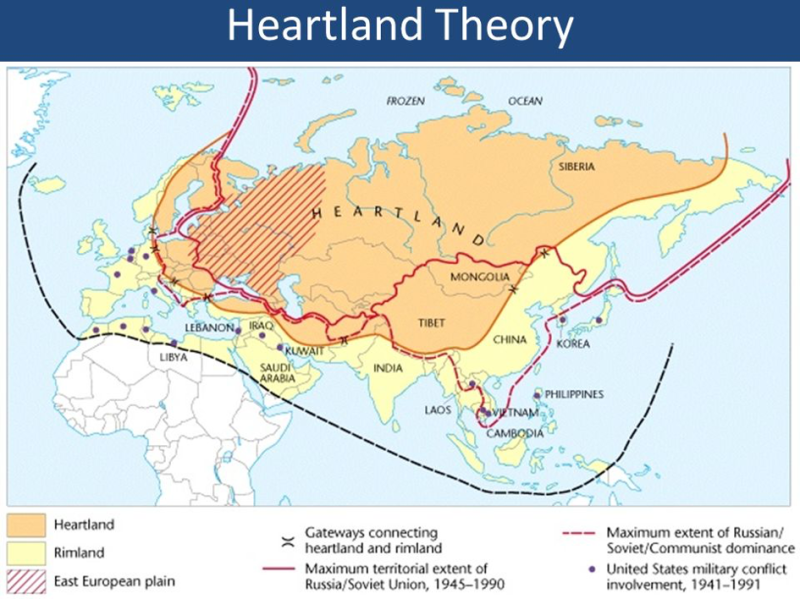
As is well known, over 100 years ago, British geologist and politician Halford Mackinder described the “heartland” as the region of the earth whose control enables domination of global developments as a whole. He postulated that the “heartland” was the core region of the Eurasian landmass. The power politics of the British Empire and later of the West as a bloc were based on this politician's strategic ideas. We refer to our article “Anglo-Saxon geopolitical strategy – unchanged for 120 years.”
Graphically, this theory can be represented as follows:
Looking at the geographical spread of BRICS in what Mackinder considered to be the most politically decisive region of the world, the following picture emerges:
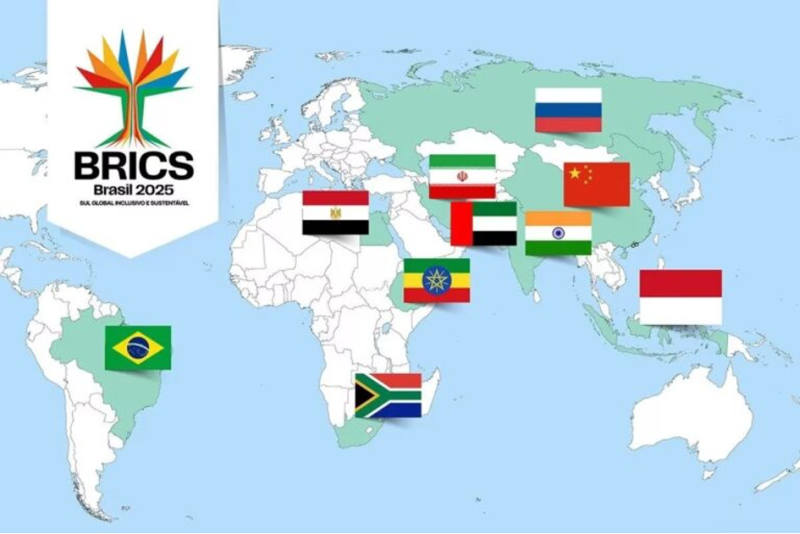
De facto, all countries in the heartland region have decided to join forces within the framework of BRICS. The two large white spots on the map do not change this. One spot shows Kazakhstan, a BRICS candidate country and close ally of both Russia and China; the other large spot between Russia and China is Mongolia. Mongolia is one of the few countries in the world that strictly aligns its policies with the principles of neutrality, in accordance with its own views, sovereign rights, and national interests. These are principles that the two BRICS giants, Russia and China, cannot live with. These principles are part of the policies practiced within the framework of BRICS.
Applying Halford Mackinder's Heartland Theory to the modern world, one could say, in simple terms, that the world belongs to multipolarity, the guiding political principle of BRICS.
National Security Strategy – Old Wine in New Bottles
Since the publication of Part 3 of our BRICS series, the White House has released a new document: the National Security Strategy (NSS). We will not go into detail here, but refer instead to Scott Ritter's article “The US Declares War on Europe” and to Andras Mylaeus' upcoming article “NSS 2025 – Verbal Cosmetics Instead of Paradigm Shift,” which will be published in the next few days.
Every US military strategy has a direct impact on the other key players in world politics.
BRICS – without being mentioned by name – must therefore necessarily be the main target of any US military, economic, and political strategy, given the economic indicators and political orientation of the confederation of states. When the Americans mention China or Russia, the strategies to weaken these countries affect BRICS directly and not indirectly.
Already in the first two sentences of the introduction to the new National Security Strategy, the US lets the world know that nothing has changed at the core of its thinking:
„To ensure that America remains the world’s strongest, richest, most powerful, and most successful country for decades to come, our country needs a coherent, focused strategy for how we interact with the world. And to get that right, all Americans need to know what, exactly, it is we are trying to do and why. “
The goal of the US is and remains global dominance, not cooperation in the sense of a win-win policy. The new strategy is merely an adaptation of the old goal and the previous approach to the changed political and military circumstances in the world. Some commentators see this as a departure from the Wolfowitz Doctrine of 1992. We disagree: The aim is to maintain hegemonic status under all circumstances.
These few words from the document alone will cause strategists in the individual BRICS countries to consider each step very carefully and coordinate with each other. They will analyze and evaluate every step taken by the US and the West with equal precision. They will not announce everything, but will purposefully continue to advance the BRICS.
As far as the information available on BRICS is concerned, the current developments make what we wrote in the first part all the more relevant:
„At present, however, it appears that this information is being deliberately kept even more vague than before, as the official BRICS website is even more reticent with information than in the past.“
An understandable approach given the situation.
Conclusion
The geopolitical realities naturally have an impact on the Western way of seeing the world. The worldview characterized by “full spectrum dominance” and the recurring pattern of political action derived from it will only change under the pressure of reality.
The world is changing—and that's a good thing
Western imperialism, which has dominated the world for the last 500 years, will not voluntarily retreat to its new role in line with reality as a result of suddenly newly acquired humanitarian views. The West, which has been cornered politically, economically, and, to the surprise of many, even militarily by the rapid developments of recent years, is only adapting to a limited extent. It is looking for ways to weaken states it defines as opponents in every conceivable way, to influence them in its own interests, and to break them away from BRICS. This is because the hegemon is forced to maintain its status. The functioning of its system depends on it.
It is therefore important to maintain balance in international politics so that only manageable political swings can occur.
This requires great patience on the part of the BRICS countries and the consistent expansion of their own structures—economically, monetarily, politically, and in terms of security policy—without provoking open antagonism toward their Western counterparts. The aim is to identify common ground for as long as possible in order to formulate a possible way out for all of humanity. A way out that prevents the worst from happening.
So much for the strategy of the multipolar Global South. It is doubtful that the Collective West, led by the US, will act reasonably. How do we arrive at such a conclusion? Quite simply. For two years, the United States has been supporting open and obvious genocide in Palestine and has allowed itself to be drawn into murder and piracy in Venezuela. In both cases, the aim is to influence regional conflicts. If the United States resorts to such practices in non-priority conflicts, how will it behave when it really matters?
«How Resilient is BRICS in the Storm of Geopolitics? – Part 4»