


The “Chinese Professor” Who Fooled the Internet’s Biggest Gatekeepers






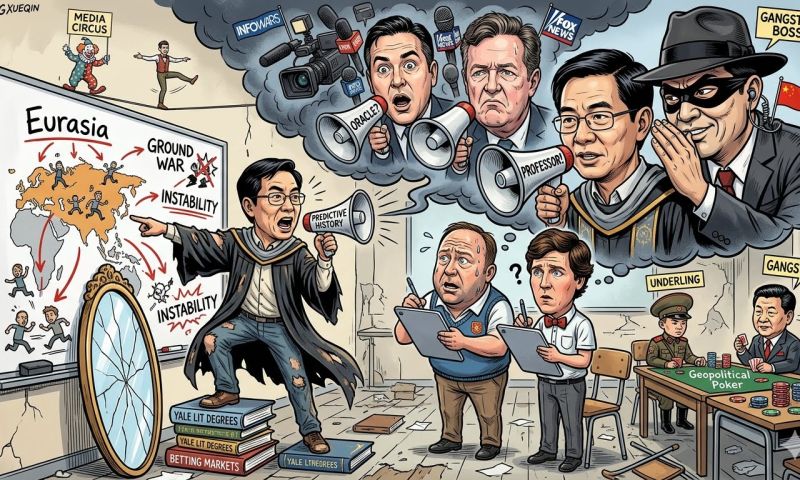
It is nothing short of astonishing how swiftly an obscure online commentator can be transformed into a global sensation when credulous media hosts pave the way. With staggering speed, figures like Piers Morgan, Tucker Carlson, and Mario Nawfal—alongside tens of millions of their viewers—fully embraced Jiang Xueqin as an academic authority and geopolitical oracle.
On major platforms worldwide, this unknown figure was suddenly being introduced as a premier historian, a master analyst, and, at times, something akin to a modern-day prophet. Yet, throughout this meteoric rise, not a single host thought to ask the most elementary questions about his credentials, his methodology, or his extraordinary claims.
Which brings us to the most basic, yet utterly neglected, question of all:
Professor of what?
Jiang was born in Taishan, Guangdong Province, China, in 1976 and immigrated to Canada with his family at the age of six. He holds a Canadian passport and graduated from Yale University with a degree in English literature—not history, geopolitics, mathematics, economics or data science.
None of that makes him unintelligent. Nor does an English literature degree disqualify him from having opinions about history or geopolitics. But it does raise an obvious question for the television and podcast hosts who repeatedly introduce him as “Professor”: What academic authority, exactly, are they invoking?
Jiang began his professional career as a freelance journalist and NGO activist before teaching at a private middle school in Beijing. It was a modest path. Yet somewhere along the way, "teacher" morphed into "professor" in the introductions of prominent media personalities.
Then came the breakthrough
Jiang’s primary 2024 geopolitical predictions regarding Donald Trump and international conflicts gained massive traction online, transforming him from an obscure commentator into a viral internet phenomenon.
Given Trump's highly popular campaign promises to end loathed "forever wars" and repair a broken economy that had plunged tens of millions of Americans into poverty, predicting his electoral victory was hardly a monumental feat (it would have been far more difficult to predict that he would break every single one of those promises once in office). Regardless, Jiang's YouTube channel subsequently exploded, quickly surpassing two million subscribers.
The result was a dramatic career transformation. Jiang left his traditional classroom role and leaned almost entirely into media: producing Predictive History, writing, appearing on podcasts and participating in increasingly high-profile studio interviews with figures including Alex Jones, Max Blumenthal, Mario Nawfal, Tucker Carlson and Piers Morgan.
The transformation was remarkable—not merely because his audience grew so rapidly, but because his perceived authority grew with it.
A former schoolteacher had become a “professor,” a geopolitical analyst, a “researcher” and eventually something approaching an oracle of world events. Alex Jones, for example, has presented Jiang as a “Top Chinese Researcher.”
But that raises another uncomfortable question: Researcher in what field—and on what basis?
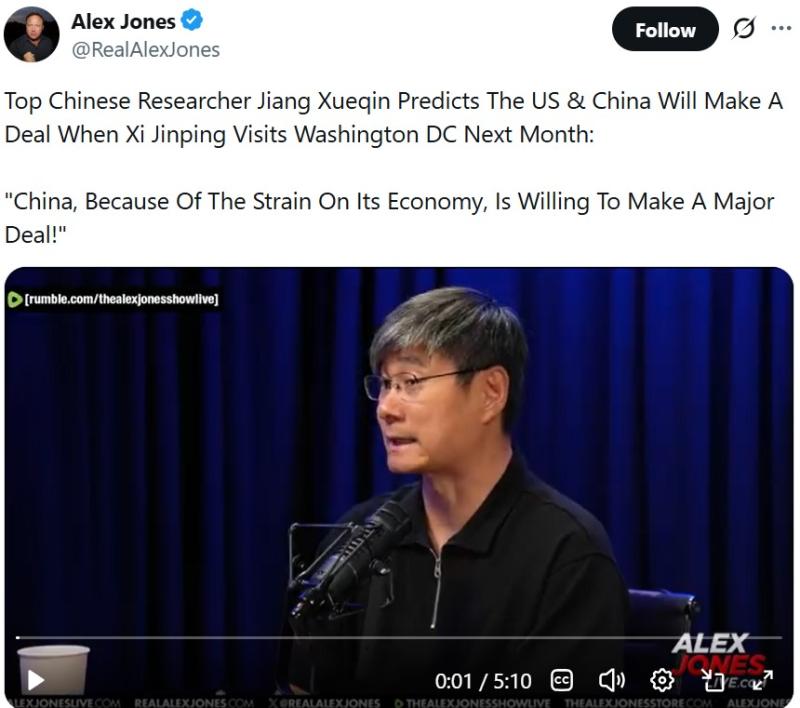
The distinction matters because Jiang’s authority is not derived merely from his ability to communicate. It is derived from the impression of specialized academic expertise.
And apparently, few of the hosts giving him that authority thought it necessary to stop and ask the most elementary question:
What, exactly, is he a professor of?
Manufacturing the Appearance of Academic Authority
Jiang’s YouTube project, Predictive History, presents itself with many of the visual and rhetorical conventions of academia: lectures, classrooms, students, diagrams and an authoritative instructor explaining supposedly sophisticated theories of history.
But appearance is not evidence.
The central question is whether these productions represent genuine academic teaching and research—or whether the classroom setting is being used primarily as a prop to manufacture intellectual authority.
That distinction matters.
A person does not become a historian because he stands in front of a classroom. A mathematical formula does not become a predictive model because it appears on a whiteboard. And an assertion about history does not become scholarship merely because it is delivered in the tone of a university lecture.
Yet that is precisely the impression created when major media personalities repeatedly address Jiang as “Professor” without establishing what academic position he actually holds or what scholarly work supports his claims.
What Happens When You Examine the Claims?
The problem becomes considerably more serious when you examine some of Jiang’s extraordinary assertions.
He has dismissed subjects including evolution, Roman history and the Holocaust as “nonsense,” while entertaining conspiracy theories such as Pizzagate and claims that the Moon landings were faked.
These are not minor disagreements among historians. They are enormous claims that require enormous evidence.
Where is it?
Instead of systematic primary-source research, peer-reviewed scholarship and transparent methodology, Jiang’s presentations mainly rely on internet material, anecdotes and elaborate narratives that can create the appearance of explanatory power without necessarily demonstrating it.
And that leads to perhaps the most important question of all: What, exactly, is the methodology behind Predictive History—and can anyone independently reproduce its predictions?
The “Psychohistory” Problem
Jiang says he employs mathematical game theory and “psychohistory,” a term borrowed from Isaac Asimov’s science fiction.
That should immediately trigger skepticism. Asimov’s psychohistory is fictional. It is a literary device built around the idea that the statistical behavior of enormous populations can be mathematically predicted. Real-world social science is considerably less convenient.
If Jiang has developed a genuine predictive methodology, the appropriate response is not ridicule. It is to demand what would be demanded of any serious predictive model:
Show us the equations. Show us the assumptions. Show us the historical dataset. Show us the predictions made before the events occurred. Show us the failures as well as the successes. And allow independent researchers to test the model.
That is how science separates a model from a story. Critics, including Triple Ampersand, have argued that Jiang’s supposedly sophisticated predictions rely heavily on publicly available political betting markets such as Polymarket. If that criticism is correct, then an obvious question follows:
Is Jiang actually predicting events—or is he repackaging information that the market has already incorporated into its odds?
The Trump Prediction—and the Problem of Retrospective Genius
Much of Jiang’s reputation rests on predictions surrounding Donald Trump’s 2024 victory and subsequent U.S.–Iran conflict.
But predicting one major event does not establish a predictive science. The internet is littered with people who made one spectacularly correct prediction and subsequently built an entire brand around it.
The real test is systematic.
How many predictions were made?
When were they made?
Were they recorded publicly before the outcome was known?
How many were wrong?
Were failed predictions deleted, quietly abandoned or rewritten after the fact?
And most importantly:
Can an independent observer calculate Jiang’s historical accuracy without relying on Jiang’s own account of his successes?
Until those questions are answered, “psychohistory” risks sounding less like a scientific discipline and more like branding.
And Then There Is Iran
Jiang has gone considerably further, predicting that the United States will ultimately wage a full-scale war against Iran involving a ground invasion and hundreds of thousands of American troops.
That is an extraordinary prediction. It therefore deserves extraordinary scrutiny.
How would such a war actually work?
Where would the troops come from?
How would they be transported and supplied?
How would the United States sustain such an operation politically and financially?
How will the American public's opposition to a prolonged ground war be addressed?
What happens when military logistics collapse, weapons systems and ammunition stocks fall to critical levels or are fully depleted—as already seen in the wars in Ukraine and the Middle East—and replenishment takes years or even decades because China withholds critical components from America’s defense industry? What happens when recruitment fails to field enough soldiers, and this shortfall collides with an already enormous debt burden and an unstable bond market—all of which are clearly foreseeable?
A geopolitical prediction is not validated merely because it sounds dramatic.
It has to survive contact with reality.
And reality is precisely where many grand geopolitical narratives become considerably less impressive—or simply ridiculous.
The Audience-Adaptive Narrative
Perhaps the most revealing feature of Jiang's meteoric rise in the media is not any single prediction.
It is how effectively the narrative appears to adapt to the audience.
For audiences hostile to the United States, he emphasizes the inevitable and catastrophic collapse of the American Empire.
For audiences convinced that “China is bad,” he emphasizes the inevitable collapse of China’s supposedly incompetent dictatorship and the superiority of Western, American-style democracy.
For audiences deeply hostile toward Russia, he delivers another convenient conclusion: Russia has already lost the war in Ukraine.
Different audiences. Different enemies. Different emphases.
And yet, like the shifting narratives of a liar, these contradictions eventually become impossible to ignore: Jiang has described China as a dictatorship while simultaneously arguing that its "dictator," Xi Jinping, wields no real power.
So which is it? Is China controlled by Xi, or is Xi merely a figurehead? Or is China actually governed by a different elite—perhaps, as Jiang has claimed on other occasions, by Ivy League-trained Chinese nationals based in the West?
These are not trivial distinctions. They fundamentally alter the entire premise of his explanation.
The Greatest Historical Blind Spot in Jiang Xueqin’s “Little Brother” Theory
Perhaps nowhere is the weakness of Jiang’s geopolitical framework more apparent than in his characterization of North Korea as essentially China’s “little brother”—a subordinate state that ultimately does what Beijing tells it to do.
China undoubtedly possesses enormous influence over North Korea.
That is not controversial.
The question is whether influence equals control.
The historical record suggests something considerably more complicated.
The “Little Brown Brothers” Analogy
There is another problem with Jiang’s “little brother” characterization: it appears to echo the old American colonial description of Filipinos as America’s “little brown brothers.”
That analogy is historically loaded. The phrase emerged in the context of the United States’ colonial relationship with the Philippines and was used to frame Filipinos as supposedly immature people requiring American tutelage and supervision.
Jiang appears to transpose that hierarchical concept onto the China–North Korea relationship: China becomes the powerful older brother, while North Korea is portrayed as the troublesome younger sibling whose behavior is ultimately determined by Beijing.
But this is where the analogy breaks down. North Korea is not the Philippines under American colonial rule, and China is not exercising the kind of formal colonial sovereignty that Washington exercised over the Philippines.
More importantly, the historical record does not support treating Pyongyang as an obedient subordinate.
The problem is not merely that Jiang uses an unfortunate metaphor. It is that the metaphor appears to smuggle an entire political assumption into the analysis:
Because China is vastly more powerful than North Korea, North Korea must ultimately be under China’s control.
That does not follow. Power asymmetry is not the same thing as political obedience.
Indeed, the history of North Korea suggests something closer to the opposite. Its leader Kim Il-sung repeatedly exploited competition among larger powers precisely because he understood that dependence on any single patron could threaten North Korea’s autonomy.
If Jiang is consciously drawing on the “little brown brothers” framework, he should explain why a metaphor developed to describe a colonial hierarchy is an appropriate model for a relationship between two sovereign states with decades of mutual distrust, strategic manipulation and competing interests. Otherwise, the analogy does more than simplify history. It determines the conclusion before the evidence is examined.
Kim Il-sung’s Great-Power Balancing Act
The Sino-Soviet split created an extraordinary opportunity.
As relations between Mao Zedong’s China and Nikita Khrushchev’s Soviet Union deteriorated over ideology, strategy, relations with the United States and leadership of the communist world, Kim Il-sung recognized that North Korea’s weakness could actually become a source of leverage.
He did not want to become Moscow’s satellite. He did not want to become Beijing’s satellite either.
Instead, Pyongyang sought to maintain enough independence from both to get assistance from both.
When Soviet pressure became excessive, Kim could emphasize North Korea’s relationship with China. When Beijing became displeased, Moscow remained available.
The objective was not to remain perfectly equidistant at every moment.
It was to ensure that neither great power acquired decisive control over North Korea.
Kim understood a simple principle of great-power politics:
If Beijing feared that Pyongyang might move toward Moscow, Beijing had an incentive to support Pyongyang.
If Moscow feared that Pyongyang might move toward Beijing, Moscow had an incentive to support Pyongyang.
North Korea could therefore turn the fear of losing influence into leverage. That is hardly the behavior of a passive pawn.
The Extraordinary Evidence of 1961
One of the clearest examples came in July 1961. Within days, North Korea signed major security treaties with both communist giants.
On July 6, the Soviet Union and North Korea signed the Treaty of Friendship, Cooperation and Mutual Assistance in Moscow.
Five days later, on July 11, Kim Il-sung traveled to Beijing and signed a corresponding Treaty of Friendship, Cooperation and Mutual Assistance with China.
Both agreements contained mutual-assistance provisions in the event of armed attack.
Think about what that meant.
At precisely the moment when Moscow and Beijing were moving toward an increasingly bitter confrontation, Kim Il-sung managed to obtain security commitments from both.
He did not select one patron and surrender himself to that patron. He positioned North Korea between two competing powers and extracted benefits from the rivalry.
That is not evidence of a country devoid of geopolitical agency. It is evidence of a small state deliberately maximizing its leverage against much larger states.
Getting Assistance From Both Sides
The same strategy extended beyond military protection. The Soviet Union provided substantial industrial, technological, scientific and military assistance. Soviet involvement also contributed to the development of North Korea’s early nuclear infrastructure.
China, meanwhile, remained an important source of food, raw materials, consumer goods and other economic assistance.
Pyongyang could therefore play one relationship against the other. When Moscow became difficult, Beijing became more important. When Beijing became difficult, Moscow became more important. North Korea did not need either superpower to love it.
It needed both to fear losing it.
The Purges Were Also About Foreign Dependence
The internal political history makes the “Chinese little brother” characterization even more problematic.
The early Workers’ Party of Korea contained competing factions associated with different foreign powers, including Soviet-aligned elements and the Yan’an faction associated with China.
Kim Il-sung eventually moved against both.
The growing Sino-Soviet confrontation helped create an environment in which Kim could portray domestic political rivals as foreign-influenced factions or “lackeys.”
The resulting purges eliminated rival centers of political power and contributed to consolidating the position of Kim and the group loyal to him. This ultimately culminated in the ideological emphasis on Juche and political independence.
There is an important irony here.
The political system that Jiang portrays as fundamentally subordinate to China was predominantly constructed around the principle that North Korea must never become subordinate to a foreign power.
This does not mean that Juche ideology and policy rendered North Korea genuinely independent in every practical sense.
It does mean that the historical development of the North Korean state cannot be reconciled with a simplistic master-and-servant model.
A Small State Can Have Disproportionate Leverage
North Korea’s subsequent history reinforces the point. Pyongyang has repeatedly demonstrated four characteristics:
Strategic autonomy: it has resisted becoming completely dependent on any single great power.
Balancing diplomacy: it has exploited competition among larger powers to expand its room for maneuver.
Asymmetric leverage: China’s vastly greater economic and military power does not eliminate the vulnerabilities Beijing itself faces when dealing with Pyongyang.
Strategic opportunism: when the international environment shifts, North Korea seeks different patrons, alternative sources of assistance, and fresh opportunities for benefit.
This does not put North Korea on equal footing with China, but it makes their relationship far more nuanced than the typical caricature suggests.
A weak state can be highly dependent on a stronger state while still retaining meaningful agency. Indeed, asymmetric dependence can sometimes give the weaker party leverage precisely because the stronger party has more to lose from certain outcomes.
China needs stability on its border
China does not want a nuclear crisis spiraling out of control. China does not want a sudden North Korean collapse producing millions of refugees. And China does not want a unified Korea allied militarily with the United States appearing immediately on its border.
Pyongyang knows that.
And that knowledge is itself a source of leverage.
The Pattern Didn’t End With the Cold War
The same strategic logic has reappeared in the relationship between North Korea and Russia. Following Russia’s invasion of Ukraine, Kim Jong-un’s government moved substantially closer to Vladimir Putin’s Russia. The two countries subsequently deepened their military relationship and entered into a formal strategic partnership.
Again, Pyongyang was responding to a changing international system. Russia needed partners. North Korea needed economic and diplomatic support. Both had reasons to exploit the confrontation between Russia and the West. The important point is not that Russia replaced China as North Korea’s new “boss.”
During the Cold War, North Korea aggressively cultivated alliances outside China and the Soviet Union precisely to gain international legitimacy and reduce its dependence on Moscow and Beijing. Pyongyang was particularly active in Africa, supplying infrastructure aid, military weapons, and guerrilla training to liberation movements and newly independent states such as Zimbabwe and Guinea-Bissau. It also forged tight anti-American partnerships with Cuba, Iran, Syria, and the Palestine Liberation Organization (PLO), providing them with arms.
In short, North Korea has repeatedly sought multiple external relationships precisely to avoid becoming completely dependent upon one patron.
Why the "Gangster and Underling" Model Falls Short
This is where Jiang’s formulation—which frames China as a "gangster" or "mafia boss" dictating terms to an underling or "little brother"—becomes problematic. The real question is not whether Beijing can exert leverage over Pyongyang; it undoubtedly can.
China controls the flow of critical economic assistance, wields immense diplomatic influence, and partly shapes North Korea’s strategic environment. Its economic and military advantages are overwhelming.
However, none of these realities prove that Beijing can simply pick up the phone and order Pyongyang to initiate a war. That is a far bolder assertion—one that demands much more robust evidence.
The actual relationship is considerably more complicated. North Korea relies on China, yet fears Chinese dominance. Beijing depends on North Korea as a buffer, yet dreads the fallout of political instability in Pyongyang. Furthermore, while North Korea actively seeks both Russian and Chinese backing, Moscow and Beijing compete just as much as they cooperate.
And Pyongyang has repeatedly demonstrated that it is willing to exploit contradictions between larger powers to preserve its own strategic freedom.
That is not a straightforward hierarchy of master and servant. It is asymmetric interdependence.
Jiang reduces this complicated history—filled with shifting alliances, nationalism, strategic deception, competing interests and weaker states constraining stronger ones—to a gangster story in which the boss gives an order and the underling bites.
It makes for compelling television and YouTube shows, establishing him as a gifted writer of fiction. As history, however, it fails to convince.
A Personal Observation
My own firsthand experience makes Jiang’s characterization particularly difficult to accept.
Having lived and worked with North Koreans—even traveling to China alongside them—I was struck by how strongly they identify as Korean and how sharply they distinguish themselves from the Chinese.

They are fiercely proud of their national identity and, in my experience, often view China with considerable suspicion, if not outright disdain.
Personal experience is not a substitute for systematic research. But it does expose a blind spot in simplistic geopolitical models: North Koreans do not see themselves the way foreign strategists see them.
To portray them simply as China’s “little brothers” overlooks the nationalism, historical memory, suspicion of foreign domination and fierce desire for autonomy that have shaped North Korean political culture for decades.
The relationship between Beijing and Pyongyang is therefore better understood as a complicated relationship between two states that need each other, distrust each other, manipulate each other and continually attempt to maximize their own freedom of action.
And that raises much more interesting questions than: “What will China order North Korea to do?”
The more revealing questions are:
How did Mao and Khrushchev privately assess Kim Il-sung’s balancing strategy?
How angry were Beijing and Moscow when Kim attempted to extract concessions from both?
How did Pyongyang survive the 1956 August Faction Incident despite challenges from both pro-Soviet and pro-Chinese elements?
How has North Korea repeatedly exploited rivalry among China, Russia and the United States?
And most importantly: How much influence does China actually possess when Beijing’s preferred outcome conflicts with Pyongyang’s own interests?
Those questions do not produce a simple geopolitical morality tale. They produce something much more interesting:
a small state that has repeatedly demonstrated an extraordinary capacity to manipulate the rivalries of much larger powers.
And that history should make anyone cautious about reducing North Korea to China’s obedient “little brother.”
The Corruption Claim
Jiang has also made sweeping claims about corruption in China, portraying it as “the world’s most corrupt country.”
But sweeping claims require comparative evidence.
I have actually done business around the world, including in China. Jiang has not built a comparable international business career. That matters when someone presents sweeping conclusions about how an entire national economy—and the people who operate within it—actually functions.
I also spent seven years living and working in North Korea. At the time, Transparency International ranked North Korea among the world’s most corrupt countries. Yet I personally never paid a bribe.
Does that prove there was no corruption in North Korea? Of course not. And that is precisely the point.
My personal experience is only an anecdote. It cannot establish the level of corruption across an entire country. The same standard must apply to Jiang. Whatever anecdotes or personal experiences he may have accumulated—if he has any—do not, by themselves, establish that China is “the world’s most corrupt country.”
And where does the United States stand? Here, corruption has been effectively legalized, allowing the super-wealthy to spend unlimited sums to buy politicians, political influence, and control. It has gone so far that foreign lobbies can help oust popular and patriotic politicians such as Thomas Massie and replace him with yet another Israel-first figure—as recently occurred—amid a large majority of lawmakers who consistently advance Israel’s agenda, even at America’s expense. How is it possible that all of this could have escaped “Professor” Jiang’s attention while he was discussing China’s corruption?
Transparency International’s latest 2025 Corruption Perceptions Index, which measures perceived public-sector corruption, ranks North Korea 172nd out of 182 countries, with a score of 15 out of 100. That puts North Korea among the lowest-scoring countries in the world—but notably not among the ten lowest-ranked countries.
China, meanwhile, scores 43 and ranks 76th out of 182, meaning it is not even among the 40 worst-ranked countries in the index.
This demonstrates why rhetoric needs to be separated from evidence. There is an enormous difference between saying “China has corruption problems” and saying “China is the world’s most corrupt country.”
The first is a proposition that can be investigated with evidence. The second is a comparative claim about China’s position relative to virtually every other country on Earth—and therefore requires comparative evidence. That distinction matters.
If Jiang wants to argue that China is uniquely or exceptionally corrupt, the burden is not to produce a few anecdotes about bribery or bureaucratic misconduct. The burden is to demonstrate, using a transparent methodology, how China compares with the rest of the world.
And if he wants to dismiss international corruption measurements as inadequate, then he should present a better methodology—one that can be independently examined and applied consistently to other countries.
Otherwise, “China is the world’s most corrupt country” is not an empirical conclusion. It is a propaganda slogan.
The Real Story: Presentation Over Verification
The most telling aspect of Jiang Xueqin’s rise is not the man himself—it is the major media platforms granting him a stage. When hosts like Tucker Carlson (whose TCN averages roughly 57 million views across social media and podcast platforms), Piers Morgan (with an active audience of about 30 million across various platforms), Alex Jones (with around 4.5 million followers), Mario Nawfal (who brands his program the “Largest Show on X”), or Max Blumenthal and The Grayzone (with more than one million followers across platforms) invite a figure like “Professor” Jiang onto shows watched by millions, basic journalistic due diligence should be a given.
Instead, elementary questions have completely disappeared:
The Credentials: What is his actual academic standing? Why treat an English literature graduate as a historical authority?
The Science: Where are his peer-reviewed papers? Can his mathematical methodology be independently reproduced?
The Track Record: What percentage of his predictions have failed? How much of his "model" is just repackaged betting-market data?
This begs the question: Did these high-profile hosts investigate his background, or did they blindly accept the "Professor" persona?
Every classic grift relies on the target's willingness to believe a well-constructed illusion. Here, style entirely substitutes for substance. Dress a commentator up in front of a classroom, hand him a marker, add a few ominous geopolitical charts, and have a celebrity host legitimize him. Instantly, millions of people assume they are listening to a certified expert.
Authority is earned through evidence, not projected through a title. If Jiang has genuinely unlocked the future, he should publish the methodology, disclose the data, and invite peer review. If his model survives the scrutiny, it’s a historic breakthrough. If it fails, it’s just a modern spin on an old scam—nothing more than a beautifully faked performance of intellectual authority.
«The “Chinese Professor” Who Fooled the Internet’s Biggest Gatekeepers»