



The AI Bubble: The Worst Bubble Ever?






AI is real, just as the internet was real. But the capital behind it is totally misallocated, and much of it is borrowed. I believe that what is building up is the worst bubble on record. The stock market has not crashed so far; the cracks are appearing in the credit market, where they do more damage.
What a bubble is: a short history from tulips to the 2008 housing crash
A bubble forms when the price of an asset loses touch with anything it could plausibly earn, and people go on buying only because the price keeps rising. It usually begins with something real.
Every history of bubbles starts with tulips. The Dutch tulip market collapsed in February 1637, yet when the historian Anne Goldgar went into the archives to look for the ruined, she reported: "I couldn't find anybody that went bankrupt."
Britain's Railway Mania of the 1840s is the more interesting case, because the technology was real. Railways were plainly the future, shares could be bought for a deposit of 10%, and many middle-class families put their entire savings into them. When the Bank of England raised interest rates and share prices began to fall, investment stopped almost overnight, and many of those families lost what they had put in. About a third of the authorized lines were never built, yet the rest still make up roughly half of Britain's railway network today. The same happened with the internet. Its infrastructure was real and shaped what came after, but far more capital was poured in than it could ever repay, and much of that capital went to the wrong places.
What decides how the story ends is debt. On Wall Street in 1929 buyers typically put down about 10% and borrowed the rest; the Dow fell by almost 90% and needed a quarter of a century to recover. In America's housing bubble the collateral was the family home; share prices fell by more than half and unemployment reached 10%. Economists who examined bubbles in 17 countries over 140 years came to a conclusion that I regard as the key to everything that follows: "what makes some bubbles more dangerous than others is credit". What matters most about a bubble is who lent the money, and far less how high the shares stand.
I see both lessons at work today: a real technology, and far too much borrowed money chasing it.
My own experience of the internet bubble in 2000
I watched the last great technology bubble from the inside. In early 2000 I held a stake in an internet company and acted as its adviser. Such companies were valued on their turnover, because there were no profits to value. Firms therefore inflated their turnover by selling to one another, and this cross-turnover became the game that everyone played. I tried to persuade the major investor to agree to a full cash transaction and failed, which he regrets to this day. A major bank then offered to float the combined company at a valuation of €450 million. The buyer considered that too little and held out for more, and since we had sold our remaining shares, we no longer had any say in the matter. A year later the €450 million had shrunk to nothing. Greed drove that decision, just as greed is driving the market today.
That experience taught me to recognize a bubble when I see one, and what I see today is the same game played with far larger numbers: companies selling to and investing in one another, financed by debt on a ridiculous scale.
The internet bubble of 2000–2002: shares, telecoms and vendor loans
The public version of my small story is well known. The Nasdaq peaked in March 2000 and did not see that level again for fifteen years. By October 2002 it had lost about 78%, and some $5 trillion of market value had gone with it.
Behind the shares stood a second bubble, in telecoms, and that one was made of glass and debt. Telecom firms spent more than $500 billion on fiber and networks in five years, and by the end of 2002 no more than 2% of North America's long-distance capacity was in use. What interests me most is how it was paid for. The equipment makers lent their customers the money to buy the equipment. Lucent alone had made more than $8 billion of such commitments, and later set aside $3.5 billion for bad customer loans.
The bill was an American recession of eight months. Cisco, which made the internet's routers and was the most valuable company in the index, lost about 90% of its value, and its share price needed more than twenty-five years to recover.
The AI boom today: what is being built and how it is financed
The present can be summed up in a single week of October 2026. On Tuesday Nvidia was worth almost $5.8 trillion and the S&P 500 set a record. On Thursday OpenAI told its investors that its annualized revenue was approaching $50 billion, not the roughly $70 billion everybody had been repeating.
The scale of what is being built is hard to grasp. The Columbia economist Stijn Van Nieuwerburgh has done the sums: the AI build-out will take about $10 trillion between 2025 and 2032. That is about 3.6% of American GDP, every year, for eight years.
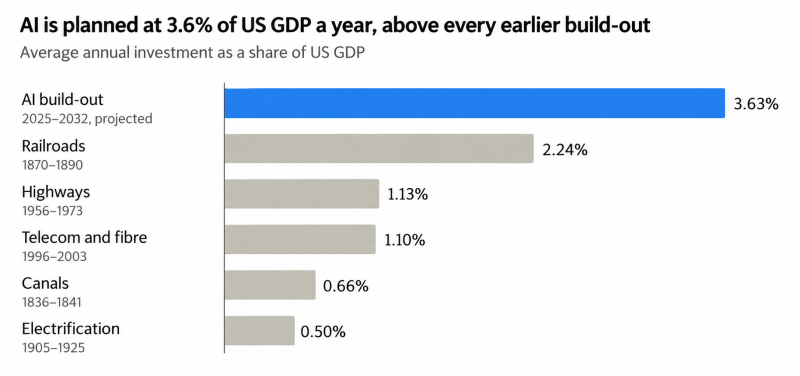
The AI figure is a projection for 2025–2032.
To earn the expected return, he reckons, the AI industry would need about $3.7 trillion of revenue a year by 2032. The companies cannot pay for the build-out themselves. On JPMorgan's estimate, the cash flow and share issues of the big cloud companies will cover only around a quarter of the AI investment planned to 2030. The rest has to be borrowed, and the borrowing has begun: by early September this year's AI-related debt issuance was already more than double that of the whole of 2025.
And that is only the visible debt. According to a Nikkei study, the five big cloud companies carry $1.65 trillion of obligations that appear on no balance sheet, which is more than the $1.35 trillion of debt they actually report. When debt has to be kept out of sight, I become suspicious.
What follows will be familiar to anyone who lived through 2000. In August Nvidia guaranteed up to $105 billion behind OpenAI's twenty-year lease of a data center in Ohio. The developer of that data center belongs to SoftBank, and SoftBank has sold junk bonds at yields of almost 10% to fund its investment in OpenAI. In other words, the chip maker guarantees its customer's rent in a building owned by that customer's shareholder, who borrowed at junk rates to buy the shares. A generation ago we called this game cross-turnover. The Bank of England now calls it "circular arrangements" and warns that they could "amplify losses if expectations disappointed".
Warning signs from the credit markets in 2026
Judged by share prices, nothing has burst; the S&P 500 stands at a record. But I pay more attention to the people who lend the money, and they are nervous. An AI cloud company such as CoreWeave now pays more than 10% for a loan. OpenAI has ruled out a stock-market listing this year. Apollo's flagship private-credit fund has limited withdrawals for three quarters running, because far more investors want their money back than it is willing to pay out. Lenders who behave like this do not believe the story the stock market is telling.
The Iran war, energy prices and interest rates: why the money is getting more expensive
What makes this fragile structure dangerous is that the price of money is rising at the same time, for reasons that have nothing to do with technology. On 28 February 2026 the United States and Israel began their war against Iran. More than a hundred American experts in international law have stated that the strikes "clearly violated the United Nations Charter prohibition on the use of force", and I share their view that this is an illegal war. The International Energy Agency called it "the biggest oil supply disruption in the history of the global oil market", and seven months later there is still no settlement. Brent crude trades at about $105 a barrel, but that is the price of a futures contract, not of oil. Anyone who needs a real barrel pays far more; in late September the gap was put at $26.
Expensive energy feeds straight into prices. American inflation is running at 3.4%, and energy costs 16% more than a year ago. In September the Federal Reserve raised interest rates for the first time since 2023, and the yield on five-year Treasury bonds has passed 5% for the first time since 2007.
For the AI build-out this comes at the worst possible moment. On one estimate, about $4 trillion of AI investment is to be financed with debt between 2026 and 2030, and every one of those dollars now costs more than it did at the start of the year. The same squeeze reaches the customers. Households and businesses that pay more for fuel and more for credit have less to spend, yet the calculation behind the build-out requires them to spend about $3.7 trillion a year on AI by 2032. Dearer energy leads to higher inflation, higher inflation to higher interest rates, and higher interest rates to less money for everything else. Nobody has yet explained to me why spending on AI should be the exception.
Unbuilt data centers, idle chips and cheaper Chinese AI
The money has been borrowed and the chips have been ordered, but a growing share of the buildings they were meant for does not exist. Of the American data-center capacity scheduled for 2026, only half was under construction in June, and projects worth at least $260 billion have been canceled this year after local opposition. Microsoft's chief executive, Satya Nadella, saw the consequence coming last November: without power and finished buildings, "you may actually have a bunch of chips sitting in inventory that I can't plug in".
Cut off from Nvidia's best chips, the Chinese laboratories had to learn to do more with less, and they have. Their models now handle most everyday engineering work reasonably well at about a fifth of the American cost. To my mind this is the most dangerous fact in the whole story. If the same work can be done with a fraction of the computing power, the trillions being borrowed for American data centers are aimed at a demand that may never materialize.
Against this background the leading American laboratories announced in September that progress ought to slow down. Anthropic's chief executive, Dario Amodei, wrote that "we must slow the pace at which we improve the capabilities of AI models", and Sam Altman of OpenAI agreed. The stated reason is safety, and the danger may well be real. But Anthropic's head of policy also called for a national law under which frontier models must be tested and can be blocked, and for a ban on selling advanced chips to China. My own reading is simple: an industry that cannot earn back its investment at Chinese prices has every interest in rules that keep the Chinese out.
The depreciation problem: chips that are outdated in three years but written off over six
There is one aspect in which the AI boom is not at all like the internet bubble, and I regard it as the most serious problem of all. The money of earlier booms bought things that last. The money going into AI buys mostly chips: about two-thirds of the cost of a data center is computing equipment. These chips, Van Nieuwerburgh notes, "may become economically obsolete within three to six years", and Nvidia brings out a new generation every year.
Are these chips written off in three years? They are not. The big cloud companies spread the cost over five to six years, and the longer the period, the better the profits look: when Meta stretched it in 2025, its net income rose by $2.59 billion in that year alone. The investor Michael Burry estimates that the big cloud companies will understate their depreciation by about $176 billion between 2026 and 2028. I have seen this before. In 2000 the fiction was in the turnover. Today it sits in the assumed life of a chip.
The market is less patient than the accountants. Late last year an Nvidia system in its third year of use was resold for less than half the price of a new one, which is below what a six-year schedule would show in the books. A chip that waits a year in a warehouse for a building loses a year of its short life without earning anything. And the Chinese are shortening that life from the other end: DeepSeek's latest model needs about a quarter of the computing power its predecessor needed for the same long task, and Chinese suppliers are expected to cover almost four-fifths of China's own market for AI chips this year.
I know of no large company that has so far written down its AI chips, and that is precisely what worries me. The debts run far longer than the chips will last: the lease that Nvidia guarantees in Ohio runs for twenty years, several lifetimes of the equipment inside the building. I know of no earlier investment boom whose principal asset aged so quickly.
The internet bubble and the AI boom compared
Measure | Internet bubble | AI boom |
Shiller P/E of the S&P 500 | 44.2 in late 1999, the record | 40.68 in September 2026, second highest ever |
Ten largest companies' share of the S&P 500 | about 27% at the 2000 peak | 40.7% at end-2025, a record |
The flagship | Cisco: nearly $560 billion, over 150 times expected earnings | Nvidia: just under $5.8 trillion on 6 October 2026, under 18 times expected earnings |
Investment per year, share of US GDP | telecom and fiber 1996–2003: 1.10% | AI build-out 2025–2032: 3.63%, projected |
Suppliers financing customers | Lucent: $8.1 billion of commitments | Nvidia: up to $105 billion guaranteed behind one OpenAI lease |
Demand for what was built | no more than 2% of long-distance capacity in use (2002) | about $60 billion of AI revenue against about $400 billion of capital spending in 2025 |
What the money buys | fiber, switches and wireless networks | mostly chips, written off over five to six years and possibly obsolete in three |
Only the third row speaks for today: Nvidia’s shares are far cheaper relative to its profits than Cisco’s were. Every other row is worse than in 2000. The market is more concentrated, the build-out is planned at more than three times the size of the telecom boom relative to the economy, and vendor financing has returned with an extra digit. The last row matters most. A fiber-optic cable lasts for decades, and the surplus fiber of the 1990s was put to use long after the companies that laid it had gone bankrupt. A chip may be outdated in three years. The telecom boom left behind an asset that could wait for demand to arrive, whereas this boom leaves behind one that is already losing its value and will be obsolete in six years at the latest.
Why this could become the worst bubble in history
When I call this the worst bubble, I am not talking about share prices; those were higher in 1999. I am talking about four things that come together: the size of the bet, the short life of what the money buys, the debt that stands behind it and the conditions under which that debt must now be raised.
The size is without precedent. Gita Gopinath, the former chief economist of the IMF, estimated in late 2025 that a fall on the scale of the dot-com crash would now destroy about $35 trillion of wealth, $20 trillion of it in American households. And if the chips last three years instead of six, the revenue needed to justify the build-out rises from $3.7 trillion a year to about $6 trillion.
The debt, moreover, is largely hidden. Much of it sits in special purpose vehicles, and Van Nieuwerburgh told reporters that their opacity is “somewhat reminiscent of what happened in the subprime mortgage crisis”. The central bank cannot help as it did then. In 2007 and 2008 the Federal Reserve cut its policy rate from 5.25% to almost zero. This time it is raising rates. The IMF’s managing director warned this week that disappointing AI results could trigger a wider financial shock.
How much worse than the internet bubble could it be? One firm of analysts, MacroStrategy Partnership, has put the bubble at 17 times the size of the dot-com frenzy and four times the 2008 property bubble. Their yardstick is broad: it counts all the capital misallocated under years of artificially low interest rates, not AI alone. Having watched €450 million go to zero in a year, I do not find the number absurd.
What the optimists say, and why it is still a bubble
There are honest objections, and I do not want to wave them away. The profits are real: Nvidia's net income is expected to double this fiscal year, and its shares are cheaper relative to its profits than the market as a whole. The supervisors are not calling a crisis either; even Van Nieuwerburgh considers it premature to conclude that AI already poses a systemic risk comparable to earlier credit booms.
None of this refutes my argument. A technology can work and its investors can still lose their money. The internet worked, and the Nasdaq fell by 78% all the same. Nvidia’s profits are real, but they consist of what its customers spend on chips, and those customers increasingly pay with borrowed money. They are borrowing against revenue that does not yet exist. If that revenue fails to arrive, the orders will stop, and Nvidia’s profits will stop with them.
Conclusion: real technology, misallocated capital
The bubble has not burst, but it is leaking, and it is leaking in the credit market, which is where bubbles become dangerous. The thing to watch is whether OpenAI can raise the $30 billion it is seeking at a $1.4 trillion valuation, about 28 times its corrected revenue.
Tulips had the price and nothing else. The railways had the scale, and left the rails. The internet had the valuation and the vendor loans, and cost an eight-month recession. Housing had the hidden leverage, and cost the deepest American recession since the Second World War. The AI boom has all of it at once. Its valuations are the second highest ever measured. Its investment plans are larger, relative to the American economy, than the canal, railway, highway or telecom booms. Its debts are growing at more than twice last year’s pace, and at the five big cloud companies most of them are off the balance sheet. Its assets may be obsolete within three years but are written off over five or six. And all of it has to be financed at the highest long-term interest rates in almost two decades, in the middle of the largest oil supply disruption on record.
AI is real, just as the internet was real; that was never the question. The question is the capital, which is misallocated on a scale I have not seen before. If it ends as its predecessors ended, this will be the worst bubble in history. The tulips, as far as the archives show, bankrupted nobody.
But few people ever owned tulips, and nobody had lent trillions against them. Today the ten largest companies alone make up two-fifths of the index in which American households, and a good many others around the world, keep their savings. The debts behind the boom are spread through the bond markets and the private-credit funds. One day another historian will go into the archives of our own time, as Anne Goldgar went into those of the tulip trade, to look for the ruined. I suspect the search will not take long.
«The AI Bubble: The Worst Bubble Ever?»