


Iran Defeats the US — Reflections






Introduction
When the “Peace Treaty” was signed in Versailles on January 10, 1920, it marked the formal end of several great empires: the Russian Tsarist Empire, the Austro-Hungarian Empire, the German Empire, and the vast Ottoman Empire. On Wednesday, June 17, 2026, something similarly momentous appears to have taken place: Iran, one of the largest and most powerful civilizations in human history, is returning to the table of world powers as an equal partner after defeating the hegemons in just under four months. This place is well-deserved, and we found ourselves in a small minority when we stated as early as March 1, 2026 that Iran would emerge as the winner of this conflict.
In this article, we will raise questions and attempt to subject them to a strict evaluation or even provide answers.
What is a Memorandum of Understanding (MOU)?
If the parties are not (yet) ready to sign a contract, signing an MOU is the correct approach: The parties agree to negotiate and, in doing so, establish key points and the framework. Without a subsequent contract, it has no legal effect—that’s the legal perspective.
However, the impact of the MOU that has now been signed is a geopolitical bombshell. The whole world has seen that the “greatest” world power—which, together with Israel, attacked Iran for the second time on February 28, 2026, in a gross violation of international law during a break in negotiations—must yield to Iran’s demands. Of course, the US is free to withdraw from the upcoming 60-day negotiations on whatever grounds it chooses, but that would ultimately amount to a breach of promise, indeed even a breach of contract, and would certainly be a diplomatic embarrassment.
The significance of this document, signed in Versailles, may therefore have little impact from a purely legal standpoint, but from a geopolitical and diplomatic perspective, it amounts to a geopolitical straitjacket for the US—a situation that is unique in US history.
Text of the MOU
1. The United States of America and the Islamic Republic of Iran and their allies in the current war, by signing this MOU, declare the immediate and permanent termination of military operations on all fronts, including in Lebanon, and undertake from now on not to initiate any war or any military operation against each other, and to refrain from the threat or use of force against each other, and ensuring the territorial integrity and sovereignty of Lebanon. The final deal will confirm the permanent termination of the war on all fronts, including in Lebanon, and other provisions of this paragraph.
2. The United States of America and the Islamic Republic of Iran undertake to respect each other's sovereignty and territorial integrity, and to refrain from interfering in each other's internal affairs.
3. The United States of America and the Islamic Republic of Iran commit to negotiating and achieving the final deal in a maximum of 60 days, extendable by mutual consent.
4. Immediately upon the signing of this MOU, the United States of America will begin the removal of its naval blockade and any disturbances or impediments against the Islamic Republic of Iran, and will fully end the naval blockade within 30 days. During this period, the traffic of vessels will be in proportion to the numbers of pre-war traffic being restored by the Islamic Republic of Iran. The United States of America further undertakes to remove its forces from the proximity of the Islamic Republic of Iran within 30 days after the final deal.
5. Upon the signing of this MOU, the Islamic Republic of Iran will make arrangements using its best efforts for the safe passage of commercial vessels with no charge for 60 days only from the Persian Gulf to the Sea of Oman, and vice versa. The traffic of commercial vessels will immediately start, and considering the need for removing the technical and military obstacles and de-mining by the Islamic Republic of Iran, will be instated within 30 days. The Islamic Republic of Iran will conduct dialogue with the Sultanate of Oman to define the future administration and maritime services in the Strait of Hormuz, in discussion with other Persian Gulf littoral states, in line with the applicable international law and the sovereign rights of coastal states of the Strait of Hormuz.
6. The United States of America undertakes with regional partners to develop a definitive, mutually agreed plan with at least $300 billion for the reconstruction and economic development of the Islamic Republic of Iran. The mechanism for the implementation of this plan will be finalized as part of a final deal within 60 days. All required licenses, waivers, and permissions needed for the relevant financial transactions will be granted by the United States of America.
7. The United States of America undertakes to terminate all types of sanctions against the Islamic Republic of Iran, including the United Nations Security Council resolutions, IAEA Board of Governors resolutions, and all unilateral U.S. sanctions, primary and secondary, in an agreed-upon schedule as part of the final deal. The Islamic Republic of Iran and the United States of America acknowledge the critical importance of the sanctions termination issue above-mentioned and expressed their intentions to immediately address these issues in the negotiations, in order to achieve mutual agreement on them.
8. The Islamic Republic of Iran reaffirms that it shall not procure or develop nuclear weapons. The United States of America and the Islamic Republic of Iran have agreed to resolve the disposition of stockpiled enriched material pursuant to a mechanism that will be mutually agreed upon in accordance with the schedule mentioned in paragraph seven with the minimum methodology to be down-blending on site under the supervision of the IAEA. The two parties also agreed to discuss the issue of enrichment and other mutually agreed matters related to the Islamic Republic of Iran's nuclear needs based on a satisfactory framework being agreed upon in the final deal. The final deal will confirm the provisions of this paragraph. The United States of America and the Islamic Republic of Iran acknowledge the critical importance of the nuclear issues above mentioned and express their intention to immediately address these issues in the negotiations in order to achieve mutual agreement on them.
9. Pending the final deal, the United States of America and the Islamic Republic of Iran agree to maintain the status quo. The Islamic Republic of Iran will maintain the current status quo of its nuclear program, and the United States of America will not impose any new sanctions and will not deploy additional forces in the region.
10. The United States of America undertakes that immediately upon the signing of this MOU and until the termination of sanctions, the U.S. Department of Treasury will issue waivers for the export of Iranian crude oil, petroleum products, and derivatives, and all associated services, including banking transactions, insurances, transportation, etc.
11. The United States of America undertakes to make fully available for use the frozen or restricted funds and assets of the Islamic Republic of Iran upon the implementation of the MOU. The United States of America and the Islamic Republic of Iran will mutually agree on the procedures related to the release of these funds during the negotiations. Such funds, whether retained in the original account or transferred, shall be made fully usable for payment to any ultimate beneficiary designated by the Central Bank of the Islamic Republic of Iran. The United States of America undertakes to issue all necessary licenses and authorizations accordingly.
12. The United States of America and the Islamic Republic of Iran agree that an executive mechanism will be established to monitor the successful implementation of this MOU and the future compliance of the final deal.
13. After signing this MOU and subject to the beginning of the implementation of paragraphs 1, 4, 5, 10, and 11 of this MOU, and the continuing implementation of these measures, the United States of America and the Islamic Republic of Iran will start negotiations regarding the final deal exclusively on the other paragraphs.
14. The final deal will be endorsed by a binding UNSC resolution
The Importance of Priority – Start with the Essentials
A discussion of all 14 points in the memorandum would go beyond the scope of this article. We will limit ourselves to a few that are essential to today’s discussion and will follow up with a more in-depth analysis.
In a document of such diplomatic significance, nothing is left to chance. Thus, the most important point comes first. The agreement does not concern the end of the military conflict between the US and Iran. Rather, Section 1 specifies that “military operations on all fronts” must be ceased and explicitly mentions Lebanon. The MOU obligates not only the US and Iran, but also “their allies” to cease all hostilities; this thus includes Israel. The biggest surprise in this document: The US is yielding to Iran’s main demand, whereby Iran is forcing the US to abandon Israel as a partner and friend.
This also means that the Israelis did not officially receive a copy of the MOU. The Americans thus made a decision together with the Iranians over the heads of the Israelis. This imposed an obligation on the Israelis that Israel has no intention of fulfilling under any circumstances: the abandonment of the conquest of Lebanon. Without participating in the negotiations, Israel—as the initiator of the war against Iran, with the US as its ally—suffered its greatest defeat since its founding at the hands of Iran.
The Israelis are neither a party to the negotiations nor a signatory, yet they are required to comply with the agreement: they are bound by contractual obligations without being a party to the contract. They are thus being forced, without being asked, to do something they do not want to do. Under private law, this situation would not even elicit a smile from Israel—“It’s none of our business; we haven’t agreed to anything at all.”
The Israelis are furious, and based on statements by Smotrich and Ben Gwir, it currently appears that the Israelis are unwilling to comply with the document and, consequently, to withdraw from Lebanon. At the time this article was written, Netanyahu had not yet made an official statement.
If—and this is to be expected—the Israelis continue the war in Lebanon and the genocide in Gaza, the Iranians essentially have two options: (1) they can withdraw from the treaty negotiations, or (2) they can justifiably attack Israel. We do not expect Iran to break off the negotiations, as the terms of the overall package are extremely favorable to Iran. Rather, they will likely attack Israel and/or its forces in Lebanon. The Israelis will then want to launch a counterstrike, but this will be impossible without US support, because without US logistical support (such as refueling aircraft and satellite support), Israel is unable to deliver bombs and missiles to Iran. That is when Trump’s steadfastness and commitment to the agreement will be put to the test. One argument against this is that Trump is completely incapable of honoring agreements (see, for example: “Agreement Incapable” by Scott Ritter or "Diplomacy on his deathbed - from Peace President to Warmonger" by Peter Hanseler).
Paragraph 1 of the document is therefore the linchpin for peace in the Middle East, and many of our colleagues are—quite rightly—extremely skeptical.
What's Driving Trump to Rush?
President Trump answered this question very clearly last night: “[…] We run out of reserves in about four weeks” (Paris, press conference, June 17, 2026, at 2:35). That seems to be an understatement, as the signing was moved up by two days; it had been agreed upon the day before that the document would be signed in Switzerland on Friday, June 19, 2026. Two days thus appear to have played a role.
Without going into the other favorable terms of the MOU, Point 10 is a clear indication of the catastrophic situation in the energy market: In it, the US guarantees—even before the sanctions are lifted—the free trade of Iranian oil and gas effective immediately. These obstacles were removed that very same night, immediately after the signing.
On April 18, we wrote in “The US: ‘Why We’re Losing’”:
"At first, Trump claimed that the Strait of Hormuz was unimportant to the US. This is demonstrably false, as while the US is a net exporter, it imports approximately 40% of its oil."
Forum Geopolitica, April 18, 2026
The Western media as a whole also downplayed the problem; Trump’s great haste is not just an indicator, but almost proof that the situation on the energy market is as dire as we described it over two months ago.
When one looks at Western media coverage of the financial market situation over the past four months, one can’t help but be surprised by the hype in the markets. Trump’s admission regarding the oil shortage is a good indicator that things are in disarray in other areas of the financial markets as well. The press remains silent. We will soon see whether our pessimistic view of things will be confirmed in reality sooner than many might like.
Conclusion
Iran’s victory over the US is now a fait accompli. The country is back among the ranks of the powerful. Militarily, it is invincible, and its decades of preparation for this conflict—under oppressive sanctions—have paid off. Furthermore, Iran dominated all its negotiating partners on the diplomatic front.
Aspiring diplomats and practicing “diplomats” would be well advised to place Iranian Foreign Minister Abbas Araghtschi’s book “The Power of Negotiation: Principles and Rules of Political and Diplomatic Negotiations” under their pillows and to toss Trump’s tome “The Art of the Deal” into the trash.
Iran, ancient Persia, is now back where it hasn't been for hundreds of years—back at the table with the major powers.
The terms of the MOU represent a well-deserved victory for Iran—they differ little from the demands it has made since the conflict began on February 28, 2026. This is a clear indication of Iran’s successful management of this conflict: escalation only in response to attacks by the opposing side; refraining from primitive and bloodthirsty rhetoric; and maintaining diplomatic composure. Iran deployed its limited resources—with virtually no air force or navy—in a deliberate and skillful manner.
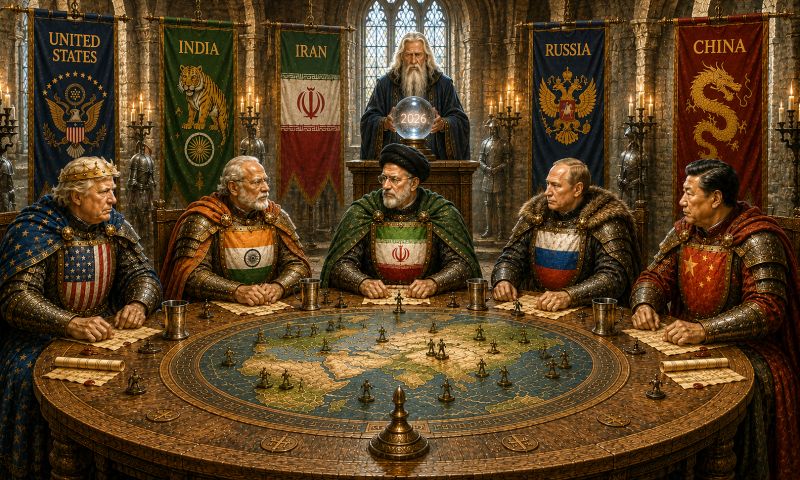
Today, the roundtable of major military powers consists of the following parties: the US, China, Russia, India, and Iran. Israel overestimated its military strength and lost. Without American help, its power is insignificant.
The successful implementation of this document into an agreement—which is also to be incorporated into a UN resolution (see paragraph 14)—depends on two factors: First, will Trump succeed in keeping the Israelis in check?—We are personally extremely skeptical about that. Second, will Trump have the strength of character to conduct and conclude the negotiations in accordance with the letter and spirit of the memorandum? The terms amount to little more than a declaration of surrender by the US, which makes it difficult for Trump to sell them as a victory.
Iran is once again a world power. The US suffered a defeat that can certainly be described as humiliating. In the US, however, the tide is turning with regard to Israel: More than 50% of Americans under the age of 50 support the Palestinians rather than the Israelis—the price of a war of annihilation and genocide. Israel has once again lost its aura of invincibility in Lebanon, following the wars of 1982 and 2006. Whether Trump can force Netanyahu to make peace remains to be seen in the near future.
«Iran Defeats the US — Reflections»