


For Europe, nothing learned will be expensive






This article was first published on GlobalBridge.com
The military situation in Ukraine is deteriorating rapidly, and last week Zelensky also came under pressure on the domestic front.
The pace of the Russian advance in eastern Ukraine has increased significantly in recent weeks, with the Russians now advancing up to 5 km a day and capturing even larger settlements at a speed that has not been seen before. Overall, the Russians have repelled Ukrainian counterattacks in at least three areas in recent days and have launched attacks of their own in several locations. It can be assumed that the Russians recognized the Ukrainians' preparations for attack and felt able to cope with their counterattacks without having to abandon their own attacks elsewhere. This means that in the coming days – which may be decisive – they will be in a position to increase military pressure on Ukraine. Several thousand Ukrainian troops are now surrounded in several locations. They face death or capture. Rescuing these Ukrainian troops in the encirclements is likely to be the Ukrainian government's most important negotiating goal at present, alongside gaining time.
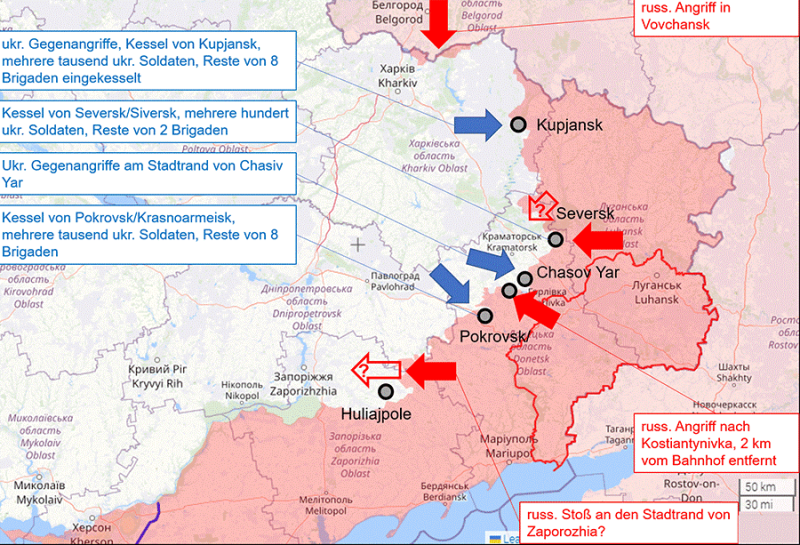
It is questionable whether the Russian side will agree to this, as this approach is familiar from spring 2015, when Ukrainian soldiers were surrounded in Debaltsevo in brigade strength and Chancellor Merkel and President Hollande rushed to Minsk to rescue these troops because they were needed to continue the war (3).
Little prospect of improvement
The war with long-range weapons, in which Ukraine has achieved a number of successes in the past, is also developing unfavorably. The Russians, on the other hand, have intensified their use of ballistic missiles and cut off the power supply to large parts of Ukraine. At the same time, the interception rate of Ukrainian air defenses has fallen and is currently reported to be only around 15 percent (4). In addition, the budget dispute in the US has led to an interruption in arms deliveries, which will continue to have an impact for some time even after they resume (5).
In the meantime, a strip of land up to 25 km wide has developed along the front line, in which Russian drones not only attack vehicles and large weapon systems almost at will, but also literally hunt down individual soldiers. One type of drone is apparently controlled by artificial intelligence and attacks detected weapon systems independently, while others are controlled by wire, rendering Ukrainian radio jamming powerless (6). However, Russian reports about the use of laser cannons that can shoot down drones should be treated with caution, as this requires clear atmospheric conditions, which are by no means guaranteed, especially in the cold season (7).
Numerous videos showing forced recruitment by the TZK recruitment agency suggest that the Ukrainian army is having difficulty recruiting new personnel. Even if some of these videos are undoubtedly fake, it cannot be assumed that they are all fake (8). The Ukrainian army's problem with mass desertion is credibly documented. The number of deserters is now said to have risen to 40,000 per month (9).
The fact that the Zelensky government has allowed seven age groups of young men to leave Ukraine, which came as a surprise to many, only makes sense if one assumes that it considers the war to be lost and wants to bring the younger generation to safety so that they will be available for reconstruction (10). However, if these young men have prospects for a new life in the West—perhaps even in Russia—they will not want to return to a devastated country where a still-corrupt elite only grants opportunities for advancement to those who have connections.
An oligarch returns
Domestically, Zelensky came under pressure when a major corruption scandal involving his inner circle came to light. His closest friend and business partner from his comedy days, Timur Myndich, is suspected of embezzling $100 million in defense funds (11). However, the Zelensky government had long been under suspicion of corruption. The timing of the press headlines is probably no coincidence, as his government team has recently found itself in a new situation: Last July, a British court ordered Ukrainian oligarchs Igor Kolomoisky and Timur Mindych to pay no less than $3 billion for defrauding PrivatBank (12). Kolomoisky was subsequently taken into custody in Ukraine, and Mindych is likely to face a similar fate. Another of Kolomoisky's business partners, Gennady Bogolyubov, was able to leave Ukraine last summer (13). Mindych probably did not commit this embezzlement alone; he may simply have been the cashier and organizer for others, and the hundred million may only be a fraction of what was actually siphoned off.
In 2019, Igor Kolomoisky supported Zelensky's election campaign in order to take revenge on Petro Poroshenko for nationalizing his PrivatBank in a questionable manner. For a while, ATMs belonging to PrivatBank would also ask customers if they were willing to donate to Ukrainian volunteer organizations, primarily the two private battalions that Kolomoisky had established (14). Zelensky's decision to remove his patron shortly after his election as president sparked relentless hatred. Kolomoisky has already announced that he will drive Zelensky around Ukraine in a cage. He just has a penchant for theatrical statements.
Smuggled out, not fled
Timur Mindych left Ukraine a few days ago under highly revealing circumstances: on November 10, at 2 a.m., a few hours before a house search was due to take place, he left Ukraine for Poland – apparently in a luxury taxi belonging to a businessman from Lviv (15). There is no question of him fleeing abroad with forged papers under cover of night and fog via a remote smuggler's path; no, he crossed the border at a guarded border crossing. Ukrainian border officials check men leaving the country very carefully, as the departure of men of military age must be prevented at all costs (16). In this context, speculation that the Ukrainian anti-corruption agency NABU was involved and instructed the border authorities accordingly is considered entirely plausible. There had been speculation for some time that NABU could also serve as a tool to remove virtually any unpopular politician from Ukrainian politics. But NABU's intervention alone was probably not enough, as there was still the border crossing to Poland, where checks are also very thorough. It can also be assumed that Mindych had more than the permitted 10,000 euros with him when he entered Poland. Overall, the impression is that a channel for Mindych's departure had been opened up. In concrete terms: he did not flee, but was smuggled out. This makes it clear that influential circles in Ukraine and in the West helped Mindych to leave the country.
A new front has opened up for Zelensky: now he is not only in danger from extreme nationalists who attack anyone who talks about a ceasefire or peace, but also from an oligarch who still has a lot of influence. For many people in Zelensky's circle, it is now a matter of sheer survival, because those around him know that he will have to make a few sacrifices so that his Western European partners do not abandon him. Energy Minister Svitlana Hrynchuk was certainly one of the potential scapegoats, resigning before she was dismissed by parliament (17). In this context, the intensification of the Russians' combined missile and drone campaign could play a role, because it showed that funds earmarked for the protection of critical infrastructure were also being embezzled (18). Regardless of how much bribe money Hrynchuk accepted, she was in danger of having to take the rap for the Russians literally cutting off Ukraine's electricity. She should have made the power supply system virtually weatherproof.
Western Europe without alternatives
A few days of bad publicity are unlikely to be enough to get Zelensky off the hook, because Mindych—and Kolomoisky too—have every interest in continuing the mudslinging campaign against Zelensky to the point where Western Europeans can no longer whitewash him.
These days, the West is paying the price for overlooking all the mistakes and weaknesses of the Ukrainian leadership, especially after the Russian attack in February 2022, for giving the likeable Zelensky unconditional support, for showing no self-criticism, and for never presenting its own peace plan. This, in turn, reveals the nature of EU foreign policy and its dilemma: it must continue to unconditionally support an administration whose corrupt character has become abundantly clear. Without corruption, it cannot continue the war against Russia; with corruption, it cannot win it.
On the other side of the Atlantic, US President Trump has already abandoned Zelensky and has been negotiating the terms of a peace treaty with Putin for some time—possibly during their summit meeting in Anchorage. Donald Trump can currently watch coldly as the elites in Ukraine tear each other apart, while the army in the east of the country is losing ground at an ever-increasing rate. He knows that Zelensky will eventually have to agree to the negotiated terms. One of Sun Tzu's strategies is to kill with someone else's knife. That is exactly what Trump is doing at the moment.
Ukraine's gray eminence, Andriy Yermak, is also in danger. As head of the presidential administration, he largely controlled the Ukrainian government's affairs and was not very popular. If Zelensky does not bow to Trump's peace terms, Trump may force him to fire Yermak as well. That would weaken Zelensky even further.
However, domestic political pressure also has its limits: there is unlikely to be a second “Maidan,” as some Russian observers are ranting about, because unarmed demonstrators would be mercilessly beaten down as traitors, if not by the police, then by nationalists. They would need the protection of the army, as would any Ukrainian politician who even wants to negotiate with Russia – the fate of Denis Kireev has not been forgotten (19). Zelensky can now only make peace if he remains abroad immediately after signing some kind of agreement.
New faces, new policies?
Speculation is already circulating about a possible successor to Zelensky, including former Chief of Staff Valerii Zaluzhnyi, who was transferred to the ambassadorial post in London after criticizing Zelensky's conduct of the war (20). However, it is questionable whether a change in the Ukrainian leadership will change anything at all. A new strongman in Kyiv still faces the fanaticism of radical nationalists who want to continue the war coute que coute, and the expectations of Western Europeans, who also demand a continuation of the war against Russia. Resources are limited in every respect and are shrinking daily. A man like Zaluzhnyi may base his warfare somewhat less on the needs of the information war and occasionally let military logic prevail, but even he cannot turn the tide. At best, he can limit the damage. For his part, Zelensky may now seek a distraction from the corruption scandal and launch spectacular military actions, no matter how pointless and costly they may be. And Zelensky knows what the West wants to hear: he can now pretend to negotiate and tearfully demand an improvement in the harsh peace terms.
Having taken office as the self-proclaimed honest leader who wanted to eliminate the oligarchy and bring about peace, Volodymyr Zelenskyy had little to show for himself in the first phase of his term before February 2022 because he was unable to deliver on his campaign promises (21). Both of his main tasks proved to be more complex than he and his government team had anticipated.
In the meantime, even a total fiasco of EU foreign policy cannot be ruled out in the medium term, which could result in a renversement des alliances. Former Ukrainian opposition politician and Putin confidant Viktor Medvechuk spoke out again a few days ago, referring to Ukraine changing sides (22). Western Europe cannot provide military assistance to Ukraine and will not be able to rebuild Ukraine within an acceptable timeframe. However, Western support, which ultimately proved ineffective, did not come free of charge. Rejecting Western claims for repayment and nationalizing the businesses already bought up by the West would be an opportunity, but one that can only be seized if Ukraine can be protected from its former allies. This is likely to be the background to Medvedchuk's statements. The Europeans have learned nothing since 2015 and may soon have to pay dearly for it.
Notes:
See „USA wollen Ukraine offenbar Unterstützung entziehen, wenn sie Abkommen nicht zustimmt“, at Der Spiegel, 21.11.2025, online at https://www.spiegel.de/ausland/ukraine-krieg-usa-wollen-offenbar-unterstuetzung-entziehen-wenn-kyjiw-abkommen-nicht-zustimmt-a-b8a9ecb4-b141-4aa7-8322-1e9745679997. See also „Ukraine soll bis Donnerstag dem US-Friedensplan zustimmen“, at Tiroler Tageszeitung, 21.11.2025, online at https://www.tt.com/artikel/30922150/ukraine-soll-bis-donnerstag-dem-us-friedensplan-zustimmen and „Militärexperte Markus Reisner: Der US-„Friedensplan“ zwingt Selenskyj in eine „sehr schmale Wahl“, Video at Welt, 21.11.2025, online at https://www.welt.de/videos/video6920a09418b978b3b9f549ca/militaerexperte-markus-reisner-der-us-friedensplan-zwingt-selenskyj-in-eine-sehr-schmale-wahl.html. See Alexander Dergay: Warum Merz von den Ukraine-Verhandlungen wusste – und dennoch untätig blieb, bei Berliner Zeitung, 21.11.2025, online at https://www.berliner-zeitung.de/politik-gesellschaft/panik-in-berlin-hat-merz-ukraine-verhandlungen-verpennt-li.10006798. Chancellor's Office Chief Thorsten Frei went so far as to say that it seemed “as if Putin could achieve war aims that he had not achieved on the battlefield.” That is precisely where Russia has achieved its war aims.
See also maps by Russian bloggers, which generally differ only by a few hundred meters from those on the Ukrainian website Live UA Map. As a Ukrainian product, Live UA Map tends to be rather conservative. See also the Pokrovsk pocket https://t.me/RVvoenkor/103932 and https://t.me/RVvoenkor/103943. About the one at Seversk/Siversk see https://t.me/RVvoenkor/103973.
This was expressed in the well-known interviews with former German Chancellor Angela Merkel and former French President François Hollande on the function of the Minsk agreements. The author witnessed the events surrounding the Debaltsevo pocket, which according to official Ukrainian rhetoric never existed, within the framework of the OSCE in Vienna. No mediation or evacuation of the troops took place, and the rebels continued fighting for several days after the ceasefire was signed in Minsk – most likely with Russia's tacit approval. See Alexander Osang: Ein Jahr mit Ex-Kanzlerin Merkel »Das Gefühl war ganz klar: Machtpolitisch bist du durch«, at: Der Spiegel 48/2022, 24.11.2022, online at https://www.spiegel.de/panorama/ein-jahr-mit-ex-kanzlerin-angela-merkel-das-gefuehl-war-ganz-klar-machtpolitisch-bist-du-durch-a-d9799382-909e-49c7-9255-a8aec106ce9c. See also Tina Hildebrandt, Giovanni di Lorenzo: Interview with Angela Merkel, at Zeit Online, 07.12.2022, online at https://www.zeit.de/2022/51/angela-merkel-russland-fluechtlingskrise-bundeskanzler. See „Ein schlechter Friede ist besser als ein guter Krieg“, at Global Bridge, 21.12.2022, online at https://globalbridge.ch/ein-schlechter-friede-ist-besser-als-ein-guter-krieg/.
See „Russland umgeht zunehmend ukrainische Luftabwehr“, at ntv Nachrichtenfernsehen, 10.11.2025, online at https://www.n-tv.de/incoming/Russland-umgeht-zunehmend-ukrainische-Luftabwehr-id30002545.html.
See Stef W. Kight: Scoop: Weapons sales to NATO allies stalled by government shutdown, at Axios, 09.11.2025, online at https://www.axios.com/2025/11/09/government-shutdown-arms-sales-nato-ukraine.
At least, that is what Russian sources are reporting. However, the author has also heard reports from Western sources about wires being left behind after such drones have been deployed. See reports by Russian war correspondents at https://t.me/RVvoenkor/103982.
See „Систему противодействия дронам LazerBuzz научили уничтожать БПЛА за 0,5 сек“, at TASS, 08.11.2025, online at https://tass.ru/armiya-i-opk/25568373.
TZK stands for ukrainian Територіальний центр комплектування та соціальної підтримки, Translated as Territorial Recruitment and Social Center. It replaced the previous recruitment system after 2021. See Yuri Lapaiev „New Reservists Law in Ukraine: A Forced Step Forward„, bei Jamestown.org, 05.10.2021, online unter https://jamestown.org/new-reservists-law-in-ukraine-a-forced-step-forward/. The legal basis is the law „Про внесення змін до деяких законодавчих актів України щодо удосконалення окремих питань виконання військового обов’язку та ведення військового обліку“ (On amendments to certain Ukrainian legal acts to improve certain issues of military service and military record keeping), on the website of the Ukrainian Parliament, online at https://zakon.rada.gov.ua/laws/show/1357-20#Text. Confirmation by the President: „Президент підписав закон щодо призову на військову службу резервістів у особливий період“ (The president signed a law on the mobilization of reservists for military service during a special period), April 21, 2021, on the Ukrainian president's website, online at https://www.president.gov.ua/news/prezident-pidpisav-zakon-shodo-prizovu-na-vijskovu-sluzhbu-r-68077. Volker Pabst, Dominic Nahr: Die Furcht vor dem Minibus: Der Ärger über rabiate Rekrutierungsmethoden wächst in der Ukraine, at Neue Zürcher Zeitung NZZ, 06.09.2025, online at https://www.nzz.ch/international/die-furcht-vor-dem-minibus-der-aerger-ueber-rabiate-rekrutierungsmethoden-waechst-in-der-ukraine-ld.1893897 and Tobias Dammers: Abschied vor dem Fronteinsatz, at Tagesschau, 02.07.2025, online at https://www.tagesschau.de/ausland/europa/ukraine-mobilisierung-zentrum-100.html. See also Isabel Coles, Ievgeniia Sivorka: Ukrainian Men Desperate to Escape War Are Drowning as They Flee, bei Wall Street Journal, 13.07.2024, online at https://www.wsj.com/world/europe/ukrainian-men-desperate-to-escape-war-are-drowning-as-they-flee-9cb6d99d.
See „Ukrainian Army Suffering 40,000+ Desertions Per Month: Frontlines Severely Undermanned“, at Military Watch Magazine, 06.11.2025, online at https://militarywatchmagazine.com/article/ukrainain-army-40000-desertions-month.
For more detailed information, see “Which men are allowed to travel abroad in 2025: list of categories and documents required for travel” at Visit Ukraine, online at https://visitukraine.today/de/blog/3154/which-men-are-eligible-to-travel-abroad-in-2025-and-what-documents-are-required?srsltid=AfmBOoqZ2DTVomT8II-bkAWIO3IsjLz4P4pL7CJvyG2lXAzk8M0lBT35#grenzubertrittsregeln-fur-manner-im-jahr-2025. See Anna Chaika: Warum immer mehr junge Ukrainer nach Deutschland kommen, at Deutsche Welle, 30.10.2025, online at https://www.dw.com/de/warum-immer-mehr-junge-ukrainer-nach-deutschland-kommen/a-74543966 and „Ukraine hebt Ausreiseverbot für junge Männer auf“, at Tagesschau, 27.08.2025, online at https://www.tagesschau.de/ausland/europa/ukraine-ausreiseverbot-100.html.
Stefan Schocher: Dollar-Bündel und Gold-Toiletten – Die gefährlichen Korruptionsvorwürfe gegen Selenskyjs Vertrauten, at Welt, 19.11.2025, online at https://www.welt.de/politik/ausland/plus691343a0043e62eea479f0dd/selenskyjs-vertraute-dollar-buendel-und-gold-toiletten-die-gefaehrlichen-korruptionsvorwuerfe.html. See Rafael Lutz: Flüchtet der «Kopf» des Kiewer Korruptionsskandals in die Schweiz? Timur Minditsch, einst Vertrauter von Ukraine-Präsident Selenskyj, will gemäss Berichten ein Haus in der Schweiz kaufen. Bundesbern schweigt, at Weltwoche, 19.11.2025, online at https://weltwoche.ch/daily/fluechtet-der-kopf-des-kiewer-korruptionsskandals-in-die-schweiz-timur-minditsch-einst-vertrauter-von-ukraine-praesident-selenskyj-will-berichten-zufolge-ein-haus-in-der-schweiz-kaufen/. Meanwhile, corruption in Ukraine is said to stop at nothing, not even the bodies of fallen soldiers. See Faustine Vincent: ‚We hunt for bodies‘: Ukraine funeral home ‚mafia‘ thrives on war, at Le Monde, 15.11.2025, online at https://www.lemonde.fr/en/international/article/2025/11/15/we-hunt-for-bodies-ukraine-funeral-home-mafia-thrives-on-war_6747483_4.html.
Years ago, PrivatBank was the heart of Igor Kolomoisky's empire, who was also rumored to control the port of Odessa and the airport in Dnipro/Dnepropetrovsk. In December 2016, it was nationalized by then-President Petro Poroshenko, likely for political reasons. To take revenge on Poroshenko, Kolomoisky supported the young candidate Volodymyr Zelensky in the presidential election campaign. See „Privatbank: Ukraine verstaatlicht größte Bank – Oligarch spricht von „feindlicher Übernahme“, at Der Spiegel Online, 19.12.2016, online at https://www.spiegel.de/wirtschaft/unternehmen/privatbank-igor-kolomoiskij-ukraine-verstaatlicht-groesste-bank-des-landes-a-1126473.html. Matthias Benz: Verstaatlichung der einflussreichen Privat Bank: Kiews grosse Säuberungsaktion, at Neue Zürcher Zeitung NZZ, 19.12.2016, online at https://www.nzz.ch/wirtschaft/wirtschaftspolitik/verstaatlichung-der-einflussreichen-privat-bank-kiews-grosse-saeuberungsaktion-ld.135710. „PrivatBank: Ukraine verstaatlicht größte Bank des Landes“, bei manager magazin.de, 19.12.2016, online at https://www.manager-magazin.de/unternehmen/banken/privatbank-ukraine-verstaatlicht-groesste-bank-des-landes-a-1126488.html. Matthias Benz: In Kiews umstrittenster Bank hält der Staat das Zepter, at Neue Zürcher Zeitung NZZ, 24.01.2017, online at https://www.nzz.ch/wirtschaft/verstaatlichung-der-privat-bank-kiews-umstrittenste-bank-ld.141399. For more information on the political background to nationalization, which is often ignored, see Tadeusz Iwański; Oligarchs making gains: the costly nationalisation of Ukraine’s PrivatBank, bei OSW Centre for Eastern Studies, Analyses, 21.12.2016, online at https://www.osw.waw.pl/en/publikacje/analyses/2016-12-21/oligarchs-making-gains-costly-nationalisation-ukraines-privatbank. „The government’s decision to take over the bank was preceded by informal negotiations between President Poroshenko and Ihor Kolomoyskyi which ended in a compromise„. During Petro Poroshenko's term in office, Kolomoisky served as governor of Dnipropetrovsk/Dnipro. During this time, he emerged as a serious political rival to Poroshenko.
See Volodymyr Verbianyi: Former Privatbank Co-Owner Bogolyubov Flees Ukraine, Report Says, at Bloomberg News, 08.07.2024, online at https://news.bloomberglaw.com/white-collar-and-criminal-law/former-privatbank-co-owner-bogolyubov-flees-ukraine-report-says. „Ukrainian billionaires lost a UK court case over a $1.9B bank fraud“ at Ukraine Business News, 31.07.2025, online at https://ubn.news/ukrainian-billionaires-lost-a-uk-court-case-over-a-1-9b-bank-fraud/#:~:text=Finance-,Ukrainian%20billionaires%20lost%20a%20UK%20court,a%20$1.9B%20bank%20fraud.&text=The%20case%20involves%20Ukrainian%20oligarchs,controls%20over%20anti%2Dcorruption%20agencies. „$2 billion was stolen through a complex loan recycling scheme to move the money through offshore companies“, beiComsure Compliance Limited, 14.08.2025, online at https://www.comsuregroup.com/news/2-billion-was-stolen-through-a-complex-loan-recycling-scheme-to-move-the-money-through-offshore-companies/. The author was able to observe corruption in various Ukrainian governments firsthand while working for the OSCE between 2014 and 2020. There should also be no illusions about the whereabouts of numerous arms deliveries. See “How weapons delivered to Ukraine end up in the hands of criminal organizations,” Global Bridge, November 10, 2025, online at https://globalbridge.ch/so-landen-die-an-die-ukraine-gelieferten-waffen-in-kriminellen-organisationen/.
They were called Dnipro 1 and Dnipro 2 and were a kind of military police battalion. In 2014, Igor Kolomoisky was still being hailed in the Western press as a “secret weapon” against Russia. See Alan Cullison: Ukraine’s Secret Weapon: Feisty Oligarch Ihor Kolomoisky (Ukrainische Geheimwaffe: Der Resolute Oligarch Ihor Kolomojsky), at Wall Street Journal, 27.06.2014, online at https://www.wsj.com/articles/ukraines-secret-weapon-feisty-oligarch-ihor-kolomoisky-1403886665. See Joachim Bartz, Alisa Bauchina and Simon Erhardt: Krise in der Ukraine – Oligarchen finanzieren Bataillone, bei Frontal21, ZDF, transcript of the talk, 05.08.2014, online at https://web.archive.org/web/20140815001344/http://www.zdf.de/ZDF/zdfportal/blob/34378272/1/data.pdf.
See Елена Капник: Миндич уехал из Украины за несколько часов до обысков: стало известно, кто вывез бизнесмена, at ТСН, 15.11.25, online at https://tsn.ua/ru/politika/mindich-uehal-iz-ukrainy-za-neskolko-chasov-do-obyskov-stalo-izvestno-kto-vyvez-biznesmena-2957546.html, in Russian. See Олег Терещенко: Бизнесмен с орбиты Коломойского: что известно о Тимуре Миндиче и как он мог уехать с страны (A businessman from Kolomoisky's circle: What is known about Timur Mindych and how was he able to leave the country?), at 24Канал, 10.11.2025, online at https://24tv.ua/ru/timur-mindich-biografija-sbezhal-iz-ukrainy-iz-za-obyska-nabu_n2949886#1762774714667, in Russian.
The author has received reports that bribes of at least €12,000 were paid for conscripts to leave Ukraine. According to other reports, there are entire networks in Ukraine that procure the necessary papers for up to €30,000, enabling conscripts to leave the country. However, Mindych may have invoked the fact that, as the father of more than three children, he is not legally required to perform military service. It is not known whether any border checks were carried out at all.
See Andrii Muravskyi: Ukrainian parliament dismisses Svitlana Hrynchuk as energy minister, at Ukrainska Pravda, 19.11.2025, online at https://www.pravda.com.ua/eng/news/2025/11/19/8008022/. See „Ukraine’s energy minister resigns following corruption probe in sector„, at Reuters, 12.11.2025, online at https://www.reuters.com/business/energy/ukraines-energy-minister-resigns-following-corruption-probe-sector-2025-11-12/. ASvitlana Hrynchuk is reportedly still in Ukraine. See „Former Ukrainian Ministers Deny Leaving Amid Energy Corruption Probe„, at Mezha, 19.11.2025, online at https://mezha.net/eng/bukvy/former-ukrainian-ministers-deny-leaving-amid-energy-corruption-probe/.
See „Korruptionsskandal erschüttert Kiews Machtzirkel: Selenskyjs Weggefährte auf der Flucht“, at Kettner Edelmetalle, 11.11.2025, online at https://www.kettner-edelmetalle.ch/news/korruptionsskandal-erschuttert-kiews-machtzirkel-selenskyjs-weggefahrte-auf-der-flucht-11-11-2025.
On March 2, 2022, Denis Kireev, a member of the Ukrainian delegation that had been negotiating with the Russian side in Gomel, Belarus, was dragged out of his car in central Kyiv by employees of the Ukrainian Security Service (SBU). His body was later found a few streets away. The SBU later claimed that Kireev was a traitor and was shot when he resisted arrest. Kireev allegedly worked undercover for the rival Ukrainian military intelligence service GUR, which in turn celebrated him as a hero. See “Ukrainian intelligence kills alleged top spy,” at ntv Nachrichtenfernsehen, 06.03.2022, online at https://www.n-tv.de/politik/Ukrainischer-Geheimdienst-toetet-angeblichen-Top-Spion-article23176488.html. See „Ukrainischer Geheimdienst erschiesst Unterhändler – angeblicher Spion“, bei Watson, 07.03.2022, online at https://www.watson.ch/international/ukraine/931396897-ukrainischer-geheimdienst-erschiesst-unterhaendler. „Einer der ukrainischen Unterhändler ist tot“, at Welt, 07.03.2022, online at https://www.welt.de/politik/ausland/article237354045/Ukraine-Russland-Verhandlungen-Einer-der-ukrainischen-Unterhaendler-ist-tot.html. See also Toi Staff: Reports claim Ukraine negotiator shot for treason; officials say he died in intel op“, at Times of Israel, 06.03.2022, at https://www.timesofisrael.com/ukraine-reports-claim-negotiator-shot-for-treason-officials-say-he-died-in-intel-op/. Hayley Taylor: Ukrainian official dead after accusations of ‚treason‘ and working for Russia, at 7NEWS, 07.03.2022, online at https://7news.com.au/news/ukraine/competing-claims-emerge-after-ukraine-official-denis-kireev-accused-of-treason-shot-dead-in-street-c-5958770. Ольга Денисяка: Вбитий Денис Кірєєв був розвідником на спецзавданні, – ГУР Міноборони (Olga Denisyaka: The murdered Denis Kireev was a spy on a special mission, – GUR of the Ministry of Defense), at ЛЬВІВСЬКИЙ ПОРТАЛ, 06.03.2022, online at https://portal.lviv.ua/news/2022/03/06/vbytyj-denys-kirieiev-buv-rozvidnykom-na-spetszavdanni-hur-minoborony, in Ukrainian.
See „Ukraine’s former commander-in-chief appointed ambassador to UK„, at Al Jazeera, 07.03.2024, online at https://www.aljazeera.com/news/2024/3/7/ukraines-former-commander-in-chief-appointed-ambassador-to-uk. See „Ukraine’s ex-army chief Zaluzhny appointed ambassador to UK„, at Le Monde 07.03.2024, online at https://www.lemonde.fr/en/international/article/2024/03/07/ukraine-s-ex-army-chief-zaluzhny-appointed-ambassador-to-uk_6595976_4.html. Zaluzhny was considered a possible new president of Ukraine and is said to have recently received a visit from Yermak: „Jermak went to London to see Zaluzhny“, bei EurAsia daily, 19.11.2025, online at https://eadaily.com/en/news/2025/11/19/yermak-went-to-london-to-see-zaluzhny. Adrian Karatnycky: Zelenskyy’s lame-duck presidency, bei Politico, 20.11.2025, online at https://www.politico.eu/article/volodymyr-zelenskyy-ukraine-corruption-scandal/. However, the Russian news agency TASS reports, citing the Washington Post, that no such visit took place: „Zaluzhny declined meeting with Jermak in London — Washington Post“, at TASS, 20.11.2025, online at https://tass.com/world/2046461.
See Oleg Tankovsky: From populism to pragmatism: The socio-political legacy of Zelensky’s leadership in Ukraine’s economic reforms, at AKJournals, Volume 47: Issue 3, 03.09.2025, online at https://akjournals.com/view/journals/204/47/3/article-p259.xml#:~:text=To%20effectively%20counter%20oligarchic%20influence,previous%20administrations%20(Minakov%202021). He reports on the failure of Zelensky's populist policies: „Although there were positive improvements in the economy and relatively successful reforms (such as land reform), overall, Zelensky failed to deliver on his campaign promises and did not make breakthroughs with his pre-war administration.“ Vgl. auch Ian Bond: Will the ‚Servant of the People‘ be the master of Ukraine? bei Centre for European Reform, 31.07.2019, online at https://www.cer.eu/insights/will-servant-people-be-master-ukraine: „Voters may have thought that they were voting against corruption and for a new broom; that does not guarantee that they will get what they hoped for.“
See „Медведчук назвал воссоединение Украины с Россией вариантом нормального будущего“ (Medvedchuk described Ukraine's reunification with Russia as a normal option for the future), at TASS, 15.11.2025, online at https://tass.ru/mezhdunarodnaya-panorama/25636633, in Russian language. This caused great consternation: „Настоящие цели Кремля и проект по русификации Украины: как Москва использовала новое интервью Медведчука — ISW“ at NV, 17.11.2025, online at https://nv.ua/world/countries/kreml-stremitsya-poglotit-vsyu-ukrainu-v-isw-dali-ocenku-intervyu-viktora-medvedchuka-50561224.html, in Russian language.
«For Europe, nothing learned will be expensive»