


“The next war with the US will be short and devastating,” predicts Iranian strategist


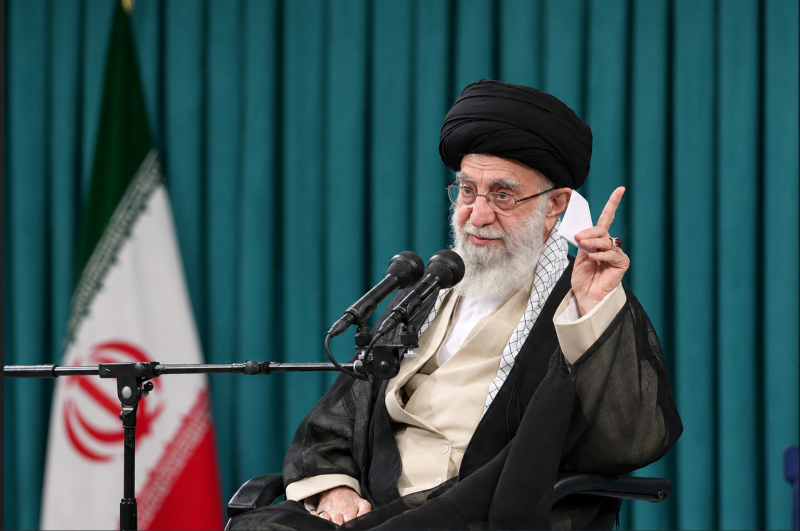
In Tehran and in Washington, the expectation is the same: a new round of the United States’ and Israel’s war on Iran could begin right after the US midterm elections on November 3. On Saturday (the 31st), the Supreme Leader, Mojtaba Khamenei, met for the first time with the high command of the Armed Forces and ordered that any threat receive a response that is “immediate, effective and without geographical limitation,” according to the Tehran Times. In Washington, the establishment itself doubts the plan. The Financial Times spoke with former US military chiefs who believe none of the strike options would bring down the Iranian government, and the Congressional Research Service already counts 81 US aircraft lost or damaged and 21 service members killed.
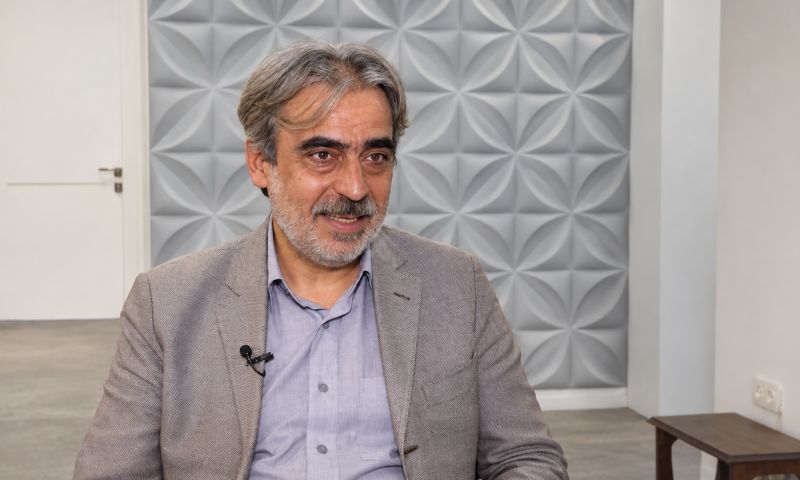
It was in this climate that Seyed Mostafa Khoshcheshm, a senior analyst and Iranian strategist, received me at the headquarters of Fars Media, in Tehran, in mid-October. We talked for almost two hours, over tea and Iranian sweets, and he did not hold back on predictions. “It will be a shorter war than the last one, from the side of the United States, but way stronger,” he said. “This time, Iran believes there shouldn’t be any limits, and it will try to inflict as much cost on the United States as possible.” Three weeks later, Khamenei’s order sounded like an echo of that conversation.
For Khoshcheshm, Donald Trump has lost the weapon he always used. “He has always beaten his opponents through escalation, the madman practice. In this round, he has lost this card. Now it is Iran that is embracing escalation in order to put an end to everything.” The Iranian response, he warns, would take the war to the Indian Ocean and to “countries that they would never imagine.” And Iran holds in its hands what he calls a weapon “millions of times stronger than the atomic bomb”: “With an atomic bomb, you could hit a country once. With the Strait of Hormuz, you could leave an impact on the entire planet, repeatedly.”
The war, for him, is part of something bigger. The 2020s would be the decade of a “painful birth,” that of the transition of power from the West to the East, which the US-led empire “doesn’t let go so easily.” No superpower will come out of it, he predicts, but four big powers — China, India, Russia and Iran — and Washington, defeated in Iran, will bet on hybrid warfare against China, including biological warfare.
The strongest explanation for Iran’s confidence, however, he looks for not in arsenals but in faith. He recounts that in his neighborhood, in eastern Tehran, residents standing in front of their bombed houses said: “This is nothing compared to what Hussein went through.” A grandson of the Prophet Muhammad, Imam Hussein was killed in 680 at Karbala, in present-day Iraq, along with a handful of companions, facing a much larger army, and his martyrdom is the heart of Shia identity. For Khoshcheshm, this is the key the West has never understood. The interview follows.
A third round, and the last
Many people here in Tehran expect an attack before the US elections on November 3, and you have predicted a third war, much more ravaging, that would reach beyond the region. What is the calculation of Israel and the United States? And how should Iran react?
Donald Trump is not always sober enough to think strategically, so he might attack even before the election, but it’s much more probable that he will do it after, especially if he loses. Most probably, he will lose the House. If that happens, since the current representatives will keep sitting for two more months, most probably he will wage the attack somewhere in late November or early December.
I believe it will be a shorter war than the last one, from the side of the United States, but way stronger. Whatever kind of attack it is, full-fledged war, targeted assassinations or pinpoint attacks, the Iranian response will be full-fledged war that will stretch well beyond the region, beyond Yemen, beyond Bab al-Mandab [the strait between Yemen and the Horn of Africa, gateway to the Red Sea] and even beyond the Axis of Resistance [the regional alliance led by Iran, with Lebanon’s Hezbollah, Yemen’s Ansarullah, Iraqi militias and Palestinian groups]. Iran is very much resolved to put an end to this war. There will be a third round, maybe in the next one or two months, and this will be the last. One side will win the upper hand and finish off everything.
What phase is the war in now?
We have had several phases. The first was decapitation, the initial attack by the United States, which failed. Then came the phase of the second strike, the Iranian response. Then came the Islamabad Accord [the April 2026 ceasefire, negotiated through Pakistani mediation], which opened the third phase, that of economic and political endurance on both sides. Now we have just started the fourth: the two sides are preparing for the last round, a very bloody war.
Each side wants to decide three things. The first is when the war starts. The second is where it will be fought: the United States wants to limit it to Iran, and Iran wants to extend it. The third is at what cost.
When you say “beyond the region,” could that be, for example, the US base at Diego Garcia [in the Chagos Archipelago, in the Indian Ocean], or even Europe?
I cannot say that, but I can tell you that they will be surprised to see Iran in places where it has never been. They will be forced to fight Iran in the Indian Ocean, in seas far away, in countries that they would never imagine. Iran will make maximum use of whatever it has, including its latest generations of missiles and drones, which it has not yet used widely, only in tests.
And then there is the cost. In the previous wars, the 12-day war [June 2025] and the 40-day war [February to April 2026], Iran intended to control the escalation, with responses not painful enough to spark a wider war. This time, Iran believes there shouldn’t be any limits, and it will try to inflict as much cost on the United States as possible.
The United States knows that. It cannot tolerate, for example, the full closure of Bab al-Mandab, which today is closed only to Saudi ships. If they bring in the British and the French, who have promised to take part in defensive operations, I believe they will not come to Hormuz, but they will be stationed around Bab al-Mandab in order to defend Saudi energy. If they do that, Bab al-Mandab will be shut off by the Yemenis themselves, who are more capable today than ever, after the recent victories they earned.
Iran has warned that this time its responses will be disproportionate. When you hit a tanker, you take great caution not to kill the sailors, because your target is just pushing the ship off course. In a full-fledged war, you cannot guarantee anything. There will be much blood.
Donald Trump has always beaten his opponents through escalation, the madman practice. In this round, he has lost this card. Now it is Iran that is embracing escalation in order to put an end to everything. Up until a few weeks ago, whenever Iran attacked ships that wanted to cross the strait illegally, there was a response by the United States. For several weeks now Iran has been punishing tankers, and the United States does not respond. That shows they don’t want an escalation into unknown territory. It will also be a shorter war because the United States doesn’t have more ammunition. But it will be devastating.
Enduring the siege
One of the layers of the Iranian strategy is economic warfare, which hits the United States, the West and also Asian allies, like Japan and South Korea. But Iran is also suffering: oil exports have fallen, there is inflation. In the military field, even US think tanks say Iran has the upper hand. And in the economic field, how much can Iran take in the next three or four months?
It depends on whose viewpoint. From the viewpoint of Scott Bessent [the US Treasury Secretary], we were about to collapse yesterday, and we didn’t. Iran has been under sanctions for four or five decades and has learned how to bypass them, sometimes quietly, sometimes making noise on purpose.
Iran is a vast country, with a population of 80 to 90 million, and it shares borders with 15 countries, nine of them on land. You cannot lay a real siege on a country like that. Ever since the siege began, after the Islamabad Accord, Iran has taken many initiatives to activate its land borders, with Pakistan, Afghanistan, Azerbaijan, Turkmenistan, Russia, Turkey and Iraq. Rail and road transportation has evolved, and the maximum use of that potential has not yet been made.
Including the railway that comes straight from China.
Exactly. This doesn’t mean that there is no pain. Sanctions inflict pain, but Iranians have learned how to endure it and how to go along with their normal life. Just take a look at the streets of Tehran: people are buying, they’re going to shops. Foreign dignitaries, Europeans, come here and are surprised. A German told our officials that he didn’t understand how normal life went on, because the image they have of a war-stricken country is that of southern Lebanon, Syria, Gaza.

Inflation is high, war has its costs, there is no denying that. But this war has elevated the threshold of tolerance of the Iranian people and helped them put away their differences. Under a foreign threat, some nations split apart and fall. Others rally around the flag, as people do here every evening. On the nights that we fire missiles, the streets are way more crowded.
Iranians have 7,000 years of civilization and 2,500 years of empire. They have been through the Mongol invasion, the Arab invasion and occupation, and they know how to endure and how to strike back. Iran has multiple cards it has not yet played, while the United States has played out all of its cards: cyberattacks, assassinations, bombings, assassinating generals, leaders and scientists, bombing cities and even schools, like the one in Minab [a city in Hormozgan province, in southern Iran]. That’s why Iranians believe that a third round would be good for them: it would end the story, and they would be the party to win. This belief helps people endure the economic hardship.
From shock to revenge
I was here last November, and I notice that people are much more confident now. At that time, they had survived the 12-day war, but the economy was not good, and in December there were protests, initially legitimate, recognized by the Leader himself [Ayatollah Ali Khamenei, Supreme Leader from 1989 until he was killed in the February 2026 attack], and then captured by the West and the Zionists. The situation today is more complicated, but people say: “We will survive, the leaders know what to do.” Why?
Because they have experienced two consecutive wars. In the first one they lost their top generals, and in the second, the 40-day war, they lost their Leader. Sometimes losing a leader makes a people collapse and surrender, and that was exactly Donald Trump’s plan. Other times, it motivates people to seek revenge, and that’s exactly what happened on day two and day three. The martyrdom of the Leader was a shock, but instead of being passive, Iranians came out into the streets for revenge, demanding his blood, and they are still doing so.
This is rooted in Iranian ideology. If you count only on politics and economy, as you would with any other country, Iran should have fallen between day one and day five of last year’s 12-day war, or of this year’s 40-day war. It did not fall because of two branches of ideology. The first is Shiite Islam and the story of Imam Hussein [grandson of the Prophet Muhammad and the third Shia imam] at Karbala [the battle of 680, in present-day Iraq, in which Hussein and his companions were killed by the caliph’s army]. The second is Iranian identity: just look at the Iranian myths and you will realize that many Iranians were already like this 2,000 years ago, before Islam. That’s why they embraced Shiite Islam and Imam Hussein so warmly: because it’s the same.
Ariobarzanes, a hero of defeat
What are these myths, and how do they meet Shia culture and the story of Hussein?
The story of Imam Hussein has a stronger role in Iran’s resistance, of course. But before it, Iranian civilization had ups and downs, and there were myths that Iranians adored. One of them is Ariobarzanes (Ariobarzan in Persian; the name used in English comes from the Greek).
Iranians were proud of their victories, of their empire, of having had half of the world. But why Ariobarzanes? Because he is a hero at the time of defeat. When Alexander [the Great, king of Macedon, who conquered the Persian Empire between 334 and 330 BC] engaged the Achaemenid army [of the dynasty founded by Cyrus the Great] and Iranians lost the war, there was one commander who had lost no battle. He was ordered to retreat because the whole army had been defeated. The others went to central Iran, to Fars province. But he did not: he went west.
To invade Iran, Alexander needed to go through the Zagros Mountains, through a very narrow valley surrounded by high mountains, which is still there, in today’s Kohgiluyeh and Boyer-Ahmad province. Ariobarzanes had, I believe, about 1,000 soldiers. He went up the mountains and waited for an army tens of thousands strong, and he stopped it. He was expected to hold out for one day, two days, a week; he held out for a month, until he ran out of spears, swords, stones, fire, any kind of weapon. Alexander eventually found a way up to the top. Ariobarzanes and his men could have escaped to Persepolis [the ceremonial capital of the empire], but they didn’t. With the tens of men he was left with, unarmed, they charged that army with their bare hands, hand to hand. Four or five of them were killed to kill one of Alexander’s soldiers. This is courage.
It sounds like Hussein.
Yes. When I say that Iranian identity helped Iranians embrace Shiite Islam and Imam Hussein, it’s not something that happened overnight. It has roots in history. Iranians are proud of what they have conquered, but they are more proud of Ariobarzanes. Imam Hussein’s story is way bigger, with many more implications: they were fewer in number and were slaughtered by Yazid’s army [Yazid was the second Umayyad caliph].
“This is nothing compared to what Hussein went through”
This admiration exists among all Iranians, even those who are not Shiites. We have a large Sunni population that admires Imam Hussein. I personally know Christians, Armenians and other minorities who come out into the streets during Muharram, the annual mourning for Hussein. They stand on the sidewalks, cry and give charity in his name. They say: “We don’t want to be Muslims, we believe in our own religion, but we love Hussein and Abbas, his half-brother. To us, he is like Jesus Christ.”
We saw this in this war. In my neighborhood, in eastern Tehran, the Americans seem to have a daily quota: they bombed it several times a day, in both wars, killing many people. In the very first attacks, documentary makers rushed to the scene and, to my surprise, they found homeowners standing outside their houses saying: “Thank God we are safe and sound. This is nothing compared to what Hussein went through. We will build it again, and we stay here until we rebuild, for the sake of Imam Hussein.” For years, in the annual ceremonies, they have been saying: “I wish I had been there on that day of Karbala, 14 centuries ago.” Now they see themselves in Karbala, with a chance to do that.
That’s exactly the difference. That’s why Donald Trump could kidnap Maduro [Venezuelan President Nicolás Maduro, captured by US forces in January 2026] in Venezuela and change everything at no cost, and here he failed. He imagined that he could do the same. I’ve been saying this to the international media for the past two decades: you think you have Orientalists, you think you know the story of Imam Hussein by heart, but you fail to break the Iranian resistance exactly because of Imam Hussein. If you understand that, you will understand why you have failed again and again. You cannot go ahead with pressure, be it sanctions or wars. Unless you kill us all, Iranians will not submit. They have learned from thousands of years of invasions: whenever they surrendered, nothing was left of Iran, they lost territory, they were slaughtered.
The bomb, from taboo to demand
Are people also asking for a tougher response?
Many are complaining: “Why don’t we show them what we’ve got? Let’s put an end to the Israeli and American atrocities.” And they are demanding the atomic bomb more than ever.
What percentage of the population supports the atomic bomb today?
I’m not sure, I would need to see reliable polls, not one or two. But this discourse is now prevalent well beyond the revolutionary portion of society. Others say: “Whether we liked it or not, we have spent a lot and paid a lot for this peaceful nuclear program, and they are not going to let it go on. Apparently, they have left us no other choice but building the bomb.” Nobody dares to attack North Korea. Trump himself said he has to say “yes, sir” to the Korean leader, and that if Iran had the bomb, he would have to treat it completely differently.
Iran never wanted the atomic bomb. There is a fatwa [a religious decree by Ali Khamenei forbidding nuclear weapons], and the position of the Iranian elites was: we don’t need it. Atomic bombs belong to the 20th century. In the 21st, they go for formats of hybrid warfare that bring you no responsibility, like cyberattacks, like biological wars. We don’t want to do that, but in any case, the era of nuclear deterrence is gone: we attacked the United States, a nuclear-armed state, and we attacked Israel, a nuclear-armed regime. The nuclear deterrence theory should be revised exactly because of what Iran has been doing to them.
But nuclear deterrence can still bring you some level of security when it comes to nuclear attacks. And that is what Iranians are now saying, even the elites and the educated class: “We didn’t want it, but we are left with no other option. If we are to put an end to everything, we need the bomb.” This is the output of the United States’ war on Iran. The discourse has shifted completely: two years ago, a major portion of society, and even of the revolutionary camp itself, would say they didn’t want the bomb. Now it’s completely the opposite.
Rallying around the flag
When you speak of the revolutionary portion of society, how many people are we talking about?
There are no reliable numbers. But one thing is for sure: at the nightly gatherings, especially in the first one or two months, you could tell from their appearance that all classes of society had taken to the streets. There have been many interviews, pictures and videos showing that even those who do not follow the Islamic dress code were there. Why? Because they are defending the country. They believe that the United States and Israel are not just the enemies of the Islamic Republic, they are enemies of Iran.
This is happening outside the country as well, in the diaspora. Many have been coming back ever since the 12-day war ended. And another part of the people has been, so to speak, enlightened by the attack. Before, they blamed the Islamic Republic for a number of reasons, under the impact of the opposition’s media empire, of channels like Iran International and BBC Persian [Persian-language TV channels based in London], which were conducting psychological operations.
There are many Farsi-language channels abroad, aren’t there?
Between 200 and 400, depending on the count. It’s a world record, a war record. These channels were saying, for example, that the Supreme Leader was hiding deep under the earth, 60 or 100 meters down. They attributed to him whatever Netanyahu was doing, or they said he had escaped. When he was martyred in his office, many people changed. These people were saying in front of the cameras: “We had heard that he was hiding, and now we are moved to hear that he was at his office and was martyred.” I call it an age of enlightenment.
There were rifts before, but now people tolerate the gaps and rally around the same flag. This has extended the realm of those who believe. The martyred Leader always said: “No matter whether you believe in the system or not, take part in the elections.” His martyrdom opened up this path: many have reconciled with the system. One sign of this is the deep rifts in the opposition led by the monarchists of Reza Pahlavi [son of the last Shah, who lives in the US]. Now they are fighting each other, even the monarchists among themselves. Well-known opponents, who took refuge in Europe and the United States decades ago, have said publicly that they want to come back to the country. They have come to realize that what they had been saying for five decades, that the Islamic Republic was going to be gone soon, was a myth they had invented themselves.
This was my third war. The first was against Saddam Hussein [the Iran-Iraq War, 1980 to 1988], and before that there was the revolution. The reactions are all the same. The generation of five decades ago reacted like this in the revolution and in the war with Saddam. Today’s youth were born 20 or 30 years ago, they have been modernized, but they behave exactly the same way.
So the last time the country had this unity was at the end of the 1980s, during the war?
Exactly. Look at domestic politics. There have always been two major factions in Iran, the reformists and the revolutionaries, and whoever was out of power would go to any extreme to bring down whoever was in power. It was a bipolar politics. But in the past year and a half, two years, you don’t see that. I very frequently say to my friends that Pezeshkian [Masoud Pezeshkian, president of Iran since 2024] is the luckiest president in the world, because nobody is blaming him for anything. He is a reformist and heads a reformist government, but even the revolutionaries don’t criticize him, even when they should. Everyone, including the media, says: let’s help him in any way possible. This is the latest product of the war and of US policies.
Each time Iranians say, “We will not cross our lines, the United States should agree to our terms, but we are for negotiations,” many criticize it, saying it is not the right discourse. But it produces something important: it gives Iranians from all walks of life a transparent image that everything was done to prevent the war. There is no way left except resistance. Otherwise, they will tear you and your country apart.
The painful birth of a new order
And Iran surprised the whole world with its military capacity to challenge the US and Israel at the same time, right?
Even we surprised ourselves. I follow military affairs, and I always thought that one day there would be a US war against China, and that the Chinese would show the world that the US was no longer so powerful. But I never imagined that it would be us Iranians who would do it.
You must have read Robert Kagan’s article in The Atlantic. Kagan, one of the leading neoconservative thinkers, wrote that the United States has suffered the worst strategic defeat in its history, called it checkmate, and said that Iran will emerge as the leading regional power. The third round is still to come, but what is likely to happen? What will Iran look like as a regional power, and what about its relationship with the Arab countries and the future of the United States in the region? And can Iran become a global power?
The world is on a transition of power from Western civilization to the East. For more than a decade, even American and European intellectuals have been saying that. To me, the decade from 2020 to 2030 is the time of this painful birth, and there will be increasing wars. Whoever holds the power, the Western empire led by the US, doesn’t let it go so easily. There will be wars and frictions, especially with the emerging powers, Russia, China and Iran. That’s why I believe we will witness some type of war against China, in 2027 or 2028.
And the Chinese are already saying that. They are preparing.
It won’t be as simple as that. If we come to agree that the United States will be defeated by Iran, they won’t be able at all to stand against China. They will go more for hybrid warfare, and this hybrid warfare will be completely different. We have the experience. I believe they will go for biological warfare, for different types of warfare alongside the military. Nuclear even. Anyway, they are showing resistance, like the Europeans against Russia.
After Iran, it will be China. I believe that in 2027 we will see the spread of viruses like COVID. The United States is not going to let go of power so easily. Trump may like Putin, but there is a deep state, which he doesn’t control. They are not going to let Putin and Russia win everything so easily. If they cannot do it through the military, they will do it through biological weapons. In China, the same. In Iran itself, the same. I know the Americans, their way of hybrid warfare, the intentions of the deep state and its behavior. The pattern is telling me that once they feel hopeless and defeated, they will release asymmetric warfare, the new ways of warfare, including this one, and cyberattacks will be augmented, not like now.
Even in cyber warfare it is like that. Before 2010, before Stuxnet [a computer virus attributed to the United States and Israel that sabotaged centrifuges of the Iranian nuclear program], the world was in a security-threat environment, with the stealing of industrial information and so on. Stuxnet changed this into cyber warfare between states. Ever since, all the main players have been increasing this capability and investing in it in unknown ways. AI is the new version of everything: cyber warfare, hybrid warfare, in different aspects.
If the world were not on a transition of power, with wars like this, the future world, to me, would no longer be the world of oil or fossil fuels. It would be the world of AI, with two categories, the lords and the slaves: those who own the software and hardware of AI, and the rest. One of the main battles between the West and the East now is over who will be the lord of AI in the future. Camps are being established. Saudi Arabia and the UAE, among the Persian Gulf Arab countries, have decided to join the US camp.
Qatar is also putting a lot of money into this.
A lot of money. And one of the things these Persian Gulf Arab countries have already lost is AI, because they relied too much on the United States. So far we have been speaking of two wars; the third one has not happened yet. The data centers will be the next, in the third one. That is one of the things they and Israel will lose. This is highly important.
If Biden were in office, the United States would be harsher on Putin.
Definitely. With Donald Trump it’s different, he plays too much in Putin’s court.
But couldn’t it be a strategic calculation? People from Trump’s circle were saying, even before the election, that the war against Russia was a mistake, because Russia is not the main adversary. He would be stopping that war in order to focus on China.
There is no denying that Iran is the top ideological enemy of the United States, and China is the economic enemy. But you cannot control everything: sometimes wars just break out. Or Russia understands, for example, that an imminent threat is coming. Maybe they did the calculations: if we do this, there won’t be a war against us; let’s undermine them now, before it’s too late. Because they would not go into a full-fledged war, as in the Crimea story.
After a decade of wars, there won’t be any superpower left: everyone’s capability will be worn off. But the power will be in the East. The new world order that will appear on the horizon, probably after 2030 or 2032, will be set by regional and international coalitions like BRICS and the Shanghai Cooperation Organization, which are equal to the West’s G7, NATO and OECD. The Munich Security Conference [an annual forum on international security, in Germany] once stood at center stage; now its rival, the St. Petersburg one, is earning importance and prestige. I was at the last one. There won’t be any superpowers, but these groupings will set the new world order.
The majority of thinkers believe there will be four big powers, though not superpowers: China, India, Russia and Iran. If they stand with each other, they can start something new in the world. If they fight each other, there will be a mishmash throughout the world.
Four powers and seven chokepoints
It’s interesting to think that all four are members of BRICS and the Shanghai Organization.
Yes. You can see major differences between China and India, but they both go to BRICS, because they have come to realize this. Now, why should Iran be among them? Economically, it’s no match for the other three. Militarily, China and especially Russia are far ahead. The reason is what makes Iran unique: the Axis of Resistance, on land and at sea.
On land, it is a market of 400 to 500 million people in the most strategic region of the world, the heartland of the world: West Asia, with its energy reserves, minerals, old civilizations, religions, linking north to south and east to west. In the next 10 or 20 years, whoever wants to do business or to impose a new world or regional order will need to work with Iran, because of this Axis of Resistance that has survived the test of time.
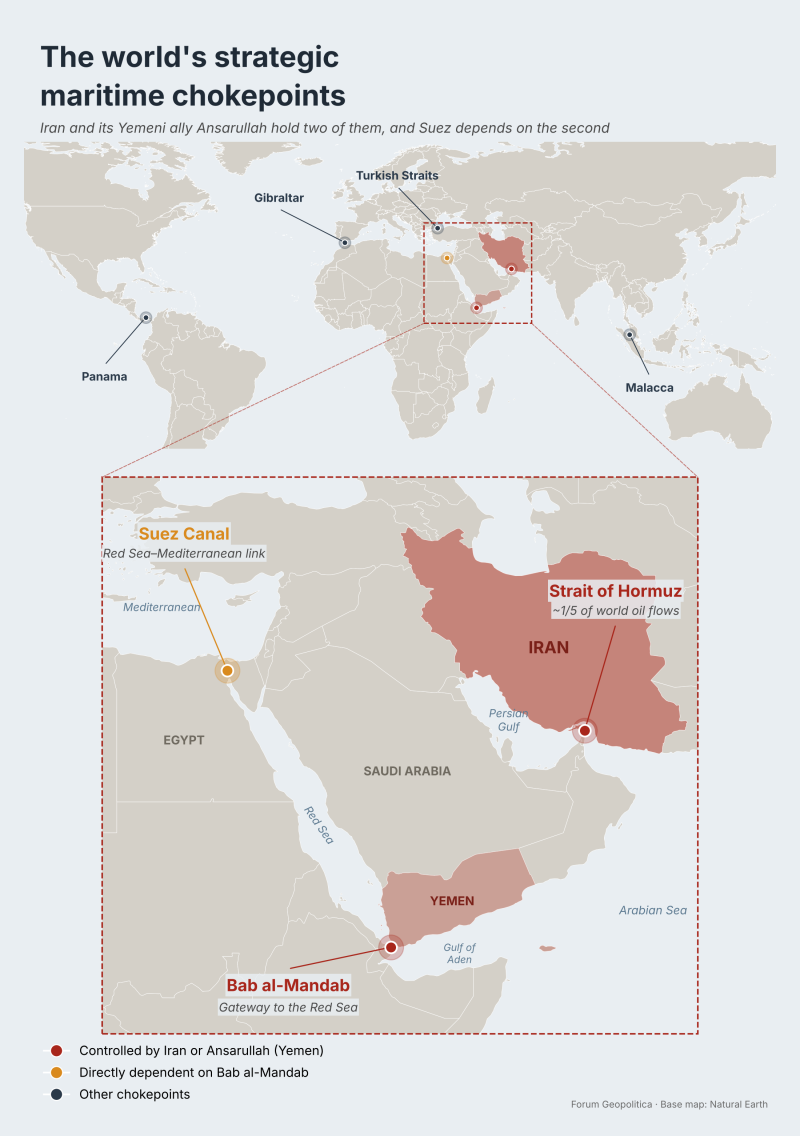
The sea is even more important. There are seven strategic chokepoints in the world, among them the Panama Canal, the Suez Canal, Malacca, Hormuz and Bab al-Mandab. They matter because most of world trade and military deployments go through the sea, and these shortcuts change the time, the delivery costs, the insurance and the risks. None of the United States, China, Russia, India, Germany or France is in control of these seven. In Malacca, I personally believe that if war breaks out, it won’t be because of Taiwan, but for controlling the strait. Whoever controls Malacca will control the markets and economies of Southeast Asia.
That’s why the United States is moving so fast in the Philippines. They had five bases, now they have nine. One of the first decrees of Bongbong Marcos [Ferdinand Marcos Jr., president of the Philippines since 2022] after he was elected was to give four more bases to the Americans.
Exactly. And Iran is in control of Hormuz, through which one third of the world’s energy supplies passes. Even when there is no longer a superpower called the United States, the Chinese will still need to get oil through there, so they will need Iran. The other one is Bab al-Mandab, under the control of Ansarullah [the Houthi movement, which governs northern Yemen], in Yemen, which is part of the Axis of Resistance. Bab al-Mandab, the Red Sea and the Suez Canal are like a pipe: whatever goes in one end comes out the other. After Ansarullah shut down Bab al-Mandab in the war that began with the Al-Aqsa Flood [Hamas’s offensive against Israel on October 7, 2023], the Egyptians issued reports three times in one year saying they had lost 60% of the canal’s revenue and maritime traffic. So Iran, at the head of the Axis of Resistance, is in charge of at least two and a half strategic straits.
This showed me, years ago, that the United States would come to war with Iran, in addition to all the other reasons, like Israel. They cannot accept this while they are escalating tensions with China over Malacca, and with Panama because of the Chinese operators in the canal. They will never let you go; they will come to fight. Iran will be one of the big powers if it can continue its control over these waterways, and so far Iran and Ansarullah have proved that they are capable of it. The world needs you today and will need you tomorrow. All economies have been hurt by the closure of Hormuz, and even if the strait opened today, economies throughout the world are counting on two more years of high oil prices. We are going to see even worse economic days in the coming months.
I read a letter from Ali Akbar Velayati [Iran’s foreign minister from 1981 to 1997 and adviser to the Supreme Leader on international affairs ever since] to the new Leader [Mojtaba Khamenei, son of Ali Khamenei, chosen in March 2026] proposing an Islamic pole centered on Iran, alongside the strategic allies Russia and China, and accompanied by “authentically non-aligned” countries such as South Africa, Brazil and Cuba. In April, he called this the world’s “third pole.” Do you share that vision? I am thinking of the audience in Latin America, and in Africa as well. Is there a place for us?
Not exactly like that. My view is a bit different. I believe that, as China, Russia, Iran and even India take more power in the format of BRICS, more countries will join it. As the dollar loses its value and share of the global market, more countries will feel free to do what they want, including Latin Americans. They will hammer out economic and political ties with Russia, China, Iran and even India, depending on India’s future policies, and they will join BRICS.
But this will not happen in the next few years. After a decade of clashes and wars, everyone will be weak, and there will be disorder in the world. Then regional coalitions will emerge: Latin America will start its own, because it has shared interests and common threats. At the same time, BRICS and the Shanghai Organization will gain importance, because there will be a power vacuum, and part of the world will be free from the yoke of the West. The world will need a new order, but it will not accept one like the post-World War II order, the Western order, with the categories of lords and slaves. Everyone will have a bigger share, though there will still be flag bearers: these four big powers.
Hormuz, stronger than the atomic bomb
And the relationship with the Arab countries?
Iran would very much like to promote unity among Muslims and wants to be friends with these nations, because Iran has a priority: defeating the main enemy, Israel and the United States. It doesn’t want friction. We believe that “divide and rule” has always been the British policy. They divided us, they fragmented the Ummah [the community of the Islamic people, beyond national borders].
But it doesn’t happen overnight; there are phases. When it comes to the Persian Gulf Arab countries, phase one is to win this war and to keep control over the Strait of Hormuz, which Iran has always had. That will be the instrument for redefining geopolitical, strategic and neighborly relations, because it is a weapon millions of times stronger than the atomic bomb. With an atomic bomb, you could hit a country once. With the Strait of Hormuz, you could leave an impact on the entire planet, repeatedly. Since the Second World War, nobody has been able to leave such a great impact on the yield of US bonds, on oil prices and on US inflation.
Iran is not going to use that weapon to colonize these countries, but to refine its relations with them. What does that mean? The United States is an enemy that attacked Iran using these countries’ territory as a launch pad. So there shouldn’t be any US bases there. Israel has been in tight cooperation with the UAE and some others, even the Saudis. Iran wants Israel out. After they show that they are harmless, there will be relations on an equal footing, sound and healthy, because we share common threats and enemies.
How do we know it will be like this? Under President Raisi [Ebrahim Raisi, president from 2021 to 2024], Foreign Minister Amir-Abdollahian [Hossein Amir-Abdollahian, killed with Raisi in a helicopter crash in May 2024] started a plan, two or three years ago, for a regional security dialogue and forum with the Arab countries: the six of the Persian Gulf, plus Iran and Iraq, the so-called “six plus two.” The idea was to guarantee each other’s security without transregional countries. Iran had already taken these initial steps before the war. It means to repair its ties with the Arab countries, but only after they relinquish Israel and the United States and stop allowing the Mossad, the CIA and others to attack Iran. You cannot fight everyone forever. We have a clear target and a clear plan for the future.
You have been preparing for this for decades, right?
For decades we’ve been preparing for this war and for the Strait of Hormuz, because we knew it was going to happen one day, sooner or later. If not now, two decades later.
The Pentagon’s budget is a hundred times bigger than Iran’s military budget. Thinking worldly, militarily and economically, they should have beaten Iran in the first few days. Why couldn’t they? Everybody is surprised, and it’s not just because of the asymmetric warfare we’ve been practicing. Might is not always right.
Shariati and the torch of Karbala
To close: Ali Shariati (1933-1977) is a little-known figure outside Iran. An Iranian sociologist and thinker, he was a voracious reader of Karl Marx, a translator of and interlocutor with Frantz Fanon, and a friend of Jean-Paul Sartre, with whom he debated at length. What was his influence on the Islamic revolutionary movement and on this whole mystique around Hussein and resistance?
He played an important role, but this has been a process of 14 centuries. Since the martyrdom of Imam Hussein, it’s like a torch that each person has given to the next, no matter whether you are a thinker or an ordinary citizen. When the torch was given to Ali Shariati, he awakened the revolutionary spirit of Imam Hussein in a whole generation, which was under the impact of two readings of Islam: the traditional and the revolutionary, that of Shariati and that of Imam Khomeini [leader of the 1979 Islamic Revolution and Iran’s first Supreme Leader (1902-1989)].
Between Shariati and the revolutionary clergy there were differences, but not wide gaps. Shariati believed that revolutionary Islam did not need much religious leadership by the clergy; the revolutionary clergy believed in the clerical hierarchy. But they worked for the same cause, and that separated them from the traditional religious system. Many youth changed their view of Islam from a traditional religion of customs to a revolutionary viewpoint.
The Shah [Mohammad Reza Pahlavi, who reigned from 1941 to 1979] spoke of the red threat and the black threat: the communists and revolutionary Shiite Islam. Navvab Safavi [a cleric, founder of the armed group Fadaian-e Islam, executed in 1956] took up guns against the regime, and to the Shah he was the immediate threat. Shariati was the more rooted threat, because he never took up a gun, he took up the pen. They were afraid of his books and, especially, of his speeches at the Hosseiniyeh Ershad [a religious and cultural center closed by the Shah’s regime in 1972], here in northern Tehran.
Whoever studies Hussein beyond the earthly meanings, the thirst, the decapitation, finds meaning in him everywhere. Even a communist [Khosrow Golsorkhi, a poet and journalist, executed by firing squad in 1974], tried by one of the Shah’s military courts in a session broadcast on TV to scare the people, said he was under the impact of the martyrdom of Imam Hussein and the justice of Imam Ali [cousin and son-in-law of the Prophet Muhammad, the first Shia imam]. His catchphrase stuck: I’d rather pick red death than living in humiliation.
Karbala is not just mourning and rituals, it’s a way of life. Take a look at the letters of our martyrs: almost all of them touch on Karbala. Reza Shah [father of Mohammad Reza and founder of the Pahlavi dynasty, who reigned from 1925 to 1941] banned the Muharram rituals; under his son, SAVAK [the Shah’s political police] tolerated the rituals but stood against any speech that touched on revolutionary Islam. In such an atmosphere, talking about the revolutionary Imam Hussein, as Shariati did, needed courage. The courage of Imam Hussein himself.
«“The next war with the US will be short and devastating,” predicts Iranian strategist»