


The Manifestation of a Political and Intellectual-Moral Regression






Introduction
The German political class is more united than ever before since the last collapse. This is the result of a development that began under Chancellor Schröder and Germany’s participation in the NATO-provoked war against independent Yugoslavia. Yet the actual starting signal was given during the chancellorship of Angela Merkel, the pastor’s daughter, ably assisted by a warmongering pastor serving as Federal President.
Unfortunately, this current unity in federal politics does not reflect historical wisdom. It is not evidence that lessons have been learned from the horrors of Germany’s own past, guided by humanism and a commitment to peace. Rather, this celebrated unity speaks to a kind of death wish.
The State of Current German Politics in Numbers
A few days ago, the German government released the figures for the 2027 federal budget and the financial plan for the period from 2026 to 2030. Here is the key table:
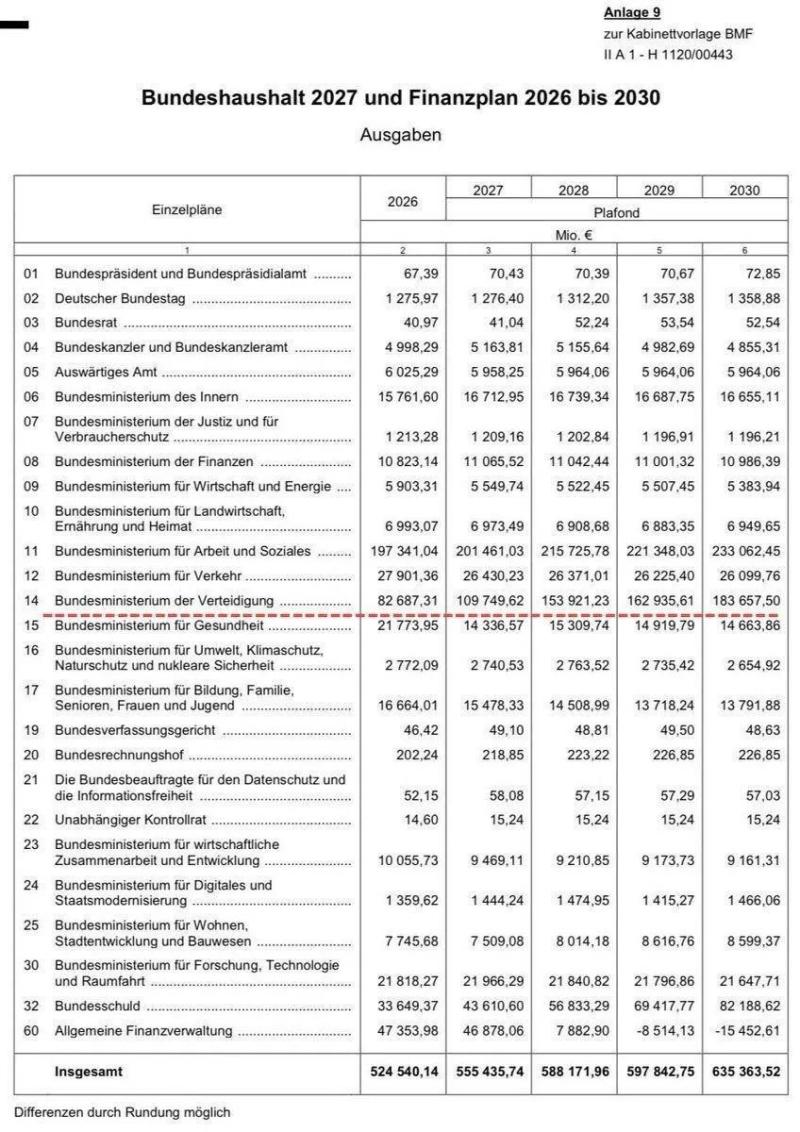
Item 14 sets the direction—the planned expenditures of the Federal Ministry of Defense. Within four years, direct defense spending will thus more than double. However, one crucial figure is still missing to put these staggering numbers into perspective. In order to be able to disburse a total of 555.435 billion euros from the public coffers in 2027—including nearly 110 billion in direct defense spending—corresponding revenue is needed.
On the Federal Ministry of Finance’s website, you’ll find the figure you’re looking for:
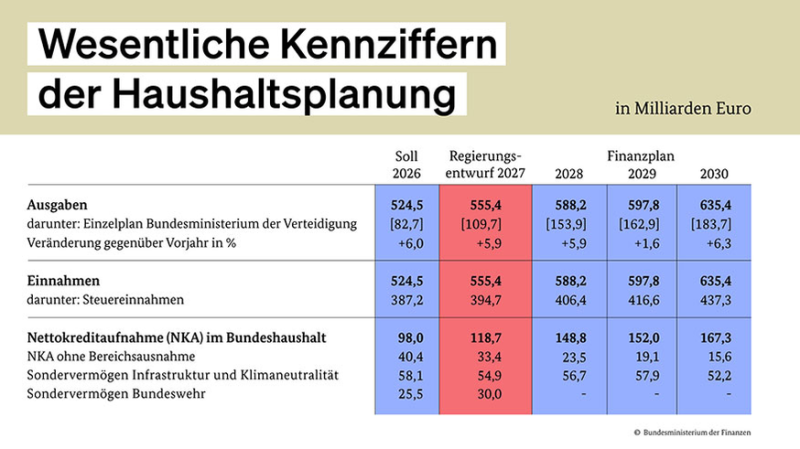
Tax revenues therefore fall far short of covering planned expenditures. The German government must continue to take on debt in order to pay for the arms race madness it has promised NATO. And that amounts to a whopping 200 billion euros—more than a third of the national budget.
But be careful. Even this massive expenditure does not cover all defense costs.
On June 25, 2025, the Federal Ministry of Defense took stock of last year’s NATO summit. The ministry’s leadership proudly and fervently informs readers:
“Member states’ defense spending is to rise to 3.5 percent of gross domestic product (GDP)—this includes, for example, military equipment and salaries for service members. Added to this is 1.5 percent for defense- and security-related areas such as infrastructure, industry, and resilience—that is, the protection of critical infrastructure, cyberspace, or the expansion of roads and bridges suitable for military use. These targets are to be achieved by 2035.”
The seemingly innocuous figure of 3.5 percent of GDP—or the modest 1.5 percent of GDP—needs to be broken down to grasp its true scale and, by extension, the direction of current German policy. What is planned for 2035, broken down into figures for the year 2025, looks like this:
GDP in 2025 amounted to 4,469 billion EUR. The 3.5 percent in direct defense spending would have amounted to 156 billion euros, while the 1.5 percent hidden in civilian budget items due to military requirements would have added another 67 billion, bringing total military spending last year to 223 billion euros according to NATO estimates. This enormous sum represents just under three times the actual defense spending in 2025. And 223 billion corresponded to 42.5 percent of the total national budget for 2025—in other words, nearly half.
Five percent of GDP will still be an extremely impressive sum in 2035—one that places a heavy burden on the budget. Given Germany’s ongoing deindustrialization, with all the associated economic and fiscal burdens—including, very likely, a significant decline in tax revenues—this five percent will be even harder to bear in the future than it would be today.
A comparison no one wants to make
Whether we like it or not, these figures and the unease they stir up lead politically and historically astute observers to reflect on how things were “back then.”
The German federal government takes every opportunity to let the public know that “the Russians” will leave their homeland by 2030 at the latest—or perhaps as early as 2029, though even earlier dates are being bandied about—and set off toward the West. We won’t dwell here on the truth of these abstruse claims. But hadn’t the German public, the “German people,” already waited in vain for the “Bolsheviks” back then? Even back then, plans were made for a scenario that only came to pass when Germany convinced “the Russians,” using the most brutal and barbaric means and methods, that it was absolutely necessary to capture Berlin.
Regarding that prewar period, I found the following figures:
“Germany’s military expenditures from 1934 through August 31, 1939, for all three branches of the armed forces—including expenditures related to rearmament—totaled 60 billion marks. During the same period, Germany’s total budgetary expenditures amounted to 101.5 billion marks; in other words, military expenditures accounted for 59.1 percent of that total.”
Conclusion
The NATO target—broken down to the year 2025—of five percent of GDP for funding NATO members’ military expenditures by 2035 amounted, in real terms, to 42.5 percent of Germany’s total national budget. In “peacetime.” This figure does not include the additional (military) expenditures for Ukraine, which were provided by Germany directly to Ukraine or found their way to Kyiv via NATO and the EU.
42.5 percent plus other war expenditures for Ukraine thus contrast with that 59.1 percent of budget expenditures in prewar Germany during the period from 1934 to August 31, 1939.
This inevitably raises questions.
How much quantity (money) is still needed to achieve the anticipated new quality—that is, war? In other words: How small is the actual percentage difference between 2025 and the rearmament period from 1934 to August 1, 1939—that is, the 59.1 percent of that time?
How far and how long is it still until “our” September 1?
And how long will it then take until “May 8”?
«The Manifestation of a Political and Intellectual-Moral Regression»