


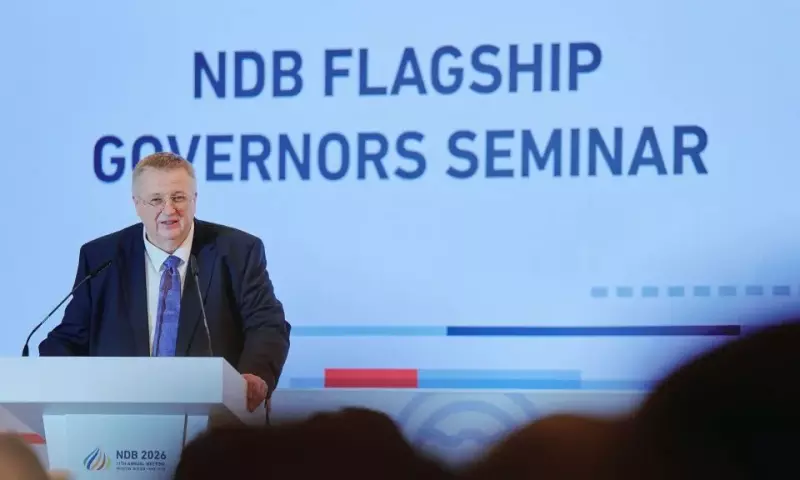
The BRICS Bank needs to make bolder decisions, according to Russia's Deputy Prime Minister






Editor’s Note: This article is published with the express permission of the author, Marco Fernandes (Brasil de Fato).
The BRICS nations are facing their greatest political challenge since their creation in 2009. Currently, two of their member countries are at war: Iran and the United Arab Emirates. The former has defended itself against Israeli-American attacks by striking back at U.S. bases and facilities located in the latter. So far, the BRICS have issued no statement on a war that already threatens to plunge the world into the most severe energy crisis since the 1970s. Faced with this impasse, their most important institution—the New Development Bank (NDB), the BRICS Bank—held its 11th annual meeting today in Moscow. The opening brought together two of the most prominent figures in the debate on the new world economic order: American economist Jeffrey Sachs (online) and Russian Deputy Prime Minister Alexei Overchuk. The two opening speeches, while offering distinct perspectives that converged on key points, reached a common conclusion: the world is undergoing profound transformations, and the NDB must take on a far more ambitious role in its second decade of existence.
Public financing as a strategic tool
Sachs began his remarks by identifying three major transformations underway in the contemporary world. The first is geopolitical: global hegemony is shifting from the West to the East. The second is ecological: 225 years of industrialization have put the environment at risk, but green technologies offer concrete hope. The third is technological: the artificial intelligence (AI) revolution, rather than being harnessed for military purposes—the path chosen by the United States—should be used to improve living standards in areas such as education, health, and public services.
In light of these transformations, Sachs was unequivocal: "The West continues to cling to a position of power it no longer possesses—and does not deserve. This is clearly evident in the wars in Ukraine and Iran, as well as in what has happened in Venezuela. We must put an end to NATO [North Atlantic Treaty Organization] and all wars. The United States and the EU [European Union] can no longer dominate the world."
For Sachs, given the challenges of the coming decades, it will be essential to increase public funding for the commons, research and development, as well as major infrastructure projects—energy, water, transportation, digital connectivity, among others. While acknowledging the importance of market forces, Sachs argued that public funding is irreplaceable for long-term planning. In this context, multilateral development banks (MDBs) will have a fundamental role to play, and regions will need to act as blocs, with neighboring countries working in an integrated manner.
The NDB is set to play a huge role in meeting this demand for public funding. And China’s vast savings should also be used to support this effort, channelled through the NDB,” argued Sachs. Such a proposal runs counter to Washington’s prescriptions for China – which Beijing wisely rejects – suggesting that the Chinese should save less, reduce the share of investment in the economy and increase the share of consumption.
Urban Expansion, Africa, and the Dollar as a Weapon
Sachs cited two concrete examples of the challenges the NDB must face. The first concerns urbanization: the global urban population is expected to increase by two billion people by 2050, requiring enormous investment in urban infrastructure. The second concerns Africa, which is expected to account for 25% of the global population by 2050 and should be one of the bank's priorities, in coordination with the African Union. In both cases, financing for new green technologies will be crucial.
Finally, Sachs called on the NDB to help create payment systems that serve as alternatives to the dollar: "The dollar has been used by the United States as a political weapon for the past 30 years to maintain its dominance over the world. Other countries' reserves are being confiscated—such as those of Venezuela and Russia. The IMF [International Monetary Fund] refuses to grant loans to countries that displease Washington. We need alternatives."
Unfortunately, none of the roundtables at the 11th annual meeting of the NDB addressed this topic specifically—one of the most strategic issues for the future of the bank and the Global South.
Overchuk: Technological Sovereignty and Financial Alternatives
Russian Deputy Prime Minister Alexei Overchuk opened his remarks by highlighting the most distinctive feature of the BRICS: decision-making based on mutual respect and consensus, regardless of the size of member countries.
He then moved directly to the central theme of the meeting. "AI has become a strategic issue and requires intensive energy consumption. But how many countries in this room produce their own chips? How many are capable of managing their own data?" he asked of an audience where the majority of represented countries depend on foreign technology for both of these.
Technological sovereignty and its financing—particularly in the fields of semiconductors and data infrastructure—emerged as the central challenge of this edition of the NDB meeting. Overchuk's question laid bare the structural vulnerability of most countries in the Global South in this area.
Overchuk cited Russia's experience following Western sanctions to illustrate the importance of building alternatives to the international financial system ahead of time. "If a country is excluded from the international financial system, how can it survive? They did this to Russia; they tried to weaken us, but we were prepared. When Visa and Mastercard left, we had already set up our own alternative system. That is why it is essential to create alternatives to the existing financial system," he stated.
This is reflected in concrete figures: trade between Russia and China reached the equivalent of $240 billion, with 98% of transactions conducted in rubles and renminbi. Trade with Russia's closest neighbors is conducted 93% to 95% in local currencies.
To enable this model to grow, Overchuk advocated for the establishment of financial and logistical connectivity. One example is the North-South International Transport Corridor—which connects St. Petersburg (Russia) to Mumbai (India) via Iran—presented as an alternative to the Western-controlled Suez Canal, supported by Russian investments in Iran and Central Asia. "The center of the global economy is shifting toward the Global South. We must connect northern Eurasia to the Global South, and the NDB should make this one of its priorities," he stated. Like Sachs, Overchuk called on the bank to lead the expansion of financial and logistical connectivity as tools for integrating the Global South—alternatives to infrastructure currently dominated by the West.
Insurance, rating agencies, and the battle of ideas
Overchuk also advocated for the creation of an insurance system specific to the BRICS countries, not to replace the existing system, but as a more robust alternative. This proposal echoes ongoing negotiations within the bloc regarding the creation of a joint reinsurance company.
Reinsurers—the insurers of insurers—are primarily concentrated in Europe and the United States and have become instruments for implementing Western sanctions. One example: Western reinsurers refuse to fully cover oil tankers exporting Russian oil beyond the price cap imposed by the G7 countries. Without reinsurance, trade comes to a halt.
Overchuk also advocated for the creation of new credit rating agencies. Russia established a national alternative five years ago, but this initiative needs to be expanded to all BRICS countries. Existing credit rating agencies—based in the United States—determine the ratings of banks such as the NDB and dictate their ability to raise funds as well as the cost of doing so. The presence of countries sanctioned by the West, such as Russia, or less developed countries, such as Bangladesh, weighs on the bank's rating, making financing more expensive and difficult. Yet serving precisely these countries is an integral part of the NDB's mission.
Finally, Overchuk proposed that the NDB begin producing analyses of major trends in the global economy, offering an alternative perspective to that of the hegemonic powers. The proposal has strategic significance: the IMF and the World Bank spend hundreds of millions of dollars annually on research departments that produce reports guided by Western interests and shape the global economic debate. The BRICS must be able to offer an alternative vision from the Global South—a battle of ideas on economics, development, and humanity's major challenges, from the ecological crisis to inequality.
In conclusion, Overchuk issued a call: "The Board of Governors must make bolder decisions, based on well-informed analyses, particularly during this second decade of the bank's existence."
The absence of most BRICS finance ministers—the Board governors—at the 11th meeting did not go unnoticed. Only the Russian minister, Anton Siluanov, and the South African minister, Enoch Godongwana, were present. Brazilian Minister Dario Durigan was unable to attend due to the temporary closure of Moscow's airports, most likely linked to the risk of Ukrainian drone attacks. But no other ministers made the trip. This raises an inevitable question: what priority do the governments of member countries actually place on the bank?
«The BRICS Bank needs to make bolder decisions, according to Russia's Deputy Prime Minister»