


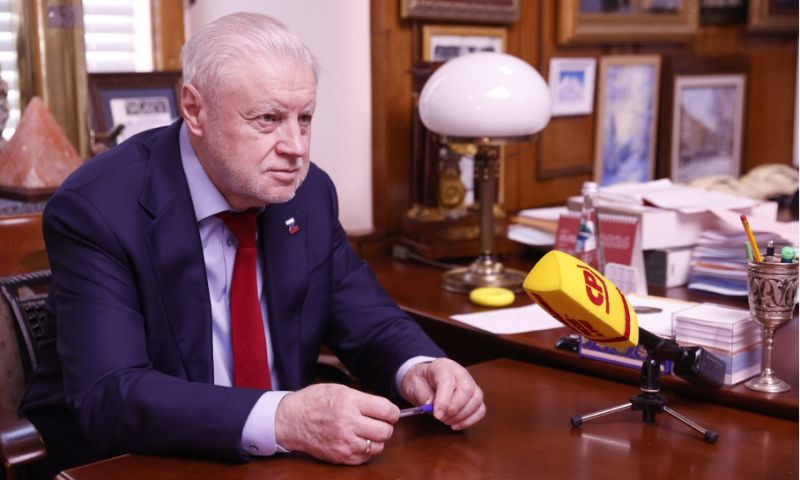
Sergei Mironov – one of Russia's leading figures






Introduction
A friend of mine called me and asked whether I would like to meet Sergei Mironov—I’d love to. The invitation gave me an insight that is denied to many. In his office in the State Duma, where we met, there is no trace of pomp, but many books and photographs that point to a long career in politics and a wealth of experience. A study that seems not to have changed for years—much like Mironov himself, who has devoted his entire life to serving his country. With his age comes experience he can bring to bear. He is concerned with Russia, not himself—and that is something one believes. His eyes sparkle with energy, and his concise, clear manner of speaking is a blessing for someone like me, whose native language is not Russian.
He was expecting an interview, but a question-and-answer format cannot capture the atmosphere; since I want to weave my own reflections into what was said, I describe this first meeting with a man who gives the impression of representing Russia not only in parliament, but also with his heart.
Who is Sergei Mironov
Mironov, 73, was born in Pushkin near St. Petersburg; his father remained in the army after the war, and his mother worked for the party. A mining engineer, geophysicist, and geologist he traveled extensively throughout his life and spent the final years of the Soviet Union in Ulaanbaatar, Mongolia. From 1991 to 1993, he served as managing director of the Russian Chamber of Commerce, headquartered in Pushkin, which is organized as a closed joint-stock company. In 1992, he graduated from St. Petersburg State Technical University. In 1993, he received a certificate from the Russian Ministry of Finance authorizing him to operate in the securities market. From 1994 to 1995, he served as Executive Director of the St. Petersburg construction company Vozrozhdenie. In 1997, he graduated with distinction from the Russian Academy of Public Administration under the President of the Russian Federation. In 1998, he completed his law degree with distinction at Saint Petersburg State University.
I don't know many people who can boast such a broad and deep academic background.
His political career began in 1995 in St. Petersburg, and after holding various political offices—including serving as Chairman of the Federation Council from 2001 to 2011—he has been a member of the Fair Russia party since 2006 and currently serves as its faction leader in the Russian State Duma.
Mironov is thus a political veteran in post-Soviet Russian politics who wields considerable influence.
Our conversation
Iran
Our conversation covered a variety of topics and began with a question about the growing geopolitical problems, such as the issue of the war in Iran and its repercussions. Mironov made an extremely interesting observation regarding problems that seem to pile up and appear unstoppable. He said that when such seemingly insurmountable situations arise, the problems keep getting bigger and then suddenly everything is resolved; one doesn’t even know when they began and sometimes not even why. Believers say in such moments that it was the Lord, and non-believers say it was coincidence. Very often, this is how it is in life.
In this way, Mironov describes a characteristic trait of the Russian people, which was likely also the key to victory over Nazi Germany. Victory was possible because the Russians did not give up even in situations where everyone else would have. This attitude of the Russians seems to have already been forgotten in the West; this is easily discernible in the current behavior of the EU and the United States.
By mentioning the Nobel Peace Prize—which Trump was not awarded—and his subsequent attempt to slip back into the role of the world’s policeman and put Iran in its place, Mironov takes a tongue-in-cheek swipe at the vain redhead from Manhattan: Iran – Persia – exists as the result of a civilization dating back millennia, whereas the U.S. has existed for only a few centuries. Trump’s plan to reset everything in Iran to zero will not succeed, because the Iranians, who are now taking to the streets with flags, have already won. Moreover, they would continue to control the Strait of Hormuz in the future and are capable of launching further strikes. The fact that Iran’s neighboring countries, which had relied on the U.S. and provided military bases, have suffered damage is indeed very regrettable, but it clearly shows these countries that they were lured into a trap. Furthermore, the bombing of missile bunkers 200 meters underground was a futile endeavor—it was impossible to defeat a global civilization with such means.
The current much higher oil price may be good for Russia, but it is nothing more than a respite for the budget. Putin sees it that way too, because it could end quickly. The average American doesn’t care about Iran or Russia; they are far away, across the ocean. Americans want cheap fuel, and whichever party achieves that will likely win the November election in the U.S. Russia, on the other hand, must rely on its own economy, and as a mining engineer, geophysicist, and geologist, he understands everything related to mineral resources very well. Russia’s wealth of resources is considerable, but ultimately still limited. He therefore considers it the duty of today’s generation to preserve this wealth for future generations. In his opinion, the Russian state is too generous in its handling of these resources. Russia reimburses exporters for the value-added tax on raw material exports, currently 22%. Last year, this amounted to 3.5 trillion rubles.
This could be better organized; incentives should be created to encourage comprehensive processing of raw materials, especially since Russian companies that export raw materials are already rolling in money. The Chinese government does not reimburse any expenses for raw material exports, but only for value-added products (cars, smartphones, etc.)—a strategy that Mironov considers sound.
During the conversation, Mironov mentioned President Putin several times. He is pleased with his presidency. He has known him since 1994. He described him as intelligent, level-headed, calm, and far-sighted. As a chess player, he is in no hurry to move a pawn or a knight, let alone the queen. No one in the West paid President Putin’s 2007 speech in Munich the attention it deserved. In it, he predicted the events that followed. Had they listened, the special operation of 2022 would not have come as a surprise. President Putin had announced on behalf of our country that Russia would not accept Nazism on its borders. Just as the Americans and British should not be surprised by Russia’s reaction, neither can they be surprised by Iran’s reaction.
Is Russia being aggressive enough?
Iran has fought back very resolutely in the war, not only against Israel and the United States, but also against their allies. And after a relatively short time, it had clearly gained the upper hand. Now, after four years of war in Ukraine, the question arises as to whether the time has come for Russia to adopt a more aggressive stance—toward the United Kingdom, for example—a question that many inside and outside Russia are asking themselves.
In this context, Mironov quotes a saying that has been around in Russia since the 19th century: «Англичанка гадит» (meaning “the British queen makes a mess” or “the Englishwoman makes a mess”), has always done so, and will always do so, but compared to Russia’s size and power, Great Britain simply does not pose such a major problem. He personally, as an emotional person, is of the opinion that the special operation should be renamed an “anti-terrorist operation,” which would allow the problems to be solved more effectively, since an anti-terrorist operation would include the killing of terrorists. However, the president would never agree to such a change, and regarding Great Britain, this is also a matter of international law, which Russia, unlike almost all other nations, strictly adheres to. The U.S., for example, kidnaps presidents and simply wants to take over Greenland. Russia is different. He personally is emotional; he would eliminate the terrorists, but the president sees it differently and is certainly right. It is crystal clear to the president that it is the British who are enabling Ukraine to carry out precision strikes. Great Britain knows what Russia knows, and that Russia has the means to strike back.
Shortly after our conversation on April 13, the Foreign Ministry issued a statement on April 15 that addressed precisely this issue and very diplomatically suggested that Russia is indeed considering attacking targets in Europe. We reported on this.
Furthermore, Europe is undermining itself by every means possible. Not only by currently paying many times more for energy as a result of foregoing cheap energy supplies from Russia, but also due to the domestic policy strategy of flooding its countries with foreigners. Mironov was last in Paris in 2010 (he was one of the first nine people to be sanctioned in 2014, and he is proud of that). Even back then, he had been sitting with a friend at an outdoor café, observing the passersby with interest. They amused themselves by counting those of obviously European and non-European origin, simply based on their appearance. Over 50% of all passersby had a non-European appearance. A proportion that no society could absorb without negative consequences for its own culture.
Nothing lasts forever. We must be patient, for the day will come when the current leaders of European countries will be replaced by those who will truly represent the interests of their nations.
The mood in Russia after four years of war – what young people think, and what the problems are.
According to Mironov, who cites sociological studies, 80% of all Russians support the special military operation. Among those over 75, the figure is nearly 100%; among those over 65, it is 95%; and among those aged 55, it is 80%.
The situation is different among younger people. Among those under 25, 40% support the special military operation and 60% say they are not opposed to it, but they don't know themselves what they want. Mironov makes an interesting point, which he bases on a sociological study—a reference that drew criticism from within his own ranks: nearly 75% of high school graduates in Moscow want to live and work abroad. But these young people do not realize that no one is waiting for them there, a situation exacerbated by the current geopolitical climate—“Ah, you’re Russian—grab a broom and sweep the street.” This situation is, however, much less pronounced in the regions.
When Mironov speaks about problems in education, it sounds much the same as in the West. A professor friend of his remarked that students are no longer able to follow, learn, and truly understand the material. Many students, he said, turn to their smartphones after just 15 minutes of a 45-minute lecture—let alone a double session of two 45-minute blocks—and are no longer capable of concentrating on the lecture for any extended period of time.
In the second year, this rector was forced to expel 28 percent of all first-year students. And this despite the fact that they had scored 100 points on the Unified State Exam. Many of them achieved top marks, but only because they had been coached by private tutors. They are unable to study independently.
Mironov’s remarks touch on issues I hear about all over the world—not a Russian problem, but nonetheless a huge problem for every society I’ve had the opportunity to observe. When I bring this up, he agrees and explains that this is also why he opposes a ban on “gadgets and messaging apps, including Telegram.” Nevertheless, he says, far more needs to be done in education to address learning challenges.
Despite the criticism he voiced above, Mironov, as a senior, says he is satisfied with the younger generation and is pleasantly surprised by the willingness of young students to volunteer for military service.
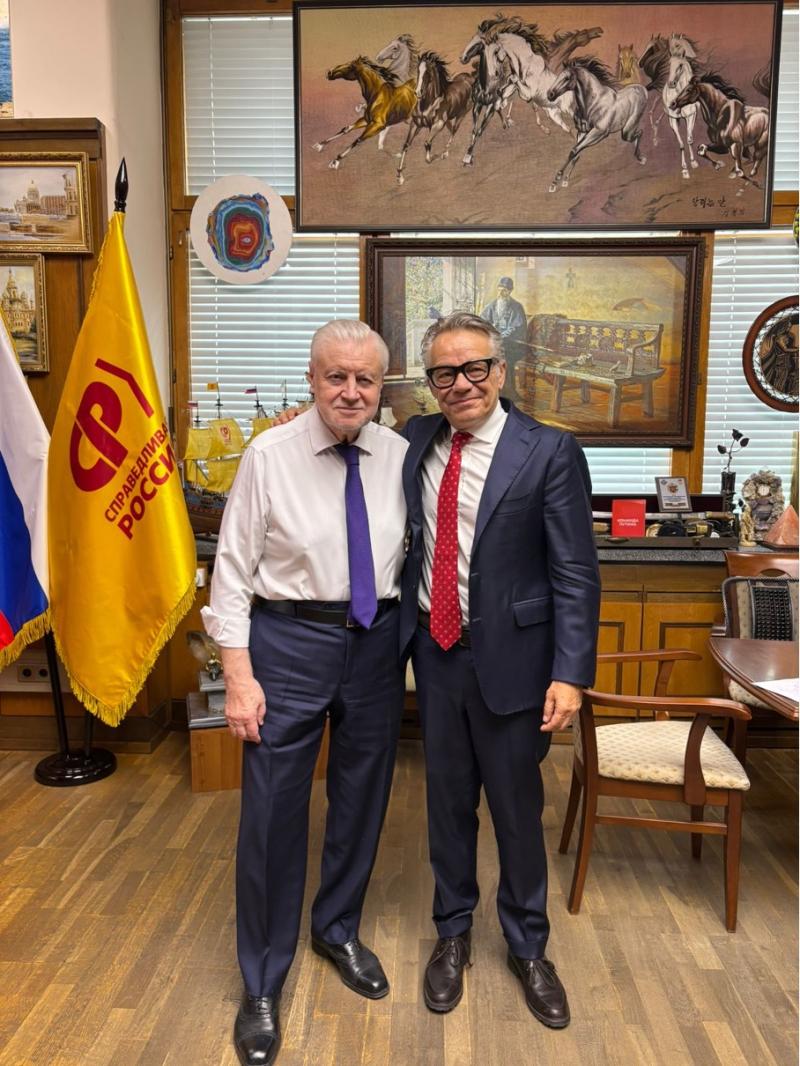
Conclusion
It is accurate to describe Sergei Mironov as a political veteran in Russia. He has earned his respect through hard work. Not only does he hold five degrees in various fields, but he has also dedicated a significant portion of his life to supporting the then-young Russian Federation. His patriotism is evident, and throughout his long political career, he has never put himself in the spotlight—as was the case during the 2024 presidential election, when, as a candidate, he said, “We all want Vladimir Putin as the next president”; such an endorsement, when one is a candidate oneself, is indeed rare among politicians.
Sergei Mironov is older than any member of the Swiss Federal Parliament, but he looks extremely young and fit and quickly gets to the heart of any topic of conversation. Russian society upholds a tradition that dates back to ancient Greece: the “Council of Elders.”
The West would also do well to show a similar respect for experience. For the elderly, weathered by life, have seen more than the young and are able to put things into perspective, combining the distant past with new ideas to create something new.
«Sergei Mironov – one of Russia's leading figures»