


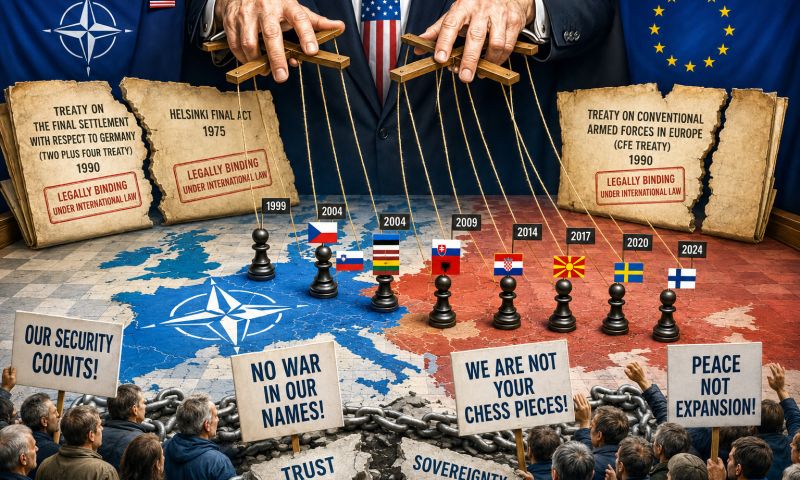
NATO in the Balkans: A History of Calculated Dismemberment






Editor's note: Following the recent article "How did NATO enlargement happen? Three case studies" (22 June 2026, by Stefano di Lorenzo), René Zittlau wanted to revisit certain aspects of this deleterious policy — the price of which we are still paying today.
The Nature of History
We live in very turbulent times. But we always have, even in Europe. It just didn’t always seem that way to us. For after World War II, until the world-changing events of the late 1980s and early 1990s, Europe as a whole—both East and West—lived within rigid structures that suggested a sense of calm. Yet this calm was only apparent. It is no coincidence that this period is called the Cold War.
Military forces faced off against one another on a scale that makes today’s figures look (still) modest by comparison. Who is aware of this today? The Cold War also took place on every other conceivable front—political, economic, diplomatic, and cultural—with massive support from intelligence agencies.
The collapse of the Soviet Union and the other states of the socialist bloc was thus the result of a war that encompassed everything except a direct military clash between the two competing sides.
History, then, does not simply happen on its own, nor does it simply come to an end; it is the result of the actions of concrete, specifically identifiable forces. And it was these forces that organized the so-called NATO eastward expansion, repeatedly violating treaties binding under international law. The will of the peoples and states was not the determining factor in this process; rather, it was made to fit the agenda.
The Deliberate and Organized Breakup of Yugoslavia
As long as the socialist bloc centered on the Soviet Union existed—and thus as long as there were minimum diplomatic and political standards governing the coexistence of competing social systems, which had been enshrined in treaties binding under international law—the disintegration or breakup of Yugoslavia was not an issue.
It was well known that the United States—and the United Kingdom in particular—considered it a mistake that the West had failed to establish a military presence in the Balkans during World War II. Nevertheless, the situation in Yugoslavia in the early 1990s was quite stable, and there was no talk of the country falling apart. Disputes among the various ethnic groups (Serbs, Croats, Slovenes, Bosnians, Albanians) or religions (Catholics, Orthodox Christians, Muslims) were also largely unknown. As in the Soviet Union, people generally had no idea who belonged where. Nationalism as a destructive force thus existed only in name. This is exactly how the Croatian political analyst Alex Krainer described it in an article on Substack:
„One of the most striking experiences in my life was the breakout of war in former Yugoslavia in 1991, and the reason was the almost instant change in collective psychology that took place as soon as the first artillery shells started landing in Croatia. Up until that moment, the vast majority of people - I’d venture to say, well north of 90% - believed that war was unthinkable; that it would never happen. Who could possibly want to fight a war? It seemed impossible; only a small handful of hotheads were advocating for war.
The stories circulating in Western media about the eruption of bottled-up centuries-old hatreds were utter nonsense. The peoples of former Yugoslavia were socially, economically and culturally deeply intertwined. In most cases we didn’t even know who, among our neighbors was a Serb, Croat or a Muslim and many families were mixed.”
Alex Krainer
So who fueled this force and let it run wild, leading the country into a destructive war? Where did the money and weapons come from?
A unified Germany went all out in this effort, led by German Foreign Minister Genscher. He secretly promised Slovenia and Croatia not only swift recognition by the EU should they break away from Yugoslavia, but also a great deal of money to support their future, including weapons from NVA stockpiles. Is this what the diplomacy of non-interference looks like—the very principle to which the Federal Republic of Germany had committed itself in Helsinki in 1975 and, just shortly before that, in the 2+4 negotiations? Not to mention the Basic Law. Even the British, who are not usually squeamish, were surprised by the Germans’ boldness, as exemplified by the EC negotiator for Yugoslavia, Lord Peter Carrington.
But evidently, the historic moment was to be seized upon to rapidly “NATO-ize” the Balkans through a “divide and conquer” strategy, which succeeded with the destruction of Yugoslavia and massive support for the establishment of Croatia, Slovenia, Bosnia and Herzegovina, and, most notably, Kosovo. The war required to achieve this was willingly accepted, with Germany at the forefront in its first military deployment since the fall of the German Reich in 1945. Does anyone still remember the “Horseshoe Plan” of the then SPD Defense Minister “Count” Scharping?
Afterward, following NATO’s first battle over Yugoslavia, all that remained of the once-great Yugoslavia was a small Yugoslavia: the federation of Serbia and Montenegro. But even that was a thorn in the side of NATO strategists. For this federation guaranteed Serbia—a historic ally of Russia—access to the Adriatic Sea and thus to the Mediterranean. Every effort was made first to separate Montenegro from Serbia as a state, and then to psychologically prepare the NATO-hostile population in the new small state for the country’s accession to NATO. The extremely close cooperation with Dukanovic—a criminal who had transformed himself into a politician—came as no surprise to anyone. Thus, Montenegro, a country without an army, became a member of the NATO military alliance. The sole reason was Serbia’s geography, which consequently lost its only strategically important access to the sea.
Montenegro, a NATO member—and, until its accession to NATO, a state that was quite friendly toward Russia—was the very country that prohibited Russian Foreign Minister Lavrov from flying over its territory on his way to Serbia for a working visit. This is a NATO policy that is hard to top in terms of perfidy.
The radical shift mentioned in the original article regarding Montenegro was not one desired by the people; it was organized—and thus imposed—by NATO. It follows the same pattern as, for example, in Ukraine.
After Montenegro’s accession to NATO, only the former constituent state of Macedonia from the old Yugoslavia remained as Serbia’s non-NATO neighbor. This problem was resolved in 2020, again through the “extremely friendly” diplomacy of NATO and the EU: Macedonia, an EU candidate country (since 2005), was put at gunpoint: Either your country is renamed North Macedonia, or you can forget about NATO accession and an EU perspective. And if you don’t want us, then please take a look at what we’re capable of organizing in terms of peaceful revolutions.
The country chose humiliation and joined NATO in 2020.
This NATO accession, too, had nothing to do with North Macedonia—a country of negligible economic and military significance—but was solely due to Serbia’s geography. For this move completed the encirclement of the country by NATO members. Since then, the country has been under massive pressure from NATO and the EU to align itself with their policies. Above all, this means joining the sanctions against Russia. Given the geopolitical realities, it is almost a miracle that the state of Serbia, under the leadership of President Aleksandar Vucic, still exists in its current form.
NATO policy is not a policy of peace
It is a myth that it is up to each state to freely decide whether to join NATO. Every membership in this alliance of states—which is anything but committed to peace and operates at the mercy of the U.S.—has strategic significance that serves U.S. interests.
It is against this backdrop that the policy of expansion—particularly since 1990—must be assessed. It had two objectives: to create the conditions for a sustained weakening of Russia and, following Russia’s successful destabilization, to create the conditions for the subjugation of China. All other issues played—and continue to play—an entirely secondary role.
Events that serve NATO’s strategy run like a common thread through the very countries of interest to NATO. These NATO-backed activities are not successful everywhere, as is the case in Serbia, for example. In some cases, national politicians do indeed seem to have learned their lessons from the sudden revolutions, as in Georgia. However, one should be cautious about taking an overly optimistic view. This is because the EU and NATO entered into a binding agreement in January 2023. Point 9 of the Joint Declaration on Cooperation between the EU and NATO of January 10, 2023 states:
“Our mutually reinforcing strategic partnership contributes to strengthening security in Europe and beyond. NATO and the EU play complementary, coherent, and mutually reinforcing roles in promoting peace and security around the world. We will continue to use the common tools at our disposal—whether at the political, economic, or military level—to pursue our shared goals for the benefit of our one billion citizens.”
Joint Declaration on Cooperation between the EU and NATO
These words must be taken very seriously. Just how seriously is evident from the current interpretation of what NATO and the EU mean by “promoting peace and security.”
«NATO in the Balkans: A History of Calculated Dismemberment»