


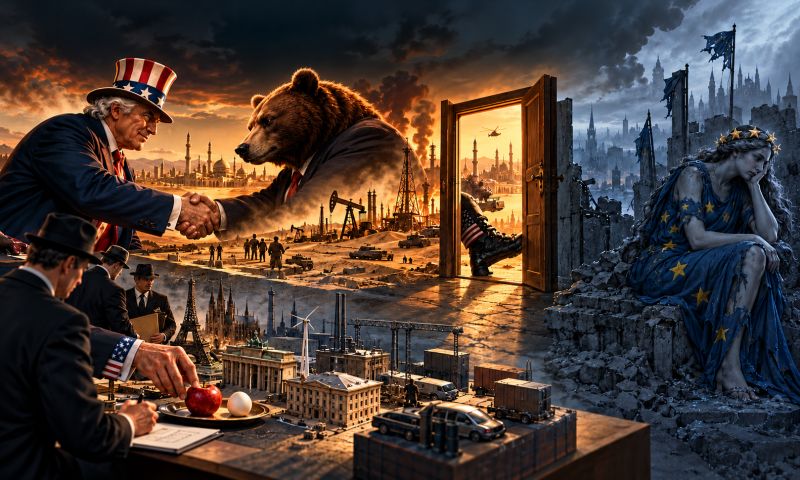
Is the U.S. Shifting Course?


Introduction
In this article, I attempt to take a look behind the scenes of the politics of a president who entered the fray as a peacemaker but who, through the wars he instigated or further fueled, brought not only death and suffering. The limits of the Western hegemonic empire have been clearly demonstrated to the American president. Militarily at breaking point, economically at breaking point, and no longer taken seriously diplomatically, the U.S. will seek a way out—and will surely find one.
The statements and predictions made in this article are intended to stimulate thought and discussion. A provocative journey into the next epoch.
Poor Odds for the Midterm Elections
Trouble for Trump – Impeachment Proceedings Loom
(Only) congressional elections are taking place. All 435 seats in the House of Representatives are up for election. In the Senate, 33 of the 100 senators are up for re-election. Senators are elected for six years, and every two years, one-third of them must stand for re-election. Trump himself is not up for election.
Nevertheless, there is a lot at stake for Trump—perhaps even everything—for the remainder of his term. Many say he must expect impeachment because he has broken countless laws, for example, with the war against Iran. After Vietnam, Congress passed the War Powers Resolution. According to Congress’s interpretation set forth therein, the president may, in principle, only commit U.S. armed forces to combat operations if
Congress has declared war,
Congress has expressly authorized the deployment by law, or
a national emergency exists as a result of an attack on the United States, its territories, or its armed forces.
Still, impeachment will be challenging. While the process can formally be initiated with a simple majority in the House of Representatives, the Senate subsequently takes the lead in the proceedings, and a conviction and removal from office require a two-thirds majority—which amounts to 67 votes. Looking at the trends, there will be around 55 Democrats in the Senate after the elections; so, based on this calculation, at least 12 Republicans would have to vote in favor of convicting and removing Trump from office, which is unlikely. Nevertheless, if Trump loses both chambers of Congress, he will become a lame duck—meaning he will be heavily isolated and unable to carry out any further initiatives, provided he abides by the law, which is highly doubtful.
Currently, there are 53 Republicans, 45 Democrats, and 2 independents in the Senate. In the House of Representatives, there are currently 218 Republicans, 214 Democrats, and one independent; two seats are vacant. The Republicans thus hold a majority in both chambers.
For Trump, There's Only One Direction—Forward
Trump wouldn't be Trump if he didn't view the congressional elections as a referendum on himself. He thinks he's the greatest, and he simply can't understand why not everyone loves him. He was actually disappointed not to have won the Nobel Peace Prize again. This is just one example of the world in which Mr. Trump lives.
The Raw Data Does Not Bode Well for Trump
Things are looking grim for the Republicans right now—and therefore for Trump as well. As of October 14, 2026, the projections show the following figures:
The Democrats win both chambers: 61%
The Democrats win the House of Representatives, while the Republicans retain the Senate: 30%
The Republicans win both chambers: 11%
The Republicans win the House of Representatives, while the Democrats win the Senate: 1%
Trump Is Not the US
The president Stands at the Helm—But Others Steer
I have already commented on the mechanisms of U.S. foreign policy in my article “War Without Peace—The U.S. Strategy Has Little to Do with Trump.” If one looks beyond the self-aggrandizing man in the White House, one sees a strategy—admittedly ruthless and cold-blooded, yet consistent—pursued by the men who truly call the shots. Among other things, this strategy is characterized by endless wars. These are lucrative for those pulling the strings, as they are financed by the general public. Winning wars was never the goal; rather, the high costs and the permanent stationing of American troops at strategic chokepoints—that is, areas rich in natural resources or of political and strategic importance—were everything. In doing so, the U.S. has taken on major geopolitical risks that are increasingly proving unwise. If the U.S. does not want to drive the whole cart into the swamp, it must focus on an area where Americans are truly world-class: reinventing themselves.
The Graham Policy Did Not Outlive Its Namesake for Long
At first glance, the diesel deal can easily be dismissed as a campaign stunt by Trump, since the total volume of this agreement amounts to less than a week’s worth of U.S. diesel consumption—somewhere between four and six days. That’s a drop in the bucket and therefore cannot be justified on economic grounds. Furthermore, since this agreement, the U.S. has been holding back on providing Ukraine with target data and early warnings, and the Starlink system has also been scaled back. This makes it more difficult for the Kyiv regime to launch attacks deep into Russia. The Americans, however, contradict this statement by Zelenskyy. More far-reaching, however, is Trump’s decision to suspend the sanctions law against Russia initiated by the late Senator Graham. This is a clear indication that the U.S. is rethinking its policy toward Russia.
The West's Longstanding Desire to Weaken and Divide Russia
Could there be much more at stake? Here, I’m putting my thoughts on paper regarding a shift in direction that could have a lasting impact on the conflict in Ukraine. The U.S.—together with the British and the EU—is pursuing the goal of weakening Russia to the point where it ultimately collapses or can be divided up in order to gain access to its natural resources. The playbook, the blueprint for this strategy, was published in 2019 by the Rand Corporation: “Extending Russia” (German: “Overwhelming Russia”).
The weakening and fragmentation of Russia is an old plan. For the sake of simplicity, let’s begin our list of attacks against Russia with the Crimean War (1853–1856). Russia was not ultimately defeated, but it lost its right to the Black Sea Fleet and had to wait until 1871 to regain it. The Russo-Japanese War (1905), an attempt financed by the City of London, was the next attack on Russia’s military power. World War I, combined with the October Revolution (1914–1917), which led to the collapse of the Tsarist Empire, followed shortly thereafter. However, with the Bolsheviks’ victory, the British lost control over the course of political events. World War II elevated the Soviet Union—the majority of which was Russia—to the status of the world’s strongest land power. The collapse of the Soviet Union (1991) led to the sell-off of its most valuable industries through oligarchs financed by the Rothschilds and other Anglo-American backers. This brought the City of London closer than ever before to achieving its ultimate goal. In addition to the money from their patrons, the oligarchs under Yeltsin wielded political influence that could be described as considerable, if not all-encompassing. It was not until the election of President Putin that the reins of power were wrested from the oligarchs—and thus from the City of London. This is one reason why the British hate Putin like the devil hates holy water.
Wars caused Russia to bleed, suffer, and grow weaker, but they never managed to herald its downfall. The events of 1917 and 1991 confirmed Clausewitz’s (paraphrased) statement that Russia cannot be defeated from the outside, but only destroyed from within. The attempts after 2000 to install figures such as Navalny or Khodorkovsky were trivial endeavors, as they failed from the outset due to their lack of standing in Russia. Ultimately, they resorted to using Bill Browder, a convicted tax fraudster, to stir up sentiment against Russia—without the slightest success in Russia.
The proxy war on Ukrainian soil is yet another attack by the West—waged by any means necessary, whether military, political, or economic—that is failing miserably. Never has Russia been stronger militarily, economically (Russia has the lowest debt in the world, with the exception of a few microstates), or socially: the vast majority of the population fully supports Russia’s geopolitical direction.
Unlike other political actors, the Americans seem to be realizing this more and more clearly, especially since, in addition to the war against Russia in Ukraine, they have created a problem for themselves in the Middle East that also appears to be spiraling out of control.
The U.S. Could Lose the Middle East Entirely
The Decline of U.S. Power—Step by Step Since 1979
The Americans had dominated the Middle East since World War II. First, they took over Saudi Arabia from the British, and after the Ajax coup (1953), they also neutralized the British in Iran. In 1979, they lost one of their two major partners: Iran. The Iran-Iraq War (1980–1988), which they subsequently instigated, may have benefited the American defense industry and, initially, American oil interests in Iraq, but it ultimately failed due to the resilience of the Iranians.
The subsequent conflicts beginning in 1991 (Iraq in 1991; Afghanistan starting in 2001, Iraq in 2003, Libya in 2011) were, in turn, a feast for the military-industrial complex, but left behind nothing but destruction and death—and no sustainable business results for the Americans. After Netanyahu had spent a quarter-century trying to persuade every U.S. president to launch an attack on Iran, he finally succeeded with the “blond-haired one” in February 2026. The result was—and remains—not only a military fiasco for the U.S. and Israel, but also led to a strengthening of the “Axis of Resistance” on a scale neither Israel nor the U.S. had ever anticipated.
The Strait of Hormuz is controlled by the Iranians—along with Oman. Bab al-Mandab is controlled by Ansarallah and appears to have the best chance of overthrowing the House of Saud, although Alastair Crook, our renowned expert and author, believes that the greatest threat to MBS comes from within: MBS is thus fighting a war on two fronts—a military conflict he seems unable to bring under control, and a family feud. The assistance he receives from the French and British is limited to his personal protection. The Saudi armed forces consist of well-paid mercenaries who are getting rich but certainly do not want to give their lives. The situation is similar with the “official” Yemeni armed forces. On top of that, Iraq and Jordan could tip over, and the situation in Syria is also unstable. The Mecca Accord has yielded no results so far: no one wants to invest blood.
A Domino Effect is a Real Possibility—British Architecture Is Going Under
If the House of Saud falls, the other Gulf monarchies will inevitably follow. Then the Americans will be left high and dry. The result would be a complete territorial and political restructuring of the entire region, which was drawn up with pencil and ruler by the British (with the help of the French) under the Sykes-Picot Agreement. Through Sykes-Picot and subsequent British influence, the following countries were “founded” up through the 1970s to secure Anglo-Saxon dominance: Syria, Lebanon, Iraq, Palestine, and Transjordan (which later became Jordan) as a direct result of Sykes-Picot, as well as Saudi Arabia, Kuwait, Bahrain, Qatar, the UAE, and Oman thereafter. All of these countries are in danger of collapsing. They are not organically developed nation-states, because they lack a shared national identity. They are artificial constructs, corporations whose leaders have been endowed with money and power to represent the interests of their founders. These constructs survive as long as they are not under pressure, since in a crisis, the populations are completely unable to recognize for whom and for what they are actually fighting.
Although the Americans and Israelis are currently making extensive preparations for war, it is out of the question that another bombing of Iran would bring any progress for the Americans. The “Mother of All Bombs,” which is now being discussed, is indeed the largest American conventional bomb, weighing 11 metric tons, but it would do little more than kick up some dust against Iran’s bunker infrastructure, which lies beneath more than a kilometer of granite. Even nuclear bombs would accomplish nothing—except for causing radiation contamination. Apart from that, the Iranians have already threatened that, in the event of an attack, they would reduce the Gulf states and Israel to rubble and ashes—which experts believe is indeed possible. I rule out a ground offensive against Iran, as this would require at least several million combat troops to stand a chance against an Iranian military currently numbering 3 million soldiers. The U.S. simply does not have such an army at its disposal, neither with nor without NATO support. As a marketing stunt, the U.S. might possibly capture a small island, but holding it and seeing the point of such an offensive would likely defy all military logic.
To bring the Houthis under control, substantial ground forces would also be needed; but here, too, nothing will be done that could weaken the Houthis' position.
Haven't Read Sun Tzu or Not Understood It
I consider the chances that the Americans will even be able to maintain their position in the Middle East to be slim. The Americans have completely underestimated the Iranians, Ansarallah, Hamas, and Hezbollah, and overestimated the Israelis. Life and history have shown time and again that underestimating one’s opponent can lead to ruin; one example of this was Germany when it invaded the Soviet Union. Trump spoke about Iran the way Hitler spoke about the Soviet Union.
The 2,500-year-old classic on the art of war—Sun Tzu’s "The Art of War"—is frequently cited and taught at American military academies, but it is evidently neither understood nor put into practice. Knowing one’s enemy and one’s own strengths—and, above all, weaknesses—is arguably the most important prerequisite for winning a military conflict.
Israel, as a Nazi State, Will Face the Persians, Arabs, and Turks—All by Itself
The Israelis, who claim to be the Jewish people—a claim I dispute—have been committing genocide since 1948; starting in 2023, they have elevated these massacres to a perverse art form and are in no way outdone by the Nazis in this regard. I would like to add, however, that while the Nazis committed these crimes in secret, the Israelis commit these horrendous acts in full view of the public and are even proud of them. The Zionist propaganda machine, fueled by billions, is faltering even in the West, although virtually every media outlet in the West supports this genocide. Even the Swiss magazine "Weltwoche", whose publisher Roger Köppel repeatedly emphasizes that he always takes the position opposite to the mainstream, does not do so in this case—he fervently promotes the genocide by denying it and selling the “Greater Israel” project as a project of peace and democracy.
Aside from these repugnant people who promote genocide, no one likes the Israelis. How could they, when the vast majority of the Israeli population supports genocide? Though the West keeps it quiet, the following countries deny entry to Israeli citizens: Afghanistan, Algeria, Bangladesh, Brunei, Iran, Iraq, Kuwait, Lebanon, Libya, Syria, Yemen, and the Maldives. Entry has also been made more difficult by Malaysia, Pakistan, Oman, and Saudi Arabia. This has less to do with Israel as a state; rather, thousands of videos are circulating showing Israeli tourists behaving in an unacceptable manner as if they were “master race”—for example, in Thailand, where many restaurants no longer serve Israelis. Since most people are too ignorant to distinguish between Zionists and Jews, Jews are once again bearing the brunt of the blame and being held responsible for the unacceptable behavior of Israel, a Zionist project; see my article “Anti-Zionism Is Not Anti-Semitism.”
I assume that the victims themselves will resolve the issue with Israel. If they apply the principle of tit-for-tat in choosing their methods, we’re in for a rough ride.
A New U.S. Strategy—Russia as an Advocate in the Middle East
It’s always foolish to underestimate the opponent, and it would be naive, dangerous, and wrong to judge American strategic thinking by Trump’s foolish ramblings. An intelligent strategy for the U.S. in this difficult situation could in fact be to give the Russians free rein—in the near future—by withdrawing support for Ukraine and the Europeans backing it there, which would lead to a rapid collapse of the Ukrainian front and allow the Russians to achieve a swift military victory.
Given the current situation and the balance of power in the Middle East, it is likely that the Americans will lose their dominance over one of the richest regions in the world: Following the fall of the House of Saud and the Gulf states, the U.S. will lose its military bases in the region and will attempt to maintain its commercial influence—for example, through production licenses—which it will likely seek to acquire from the successors. Without the influence of a powerful advocate, this will not be possible. In the new Middle East, the Turks, the Iranians, the Chinese, or the Russians could serve as such advocates. President Erdogan is not a wise choice—he is about as reliable as Trump; nor are the Iranians, who have attacked the U.S. on multiple occasions. The Chinese are a second-best option, as they are viewed by the U.S. as its main adversary. The Russians offer good assurance, if only because they always keep their word in international treaties. This may not fit with Western propaganda at all, but President Clinton said on September 25, 2013: “He kept his word in all the deals we made.” When asked whether Putin had ever broken a personal agreement with him, Clinton replied: “No, he did not.”
The Americans therefore have good grounds to make amends with the Russians.
The Consequences for European States, NATO, and the EU Will Be Severe
The Americans would thereby abandon Europe, undermine NATO, and neutralize the EU as a center of power. If the U.S. leaves Europe, Europe will not be able to finance the costs of fighting a (fictitious) enemy, let alone provide troops.
The most bellicose figure in Europe is Friedrich Merz, who, with Germany on the brink of economic collapse, has made the Russian threat Germany's top priority.
“My biggest concern is NOT our economy. My biggest concern is the influence Russia exerts on our society.”
That borders on madness, since the Germans have absolutely no desire to go to war against the Russians. Or is it not madness after all?
Merz may follow in the footsteps of Hermann Göhring, who said:
“Of course, ordinary people don’t want war—neither in Russia nor in England nor in America, nor in Germany. That goes without saying. But ultimately, it is a country’s leaders who determine its policies, and it is always easy to rally the people … All you have to do is tell them they are under attack and denounce the pacifists for a lack of patriotism and for endangering the country. That works the same way in every country.”
Hermann Göhring, April 18, 1946
The blood in the veins of the European peoples is beginning to boil: No one told them that they would be doomed because of their aggressive stance toward Russia. The unrest in France, Italy, and Albania is proof of this—it will spread both geographically and in intensity.
These are not the conditions needed to survive, let alone thrive. Thanks to Western media propaganda, however, most Europeans do not yet sense the smell of doom.
Unless a miracle happens, Europe will become a poorhouse, and then the Americans—with companies like BlackRock—will come back and buy up Europe for 10 cents on the dollar—all while proclaiming friendship. How did that go again with World War II and the U.S.’s “friendly” rescue of Europe?
Conclusion
This thought experiment certainly finds fertile ground in today’s realities. It would be a path that could prevent a world war among the great powers—and thus, ultimately, the great nuclear Armageddon.
Can this American plan be communicated to their own people?—What Europeans or Zelensky say, think, hope for, and want is irrelevant.
«Is the U.S. Shifting Course?»