


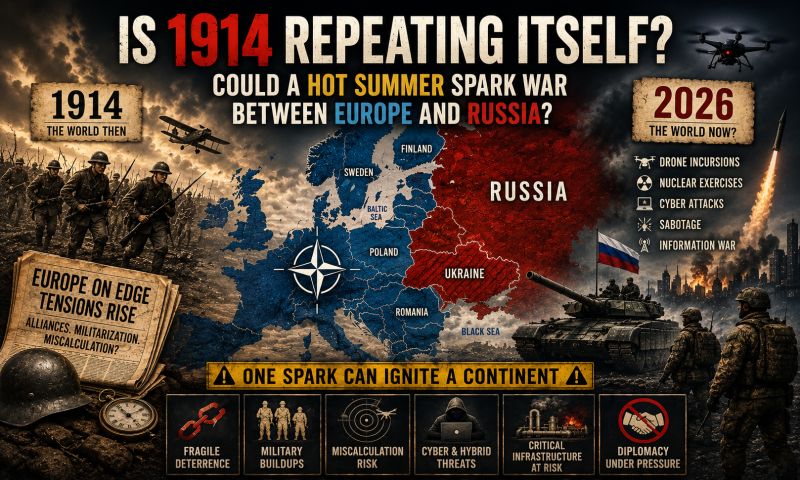
Is 1914 repeating itself? Will war between Europe and Russia finally break out openly?






Introduction
The outbreak of war in 1914 came as a surprise to many, as they were unaware that the British had set a trap for the Germans that snapped shut in the summer of 1914. Even 100 years later, Christopher Clark wrote the bestseller “The Sleepwalkers: How Europe Went to War in 1914,” implying that the war had been unintended and avoidable. Like all major wars, the British left nothing to chance—everything was calculated, and the culprit was identified from the first day of the war: Germany. A falsehood that persists in history books to this day. The British and Americans also had a hand in the outbreak of World War II. After this war, too, both managed to present themselves as great liberators (see our article “Will Evil Prevail?”).
If war were to break out in Europe for the third time in 112 years, the culprit would already be identified: Russia. Since 2014, Europe and the US have been waging a war against Russia, so far limited to Ukrainian territory. That could change soon.
In March/April 2022, a few weeks after the start of the special operation, Russia attempted to reach an agreement with the Ukrainians, which nearly succeeded. Then Boris Johnson appeared in Kyiv as an envoy of “Perfidious Albion” and saved the war. The subsequent major NATO counteroffensive in the summer of 2023 failed miserably against the Russians’ fortifications—NATO’s humiliation was great, Ukraine’s losses terrible. In total, they amount to 2 million dead and millions wounded, which corresponds to nearly 10% of the remaining population in 2026. The Russians have likely suffered around 200,000 casualties; relative to a total population of 147 million, that is few. For the bereaved families on both sides of the front, it is a catastrophe.
The will to win, loyalty to the homeland, and military and strategic superiority are reflected, among other things, in the number of volunteers. In Russia, approximately 1,200 volunteers continue to sign up for the front lines—every single day. The situation in Ukraine is the exact opposite. Bounty hunters are hunting young men like animals, leading to increasing attacks on them by the local population; even heroic grandmothers are taking up sticks against this scum, because deployment to the front in Ukraine means certain death or capture as a prisoner of war. The regular troops have been so decimated that the forcibly recruited, fresh new soldiers, who have undergone a two-week crash course, either die or desert.
Even after four years of war, the Western media paint a different picture, though they are increasingly struggling to substantiate their propagandistic predictions of a Ukrainian “victory” and a Russian “collapse” with facts. Yet this “journalism” is still enough to keep the more naive readers hanging on.
“Ukraine now serves merely as a fig leaf for Europe’s open war against Russia”
NATO is escalating a war in which, by its own account, it is not officially directly involved, but the truth is quite different. Starting in 2022, it first supplied artillery, then main battle tanks, then fighter jets, then missiles, then cruise missiles—all as part of a package that included on-site experts to maintain, program, and guide these weapons.
According to the Research Service of the German Bundestag, Germany had already left the “safe zone of non-belligerence” as early as 2022 by training Ukrainian soldiers on the delivered weapons . This official analysis and assessment dates back merely four years and strikes the reader of 2026 as a document from pre-war times.
Since then, countless red lines have been crossed, and we already reflected on this in early February 2023 in “Sleepwalkers at Work: World War III Has Likely Already Begun.” The escalation across Europe has recently reached a point where even the Russian leadership, which is striving for a diplomatic solution, will no longer be able to ignore the realities. European countries are preparing to station nuclear weapons in Poland and are producing thousands of drones—manufactured outside Ukraine—capable of reaching and damaging infrastructure deep within Russia. On May 22, the brutality reached a new peak: In Luhansk, a student dormitory was attacked by over a dozen drones—notably at night, while all the students were asleep. The result: 21 dead students and scores of wounded. The similarities to Israeli warfare are striking. Moreover, these attacks are evidently being launched not only from Ukraine but also directly from the Baltic states. Furthermore, in an interview with the “Neue Zürcher Zeitung” (NZZ) on May 18, the Latvian foreign minister even claimed that NATO has the means to “razed to the ground” Russian military installations in Kaliningrad.
The current attacks can no longer be described as Ukrainian. Ukraine now serves merely as a fig leaf for Europe’s open war against Russia.
Europe's Lack of Fear of War
The escalations described here stem from Europe’s mistaken belief that Russia’s restraint in the face of years of Western provocation is a sign of weakness. The fact that Europeans interpret this patience and desire for de-escalation in this way only increases the risk of a major conflict. The Russians have good—indeed, very good—reasons to prevent another direct war with Europe. No country—except China—suffered on such an apocalyptic scale during World War II as the Soviet Union. This is still omnipresent in Russian society today. President Putin knows this, and a de-escalatory stance regarding war is the hallmark of a president who respects and honors the 27 million victims.
Europeans, on the other hand—especially the Germans—have completely lost their fear of war, including nuclear war. These are not mere assumptions, but proven facts. For instance, as early as May 2022, when the arms delivery bonanza in Germany was really taking off, Friedrich Merz announced that he was not afraid of a nuclear war. While Merz was still in the opposition in 2022, this fool is currently the Chancellor. Anyone who isn’t afraid of a nuclear war is a fool. The German media downplays this statement—but we’ll see below that Mr. Merz essentially meant exactly what he said.
Together with Starmer and Macron, the former flag cadet of the Bundeswehr is leading Europe toward war, with the full support of Ms. von der Leyen and Ms. Kallas, who are evidently willing to act out their Russophobia to the extent of accepting the downfall of Western Europe.
What these ladies and gentlemen seem unable to grasp is the fact that President Putin, with his conciliatory stance and goodwill toward Europe, is among the most patient. The claim repeatedly made in the West that Russia in general and President Putin in particular are aggressors cannot be substantiated by facts. In Russia, there has been intense debate since at least 2014 over whether to take a tougher stance toward Europe. There are numerous influential figures who criticize the Kremlin’s diplomacy-oriented strategy. In light of the West’s irrational policies, these views are gaining increasing support, and the proposals made are by no means limited to diplomatic notes of protest or tougher rhetoric. Russia is currently debating whether to sober up the war-drunk Europeans by force of arms, with Professor Karaganov having for years sought to persuade the Kremlin to adopt a course of action that includes the use of nuclear weapons against Europe.
“Karaganov Doctrine”
Professor Sergey Karaganov is Honorary Chairman of the Russian Council on Foreign and Defense Policy and a faculty member at the School of International Economics and Foreign Affairs at the Higher School of Economics (HSE) in Moscow. Although he is not a member of the Russian government, his influence on the views of decision-makers should not be underestimated.
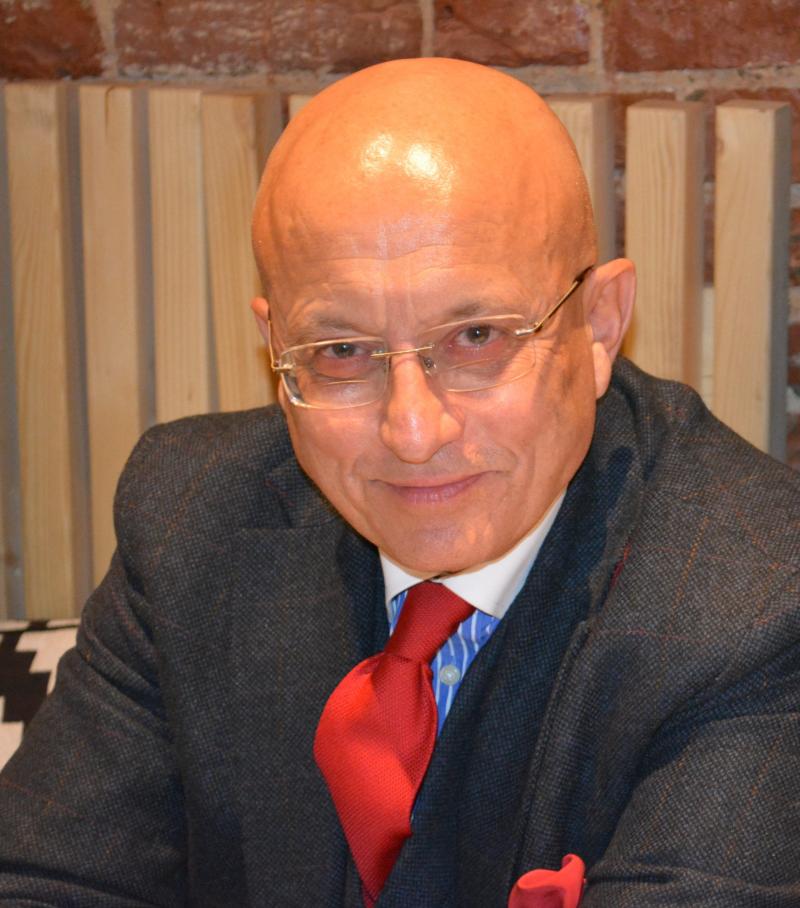
Karaganov wrote an article—a memorandum—as early as June 2023. In this essay, he placed the issues surrounding the current conflict in Ukraine within a broader context. He concluded that the government’s conciliatory, diplomatic stance would not succeed, since a Europe in decline had not the slightest interest in seeking and implementing a diplomatic—that is, peaceful—solution.
“We must not repeat the “Ukrainian scenario.” For a quarter of a century, we did not listen to those who warned that NATO expansion would lead to war, and tried to delay and “negotiate.” As a result, we have got a severe armed conflict. The price of indecision now will be higher by an order of magnitude.”
Sergey Karaganow, 13 June 2023
He believes that Russia will prevail on the battlefield, regardless of whether it conquers only the four regions that already belong to Russia (Donetsk, Luhansk, Zaporizhzhia, Kherson), additional territories, or even all of Ukraine. However, this would not solve the problem, because a purely military victory would not bring peace and would not resolve the issue. The West’s will to aggress must be broken. However, this alone cannot be achieved through nuclear deterrence, as Western Europe has lost its fear of war—even of nuclear war. Statements by Friedrich Merz from 2024 confirm Karaganov’s assertion, as Merz declared, among other things: “Freedom is more important than peace. (…) You can find peace in any cemetery.” A chancellor with such a limited understanding of politics naturally has no fear of a nuclear war with Russia either. In that case, Germany can only look back longingly to Helmut Schmidt. The former German chancellor (1974–1982), who himself served as a young officer on the Eastern Front, coined the quote:
“People who have never experienced war but who wage or provoke war themselves do not realize the terrible damage they are causing.”
Helmut Schmidt
Germans are fully justified in asking why there are no longer any wise politicians in their country these days.
According to Karaganov, at any rate, the goal is to restore this fear of war. Quote:
"We will have to make nuclear deterrence a convincing argument again by lowering the threshold for the use of nuclear weapons set unacceptably high, and by rapidly but prudently moving up the deterrence-escalation ladder."
Sergey Karaganow, 13. Juni 2023
Folglich schlägt Karaganow den Einsatz von Nuklearwaffen vor, um die Angst vor diesen Waffen wiederherzustellen und vertritt die Meinung, dass ein Vergeltungsschlag nicht zu erwarten sei, da die Amerikaner zum einen nicht ihr eigenes Land in Gefahr bringen würden und zum anderen nicht Boston für Posen opfern.
"I have said and written many times that if we correctly build a strategy of intimidation and deterrence and even use of nuclear weapons, the risk of a “retaliatory” nuclear or any other strike on our territory can be reduced to an absolute minimum. Only a madman, who, above all, hates America, will have the guts to strike back in “defense” of Europeans, thus putting his own country at risk and sacrificing conditional Boston for conditional Poznan."
Sergey Karaganow, 13 June 2023
One can certainly agree with Karaganov’s view that pursuing a diplomatic solution to the conflict will not yield a lasting result for Russia; in other words, due to the strategic aggression of Europe—and the US as well—peace with Ukraine, or whatever remains of it, will not be possible.
I do not consider Karaganov’s advocacy of a limited first strike with nuclear weapons—even following a warning strike with conventional weapons, as he has proposed—to be a wise strategy. When President Putin was asked about the Karaganov Doctrine on June 16, 2023, he clearly stated, “I reject it,” and explained, among other things:
"I have already said that the use of the ultimate deterrent is only possible in case of a threat to the Russian state. In this case, we will certainly use all the forces and means at the disposal of the Russian state. There is no doubt about that."
President Putin, 16 June 2023
Nevertheless, on November 19, 2024, the Russian Federation updated its nuclear doctrine. Sergey Karaganov had a significant influence on the public and expert debate that preceded the revised Russian nuclear doctrine, but there is no clear evidence that he was directly involved in its official drafting.
The threshold for when nuclear weapons may be used has been lowered: Russia reserves the right to use nuclear weapons in response to a conventional (non-nuclear) attack that poses a critical threat to the sovereignty or territorial integrity of Russia or Belarus (as part of the Union State). In the 2020 version, a higher threshold applied: an attack that threatens the “existence of the state.” The doctrine was supplemented by a so-called “Joint attack clause”: An attack on Russia (or its allies) by a non-nuclear-weapon state with the participation or support of a nuclear-weapon state is considered a joint attack by both states. This targets scenarios in which the West supports Ukraine. (Full text in English: here).
The new doctrine has lowered the threshold for use and widened the constellation of the attack.
I cannot judge whether the current attacks by the Europeans meet the criteria for a nuclear response.
There are two further important arguments against deployment in the current situation. If Russia—following the United States in 1945—were to launch a nuclear strike, this would make Russia a nuclear aggressor. Regardless of whether the nuclear doctrine permits such a deployment, it would be extremely damaging to the country’s reputation and place an enormous strain on relations with friendly nations. Furthermore, it would generally—and particularly for Israel and the US.—lower the threshold for the use of these weapons.
Just as in Russia, hardliners in the US are already advocating for the use of tactical nuclear weapons. Some experts (e.g., from the Hudson Institute or the Heritage Foundation, as well as figures such as Keith Payne and Elbridge Colby in the broader context of deterrence) argue that the US must have better tools for “escalation dominance,” including tactical nuclear weapons. Setting such a precedent would open Pandora’s box. The risk of further escalation would be significantly higher than it is today, and the end of humanity would be de facto within reach.
Conventional Escalation
Although the use of nuclear weapons against Europe would do more harm than good under the current circumstances, Russia will have to consider how to confront the Europeans in order to bring this conflict to a military end—the war with Europe, mind you, not with Ukraine.
Oreshnik
Karaganov’s white paper dates from June 2023—at that time, the “Oreshnik” did not yet exist. This weapon was first deployed on November 21, 2024, against Ukraine’s largest defense complex, the “Yuzhmash” corporation in Dnipro. Multiple underground floors were completely destroyed, and this was achieved without any warhead, solely through the weapon’s kinetic energy. We reported on this in “Putin Checkmates NATO – Reason for Hope?”.
The Oreshnik flies at a speed of Mach 10, which makes this weapon invulnerable. Western defense systems are effective against targets up to a speed of Mach 3. Furthermore, according to initial estimates, the Oreshnik has 6 warheads, each of which has three sub-warheads. These 18 projectiles in total can be programmed to strike different targets and are individually navigable. The kinetic energy resulting from a speed of Mach 10 alone makes the impact of this weapon difficult to imagine and brings it close to the destructive power of a tactical nuclear weapon.
Russia therefore certainly possesses means of escalation below the nuclear threshold. In terms of their effect, however, they come close to tactical nuclear weapons. The American military expert Scott Ritter provided detailed information about this weapon on November 26, 2025. “The Oreshnik Factor”—highly recommended.
Although Karaganov has mentioned the Oreshnik in his appearances since its first deployment, he does not seem willing to include it in his strategic considerations as an alternative to nuclear weapons.
Possible Strategy
Europe has been supporting Ukraine’s actions since well before 2022. By now, Europe’s leaders are openly advocating a strategy of “forever war” against Russia—a strategy that merely glosses over Europe’s role as an aggressor with empty rhetoric. Words alone cannot convince an aggressor of the wrongdoing of its actions. Russia must do more than send a signal; the use of military force against Europe itself is on debate.
The information regarding the targets of the attacks, as well as the target coordinates, comes from NATO satellites and surveillance drones and aircraft. The imposition of a no-fly zone over the Black Sea would be a first step. The US has employed this measure several times in recent decades; for example, in Iraq (1991–2003), Bosnia and Herzegovina (1993–1995), and Libya (2011).
The Collective West would howl over such a measure and appeal to international law. A weak argument from countries that created the Ukraine problem in the first place, and that advocate genocide in the Middle East, the overthrow of Maduro, and an attack on Iran. This no-fly zone would have to be enforced with radical military force from day one.
The second step would be the announcement that within 24 hours of another attack on targets within Russia, a military response would follow against the production facilities of those countries that manufacture, supply, and maintain the weapons used in the attack. Such an attack would then, however, have to result in complete destruction—and not merely serve as a signal.
The third stage of escalation would then be the announcement of the destruction of decision-making centers in Europe and the implementation of that plan. This includes military command centers, the headquarters of the relevant intelligence agencies, and, in a further escalation, government seats of power.
Conclusion
The situation for Russia is extremely serious. NATO seems to have grown accustomed to waging war against Russia “from a safe distance” without facing any negative consequences. If Russia does not immediately curb NATO’s appetite, this will further embolden the Collective West’s strategy of weakening Russia forever—“forever war.”
The strategies and possible Russian responses discussed here have the advantage of bringing about a decision, but they also carry the risk of World War III breaking out openly. Such an escalation should only be advocated by those who are prepared to sacrifice their own lives and the lives of their loved ones. On all sides of the conflict. This certainly corresponds more to the Russian mentality and not at all to the Western one.
It remains to be seen how Russia assesses the current situation and what conclusions it draws. However, the risk of a full-scale escalation is in any case significantly higher than the public would like to believe.
«Is 1914 repeating itself? Will war between Europe and Russia finally break out openly?»