


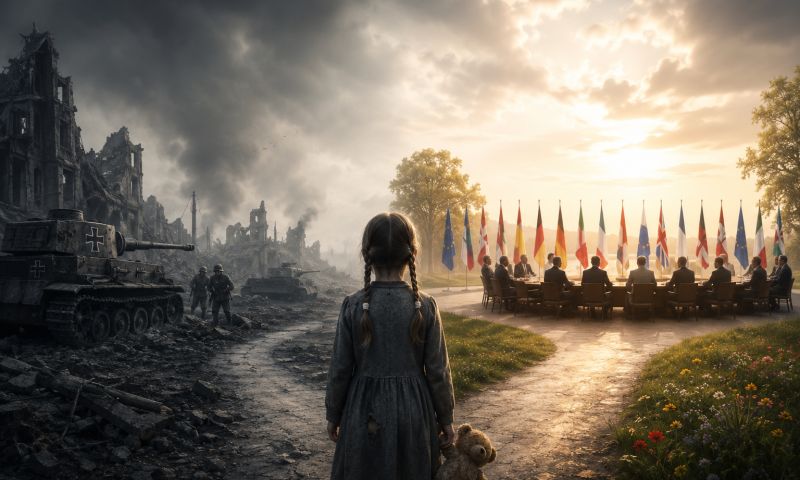
Germany does not need nuclear weapons; what it needs is, at long last, negotiations on a new European peace order






I must admit, I couldn’t believe my ears when I recently heard General Erich Vad—Angela Merkel’s former security policy advisor, who is otherwise respected for his public advocacy against the unquestioning continuation of arms deliveries to Ukraine and in favor of initiating negotiations—say in a lengthy podcast interview that Germany needs its own nuclear weapons.
Those who had been thinking deeply about the matter had, in fact, always been aware of this, but now it had apparently become clear even to the last of them that the U.S. “nuclear umbrella” would be unreliable in the event of a crisis—as would any future French one. For, in the end, no foreign power would be willing to risk its very existence because of a conflict elsewhere.(1)
Therefore, Germany’s security can ultimately only be guaranteed by its own nuclear weapons. Germany must—in Vad’s words—“go nuclear.”(2)
I think Statement 1 is correct.
Demand 2 is an idea straight out of a madhouse.
Germany can only “go nuclear” if it violates several treaties binding under international law at once—treaties that form the legal basis of our state’s existence among nations, including the most important of all treaties, the 2+4 Treaty.
If Germany were to actually disregard this (as Vads’ rhetoric does in a brash and nonchalant manner) and take serious steps to acquire nuclear weapons, it would—and it doesn’t take much foresight to predict this—very quickly realize from the reaction of the international community that it would be better to steer clear of such a course of action.
However, if—contrary to expectations—Germany were to actually succeed in acquiring nuclear weapons due to “fortunate” circumstances, this would significantly increase the likelihood of a catastrophe of considerable magnitude befalling humanity.
General Vad is the co-author, along with Klaus von Dohnanyi, of the book "Frieden – Wie geht das?" (Peace—How Does It Work?). Does that mean peace is achieved by Germany acquiring nuclear weapons?
In an interview he gave to Roger Köppel, Klaus von Dohnanyi argues that the tragedy of European history lies in the fact that Great Britain has always prevented the emergence of a continental European hegemonic power [which, in my opinion, is historically accurate] and that Europe therefore now stands, so to speak, leaderless (without a hegemon). As the United States’ hegemonic power in Europe wanes, this leadership role is now naturally falling to Germany as the strongest European power. If I’m not mistaken, that is roughly the main message of Vad and Dohnanyi.
In my opinion, this description of the situation is correct at first glance, but not upon closer inspection, since it overlooks the fact that there is already a major power in Europe—namely (“stupid!”) Russia.
It goes without saying that Germany cannot assume a leadership role in Europe simply because it does not have the power to lead Russia, the major European power.
Germany has already tried this twice in the last century. The outcome was rather unpleasant for Germany on both occasions. Given the new technologies that have since emerged, a third attempt has a good chance of ending in such a way that, afterward, there will be no one left to regret having undertaken it.
Vad wants Germany—the new (Western) European power set to succeed the American hegemon—to “protect itself” against Russia with nuclear weapons. In my opinion, that’s pretty much the opposite of what Germany should be doing.
Instead, Germany should take up Russia’s proposal, made to NATO and the U.S. in December 2021, to negotiate a New European Peace Order. In December 2021, Putin proposed to the West that they negotiate on the Ukraine issue and, by extension, on the reorganization of Europe. At the time, he was told—in a manner as arrogant as it was foolish—that it was none of his business.
Had they not done so—had they shown some wisdom and a sense of responsibility and entered into serious negotiations—then, by all reasonable estimates, Europe would have been spared the carnage in Ukraine that has now been going on for five years.
Even after hostilities began, this would still have been possible had the negotiations between Ukraine and Russia—which had already been successfully conducted in Minsk and Istanbul to the point of initialing an agreement—been continued. But the circles in power in Washington at the time and their Ukrainian followers wanted it otherwise.
What was achieved in 1815 by the Congress of Vienna and in 1878 by the Congress of Berlin is now on the agenda again. The 2+4 Treaty and the 1975 OSCE Helsinki Accords could serve as a basis for this.
A Germany that remains free of weapons of mass destruction will have to be an indispensable part of the overall arrangement. This will be true even if NATO were to cease to exist—an organization one of its purposes, after all, is to keep Germany under control—“to keep the Germans down,” as Lord Ismay, NATO’s first Secretary General, famously put it.
In the long run, Germany will not be able to achieve its security through possession of weapons of mass destruction, but only through balanced relations with its neighbors that strive to reconcile differing interests. (In this respect, its situation resembles that of Israel.)
The 2+4 Treaty allows Germany to maintain a military force of up to 370,000 troops. Currently, the Bundeswehr has significantly fewer—185,000 troops. According to the Basic Law, the mission of this army is to defend the territory. (Unfortunately, this provision of the Basic Law has been violated for many years by all sorts of excessive and illegal [because they violate the Basic Law] foreign missions—missions in which, incidentally, approximately 200 soldiers have lost their lives to date.)
The structure and capabilities of the Bundeswehr should be restructured so that any foreign power seeking to occupy Germany (Note: I currently see none.) would have to pay the highest possible price for doing so.
It is not the military’s role to do more than this; rather, it is the role of preventive diplomacy.
«Germany does not need nuclear weapons; what it needs is, at long last, negotiations on a new European peace order»