


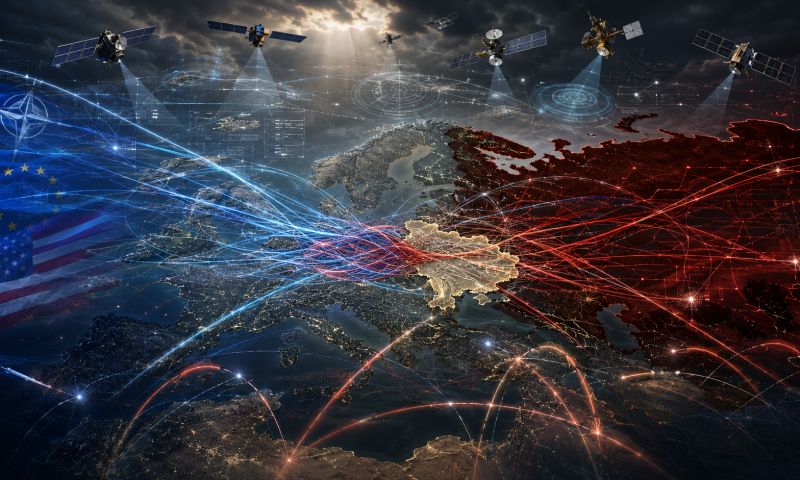
From Special Operation to War — Russia Changes Its Strategy






Introduction
Recently, a spirit was laid to rest—the spirit of Anchorage. No one knew him personally; he had never revealed his identity to anyone. Nor were there any documents describing him. And yet he was on everyone’s lips, even though those involved in this “summoning” of the spirit had interpreted him in very different, even diametrically opposed, ways.
Then the moment came: Within a few hours, the Russian president and his foreign minister spoke out about this spirit. They were followed, as if in a cascade, by a series of other leading Russian politicians.
While Foreign Minister Lavrov buried it—briefly, succinctly, and in a way that left no room for misunderstanding—the manner in which Vladimir Putin subsequently bid farewell to this “ghost” led some observers to speculate about rifts within the Russian leadership.
The events of the past few days have put an end to these speculations. The “Spirit of Anchorage” no longer has a foothold in Russia. The way has been cleared for another—in full view of everyone.
The Process of Rethinking
The conflict in Ukraine—the “Special Military Operation”—has left many puzzling since its outset as to how Russia intends to achieve its stated goals: demilitarization and denazification as prerequisites for Ukrainian neutrality, which must necessarily entail a renunciation of NATO membership. The longer the conflict dragged on, the more this speculation in the West was reinterpreted as a sign of Russia’s weakness. Any boundaries set by Russia—the famous “red lines”—were ignored and crossed, while Ukraine was flooded with weapons, money, and the conviction that the West would stand behind the illegitimate clique in Kyiv at all times and that together they would tear Russia to pieces. If not today by Ukraine alone, then by 2029 or 2030 at the latest, together, “side by side” with NATO.
This is the background to the decisions that have been taking shape within the Russian leadership—in full view of everyone—over a period of several months. The Ukrainian drone attack last fall on the Russian president’s residence in Valdai and a nearby command center for Russia’s nuclear forces can be considered the starting point.
Ukraine cannot carry out attacks of this kind on its own. The drones used could not have been manufactured without Western assistance; technically, the target coordinates could only have come from the United States or the United Kingdom; and Ukraine received the routes to the specified targets from the United States based on American satellite and intelligence data.
There is much to suggest that, from that point on, the Russian political and military leadership scrutinized every move by the West as a whole—and by the U.S. in particular—to ensure it was consistent with the agreements reached in Alaska, the “spirit of Anchorage” so often invoked by the Russian side. Putin refrained from publicly criticizing the U.S.’s behavior and repeatedly extended verbal overtures to Trump; however, Trump and his inner circle, in their hubris, interpreted these solely through their American lens.
The Dawn of a New Reality of War
Such an arrogant, high-handed approach by the U.S.—with NATO and the EU following in its wake—was bound to prompt Russia to make decisions whose implementation will create a new reality of war in Ukraine and possibly beyond. Russia’s cautious approach toward the U.S. in the Iran conflict could also have served as a warning to the U.S. and its vassals. But rational behavior is not part of the code of conduct of today’s Western leaders. There is much to suggest that, in the literal sense, the West is politically, economically, and militarily up to its neck in water—and in some cases even higher—and that its basic survival instincts have been severely disrupted. A drowning person can only be meaningfully helped if he is willing to accept help.
And so, in recent days and weeks, Russia has intensified its attacks on Ukraine in a way that neither Ukraine nor its sponsors seemed prepared for. The strategically important city of Konstantinovka has been captured, and the equally important city of Liman is on the verge of falling.
The airstrikes have been specifically expanded to target Kyiv, particularly its production and storage facilities. The four massive attacks carried out over the past 14 days have become increasingly intense, precise, and devastating with each instance, as Russian troops have adjusted their tactics to leave the Ukrainians with no warning time. This has particularly severe consequences for the defense industry when personnel lack the crucial 10 minutes needed to evacuate.
Three 5-star hotels were also hit, though Ukraine did not even mention them in its propaganda statements. The Kyiv suburb of Vishnevoje was largely destroyed—not by Russian weapons, but by secondary explosions following a Russian missile strike on a massive weapons depot located in the town that contained large quantities of American ammunition. There is also talk of a large number of Patriot air defense missiles. It should also be noted that storing ammunition in urban areas is prohibited under international agreements. This is yet another story that has been completely ignored by the Western media.
But the real news of the past few days was the following:
“There is a war going on—a real war. Do you know why it’s a war? Because it all started as a ‘special military operation.’ It’s continuing as a war because Kyiv has the backing of Berlin, Paris, The Hague, Oslo, and, unfortunately, Washington as well. Because they’re helping it aim using its satellites and helping it direct foreign weapons at our targets through its entire infrastructure. Under these circumstances, we must realize: The regime in Kyiv is capable of anything.”
Dmitry Peskov
This is what Dmitry Peskov, the Russian president’s spokesperson, said in an interview with the Russian newspaper “Vesti” on July 5, 2026.
The significance of this statement is a logical continuation of the remarks made by President Putin and Foreign Minister Lavrov, which we referred to above. Before speculation gets out of hand, let’s strive for a sober analysis of Peskov’s words.
When Russia launched its Special Military Operation in February 2022, the Russian leadership described it, both politically and legally, as an operation to liberate the Luhansk and Donetsk Republics, which had previously been recognized by Russia under international law. This defined the scope of the SMO as limited to the territories of these regions, which now belong to Russia.
No one could have foreseen how events would unfold. Even though the West had been doing everything in its power since 2014 to transform Ukraine into an anti-Russia, it was impossible to predict how far the so-called “collective West” would go. There was likely hope within the Russian leadership that an agreement with the West regarding Ukraine could be reached at some point. An agreement WITH Ukraine became increasingly unrealistic due to developments, especially since the Russian president pursues a legalistic approach. The leadership in Kyiv, for one, lacks legitimacy and, for another, has repeatedly demonstrated that it is not capable of negotiating.
The Donbass—that is, the Luhansk and Donetsk regions—is under Russian control except for a few square kilometers. With the final takeover of these areas, the Russian leadership needs a basis for lifting the territorial restrictions on the SMO in the Donbass.
By explicitly naming the participating Western countries and specifying the nature of their involvement, it will be difficult for the West to refute the characterization of its involvement as a war against Russia.
Conclusion
The verbal reference to a “war” is not new. As early as March 22, 2024, Peskov made the following remarks in an interview with “Argumenty i Fakty”:
“We are in a state of war. Yes, it began as a special military operation, but as soon as that clique formed there and the entire West intervened in the conflict on Ukraine’s side, it was already a war for us. I am convinced of that. And everyone needs to understand this in order to mentally prepare themselves for it.”
Dmitry Peskov
Russia evidently had high hopes for U.S. President Trump’s willingness to make peace and avoided virtually any criticism of his behavior. The Anchorage meeting must be viewed against this backdrop. However, as it became increasingly clear that, on the one hand, Trump could not prevail against the hawks in the U.S. and, on the other hand, he likely did not even want to, a process of rethinking began among the Russian leadership that dragged on for months.
When Peskov spoke of a “state of war” in 2024, that phrasing still left room for interpretation. Today, his statement is: “We are at war—a real war.” And he names the parties involved.
«From Special Operation to War — Russia Changes Its Strategy»