


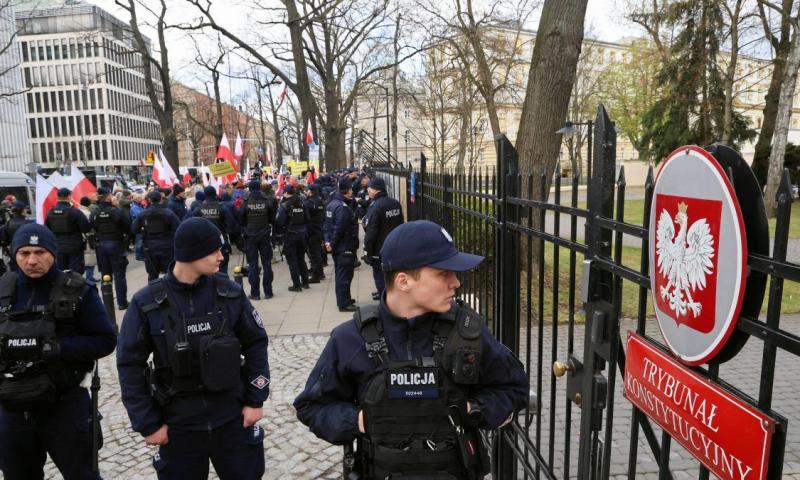
Coup d'état in Poland


Introduction
Europe is sinking ever deeper into political, economic, and social processes that, until just a few years ago, were perceived in Western Europe as “normal” aspects of life in countries in Africa, Asia, and Latin America. In recent weeks, for example, France, Italy, Spain, and Germany—and this list is by no means exhaustive—have witnessed acts of arson and looting whose brutality came as a shock to many citizens. Political elites were quick to look everywhere for the causes, but not within their own way of conducting politics, which is completely detached from the will of the people. The blame was placed on everyone else: migrants, clans, random troublemakers, radical leftists, radical rightists, and—not to be forgotten—Russia. …
Of course, this kind of search for causes does not stand up to an honest assessment of the situation. Europe has been in a massive crisis for years, one that has now engulfed all areas of life.
Wrong political decisions led to political crises. These were inevitably followed by an economic collapse unprecedented since 1945. The blame lay—and still lies—with, who would have thought, Putin. It was he who guided Chancellor Scholz’s hand in shutting down Nord Stream. Not to mention other “hybrid” attacks on the peace-loving NATO and EU West.
The Shift from Quantity to a New Quality
The constant denial of well-known causes of crises inevitably exacerbates them. Poland has now reached a new, previously unknown level of crisis. However, the events surrounding the Polish Constitutional Court cannot be viewed in isolation, as Poland plays a central role in the plans of the EU leadership. These events are part of a dramatic escalation of the EU-wide political crisis and have reached a new level in Warsaw.
Occasionally, the Western media refers to a “coup d’état,” as here or here. The quotation marks are intended to underscore the impossibility of such a development rather than to be taken as a direct quote. A critical, objective examination of the events in Poland, however, would at the very least have to compare the events to the definition of a coup d’état—something that is consistently omitted.
“A putsch or coup d’état (often from the French coup d’état [ˌkudeˈta]) is an illegal, usually violent, and surprise action carried out by members of the military or paramilitary organizations and/or a group of politicians with the aim of seizing or retaining power in the state.”
Wikipedia.
Was that the case in Poland? Why would anyone do that? Who would have an interest in it?
Let’s recap. On October 30, 2026, Polish Constitutional Court Justice Anna Korwin-Piętowska ordered Constitutional Court President Bogdan Święczkowski to immediately suspend his official duties for one month. She issued the same order for Vice President Bartłomiej Sochański and declared herself the new head of the court. In other words, the subordinate declared her superiors removed from office.
As far as is known, she did so on the instructions of Prime Minister Donald Tusk.
However, a Polish prime minister has no authority whatsoever to intervene in this manner. Tusk’s actions were therefore unlawful—or, as described in the definition above, “illegal.”
To enforce his directive and support Anna Korwin-Piętowska, Prime Minister Tusk deployed the police against the Constitutional Court. He thus used his power to deploy armed forces against a constitutional body. His actions therefore met another criterion of the definition: “… mostly violent and surprise actions by members of the military or paramilitary organizations…”.
Did Donald Tusk also have the “…goal of seizing power in the state or retaining it for himself”?
All the events described took place during a long-planned trip abroad by Polish President Karol Nawrocki to Senegal. Furthermore, the operation took place on the eve of an important national holiday, All Saints’ Day. Tusk knew that at that time, a great many people—especially those from Warsaw—would be on their way to visit their families. The timing of the operation thus appears to have been well-planned. When Nawrocki was informed of the events in Warsaw during his outbound flight, he immediately returned to Poland. Upon arrival, he went directly to the Constitutional Court, where he forcefully gained access—pushing past police barricades and even confronting Constitutional Court justices loyal to Tusk. What we’re talking about here is an attempt to deny the president of a country access to the very institution that embodies the constitution. These scenes speak volumes about the individuals and their backers who caused this national crisis.
A Look Back
In 2023, parliamentary elections were held in Poland. The current Prime Minister, Donald Tusk, had until then been one of the most prominent and influential EU politicians and, in his actions, an extremely loyal follower of EU President von der Leyen. In 2023, one could not help but get the impression that Tusk had not been sent to Poland by the EU leadership to become Poland’s prime minister, but rather, above all else, to advance the interests of the EU. In his election campaign, he focused on the following priorities: ending the power of the “Law and Justice” (PiS) party, restoring the rule of law, and normalizing relations with the EU in accordance with the EU’s wishes. The latter involved, in particular, rolling back the PiS government’s judicial reforms. This referred, among other things, to the manner in which judges were appointed to the Polish Constitutional Tribunal, as well as the replacement of those judges who did not conform to EU expectations. It should be noted that while the judicial reform implemented by the PiS government was not to everyone’s liking, it had been carried out in accordance with Polish law.
The results of the 2023 elections were as follows:
Party/Alliance | Share of the vote | Seats | Comparison with the Last Election |
Law and Justice (PiS) | 35,38 % | 194 | Minus 41 Seats |
Citizens' Coalition (KO) | 30,70 % | 157 | Plus 23 Seats |
The Third Way (Trzecia Droga) | 14,40 % | 65 | New to Parliament |
New Left (Lewica) | 8,61 % | 26 | Minus 23 Seats |
Confederation (Konfederacja) | 7,16 % | 18 | Plus 4 Seats |
Voter turnout, at 74.4 percent, was the highest since 1990.
Tusk remains the leader of the “Civic Coalition” to this day and, in 2023, formed a coalition government together with the “Third Way” and the “New Left.” However, all his efforts to reverse the judicial reform were thwarted by then-President Andrzej Duda. Duda either sent the bills—drafted by Tusk for this purpose—back for review or refused to sign them.
The new Prime Minister Tusk thus pinned his hopes on a victory by Rafał Trzaskowski in the 2025 presidential election. However, Trzaskowski, deputy chairman of Tusk’s “Civic Coalition” party, suffered a surprising and very narrow defeat at the hands of the current president, Karol Nawrocki, who is closely aligned with the PiS.
Kandidat | Political Party Support | Share of the vote |
Karol Nawrocki | Supported by the “Law and Justice” (PiS) party | 50,89 % |
Rafał Trzaskowski | Supported by the ruling “Citizens’ Coalition” (KO) | 49,11 % |
The European Dimension of the Scandal
As previously mentioned, Tusk was a highly influential politician in Brussels until 2023. Given the EU’s aggressive policy toward Russia and the role assigned to Poland in that context, the ongoing uncertainty surrounding the Polish Constitutional Court has a significant European dimension. After all, a court inclined to make its own decisions independently, without EU influence, is certainly capable of producing surprises.
It is therefore entirely conceivable that the script for this Polish drama was not written exclusively in Warsaw. This is because the judicial reforms demanded of Poland by the EU are by no means welcomed everywhere in Poland. The PiS certainly has its own vision for Poland, independent of the EU.
Bartłomiej Sochański, the vice president of the Constitutional Tribunal—who is unpopular with the EU—served as the reporting judge in the landmark ruling of the Polish Constitutional Tribunal on October 7, 2021 (Case No. K 3/21). In this ruling, the Court held that certain interpretations of the EU Treaty by the European Court of Justice were incompatible with the Polish Constitution.
In his oral explanation, Sochański essentially argued that the Polish Constitution ranks above the EU Treaties in the national hierarchy of norms. EU law takes precedence over ordinary Polish laws only to the extent that Poland has expressly transferred corresponding powers to the EU. EU institutions may not act outside the scope of the powers transferred, and the European Court of Justice cannot override the Polish Constitution through its case law.
Conclusion
The consequences of Polish Prime Minister Donald Tusk’s actions are significant. A country that was already politically divided even before this crisis has been pushed even deeper into crisis. The country’s three most important constitutional institutions—the government, parliament, and the president—view one another with deep mistrust.
The head of government attempted to strip the president of his powers in constitutional matters. As in many other countries, however, the Polish president has a decisive vote on constitutional issues.
In the wake of Tusk’s failed attempt to reshuffle the Constitutional Tribunal, parts of Parliament are calling for the prime minister’s resignation and early elections. A forced resignation by Tusk would come at an inopportune time for EU leadership. After all, a victory by the EU-critical PiS would be anything but impossible. The PiS under Jarosław Kaczyński would likely bring Poland closer to the U.S. than to the EU. But what would the EU’s policy toward Russia look like if Poland were to align itself more closely with the U.S. than with Europe? Implementing an aggressive EU policy toward the East is inconceivable without Poland, neither economically nor militarily. And politically, a Poland led by the PiS would be a disaster for Ukraine. Party leader Kaczyński stated clearly that Ukraine “cannot join the EU with the baggage of Banderaism” and announced that he would “do everything to prevent this” if Ukraine does not stop glorifying the perpetrators of the Volhynia massacre. The PiS has already submitted a corresponding draft parliamentary resolution calling on the government to block Ukraine’s EU integration process.
I repeat the question I posed above:
Did Donald Tusk also have the “...goal of seizing power in the state or retaining it for himself”?
In court, criminal liability is assessed based on the following four questions:
Did the defendant have a motive for the crime? Did he have the opportunity to commit the crime? Did he have the means to do so? And finally: Did he have the intent to commit the crime?
«Coup d'état in Poland»