


A Pragmatic Compromise Rather than Empty Words






Military circles in Germany and Switzerland are currently complaining about the low level of preparedness of their armed forces for war and the resulting lack of a deterrent effect on Russia. Some already see the Russian army advancing unhindered to the Atlantic. Old fears from the Cold War era are being reawakened. Will bold rhetoric in the run-up to the Ukrainian summer offensive in 2023, followed by hangovers after its failure and a mood of panic, now give way to more objectivity?
Honest reassessment necessary
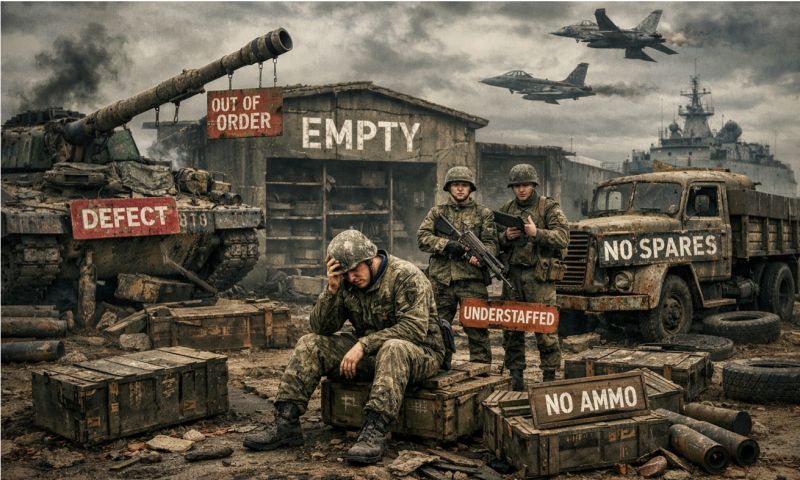
An inventory currently paints a rather bleak picture: at present, Germany is unlikely to be able to field much more than a single operational heavy division (2), whose readiness must be achieved by “cannibalizing” other units (3). In general, the Bundeswehr's battle tanks, armored personnel carriers, and artillery suffer from low availability rates, technical problems, and extremely low ammunition stocks (4). The situation is particularly serious in the artillery sector: ammunition stocks are likely to cover only a fraction of the calculated requirements and would hardly last longer than one to two days in a high-intensity conflict (5).
A key structural deficit in the Bundeswehr's so-called heavy units lies in logistics. There is a lack of specialized transport vehicles for fuel and ammunition to supply larger units over several days (6). Based on military experience, it must be assumed that the Bundeswehr can keep a maximum of 3 to 4 brigades (7) in action for a maximum of 48 to 72 hours before fuel and ammunition shortages would force them to cease combat operations – regardless of the combat strength of the troops themselves.
The German Air Force and Navy also have limited combat capabilities. Although the Air Force has modern combat aircraft, it has very limited weapon stocks and little experience in live combat. The ships of the German Navy may not be able to replace the ammunition they have on board once it has been used up, as resupply at sea is likely to be difficult (8). After a few days of intensive operations, the ships would be virtually defenseless.
Another key problem is the lack of combat experience. Only a very small proportion of active personnel have ever taken part in intensive combat, primarily in Afghanistan. Some of the soldiers involved in this are likely to leave active service soon. This limited experience is not sufficient to ensure realistic training and leadership for a major conventional conflict.
All consequences considered?
This poses considerable risks for NATO. Although Germany sees itself as a protective power for Eastern Europe, in an emergency it is itself dependent on protection from its allies. The German Armed Forces can neither defend their own territory nor sufficiently secure their forward presence in the east. An army that can only hold out for a few days is not a credible deterrent. Without an honest reassessment of capabilities, logistics, and sustainability, Germany's military contribution in a serious conflict threatens to remain symbolic—with far-reaching consequences for alliance defense.
The Bundeswehr's weak operational readiness today has its roots in the past. After the collapse of the Warsaw Pact and the Soviet Union itself, no realistic military threat was seen anymore and military capacities were reduced. One aspect of this was the suspension of compulsory military service by Defense Secretary Karl-Theodor zu Guttenberg on July 1, 2011. In view of the absence of any threat, the disruption to the life of a young man that several months of military service represents was hardly justifiable anymore. Added to this was the new range of tasks involving so-called crisis management operations across the globe. This could only be done with volunteers, as voters and taxpayers would probably have opposed sending conscripts to Iraq, Afghanistan, Mali, and elsewhere. However, the suspension of conscription had consequences that may not have been clear to all those involved when the decision was made.
What operational readiness really means
Operational readiness is generally assessed according to the criteria of personnel, training, logistics, and leadership. With regard to personnel, it was already apparent in Switzerland in the Army 95 and also in the Army XXI that the available personnel were not sufficient to fully staff all units. This was partly due to overly generous planning and partly to an underestimation of absenteeism rates. From 2009 onwards, the introduction of civilian service without a conscience test did the rest (9). This forced a prioritization of units: those that were intended for likely missions – namely disaster relief and support for civil authorities – had to be fully staffed at the expense of those for which such missions were unlikely. This naturally left frustration among those commanders of militia formations who had to go into service with understaffing (10). If units are to be guaranteed to go into action at full strength, then nowadays they probably have to be over-funded, because it is to be expected that a certain number of conscripts will not respond to a call-up. There is little recent experience to draw on. After the reintroduction of conscription, the German Bundeswehr would have to deal with similar problems. The problem is not purely military, but one that affects society as a whole: just imagine how many citizens, with and without a migrant background, would flee to safer climes in the event of a crisis in Central Europe. In the case of Ukraine, the number is now demographically relevant: according to the new defense minister, Fedorov, for example, 2 million men of conscription age are being sought! (11) The question of conscripts who are indispensable in their civilian functions would also have to be clarified before mobilization plans could be drawn up.
There are also a whole range of problems in the area of training. For example, there are training sequences that are only carried out in cases of urgent need because they are costly, because they involve a risk that is best not taken in peacetime, or for other reasons. The former include, for example, backup procedures in case navigation or distance measuring devices fail, fire control computers break down, and the like. Such devices are virtually omnipresent today.
Military training no longer takes place somewhere in the field or forest, but on specialized training infrastructure operated by specially trained personnel (12). This infrastructure is expensive and is used to its full capacity whenever possible. Redundancies are rare. This is especially true for simulators, which can also be used to practice things that cannot be done with the real equipment. It is not possible to increase the utilization of this infrastructure at will, which means that the number of units that can train on it is limited. In addition, instructional personnel must be trained in training methodology to ensure that training is targeted and effective. What is sometimes offered at our military bases is often painful for training methodologists to watch.
Achilles' heels: logistics and training
In the field of logistics, training and operational readiness result in a massive increase in the consumption of ammunition, fuel, spare parts, and repairs and maintenance. According to Russian experience, ammunition consumption increases by a factor of 30 to 50 during operations (13). The enormous ammunition stocks that remained after the end of the Cold War, especially in the Eastern Bloc countries, were justified. It is doubtful that the Swiss Army and probably also the German Armed Forces even have the depots necessary to store such quantities of ammunition safely and properly. It is a plausible assumption that training for operational readiness would increase ammunition consumption by a factor of 10 compared to peacetime consumption. It would be worth investigating whether the Swiss Army or the German Bundeswehr already possess these quantities of ammunition today.
But ammunition is only one aspect among many: spare parts and maintenance services are two others. In training operations, weapons and equipment are carefully maintained and serviced; obviously, because they need to be available again for training the next day. Such consideration can no longer be expected when the equipment is used relentlessly. That is why the National People's Army and the Soviet Army had considerable surpluses of weapons and equipment during the Cold War, which in some cases amounted to double the required equipment (14). This would also have to be provided, as well as additional maintenance personnel, spare parts, workshops, and more.
Finally, the leadership must also be trained. Commanders and staff must be given the opportunity to make decisions for an upcoming mission, review them in wargaming, and practice them in combat simulators before conducting large-scale exercises with the troops (15). During this time, someone else must work with the troops. In addition, the cadres must be supervised, because conducting war games and practicing in combat simulators also requires special know-how. In the German Armed Forces, there would probably be a strong temptation to withdraw tactics instructors from training centers if there is a shortage of cadres in operational units. However, this would have long-term implications for the training of young recruits.
Resolving all these issues, the entire process of expanding training infrastructure and logistics, creating a corps of instructors and other areas to the point where all those fit for military service can be trained to a level that allows them to participate in a mission, is a lengthy process and would probably take almost a decade in several stages, as well as consuming the $100 billion “special fund” that has been discussed in the past. “Grow immediately” is the demand. Some people imagine this to be rather simple.
Outdated image of war
However, the reintroduction of conscription and the creation of a half-million-strong army would have far-reaching consequences for the Bundeswehr's strategy: voters and taxpayers would likely set the parameters for where their army could be deployed—and where not. Would it be justifiable to deploy German conscripts in Greenland or eastern Turkey, or would their deployment be limited to neighboring countries under threat? If that were the case, then alliance defense would look very different.
Added to this is a very central point: the wars in Nagorno-Karabakh and Ukraine revealed a partly new picture of warfare, with artillery that also destroys point targets, drones that leave uncamouflaged and mobile targets no chance, highly precise aerial bombs, electronic warfare, and more. It is likely that we will have to abandon many of the ideas we had during the Cold War and the wars in the Persian Gulf, as well as during operations to suppress uprisings around the world—and many of NATO's missions in recent decades were nothing more than that. This also has implications for weapons and equipment in general (16). If the image of war is outdated (not to be confused with the concept of the enemy image), then military training becomes a reenactment of military history.
Credible deterrence is not based on announcements, but on functional equipment, ammunition, logistics, endurance, and trained personnel—and this is precisely what Germany is sorely lacking. Germany is well on its way to spending money it does not have to buy weapons that may not even be effective, to equip soldiers it cannot recruit or train, for missions whose purpose is questionable.
The federal government faces a dilemma
It is undeniable that there is currently a considerable gap between political rhetoric and military reality, and that this gap is likely to remain for years to come. In the short term, it would be wise to refrain from bold rhetoric. Strong words alone will not reassure the alliance partners in Eastern Europe and will not impress the Kremlin. In the medium term, Germany can do little more than bring selected units to operational readiness with full personnel and equipment, equipped with all the necessary supplies for weeks or months of intensive combat and trained to operational readiness. The discussion about the reintroduction of conscription – if it is to serve any purpose other than exerting domestic political pressure – will reveal the whole dilemma: a professional army is too small to impress Russia, and a large conscript army cannot be deployed to Russia's borders. Until this moment of weakness is overcome, Ukraine will apparently serve as a bulwark against Russia. In the long term, this strategy only makes sense if the war in Ukraine can be ended while it still has an army and militarily usable resources. Reducing these will be the Russians' goal in the coming months.
In the end, however, it will probably be unavoidable to find at least a modus vivendi with the unloved neighbor to the east. Chancellor Merz is apparently already preparing for this.
Notes:
1. See excerpt from Chancellor Friedrich Merz's speech at the New Year's reception of the Chamber of Industry and Commerce in Dessau. January 14, 2026: Chancellor Merz in Dessau: “Russia is a European country,” on russland.RU on YouTube, January 17, 2026, online at https://www.youtube.com/watch?v=3Fx1NMn2Xmc. Words such as “reconciliation with Russia” and generally conciliatory words are surprising in today's world, in which large sections of the press have allowed themselves to be drawn into a war course against Russia. See Sabiene Jahn: Should Merz be trusted? Signals from Russia, European disorientation, and British sobriety, at Global Bridge, January 22, 2026, online at https://globalbridge.ch/soll-man-merz-trauen-russland-signale-europaeische-orientierungslosigkeit-und-britische-nuechternheit/.
2. A division in the land forces is a large unit that is capable of independently conducting combined arms combat and has subordinate units from various branches of the army for this purpose. The personnel strength of an army division usually consists of around 15,000 to 20,000 soldiers. The division is either subordinate to brigades (typically 3) of combat troops (infantry, tanks, armored infantry) and independent units of combat support troops (artillery, engineers, air defense, reconnaissance, command support, etc.) or regiments of combat and combat support troops. Occasionally, additional regiments or brigades are assigned to a division for training or administrative purposes, such as the 1st and 10th Armored Divisions of the German Armed Forces.
3. In order to bring the allegedly “cold-start-capable” 10th Armored Division up to full strength, personnel must be transferred there from other units. For more information on the personnel problems of the Bundeswehr, see the report of the Parliamentary Commissioner for the Armed Forces German Bundestag, printed paper 20/15060, 20th legislative period Information from the Parliamentary Commissioner for the Armed Forces, Annual Report 2024 (66th report), March 11, 2025, available online at https://dserver.bundestag.de/btd/20/150/2015060.pdf. On the problems of understaffing in all personnel categories, the high average age, and the high dropout rate of newly recruited soldiers, pp. 53-59.
4. See Ferdinand Alexander Gehringer: Unfit for war! The arduous path to overall defense capability, in Die Politische Meinung, Konrad Adenauer Foundation, May 5, 2025, online at https://www.kas.de/de/web/die-politische-meinung/artikel/detail/-/content/kriegsuntuechtig. See Federal Ministry of Defense, Armaments Department, Division Rü I 4: 19th Report of the Federal Ministry of Defense on Armaments Matters, April 30, 2024, online at https://www.bmvg.de/resource/blob/5820310/c30ac0f6b6437838720d9d7e1298f6a8/19-ruestungsbericht-teil-1-data.pdf. The report shows significant delays in some projects, with the “front-runner” A-400M transport aircraft delayed by no less than 204 months and the Eurofighter Typhoon AESA by 63 months; see p. 20. In addition, there are cost overruns of up to 38% for the Eurodrone and 34% for the Eurofighter; see p. 22. See also Clemens Speer: German Army only 50% operational, in Security & Defense, February 14, 2025, online at https://suv.report/deutsches-heer-nur-zu-50-einsatzbereit/. Johannes C. Bockenheimer: New report: The German Armed Forces are lagging behind in terms of armament, in Neue Zürcher Zeitung, June 20, 2025, online at https://www.nzz.ch/international/neuer-bericht-die-bundeswehr-hinkt-bei-der-ruestung-hinterher-ld.1889921.
5. See Matthias Gebauer: Pistorius wants to order artillery shells for up to €15 billion, in Spiegel Politik, June 25, 2024, online at https://www.spiegel.de/politik/ deutschland/bundeswehr-boris-pistorius-will-artillerie-granaten-fuer-bis-zu-15-milliarden-euro-bestellen-a-9e8fe920-7cb3-46f7-ae70-8b9e8fcd1cc3.
6. See “Rheinmetall delivers around 1,400 additional logistics vehicles to the German Armed Forces,” at hartpunkt, Monitor for Defense and Security Policy, August 4, 2025, online at https://www.hartpunkt.de/rheinmetall-liefert-rund-1-400-weitere-logistikfahrzeuge-an-die-bundeswehr/ and “Made in Austria, German Armed Forces orders over 1,000 logistics vehicles from Rheinmetall,” at Militär aktuell, 05.08.2025, online at https://militaeraktuell.at/bundeswehr-rheinmetall-1-000-logistikfahrzeuge/#:~:text=German%20Armed%20Forces%20orders%201,000%20logistics%20vehicles%20from%20Rheinmetall.
7. A brigade in the land forces is a large unit that is capable of independently conducting combined arms combat and has subordinate battalions (divisions) from various branches of the army. It usually has a personnel strength of 4,000 to 6,000 and is often part of a division.
8. See Clemens Speer: Frigate 125 – a political fair-weather vessel? In Security & Defense, January 7, 2025, online at https://suv.report/fregatte-125-ein-politischer-schoenwetterpott/#: ~:text=The%20frigates%20do%20not%20have%20the%20capacity%20to%20engage%20in%20modern%20naval%20combat.
9. See “Effects of reintroducing conscience testing after recruit school,” interpellation submitted by National Council member Hurter Thomas, March 16, 2022, on the Swiss Parliament website, online at https://www.parlament.ch/de/ratsbetrieb/suche-curia-vista/geschaeft?AffairId=20223171.
10. The author particularly remembers the dispute over the personnel support of Reconnaissance Battalion 10 of the Swiss Army. The high operational readiness of the NVA during the Cold War, with at least 85% of the target strength permanently on site, came at the cost of very drastic interventions in the daily lives of the personnel. See Rüdiger Wenzke: The National People's Army (NVA) and its social and political significance, online at https://lernen-aus-der-geschichte.de/sites/default/files/attach/10976/wenzke-nva.pdf#: ~:text=Die%20NVA%20galt%20sp%C3%A4testens%20seit%20Ende%20der,etwa%20300%20Kampfflugzeuge%20und%20fast%20100%20Schiffe.
11. Fedorov recently told the Verkhovna Rada (parliament) that 2 million Ukrainians were wanted (presumably in hiding or having left the country) and 200,000 had deserted from the army. See Федоров: 2 млн украинцев находятся в розыске, а еще - 200 тысяч - в СВЧ, at RBK Ukraina, January 14, 2026, online at https://www.rbc.ua/ukr/news/fedorov-2-mln-ukrayintsiv-znahodyatsya-rozshuku-1768388384.html, in Russian.
12. In the German Bundeswehr, the combat training center in Gardelegen is the most striking example. See “Rheinmetall modernizes Bundeswehr combat training center,” in Militär aktuell, November 22, 2025, online at https://militaeraktuell.at/rheinmetall-gefechtsuebungszentrum-bundeswehr/. Similar centers exist in Switzerland in Walenstadt and Bure.
13. This was taught at the Military Academy of the General Staff of the Russian Army, which the author attended in 2013/14. The increase varies for different types of ammunition and depends on various factors. For an initial combat phase, for example, a BM-21 multiple rocket launcher (projectile launcher) can be expected to require 50 tons of rockets, which are stored close to the troops.
14. In the NVA, five mobilization divisions based on training centers were to be set up in the event of war.
Vehicles, weapons, and equipment for each division were stored in so-called complex warehouses. The Bundeswehr intends to tackle the problem of material shortages by introducing a so-called circulating reserve, which will consist of equipment that is not permanently assigned to individual units and can quickly replace defective equipment in the troops. The Swiss Army has been familiar with this concept for a long time. See Waldemar Geiger: Increasing operational readiness – Bundeswehr apparently plans to establish a circulating reserve, at hartpunkt, Monitor für Defence und Sicherheitspolitik, June 22, 2025, online at https://www.hartpunkt.de/erhoehung-der-einsatzbereitschaft-bundeswehr-plant-offenbar-die-etablierung-einer-umlaufreserve/.
15. Instead of wargaming, one can also use the old, now frowned-upon term “war game.” The author himself worked for three years as an instructor at the General Staff School in Kriens, which is also responsible for the tactics simulator.
16. This is precisely the problem addressed by the "Reform Plan for Bundeswehr Procurement until 2029. Position paper of the CDU/CSU parliamentary group in the German Bundestag, resolution of January 28, 2025,“ available online at https://www.cducsu.de/sites/default/files/2025-01/PP%20Beschaffungswesen.pdf. See chapter ”Procurement equips our Bundeswehr for the conflicts of the past," p. 8f.
«A Pragmatic Compromise Rather than Empty Words»