

A Permanent Coup d'État – Repression, Censorship and Ideological Apparatus (Part I)





Political science is, by its very nature, a highly normative discipline. When it comes to questions of governance—that is, the unequal distribution of social power—political scientists first seek solutions through the analysis of constitutions. This is why “comparative government” is a core discipline within political science. What role do constitutional bodies play, how do they work with or against one another, and how are the “checks and balances” organized? In a further step, one compares constitutional norms with constitutional practice. In all the states I am familiar with, constitutional practice deviates significantly from constitutional norms—with one exception: In the United Kingdom, there is no written constitution, and thus no constitutional norm. The constitution is a kind of common law, deriving from constitutional practice and therefore unable to deviate from it.
The Constitution as an Empty Shell
Constitutional issues are questions of power, as Ferdinand Lasalle wrote.[1] So when people speak of a coup d’état, they usually imagine a coup d’état against the constitution. What we are witnessing today, however, is a coup d’état within the constitutional framework: the constitutional shell remains intact but is being hollowed out; the state of emergency—and with it a new form of authoritarian governance—goes hand in hand with a kind of simulation of democracy. The suspension of the rule of law takes place within the constitution, which is reduced to a cocoon from which a new dictatorship is emerging.
One example of this is the extrajudicial sanctions imposed on individuals. They are stripped of all rights not through a breach or suspension of the rule of law, but by circumventing the procedures of the rule of law—procedures that are formally preserved but simultaneously replaced by a form of arbitrary rule. It is, therefore, the establishment of a dictatorship on velvet paws, whose claws remain invisible to the majority but are all the more effective for it. According to Giorgio Agamben, the state of emergency transforms “into a constant practice of governance.”[2]
The term “permanent coup d'état” was coined by François Mitterrand.[3] It was modeled on de Gaulle’s Constitution of the Fifth Republic and is gaining new relevance today. Mitterrand criticizes the president’s centralized and authoritarian concentration of power and describes how an initial coup d’état becomes a permanent one: The president appoints the government and can dismiss it; he can dissolve Parliament, call for new elections, schedule a referendum; he is elected directly by the people, is commander-in-chief of the armed forces and the nuclear strike force, can declare war and make peace, and can invoke Article 16 of the Constitution. What else is left? When Mitterrand himself was elected president in 1981, he ruled for 14 years and used this very concentration of power himself; indeed, he even personally authorized the bombing of the Greenpeace ship “Rainbow Warrior” on July 10, 1985.[4] The reinstatement of Nazi-era collective punishment in the case of Hüssein Doglu—whose wife and mother had their bank accounts frozen—shows that this is a case of blatant state terrorism directed against dissidents who, for example, adhere to the peace clause of the German Basic Law.[5] So it seems to me that this is aptly described by the term “permanent coup d'état.”
Repression without martial law: German examples
A few examples: Political scientist Prof. Dr. Ulrike Guérot was fired by the University of Bonn because she refused to go along with the propaganda narrative.[6] At the urging of the Federal Financial Supervisory Authority, the Hamburg Savings Bank has closed journalist Ulrich Heyden's account.[7] The Swiss citizen Jacques Baud, the journalist Hüssein Dogru, and others are being subjected to extrajudicial sanctions and deprived of all their rights.[8] The conviction of “Querdenker” activist Michael Ballweg is a prime example of how prosecutors, bound by official directives, abuse due process to drag government critics into court.[9] Journalist Patrik Baab lost a teaching position at the University of Kiel because of his reporting in the Donbas—a decision that the Schleswig-Holstein Administrative Court ruled was illegal and unconstitutional.[10] The Federal Prosecutor General has issued an arrest warrant for the chairwoman of the Friedensbrücke association on charges of supporting a terrorist organization, after the two Donbas republics of Donetsk and Luhansk—with which representatives of the German federal government were still participating in the Minsk negotiations as recently as 2015—were retroactively designated as terrorist organizations for a period of ten years—a move that is actually prohibited under Article 102, Paragraph 2 of the German Basic Law.[11] The list could go on indefinitely. This means that the approach is coordinated and centrally orchestrated.[12]
Political Persecution, Propaganda, Censorship: A Coordinated System
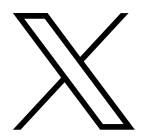
Political persecution, propaganda, and censorship go hand in hand. Together, they form an “instrument of domination used to advance economic interests, political power, and cultural hegemony.”[13]
The wave of repression against opponents of the war and the government was triggered by NATO. At their summit in Vilnius in 2023, the governments of the member states announced that they would step up their cooperation with the EU in the fight against so-called “disinformation”.[14] This suggests that NATO is pulling the strings behind the scenes in the fight against dissenting opinions. With its “Strategic Agenda 2024–2029,” announced in June 2024, the EU shifted course toward military readiness. In it, the EU Council promises to “strengthen the EU’s resilience as part of a comprehensive approach covering all threats and the whole of society.” The EU classifies everything it considers “disinformation” as an attempt at destabilization, placing it in the same category as terrorism and violent extremism.[15]
NATO Behind the Scenes
Norbert Häring rightly points out that the EU is thereby effectively declaring critics of the government and NATO to be enemies of the state. As a result, an undeclared state of emergency already prevails in the EU: “This means that NATO is effectively ruling from behind the scenes, and the usual constitutional guarantees for peacetime—such as freedom of speech and freedom of information—no longer apply when issues of importance to NATO are at stake.”[16] Last year, the German government stated that it is bound by classified NATO objectives.[17] Research shows that the governments of NATO member states are using all social organizations and forces as a conduit to subject all those who adhere to the peace mandate of the Basic Law to reprisals.
This is a cross-institutional system of political persecution. As the author knows from personal experience, it involves universities such as Kiel University (CAU) and the HMKW in Berlin, academies, foundations, and commissions such as the German-Ukrainian Commission of Historians, foundations affiliated with parties in the Bundestag such as the Rosa Luxemburg Foundation and the Friedrich Ebert Foundation, the German National Library Association, the Federal Financial Supervisory Authority, restaurants such as the “Palenke” in Kiel and conference centers—for example, by refusing to rent out spaces—local governments, online publications such as T-Online from the Ströer Group, newspapers and magazines such as Der Spiegel, the FAZ, the Sächsische Zeitung, and the Süddeutsche Zeitung, public broadcasters such as MDR, youth organizations such as the Linksjugend, state- and EU-funded so-called non-governmental organizations such as “Fake Observers,” so-called fact-checkers such as “Correctiv,” bookstores and unions such as Verdi, as well as various internet trolls such as the organization Nafu. Pressure is also being exerted through intelligence agencies.[18]
Ideological Apparatuses as Communicating Vessels
In this way, the ideological apparatuses function like communicating vessels. These are all the apparatuses that organize the intellectual reproduction of society. According to the French philosopher Louis Althusser, the task of ideological apparatuses is to ensure loyalty to the market economy and to state-mandated policies.[19] These ideological apparatuses include schools, universities, academies, think tanks funded by the state or the private sector, so-called nongovernmental organizations funded by the state or supranational bodies, foundations, transatlantic organizations, associations, federations, and political parties, public and corporate media, fact-checkers who do not actually check facts but rather verify compatibility with propaganda narratives, churches, online publications such as Wikipedia, the forgery workshop of intelligence agencies and governments.[20]
These ideological apparatuses now engage in a subtle collaboration with the repressive state apparatuses. What usually follows is a back-and-forth between the ideological apparatuses of bourgeois rule and their interlocking with measures taken by the repressive state apparatuses—the judiciary, the police, state media regulatory authorities, and tax authorities. The goal is to enforce covert censorship by circumventing due process, to compel anticipatory obedience by instilling fear in third parties, and to destroy the economic livelihoods of the targeted individuals. These public executions aim to intimidate the entire population within a new anti-democratic power structure.
Transatlantic Elites and the Academic Precariat
It is no coincidence that, at least at one university, the very people who actively pushed for his dismissal are those who feel a sense of obligation to transatlantic networks such as the German Marshall Fund. This reveals where the real masterminds behind the public campaign of censorship and denunciation are to be found. This is by no means to suggest that these actors receive instructions from Langley. Rather, the haste of their actions proves that they see themselves as having a debt to repay. After all, conference invitations, scholarships, research trips, and the approval of research projects are at stake. They believe it is better for their own careers to act as agents of legitimacy for American interests.[21]
The goal of the collaboration between ideological and repressive state apparatuses is to subject anyone who deviates from the propaganda and war agenda of NATO governments to reprisals. At the same time, they serve the purpose of instilling fear by setting an example, thereby forcing preemptive obedience among the population. However, this instillation of fear through arbitrary reprisals against dissidents did not begin with the Russian invasion of Ukraine on February 24, 2024. It began in 2020 with the coronavirus and the staged state of emergency. With the help of infection control measures, democratic procedures and individual fundamental rights were suspended by decree, thereby undermining the constitution. The mobilization of fear was intended to paralyze citizen resistance. The ruling oligarchy used the outbreak of the respiratory disease as an opportunity to declare a global state of emergency.[22]
The censorship industry is spreading into all areas of society because it can rely on two social pillars. One of these pillars acts as a transmission belt for NATO and the United States—namely, the transatlantic-corrupted academic elites. The second pillar is the academic precariat.
The primary social agents are thus those elites who are integrated into the hegemon’s worldview. A whole range of elite-integration mechanisms serve this purpose, such as the Rockefeller Foundation, the Council on Foreign Relations, the privately funded German Council on Foreign Relations (founded on its model), the German Institute for International and Security Affairs, the German Marshall Fund, the Atlantic Institute, the Atlantik-Brücke, the American Council on Germany, the American Enterprise Institute, the Heritage Foundation, and other organizations. They form a “policy-planning network” that functions as a think tank and consensus-building workshop, as a talent incubator and recruitment pool, and as a revolving door into politics, business, and the media. At the same time, they shape a prestige pipeline and numerous career paths—from Fulbright scholarships and funding from the German Marshall Fund to membership in Atlantik-Brücke or think tanks such as the Atlantic Council.[23]
The second social group has a broad impact—the academic precariat. This refers to university graduates who have to scrape by, for example, as freelancers in the media, as project workers at government-funded so-called NGOs, or as temporary employees at think tanks. For all these professional groups, it is a matter of survival to adopt the mindset and wishes of their superiors with anticipatory obedience. They are under constant pressure to inform on others in order to prove themselves to their bosses and remain within the ideological apparatus.
Political persecution, then, is not the work of the intellectually deficient, but rather reveals the academic elites’ submission to the discourse of power. The convergence of academics with NATO ideology is disconcerting, not only—as Karl Dietrich Bracher put it with regard to the Nazi worldview—in view of the primitiveness of the conglomerate of ideas from which this propaganda draws, but “even more so through the blind submission to its emphatically intolerant claim to exclusivity... But this merely demonstrates the process of self-alignment, which extended “from constitutional lawyers to economists, from historians to Germanists, from philosophers to natural scientists, from publicists to poets, musicians, and visual artists.” “Byzantinism, manipulation, and coercion are inextricably intertwined.”[24]
Transatlantic elites corrupted by the system and the academic precariat define what Max Weber once called the “steel-hard shell of servitude,” which “dictates the lifestyle of every individual […] with overwhelming force”.[25] If you want to know how things were back then, you just have to take a close look at today.
The political repression described above is not the product of bureaucratic overreach or spontaneous ideological alignment. It is rooted in a structural crisis of financial capitalism that is driving ruling elites toward war — and toward the elimination of every dissenting voice. This is what we will examine in the second part of this analysis.
[1] Lasalle, Ferdinand: Über Verfassungswesen. Vortrag, gehalten 1862 in einem Berliner Bürger-Bezirksverein. https://www.gewaltenteilung.de/tag/ueber-verfassungswesen/
[2] Agamben, Giorgio: Ausnahmezustand. Frankfurt a. M. 2020(8), S. 14
[3] Mitterrand, Francois: Le coup d'état permanent. Paris 1964
[4] Bremner, Charles: Mitterrand ordered bombing of Rainbor Warrior, spy chief says. The Times v. 11.07.2005, https://www.thetimes.com/travel/destinations/europe-travel/france/paris/mitterrand-ordered-bombing-of-rainbow-warrior-spy-chief-says-3kl9n65m8g2
[5] That will also be rolled out across Europe: Galloway, George: The UK is Now A Police State. Global Geopolitics, 31.05.2026, https://globalgeopolitics.co.uk/tag/police-state/
[6] Egner, Heike u. Anke Uhlenwinkel: Wer stört, muss weg! Die Entfernung kritischer Professoren aus Universitäten. Neu-Isenburg 2024
[7] Ulrich Heyden interview with Patrik Baab, 02.05.2026
[8] Hofbauer, Hannes: Aller Rechte beraubt. Mit außergerichtlichen EU-Sanktionen zum autoritären Staat. Wien 2026
[9] Moser, Thomas: Der missbrauchte Rechtsstaat. Wie die Politik regierungskritische Bürger vo Gericht zerrt. Köln 2026
[10] Schleswig-Holsteinisches Verwaltungsgericht Az.: 9 A 31/23
[11] Hohmann, Ralf: Alles Terror, oder was? Bundesanwaltschaft verfolgt humanitäre Helfer. Volksrepubliken im Donbass zu Terrororganisationen erklärt. UZ v. 06.06.2025, https://www.unsere-zeit.de/alles-terror-oder-was-4804000/
[12] liber-net: Das Zensurnetzwerk: Regulierung und Repression im heutigen Deutschland. 19.11.2025, https://liber-net.org/wp-content/uploads/2025/11/de-report-de.pdf
Häring, Norbert: Der Wahrheitskomplex. Wie NGO's im Staatsauftrag unerwünschte Meinungen bekämpfen. Neu Isenburg 2026.
MacMahon, Collin: Der Zensurkomplex. Wie Regierungen, Geheimdienste und NGO's ihre Büger überwachen und politisch unerwünschte Meinungen bekämpfen. Rottenburg 2024
[13] Hofbauer, Hannes: Zensur. Wien 2022, S. 7
[14] “As we step up our efforts to build resilience, we will continue to work with our partners who are undertaking similar efforts, particularly the European Union. (…) We will continue to combat disinformation and misinformation, including through positive and effective strategic communication. We will also continue to support our partners in strengthening their resilience to hybrid challenges.” Häring, Norbert: Der Bannstrahl der EU gegen kritische Publizisten geht auf einen NATO-Gipfelbeschluss von 2023 zurück. Geld und mehr v. 06.01.2026, https://norberthaering.de/propaganda-zensur/eu-sanktionen-nato-giplel/
[15] “We will strengthen our democratic resilience, including by (…) countering attempts to destabilize us, such as through disinformation and hate speech. (…) We will counter attempts to sow division, radicalization, terrorism, and violent extremism.” Häring, Norbert: Der Bannstrahl der EU gegen kritische Publizisten geht auf einen NATO-Gipfelbeschluss von 2023 zurück. Geld und mehr v. 06.01.2026, https://norberthaering.de/propaganda-zensur/eu-sanktionen-nato-giplel/
[16] Häring, Norbert: Der Bannstrahl der EU gegen kritische Publizisten geht auf einen NATO-Gipfelbeschluss von 2023 zurück. Geld und mehr v. 06.01.2026, https://norberthaering.de/propaganda-zensur/eu-sanktionen-nato-giplel/
[17] Häring, Norbert: Bundesregierung bestätigt Bindung an geheime NATO-Ziele. Geld und mehr, 07.07.2025, https://norberthaering.de/macht-kontrolle/nato-ziele/
[18] All of these examples are documented.
[19] Althusser, Louis: Ideologie et appareils ideologiques d’état. In: La Pensée, Nr. 151, Juni 1970, S. 22. http://classiques.uqac.ca/contemporains/althusser_louis/ideologie_et_AIE/
ideologie_et_AIE.pdf
[20] Buyniski, Helen: Wikipedia: Ein Sumpf aus pblen Machenschaften, Teil 1, Free21, 19.04.2020, https://free21.org/wikipedia-ein-sumpf-aus-ueblen-machenschaften-teil-1/ , Teil 3, Free21, 15.08.2020, https://free21.org/wp-content/uploads/2020/08/01-Buyniski-Wikipedia-Teil3.pdf
[21] Baab, Patrik: Auf beiden Seiten der Front. Meine Reisen in die Ukraine. Frankfurt a.M. 2023
[22] Van der Pijl, Kees: Die belagerte Welt. Corona: Die Mobilisierung der Angst - und wie wir uns daraus befreien können. Dannenberg 2021
[23] Bonilla, Nel: Die Vereinnahmung der Eliten und die Selbstzerstörung Europas. Nachdenkseiten, 07.09.2025, https://www.nachdenkseiten.de/?p=138528&pdf=138528
[24] Bracher, Karl Dietrich: Die Deutsche Diktatur. Köln Berlin 1969, S. 275
[25] Weber, Max: Die protestantische Ethik und der "Geist" des Kapitalismus. In: Archiv für Sozialwissenschaft und Sozialpolitik. 21, 1905, S. 1–110
«A Permanent Coup d'État – Repression, Censorship and Ideological Apparatus (Part I)»