


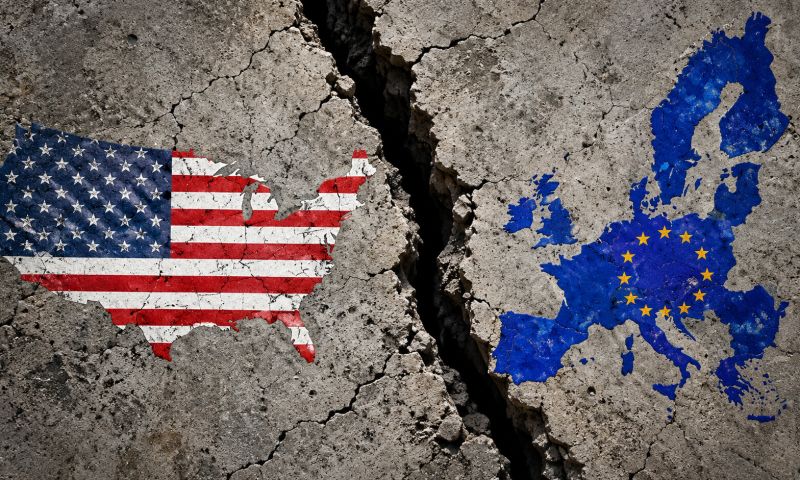
The 'War of Grand Design' Transforms to More Narrowly Bolster US Hegemony


The paradigm shifts. The networked supra-national stratum that long has pursued its global ‘grand design’ through manufacturing public consent for wars of imposed compliance has, at last, run up against the limits to power. We are, indeed, at an ‘emperor has no clothes’ moment. All can see it.
Its traditional tools — the US military, the dollar system, the credit trap, the Bretton Woods structures, shock economic therapy and currency wars — are failing to preserve the US élite weltanschauung wherein it would be ‘unimaginable’ that the US having won the Cold War were it to face a world in which the US did not continue to dictate the blueprint.
“In the golden light of an Athens evening, with the Acropolis over his shoulder”, US Secretary of State Marco Rubio, on 7 October, openly praised colonialism; he engaged in egregious erasures of history, and demanded a return to Western domination of the world. Rubio asserted that the West must use military force to “maintain its place at the head of the world”; the West is “the greatest civilization in the world”, he declared, emphasizing that it is a “civilization that we must fight to defend today with the same passion as our forefathers did”.
But now, those traditional tools to preserve its place at the head of the world are proving less effective against states that possess alternatives — China, Russia and Iran are clear pointers to the trend that economic, financial and even kinetic wars are failing to produce quick results. Quick victories for the Matrix are no longer so readily available.
To suggest, on the other hand, that civilisational states could stand up to the US more forcefully ignores everything about the deep nature of this conflict. The ‘One Global Government Grand Design', is a war to eliminate those Civilisational States that offer a different consciousness through which to view and understand the world.
What does that mean? It was former British Prime Minister, Benjamin Disraeli, who in 1846 inferred —“The world is governed by very different personages from what is imagined by those who are not behind the scenes”.
Disraeli repeatedly explicitly warned against 'world revolution' (or colour revolutions in today’s vernacular). Disraeli saw and repeatedly ‘called out’ “a design” behind the series of revolution eruptions that had occurred in many parts of the world at the time in the mid 1800s.
Today it is Emmanuel Todd, the respected French historian and anthropologist, who is echoing Disraeli: Todd sees too in today’s wars something far more profound than a series of separated and distinct territorial conflicts.
Moscow is not waging war against the 20-million odd inhabitants of Ukraine —
“It is confronting, through Ukraine, the entire Atlanticist bloc, NATO as a whole, its intelligence services, its arsenals, its satellites, its military industry, and its media machine. Ukraine is merely a theatre of operations, a battlefield in a latent world war."
Ukraine, Iran, Yemen or China — all are mere theatres of operations; one battlefield amongst many (occurring in hybrid space) related only through their being swept into a latent world war.
For Todd, today’s wars are a civilizational clash between a declining West and a Russia defending a more traditional, more sovereign, conception of political and social order. Wolfgang Münchau suggests that Ukraine and the Iran-Middle East wars plausibly might merge into a single war — the geopolitical rivalry between China and the US remaining as the primordial conflict of our times.
Emmanual Todd has pointed out that the West, despite its apparent economic and technological superiority, is showing signs of profound fragility — an aging demography, a crisis of confidence, deindustrialization, and a loss of ideological bearings.
For decades, as Mattias Forsgren has written,
“The Western core has lived off financialization and the systematic offshoring of production. Industrial capacity was relocated to low-wage countries while the metropolitan economies shifted toward rent extraction, asset inflation, and the recycling of global savings through the dollar system. The near-collapse of 2008 exposed how close this structure had come to the abyss … The Covid years repeated the pattern on a greater scale. The structural problems remain unresolved. What has been constructed however, is a more leveraged and fragile system”.
This leveraged financial system is now vulnerable to a potentially crippling financial crisis.
Until 2022, when Europe chose to throw its hand in with Ukraine, Europe’s ruling strata was a party to this 'Grand Design' project, led by the ‘global-government’ power bloc. Europe’s ruling strata still is in thrall to ‘the design’. But in this Trumpian era, it is no longer a full partner. Today, the reality is that America cannot risk vertical escalation to all-out war vis-à-vis its competitors to conserve its global primacy. Its military is too depleted and dysfunctional.
In reaction, opponents such as Russia and Iran have chosen a more subtle, slower, but also far more ambitious strategy, Todd suggests. It is one that combines military pressure, economic warfare, diplomatic battles, geopolitical influence, and information warfare. The goal is not just to win militarily, but to durably reshape the world order.
To manage this changed paradigm of war, the US is unloading the ‘vertical confrontation aspect’ onto proxies:
“The European Continent is being transformed from ally into a resource: economically drained, politically captured, and militarily prepared as the theatre in which the costs of imperial repair can be paid” (Forsgren).
The ultimate expression of the US' strategy is a managed escalation of confrontation that keeps the American homeland as sanctuary, whilst Europe absorbs both the conventional attrition and the nuclear risk.
By continuing to act as a willing proxy - through continuing to supply missiles and drones to Ukraine for launch deep into Russia, Europe must expect Russian retaliation – albeit carefully modulated against vulnerable European ‘assets’. Nonetheless, Europe would then be at war with Russia — a war that, as Wolfgang Münchau acknowledges, Europe is not in a position to win —
"Whose bond markets are going to be blown up first? Who is going to run out of interceptor missiles first? Thanks to the much maligned Common Agricultural Policy, Europe is not going to run out of food. But on every other count — military, energy, finance — Europe is at a disadvantage”.
Since Europe lacks the conventional military resources to mount any decisive escalation of its own, then nuclear weapons risk appearing as the only available 'quick fix'.
The mantra that President Putin’s nuclear threats are a “bluff” principally serves to lower the psychological caution to European escalation — an escalation that could risk provoking Moscow to perceive little option other than to resort to tactical nuclear weapons as the means to restore credibility to the Russian nuclear deterrent.
In such context — and with US’ escalatory potential largely expended — the US almost certainly would not be ready to put on the table the risk that US cities might be nuked as conflict escalates.
“US tactical nuclear weapons were planned for use inside Europe, against forces on European soil, precisely to keep any nuclear exchange geographically limited”, Forsgren argues —
“Thus the masters of the ‘Design’ strategy - aim to corner Russia into a position where its only alternatives are strategic retreat – or, the destruction of Europe as a proxy — a destruction that would nonetheless come at the price to Russia of the damage European nuclear weapons would inflict on Russian territory and forces … whilst all along the American homeland and its financial superstructure stays out of range”.
Forsgren suggests —
“The calculation appears to be, that by gradually raising the level of pressure — keeping Russia inside the zone of zugzwang without crossing into open strategic nuclear exchange — the United States security strata hopes to force Moscow to back down - rather than accept the costs of a wider war”.
The aim has not changed over many decades — it is to compel Russian capitulation. Such a scenario would represent one ‘theatre of operations’ removed in the ultimate proxy conflict to subordinate China to 'the Design'.
“The more Europe is positioned as a disposable nuclear front, the sharper the dilemma becomes. The practical effect is to place the entire European continent — and Russian decision-making — on a hair-trigger”.
Europeans must surely realise how they are being used to corral Russia into a war that neither it, nor ordinary Europeans want. Yet having so zealously embraced the Ukraine conflict as a ‘virtuous’ totem around which all fractious European parties could gather, they could well face economic and political catastrophe if Europe continues on its present course of provoking Russia.
‘Doubling-down’, as the Europeans seem intent on doing, is no strategy. Their fear-mongering about (imagined) Russian hybrid aggression easily can become a self-fulfilling narrative — leading precisely to an accidental European hot war naively conceived by some in the western security space as the means by which to corner Russia and force its capitulation.
We are at the point where the European political class simply will not allow the topic of war to be aired openly. European elites cling to their strategic denial that Ukraine is losing its war with Russia. Yet the US and Europe teeter at the brink of a bond market collapse, and face clear evidence that their only weapon against Russia — sanctions — has never worked.
Will Trump’s tergiversation over continuing the oil blockade on Russia (i.e. by purchasing Russian diesel to manipulate its retail price downwards in the US) and the Witkoff initiative to restart Nordstream as an inducement to Moscow to begin talks fracture the European common façade? We shall see.
«The 'War of Grand Design' Transforms to More Narrowly Bolster US Hegemony»