


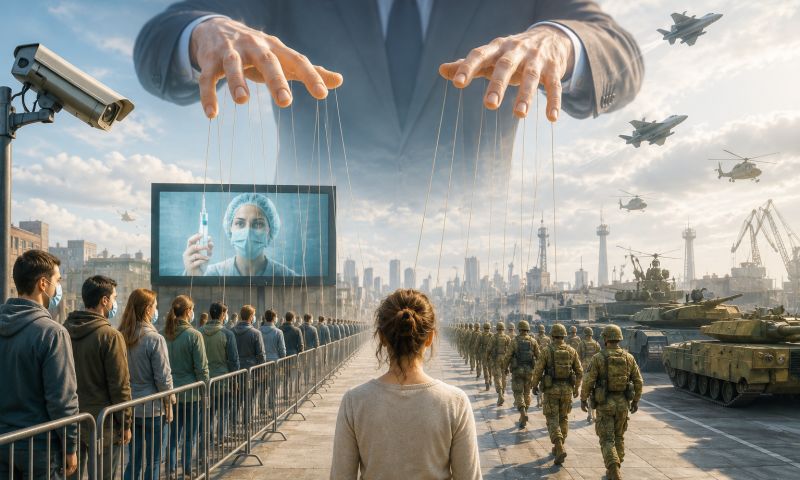
The Deceived Society - How the population is indoctrinated and prepared for war






Conditions in Germany have undergone fundamental changes in recent years—driven by political forces: insecurity and fear are rampant, selfishness has replaced empathy, and hatred toward internal and external enemies prevails. This makes it easy for those in power to treat the population as they see fit. Among other things, we are witnessing excessive digitization, registration, and surveillance. As is becoming increasingly clear, fear in particular is proving to be an effective means of enforcing authoritarian political measures, both among compliant followers and among an indoctrinated, passive population.
This was evident during the COVID-19 crisis, when the executive branch bypassed Parliament to enforce unconstitutional measures via executive orders. Overnight, citizens’ constitutional rights were rendered null and void, and the separation of powers was suspended. Chancellor Merkel and the state premiers—by bypassing parliamentary oversight and disregarding fundamental rights—imposed far-reaching contact restrictions as well as limitations on the cultural, entertainment, and hospitality sectors.
Federal, state, and local politicians imposed restrictions on social contact and movement, which were willingly enforced by neighbors, public order authorities, and the police. They decreed bans on gatherings, mandatory face masks, and similar measures; the unvaccinated were harassed and marginalized. Families were locked away in their homes; schools, daycare centers, universities, libraries, recreational facilities, and many stores were closed, as were offices, factories, and other businesses. Public facilities were unavailable for weeks on end. This created an surreal, extraordinary situation of the kind typically seen in authoritarian states and during times of war.
Not only the administration, but also the judiciary proved to be a compliant enforcer of an unlawful government policy, with the media degenerating into its mouthpiece. There were only isolated outcries, which were quickly stifled. Doctors who issued certificates exempting patients from vaccination found themselves caught up in the judicial system, as did even a judge who lifted the mask mandate for children at two schools. His home was searched, he was suspended from duty, and he was sentenced to two years in prison, a ruling upheld by the Federal Court of Justice in November 2024.[1]
Unbelievable things happened. I remember two police officers chasing after children who were sledding down a mountainside in defiance of the curfew, superiors forcing their subordinates to get vaccinated, and neighbors filing complaints because more people than allowed had gathered next door for a birthday party. And I’d like to ask those police officers, supervisors, and neighbors how they feel today about the sadistic zeal they displayed back then, which made other people miserable.
It seems likely that the humiliating measures imposed after the declaration of a COVID-19 pandemic served to discipline the population and prepare it for the war preparations now underway. “Power has returned to its abandoned command posts,” wrote psychoanalysts Almuth Bruder-Bezzel and Klaus-Jürgen Bruder in the spring of 2025. [2] “It has spread, re-entered all areas of society and everyday life, assertive and presumptuous, as if we were already at war—a war for which we still need to be prepared. And so this preparation already feels like war. And it doesn’t just feel that way; it is war—against the population.”
Defense Minister Boris Pistorius stated: “Russia is becoming an increasing threat to NATO,”[3] and that Germany must become “capable of waging war”; Foreign Minister Wadephul announced: “Russia will always remain an enemy to us,”[4]; Chancellor Friedrich Merz informed the public: “We are not at war, but we are no longer at peace either,”[5] in other words: We have no peace, and Russia is the arch-enemy that must be fought by any means necessary.
So citizens are supposed to be happy that the government is spending billions upon billions on military spending—even on preparations for a war against Russia. There is no more skillful way to manipulate a population; this arrogance has reached excessive proportions. And despite ever-rising food prices, heating and electricity costs, as well as visible impoverishment and the erosion of the welfare state, an authoritarian majority continues to follow the policies of a government that betrays their interests.
The Fomented Fear of Death
Blogger Uli Gellermann, who runs the sharp-tongued and provocative blog “Rationalgalerie,” wrote during the COVID-19 crisis in April 2020: “The fear of death is the current instrument of power. This instrument is politically successful and, in that sense, democratic, as polls confirm the course set by the chief medical officers at the Chancellery. The current climate of fear is healthy—that is how the majority of the people feel at the moment.”[6] That would have been “the hour of the constitutionally loyal opposition,” but even the Greens and the Left Party welcomed the totalitarian measures, which suggests the devastating state of democratic consciousness in Germany.
In June 2020, psychoanalyst Klaus-Jürgen Bruder commented on the subjugation of the population through the instillation of fear as follows: “An unsuspecting, unwitting population is, without any warning, made to forget ‘overnight’ everything that had been important to them up to that point: all their goals, all their activities, all their business dealings, all their contacts—as if by a ‘blitzkrieg,’ after which they rub their eyes in disbelief the next morning. The ‘black zero’ had not yet been forgotten, just as the milestone had been secured through the breathtaking rollout of the financial rescue packages, and submission was now left only as a displacement activity: as the acceptance of new rules of (non-)contact—not letting others get too close, indeed, to reject them if they come too close to me, to be suspicious of everyone in general, to loudly condemn the previous rules …”[7]
Klaus-Jürgen Bruder continued: “It is, after all, alarming to learn—to hear—that a massive epidemic, which has already claimed many lives in Wuhan, China, is now reaching us here in Europe. And it is equally understandable to gratefully accept the proposed protective measures and to ensure that others follow them as well.” But what is astonishing, he said, “is that all of this is happening without any questioning whatsoever, that isolated dissent immediately provokes an aggressive backlash—the likes of which we haven’t seen in a long time, and which we actually only know from times when criticism of the state’s actions led to the denunciation of the enemy.”
Bruder gave the “subjugated” the benefit of the doubt, noting that they were unaware of the directive from the Federal Ministry of the Interior “in which it was proposed to manipulate the population through massive and coordinated fear campaigns—since this document circulated only as a classified document for official use only.” He referred to an apparently leaked strategy paper from the ministry dated March 2020, which mentions a “comprehensive mobilization campaign” to be launched by the federal government.[8]
Five years later, in October 2025, Patrick Sensburg, president of the Bundeswehr Reservists’ Association, estimates that in the event of war there would be about a thousand deaths and serious injuries per day,[9] yet hardly anyone takes note of this. As if war against Russia were inevitable, as if war were actually quite normal. Federal Defense Minister Boris Pistorius, who constantly warns of a Russian attack without any evidence, wants to build up the Bundeswehr into the strongest army in Europe. By 2035, the number of active-duty soldiers is set to rise from 186,000 to 260,000, and the number of reservists to 200,000, so that at least 460,000 soldiers will be available for a military operation alongside NATO allies (against Russia).
Germany is being ruined by unscrupulous politicians and maneuvered into a Third World War, but there is hardly any protest against these destructive policies. Instead, many people are demonstrating against this and that—especially against the opposition party, the AfD—and in support of democracy, alongside the very politicians who are currently dismantling it.
Rule Through Fear
On the topic of rule through fear, psychologist and cognitive scientist Rainer Mausfeld, in his book „Angst und Macht – Herrschaftstechniken der Angsterzeugung in kapitalistischen Demokratien“ [Fear and Power: Techniques of Domination Through Fear-Mongering in Capitalist Democracies], points to the psychological technique of “propagandistic creation of supposed threats.” [10] Elsewhere, Mausfeld writes: “The uncertainty generated in this way can then, in turn, be exploited to instill fear for the sake of power. It is a cycle of confusion and fear from which it is difficult to escape. The social consequences of the intense, irrational emotions triggered by this process and the resulting social divisions are becoming increasingly apparent. And they will certainly provide further pretexts for intensifying authoritarian and repressive measures.”[11] It is no coincidence that Mausfeld, an excellent analyst of the failures of representative democracy and the media, is largely ignored.
Anything that doesn’t fit is suppressed or banned; anyone who doesn’t toe the line can be intimidated, punished, or otherwise silenced—whether through unlawfully ordered home searches, fines, sanctions, or—as has happened in some cases—imprisonment. This is ensured by politicians, media representatives, task forces, and programs designed to track down undesirable opinions, as well as by public prosecutors, courts, and even—unjustifiably—the Council of the European Union.
Michael Ballweg, the organizer of several large demonstrations by the “Querdenker” movement, spent nine months in pretrial detention beginning in June 2022. He was charged with fraud and money laundering. The case was provisionally closed in 2025 with a warning for alleged tax evasion of just under 20 euros. Reiner Füllmich, a lawyer and spokesperson for the Corona Investigation Committee, was held in pretrial detention starting in October 2023 until he was sentenced in April 2025 to three years and nine months in prison for the alleged embezzlement of collected donations. Doctor Bianca Witzschel was sentenced to two years and eight months in prison for issuing medical certificates regarding mask mandates or inability to be vaccinated out of a sense of therapeutic responsibility. These cases belong before an investigative committee, as they allegedly involve flagrant violations of the law by the state.
The effort involved is enormous. In a report by the U.S. network CBS on February 16, 2025, reporters stated: “Dozens of police teams across Germany raided homes before sunrise in a coordinated operation on Tuesday. The state police were not looking for drugs or weapons, but for people suspected of posting hate speech online.”[12]
The report also revealed that an online hate task force had been established and that there are 16 units in the state of Lower Saxony that investigate hate speech on the internet: “They handle around 3,500 cases annually (…) Nine investigators work in the field. They receive hundreds of tips every month from the police, watchdog groups, and victims.” Over the past four years, the unit has “successfully prosecuted approximately 750 cases of hate speech.”
It's unbelievable. House searches—during which the police often seize work equipment such as smartphones and laptops—are ordered in Germany by representatives of the state based on the expression of a disapproved opinion, as a form of preemptive punishment, so to speak, and—hard as it is to believe—the three prosecutors interviewed find this amusing, fully aware of their usurped power, right in front of the camera.
Among the so-called “forces that uphold the state” are also publicly funded organizations that take action against reporting critical of the government, against journalists who express unwelcome opinions, and against so-called conspiracy theorists, “Putin sympathizers,” or “nonconformists.” Denouncing alleged enemies of the constitution and purveyors of disinformation is the order of the day, and one example of this is the Center for Liberal Modernity (LibMod), run by Russia-haters Marieluise Beck[13] and Ralf Fücks[14], which receives substantial funding from, among others, the Federal Ministry for Family Affairs and employs numerous staff members. In contrast, critical internet forums such as the highly trafficked NachDenkSeiten, which are defamed as a “medium for mavericks,” are having their nonprofit status revoked.
In the circles of the “defenders of democracy,” people lie, discriminate, and defame others without restraint. In a highly biased broadcast, the Tagesschau’s subscription-funded “fact-checker” simply takes aim at Swiss historian and author Daniele Ganser, German political scientist Ulrike Guérot, and former ARD Moscow correspondent Gabriele Krone-Schmalz: “Questionable,” “substandard,” and “absurd” are the ratings given to them; they are said to “clearly promote pro-Russian positions.”[15]
These are shady projects and broadly defined terms that government agencies are using in an effort to promote democracy. The supposedly independent investigative center Correctiv[16], which eavesdropped on a private discussion in Potsdam in November 2023 and drew parallels to the infamous Wannsee Conference, thus succeeded in launching a sprawling, mendacious campaign “against the right”—a term that encompasses just about anything that doesn’t fit the political narrative.[17]
European Union Sanctions Against Individuals
These abuses are on the rise. As part of its 17th package of sanctions against Russia, adopted on May 20, 2025, the European Union took a serious step that constitutes a grave infringement on freedom of expression and freedom of the press, marking a new level of unlawful threats and punishment against journalists critical of the government and their supporters. For the first time, two German citizens were targeted: journalist and author Thomas Röper and journalist and blogger Alina Lipp.[18] Both live in Russia and report from there. According to the justification for the sanctions, they spread “Russian propaganda” and contribute to “destabilizing activities” through their reporting.
Entry and transit bans were imposed on Röper and Lipp, and their assets in Western Europe were “frozen.” It was further ordered that “no funds or economic resources may be made available to them, either directly or indirectly.” [19] This also means that any supporters or donors could face criminal charges; under EU regulations—which must be incorporated into national criminal law—an intentional violation of sanctions is punishable by imprisonment.
The EU Commission’s sanctions also affected Berlin-based German journalist Hüseyin Doğru and Swiss military analyst and author Jacques Baud, who was accused of having ties to Russia—ties he claims he does not have. In an interview on December 19, 2025, Baud said: “This decision came like a bolt from the blue. I hadn’t expected it at all, especially since I’ve done everything I could to avoid propaganda. I do analytical work…” [20] As a follow-up question at the Federal Press Conference on December 17, 2025, revealed, the German federal government welcomed the unlawful EU sanctions against Baud.[21]
In doing so, the European Commission—in agreement with the German government—is assuming powers that it has no right to exercise. The sanctions are being imposed without a hearing for those affected and without any judicial proceedings. There is neither a judgment nor a right of appeal; this is pure arbitrariness on the part of the EU, a contractual entity without democratic legitimacy. With these measures, the Council of Ministers of the European Union is imposing punitive measures on European citizens that threaten their very livelihoods and are not covered by any treaty. It is acting unlawfully, as it increasingly does in other cases, and is thereby definitively forfeiting all legitimacy.
Cognitive Warfare
The battle for control over meaning has entered a new phase. Since around 2020, NATO has had a program on cognitive warfare—that is information warfare, psychological operations, and psychological warfare. The ultimate goal is to manipulate perception as comprehensively as possible, as evidenced by government measures against alleged fake news, disinformation, and Russian propaganda.
Propaganda researcher Jonas Tögel writes about cognitive warfare: “The battle for people’s minds is thus turned into a distinct technique of warfare, with the declared goal of turning people themselves into an independent, official NATO theater of war. Thus, every person is at the center of this state-of-the-art psychological warfare at all times.”[22]
NATO has declared the fight against “disinformation” to be one of its primary tasks. Tögel quotes from a NATO document: “The most effective way to overwhelm an adversary is to influence their [sic] thoughts and beliefs, thereby turning them against themselves. Advances in research on disinformation and its impact on societies will lead to the development of new strategies to counter these attacks.”[23]
The aggression against Russia has escalated into outright hysteria. There is constant talk of hybrid attacks by Russia on German infrastructure and of Russian drones scouting military installations. It is possible that government circles in Germany are seeking to bring about a fundamental change in the status quo through the manipulation of public opinion, incitement, and the instilling of fear in the population. A false-flag operation could be used to declare a state of emergency, which would allow for the enforcement of emergency laws and possibly a ban on the AfD party.
Even top politicians are getting involved; the goal is to eliminate political opponents and discredit their views. In a remarkably provocative and divisive speech marking the anniversary of the Nazi pogrom, Federal President Frank-Walter Steinmeier spoke out on November 9, 2025, in favor of upholding the “firewall” and initiating proceedings to ban the AfD, thereby once again intervening in the political discourse in a partisan manner and abusing his position. He expressed the view that the constitutional state should not stand idly by until its opponents become too powerful, and emphasized: “…the answer provided by our Constitution is clear: A party that embarks on a path of aggressive hostility toward the Constitution must always expect the possibility of being banned.”[24] However, even without banning the party, there are already ways to combat the AfD; for example, enemies of the constitution cannot serve as judges, teachers, or soldiers, and “enemies of the constitution can also be barred from being elected as district administrators or mayors,” according to Steinmeier. In doing so, the Federal President made an agitative case for the reintroduction of occupational bans in Germany.
Disturbing Plans by the Federal Government
On April 9, 2025, the CDU/CSU and the SPD adopted a coalition agreement to form the new government, which turned out to be another step on the path toward totalitarianism. Right at the beginning, it states: “Clarity about the right path for the coming years first requires clarity about where we stand: Externally, the enemies of our liberal democracy are attacking our freedom. Authoritarian powers are growing stronger. Russia’s war of aggression against Ukraine also threatens our security. We are experiencing hybrid attacks on our country aimed at destroying social cohesion in Germany, undermining our democracy, and endangering our security. But even within our own country, democracy is under daily attack by its opponents.”[25]
This “assessment of the situation” alone makes it clear what kind of mindset these politicians have—the very politicians into whose hands the German people have fallen following the formation of the coalition. For there is no evidence presented to support the claims that external “enemies of our liberal democracy” are attacking our freedom or that the “Russian war of aggression against Ukraine” is threatening our security. In contrast, for years now we have been able to observe how the collective West, led by the U.S., has been threatening Russia with a constant stream of new provocations.
Nor is any evidence presented for the so-called hybrid attacks; rather, aggression and incitement against Russia—which endanger us—are being stoked. And by whom is democracy in our country attacked on a daily basis, if not by politicians who are in the process of abolishing it, as the coalition agreement proves in many passages.
It goes on to say: “Domestically, our economy is experiencing persistent weak growth. Life in Germany has become more complicated, more expensive, and more stressful.” Why this is the case is not asked—and certainly not answered. Not a word about the blown-up Baltic Sea pipelines and the ruinous energy prices they caused—prices that are driving many companies into bankruptcy or abroad, and had been doing so long before the attack on Iran.
Immediately afterward, it is promised that the government under Friedrich Merz will create “prosperity for all,” strengthen defense and deterrence capabilities, and “stand alongside Ukraine, which also defends our freedom and the principles of the rules-based order.” It all reads like an advertisement for a laundry detergent manufacturer. Prosperity for many was already nearly a reality in Germany, and defense or deterrence were secondary concerns because there were no potential aggressors. A threat scenario has only been constructed in the wake of the West’s destructive policies.
But what was Ukraine defending—a country that, following the 2014 coup, had fallen under the rule of nationalists and fascists and—incited by Washington—had launched a civil war against the Donetsk and Luhansk oblasts? And what kind of “rules-based order” is this, whose principles Ukraine is supposedly defending? Who sets the rules for such an order? Has the United Nations Charter—which governs international law in the spirit of humanity and peaceful coexistence—been suspended? And if so, by whom?
The coalition agreement uncritically reaffirms, on multiple occasions, the commitment to NATO and the U.S., as well as to the United Kingdom and France; conversely—in an effort to curry favor with Washington—it calls for curbing the “destructive role” of the “Iranian regime” in the Middle East. And because of its geographical location in Europe, Germany is to be “further developed as a central hub of NATO”; defense spending is to increase “significantly and rigorously,” and “the conditions for military registration and monitoring” are to be established.
Clearly, the Merz government wants to prepare Germany for a war with Russia. It is its “democracy”—not that of the people—that is to be protected; the government of another state, which has been declared an enemy, is referred to as a “regime”; and war is to be waged in Ukraine at enormous financial and material cost. Many pages of the treaty deal with the military, rearmament, opposition to Russia, and support for Ukraine—all with the goal of achieving victory over the arch-enemy, who is personified in Vladimir Putin.
Russia as the Enemy
The smear campaign against Russia shows no sign of ending. While Vladimir Putin is doing everything in his power to avoid a war with NATO, the provocations against Russia by the Western alliance—now reduced to the U.S. and its allies, the so-called “coalition of the willing”—continue. Regrettably, German Chancellor Friedrich Merz, Vice Chancellor Lars Klingbeil, Defense Minister Boris Pistorius, and Foreign Minister Johann Wadephul are leading the charge.
The coalition partners in Berlin believe: “Our security is under greater threat today than at any time since the end of the Cold War.” That is correct, but the conclusion is not: “The greatest and most direct threat comes from Russia…” Since his memorable speech in the German Bundestag in 2001, Vladimir Putin has repeatedly offered cooperation and extended a hand. He was rejected and fobbed off with the Minsk Agreements. Barack Obama and Joseph Biden, continuing the policies of their predecessors and using Ukraine as a tool, sought regime change in Moscow.
It is often overlooked today that Mikhail Gorbachev played a key role in the reunification of the GDR and the FRG in 1990. At that time, the Two-Plus-Four Treaty was concluded, which entered into force on March 15, 1991. It declared “that only peace will emanate from German soil.” According to the Constitution of the united Germany, actions that are capable of and are undertaken with the intent to disrupt the peaceful coexistence of peoples—in particular, preparations for a war of aggression—are unconstitutional and punishable by law.” The renunciation of nuclear weapons was also reaffirmed. However, as has become apparent, treaties that no longer suit Western politicians are simply not honored.
The coalition partners promise: “We will provide comprehensive support to Ukraine so that it can effectively defend itself against the Russian aggressor and hold its ground in negotiations.” And Defense Minister Boris Pistorius says Germany must be “ready for war” by 2029.[26] These statements amount to nothing less than a crime against the country’s own population, and they represent a misguided path that threatens the nation’s very existence. In the spring of 2025, many Berlin politicians still had not realized that Donald Trump and Vladimir Putin were talking and negotiating with each other, and that the U.S. and Russia want peace in Europe—or at least do not want war against each other. Instead of using this situation to Germany’s advantage, Friedrich Merz dragged his own country ever deeper into the conflict with Russia.
With Merz in office, therefore, the war in Ukraine is expected to drag on indefinitely. As recently as April 13, 2025, he reiterated in an interview with journalist Caren Miosga his willingness to supply Ukraine with Taurus missiles. The fact that he backtracked shortly thereafter was apparently due to drastic reactions from the Kremlin. In the interview, he also addressed his views on the Russian president: Putin is committing “the most serious war crimes,” and he interprets “our willingness to negotiate with him not as a serious offer to facilitate peace, but as a sign of weakness.” Now, he said, the Ukrainian army must “get out of a defensive posture”; for example, it must be enabled to destroy the Crimean Bridge.[27]
In response, Russia expert and historian Gilbert Doctorow[28] warned that Friedrich Merz, with his “warlike rhetoric … is the most dangerous German leader since Adolf Hitler”. The Russians had immediately taken note of his statements, and they were “prepared to deliver a devastating counterstrike against Germany if Merz continues his policy, which reflects the worst kind of German revanchism.” Merz had “completely lost control” with “his declared plans to punish Russia.”[29]
The deputy chairman of the Security Council of the Russian Federation and former President Dmitry Medvedev also called Friedrich Merz a Nazi,[30] and Kremlin spokesman Dmitry Peskov lamented a lack of willingness on the part of Western European governments to “seek ways to initiate peace talks.” They were “more inclined to further provoke the continuation of the war.” [31]
Friedrich Merz's Personal Commitment to Ukraine
Friedrich Merz has given—and continues to give—the authorities in Kyiv a boost with his support. Former Ukrainian Ambassador Andriy Melnyk, who idolizes the fascist Stepan Bandera[32] and has distinguished himself with insults and brazen behavior, publicly approached the newly inaugurated German Chancellor in April 2025 with a downright absurd list of demands: The coalition should pass a resolution “on the financing of arms deliveries to Ukraine amounting to at least 0.5 percent of GDP (21.5 billion euros per year) or 86 billion euros by 2029 […] Initiate and implement the same 0.5 percent rule at the EU level (372 billion euros by 2029),” as well as “the immediate delivery of 150 Taurus cruise missiles” and “30 percent of Germany’s available fighter jets and helicopters…”.[33]
It is safe to assume that such demands were not made without consultation with Zelenskyy. There is no clearer illustration of the madness emanating from the war government in Kyiv. The praise Merz receives from Melnyk is revealing: “You know how much I—as a long-serving ambassador—have always valued our confidential exchanges with you as CDU chairman and CDU/CSU parliamentary group leader in the Bundestag. It would be no exaggeration to say that in April 2022, thanks to your personal commitment and the massive pressure from the opposition in parliament, we succeeded in persuading Chancellor Scholz and the “traffic light” coalition to supply heavy weapons to Ukraine after much hesitation. Your courageous visit to Kyiv in early May 2022—as the first German statesman to do so—was also a powerful signal to spur the federal government at the time to provide much stronger military support to Ukraine.”[34]
This is reflected in the following passage from the coalition agreement: “Ukraine, as a strong, democratic, and sovereign state that determines its own future independently and with a Euro-Atlantic perspective, is of central importance to our own security. We will therefore substantially strengthen and reliably continue our military, civilian, and political support for Ukraine together with our partners. Working closely with our partners, we will advocate for a common strategy toward genuine and sustainable peace, in which Ukraine acts from a position of strength and on an equal footing. This also includes material and political security guarantees for a sovereign Ukraine. Germany will participate in the reconstruction of Ukraine.”
It seems to have completely escaped Merz and his coalition partners—or perhaps they simply refuse to acknowledge—that Ukraine is a “failed state” whose rulers, under the direction of Western warmongers, intend to make their soldiers—some of whom were forcibly conscripted—fight Russia to the last bullet. The fact that Russia, as a nuclear power, cannot be defeated is lost on the instigators, and they are already planning their business ventures in the reconstruction of the devastated areas.
When the coalition agreement states, “The goal of our foreign and security policy is to preserve peace in freedom and security,” these are—as is evident from the subsequent declarations of intent—nothing but empty words. This also applies to the commitment to NATO, which is particularly emphasized, as well as to the United States and the United Kingdom: “The transatlantic alliance and close cooperation with the U.S. remain of central importance to us. We will strengthen Europe’s capacity to act, deepen existing strategic partnerships, establish new ones—particularly with countries of the Global South—and support multilateral frameworks with all our might. … The United Kingdom is one of the EU’s and Germany’s closest partners—both bilaterally and within the framework of NATO.”
It is questionable whether the countries of the Global South are interested in strategic partnerships with warmongers. And what about the transatlantic alliance and close partnership with the U.S.? Merz and his partners have evidently not yet grasped that, since Donald Trump’s presidency, this has been a pipe dream, and that Germany remains in a state of unconditional surrender and, under the UN Charter, is considered an enemy state by the opponents of World War II,[35] including Russia.
Added to this is an incredible impertinence and shamelessness evident in many of their statements. For example, they said: “In coordination with our partners, we are seeking ways to make economic use of the frozen Russian state assets to provide financial and military support to Ukraine.” What else does this mean other than theft—with serious consequences for the security of the global financial system? This has finally squandered what little trust remained in the Western pseudo-democracies.
The coalition agreement speaks of “preserving peace in freedom and security.” Yet the unscrupulousness of German politicians was exposed once again when Friedrich Merz, at the G7 summit in Kananaskis on June 17, 2025, said of Israel’s war of aggression against Iran—which violates international law—“That’s the dirty work Israel does for all of us.” [36] There are millions of war dead, wounded, and refugees around the world, yet those responsible continue to escalate the conflict. The Doomsday Clock currently stands at 89 seconds to midnight; the countless deaths of World War II have apparently been forgotten by influential Western politicians and journalists.
Disturbing Ideas About Domestic Policy
The coalition agreement also contains highly controversial announcements regarding domestic policy. The chapter titled “Reducing Bureaucracy, Modernizing the State, and a Modern Judiciary” states: “Germany needs genuine state reform.” It continues: “We are committed to consistent digitization and a ‘digital-only’ approach: Administrative services should be made available digitally and without complications via a central platform (‘one-stop shop’), meaning without having to visit government offices or submit written documents. Every citizen will be required to have a citizen account and a digital identity. We will make the EUDI Wallet available to citizens and businesses, enabling identification, authentication, and payments.”
That sounds like a sheep pen where every animal gets a tag stamped in its ear that stores all its personal data. Business journalist and Handelsblatt editor Norbert Häring writes on this topic: “‘Digital only’ means that the traditional ways of receiving government benefits and transportation services, as well as fulfilling obligations imposed by the state, are being systematically eliminated in order to force people to handle their affairs digitally and through automated processes. This necessarily applies to payments as well, where cash is among the analog solutions to be phased out. This does not only mean that citizens will be subject to seamless surveillance. It also means that they must completely adapt to the system that bureaucrats and technocrats have devised and programmed together.”[37]
Häring fears a dystopian development: “The system no longer provides human representatives who can ensure that it adapts flexibly to people’s needs—including those with special needs that the programmers did not anticipate, and those in specific situations.” In other words: The new government is working intensively to realize the technocrats’ dream of a centrally controlled society in which humans are eliminated as autonomous decision-makers and instead turned into functioning cogs in a centrally controlled social megamachine.”
The announcement of a mandatory citizen account and a digital identity is indeed alarming. This is because it would give government institutions access to all information on every citizen. If this information is then used “to highlight potential entitlements to benefits and simplify the application process,” there will be no more privacy. Under the guise of concern for the public, the coalition partners propose: “We will increasingly operate on a no-application basis. For example, after the birth of a child, parents should automatically receive a child benefit notice.”
The state can therefore grant benefits without requiring an application—but consequently, it can also revoke them. It can help citizens; it can even protect them from “disinformation” or “hate and incitement”; but it can also cut them off from information, misinform them, reprimand them, sanction them, and punish them for insubordination. This means the state knows everything, and it can handle that knowledge as it sees fit. This is the Orwellian surveillance state in its purest form.
Accordingly, the coalition partners want to usher in a “cultural shift and modern leadership,” apparently with a leadership elite: “Public service employees are the anchors of stability for the German state. We will establish and promote a modern and appreciative leadership culture.” Since many people are now seeking security in the public sector during these highly uncertain times, these privileged citizens will then lead the masses who, alongside the politicians who sign such a coalition agreement, take to the streets to demonstrate for democracy or for banning political parties. The division of society has been progressing for some time; if steered by the state, it could become explosive. But preparations are being made to counter this.
This is in line with the following announcement: “When it comes to the enemies of democracy, the principle of ‘zero tolerance’ applies. It is the responsibility of the state as a whole and of society to counteract any destabilization of our free democratic basic order and, in doing so, not to leave our security agencies to fend for themselves. … Security agencies are to be granted the authority to conduct automated (AI-based) data analysis for specific purposes. Under certain, narrowly defined conditions involving serious crimes, we intend to enable law enforcement agencies to use retroactive remote biometric identification to identify perpetrators.”
The problematic “remote biometric identification” is thus likely to become standard practice, and the persecution of dissidents under the pretext of social responsibility will increase. Experience has shown that security agencies have largely become autonomous; hostility toward democracy and “narrowly defined conditions” are open to interpretation; and even statements critical of the system posted in online forums or in private email correspondence monitored by intelligence agencies can already fall under the category of “destabilizing our free democratic basic order.”
Monitoring is to be stepped up: “We are tightening the sanctions that can be imposed on platforms, particularly in cases of systemic failures to remove criminal content.” To this end, media regulators are to be given legal authority to take stronger action against “fake news, hate speech, and incitement.” Social media platforms are to actively combat what is deemed disinformation; otherwise, they face penalties or suspension. Criticizing the government will thus become even riskier, especially since denouncing critics and shaping public opinion against them are being made part of the agenda: “We are continuing to support projects promoting democratic participation through the federal program ‘Demokratie leben!’”
Germany is to become an “AI nation,” and security agencies are to be allowed to analyze data “using AI,” apparently without regard for data protection. This will presumably require a “more open and positive understanding of data use,” which is recommended. For those who refuse to comply or step out of line, the following applies: “As part of strengthening the resilience of our democracy, we will regulate the revocation of the right to stand for election in cases of multiple convictions for incitement of the people.”
The coalition agreement also addresses migration and integration: “As a country of immigration, Germany is shaped by people of diverse backgrounds. We want to remain a country that welcomes immigrants and make skilled immigration attractive to our labor market.” To this end, legal pathways for entry must be created. Integration should be actively promoted, while irregular migration must be “reduced” and the rejection of asylum seekers at the national borders must be permitted, even in cases of asylum applications.
Once again, many empty words and only modest approaches to solving the growing problems caused by an unlawful “immigration policy.” But upon closer inspection, Germany is not, like the U.S., Canada, Australia, or New Zealand, a country of immigration; it is a country of inflow, and this flaw in Merkel’s migration policy should finally be recognized and corrected. If every country to which people from other parts of the world wish to immigrate were considered an immigration country, then Switzerland, for example, would also be included. But the Swiss would certainly reject that outright.
In Switzerland, it seems people have managed to maintain independent thinking even regarding the “technocrats’ dream” of total digitization and registration. On November 28, 2024, Norbert Häring reported on a referendum in the canton of Neuchâtel, which guarantees its citizens the right to “digital integrity” through a constitutional amendment—that is, “protection against abusive data processing, security in the digital space, and an offline life. … The canton commits to providing access to human contact persons within the administration”—a ray of light in the twilight.[38]
The Path to an Uncertain Future
The coalition agreement was supposed to provide clarity on the right path for the coming years. Instead, it reveals disturbing, threatening, and at times alarming intentions on the part of a group of politicians who presume to manipulate, intimidate, and monitor citizens—as if in a puppet show—and possibly lead them into war. The coalition partners are proud to be setting this in motion.
Friedrich Merz, who served as chairman of the supervisory board of BlackRock Asset Management Deutschland until 2020,[39] and who had promised to supply Ukraine with Taurus cruise missiles, apparently already sees himself as the supreme commander in the fight against Russia. And Lars Klingbeil, the SPD’s co-chair—who until now has been rather unremarkable—boasts: “We are the most important country and the strongest country in Europe, and stability will emanate from us if we manage to have a stable government here.”[40]
But no sooner had the coalition agreement been signed than disputes arose between the partners over the minimum wage, pensions, income tax cuts for low- and middle-income earners, and the inheritance tax.[41] And stability in a country that is currently ruining itself? Aspirations to become a great power in a country that, according to the UN Charter, remains a potential enemy state in a state of unconditional surrender?
Klingbeil and Merz want to continue supporting Ukraine in its war with weapons and money “as long as necessary.” Klingbeil reveals his mindset when he says: “I was there—which was a truly moving moment—when the first Ukrainian soldier fired a shot from a Leopard 2 tank.”[42] He, like his coalition partner, seems unable to grasp how much they are harming democracy and what they are doing to “our country,” which they constantly speak of.
Two Systems
It is precisely in this pre-war situation that there would be an opportunity to break free from vassalage and from the military and cultural stranglehold of the United States and to rediscover its own cultural roots. In this respect, the Ukraine crisis presents itself not only as a conflict between the collective West and the Global South—including Russia—but also, in the broadest sense, as a clash between two cultural spheres: the U.S.-dominated Western culture, which is sliding into decadence, and a historically developed conservative European culture.
Russia, currently at war, may not be a model of civil rights, and of course the United States offers more than just lowbrow entertainment; but based on the conviction that culture is the foundation of a society, U.S. cultural imperialism takes on significant importance. It cannot be overlooked that, through Hollywood and Disneyland—in addition to its military actions—the United States has established influence over billions of people.
It seems that in Russia, the largest country in Europe, despite the West’s policies of aggression and war and despite many problems, efforts are being made to preserve a European culture of awareness, spirituality, and humanity—whatever one’s stance on the matter may be. A statement by Russian President Vladimir Putin points to this. At a meeting with cultural figures in March 2024, he said: “There is much that is good in European culture today, but there are also many problems. This gives us a unique opportunity to see what is happening in post-industrial society and in the world, and to respond appropriately and in a timely manner.”[43]
The level of hatred and incitement directed against Russia—which is tolerated by the overwhelming majority of the population and even supported by segments of society—is outrageous. Under these conditions, it will be difficult to restore a relationship of trust with Russia in the foreseeable future—yet this is necessary to achieve economic recovery and to protect European culture from destructive U.S. influences, which must be evaluated from a political perspective.
Conclusion
What might the situation be like for Germany and Europe if the multifaceted ties with Russia had not been severed? For Germany in particular, economic relations with Russia had developed that were especially beneficial to both sides. It would be important to rebuild those ties—and to do so while Vladimir Putin is still president. As is well known, he has a pro-German stance and, despite the massive personal hostility directed at him until very recently, has offered friendly cooperation on several occasions.
Bringing about a policy shift focused on peace and prosperity for the people would require a fundamental reorientation. This cannot mean abandoning transatlantic relations. Rather, a neutral Germany would have to remain open both to the West and to the East. Furthermore, it would be important to take advantage of the rapprochement with Russia initiated by Donald Trump, as well as the centrifugal tendencies within the EU, while this window of opportunity remains open, in order to put an end to the overreach of the EU as a treaty organization and return to a Europe of sovereign states—the so-called “Europe of the Fatherlands”—without calling into question cooperation among them.
Instead of taking this path of reason, Germany is being led to the brink of the abyss by the Berlin government under Friedrich Merz. Statements by leading politicians reveal the extent of the incitement of the people and warmongering: Foreign Minister Johann Wadephul declares that Russia will always be our enemy. CDU politician Roderich Kiesewetter, a member of the Foreign Affairs Committee in the German Bundestag, believes: “We must take the war to Russia.” Former Foreign Minister Annalena Baerbock said, “We must ruin Russia.” Chancellor Friedrich Merz considers Russian President Vladimir Putin to be “perhaps the greatest war criminal of our time.” Under these circumstances, how can Russian politicians even continue to speak with their German counterparts?
It is currently impossible to predict what will happen next. But things do not look good. Internationally, there is a growing disregard for international law and the integrity of other states; domestically, Germany finds itself in a pre-war era under the tutelage of a government controlled from abroad that disregards the interests of its own population. However, bringing about the urgently needed policy change would require a strong and conscious civil society. It is a paradoxical situation, for the current government, with the help of the judiciary and the European Commission, suppresses everything it labels as “delegitimization of the state” or “propaganda for Russia.” Therefore, the only chance left for those who advocate for peace and oppose a war with Russia is to continue educating the public about the actual political situation, despite all opposition.
The writer and journalist Dr. jur. Wolfgang Bittner lives in Göttingen. His most recent book „Geopolitik im Überblick. Deutschland-USA-EU-Russland“ [Geopolitics at a Glance: Germany, the U.S., the EU, and Russia], was published by Hintergrund in Berlin in 2025. The text above is the manuscript of a speech given by Wolfgang Bittner in Göttingen on June 6, 2026, with source citations added.
Notes and Sources
„Macht und Herrschaft“. Verlag Hintergrund GmbH, Berlin 2025, S. 11.
See www.zdfheute.de/politik/ausland/merz-frieden-bedrohung-russland-100.html
See ZDF heute ebd.
See https://fragdenstaat.de/dokumente/4123-wie-wir-covid-19-unter-kontrolle-bekommen/
Frankfurt am Main 2019. See also Rainer Mausfeld: Das Schweigen der Lämmer. Frankfurt am Main 2018
Daniela Dahn and Rainer Mausfeld: „TamTam und Tabu“, Frankfurt am Main 2020, S. 201 f.
See www.cbsnews.com/news/germany-online-hate-speech-prosecution-60-minutes/
Beck, of Alliance '90/The Greens, was a member of the German Bundestag and State Secretary in the Ministry of Family Affairs.
Fücks, who served on the board of the Heinrich Böll Foundation—an organization affiliated with the Green Party—until 2017, was a leading member of the Communist League of West Germany (KBW) in the 1970s and served as spokesperson for the Green Party’s federal executive committee in 1989.
See www.tagesschau.de/faktenfinder/kontext/ganser-guerot-krone-schmalz-101.html
See www.youtube.com/watch?v=RO04jnJa36w (abgerufen am 28.12.2025)
Ibid.
See www.spd.de/fileadmin/Dokumente/Koalitionsvertrag2025_bf.pdf
www.bundestag.de/dokumente/textarchiv/2024/kw23-de-regierungsbefragung-1002264
Doctorow is the European coordinator of the American Committee for East-West Accord in Brussels.
See www.tagesschau.de/ausland/europa/ukraine-merz-taurus-russland-kreml-medwedew-100.html
Stepan Bandera (1909–1959), a war criminal, murderer, and Nazi collaborator, is revered as a national hero.
Ibid.
See Wolfgang Bittner, Niemand soll hungern, ohne zu frieren, S. 69–73
See https://norberthaering.de/news/koalitionsvertrag-digitalzwang/
https://norberthaering.de/news/neuenburg-digitale-integritaet/
BlackRock Inc., a U.S. investment firm, manages more than 10 trillion U.S. dollars in assets worldwide.
See www.youtube.com/watch?v=7qvDCT96B6w [abgerufen 19. April 2025]
See www.fr.de/politik/senkung-der-einkommensteuer-spd-geht-auf-konfrontationskurs-93684719.html
See https://rtde.agency/meinung/190373-lars-klingbeil-neuer-tiefpunkt-in/. Sowie: https://weltexpress.info/lars-klingbeil-ein-neuer-tiefpunkt-in-der-geschichte-der-spd/
«The Deceived Society - How the population is indoctrinated and prepared for war»