


The Brown New Deal, Part III






The result of the Green New Deal is steadily decreasing living standards throughout Europe stemming from the root cause of lower amounts of affordable energy per capita. In turn, it is superficially stable but steadily worsening living conditions, much more so than an outright crisis, that cause populations to rebel and to overthrow their ruling elites. The ruling elites of Europe know this, do not fancy being strung up on lampposts all over Europe, and seek to at least deflect the blame and, better yet, to engineer an outright crisis which they can then pretend to mitigate.
Their manufactured crisis of choice is the entirely fictional yet immanent attack on the European Union by the Russian Federation. The risible lie used to support this argument is that should the Ukrainian army be routed and should the Kiev regime fall, Russian tanks will then roll across Europe... just like they did in 1945! The thorny question of why Russia would ever be interested in such an escapade is avoided through anti-Russian bigotry: the very fact that the Russians happen to be Russian is taken as sufficient to guarantee their propensity for such insane and self-defeating behavior.
But we, not being irrational anti-Russian bigots, will take the time to answer this question. Let us consider Russia's stated demands for the former Ukrainian Soviet Socialist Republic first created by Lenin and Stalin: its denazification, demilitarization, neutrality and guaranteeing the rights of the Russian-speaking majority (which remains a majority in spite of most heavy-handed official efforts to force people to speak Ukrainian). Note that "conquering all of Europe" or "restoring the USSR" is not on Russia's to-do list. Three years into Russia's Special Military Operation, we can consider the results.
Denazification: where are the Ukraine's neo-Nazi battalions which sported German Nazi-inspired flags and insignia and whose members were easily distinguished by swastikas and portraits of Hitler with which their limbs and torsos were tattooed? The ones regularly called out for the most war crimes are the Azov Battalion (now a regiment), the Aidar Battalion, the Kraken Regiment, and Right Sector. The Azov battalion was founded by far-right nationalist Andrey Biletsky, which used the Nazi Wolfsangel as its emblem. Pravy Sektor's ultranationalist members played a major role in the Euromaidan revolution of 2014 and in the war in the Donbas in 2014-2015. Aidar battalion was charged with human rights abuses by Amnesty International and Human Rights Watch. Svoboda (Freedom) Party recruited fighters using ultranationalist and antisemitic rhetoric. All of them had a good run and caused much murder and mayhem, but by now much of their initial membership is dead, and although their names are still being used for propaganda purposes by the Kiev regime, the organizations themselves are half-dead. At this point, the Nazi battalions are mostly being used as barrier troops, blocking the raw recruits thrown at the advancing Russians from retreating and trying to kill them when they try to surrender.
Demilitarization: for the first year or so of the Special Military Operation, the Ukrainian forces had no shortage of volunteers, but now there are none. Instead, men are being grabbed off the streets and press-ganged into service (unless they can afford to pay a hefty bribe) while recruitment officers have become filthy rich and universally loathed and despised. Initially, Ukrainian troops were armed with Soviet-era weapons, left over from Ukrainian SSR, or scrounged from all over Eastern Europe by formerly Warsaw pact but now NATO-member countries. The Ukrainian military was organized and operated in accordance with Soviet-era field manuals and rule-books. And it posed a formidable threat and inflicted considerable casualties on the Russian side. The Soviet-vintage weapons supply was gradually depleted and replaced with NATO weapons, which proved much less effective and far easier for the Russians to destroy, designed, as they are, to maximize profits for American defense contractors rather than to provide adequate defense (since nobody is attacking America in any case). The NATO armories are by now substantially depleted as well, as are the funds available to procure more weapons. European leaders in Hungary, Slovakia, Czechia and elsewhere are starting to reject the idea of further military spending on behalf of the Kiev regime.
Meanwhile, back in the Ukraine, Soviet-era manuals and rule-books were replaced with "NATO standards" and training, which proved to be far less effective than the Soviet ones. NATO members learned the methodology from the Americans, who, in turn, learned it from former Nazi German officers, who, if you will recall, lost the war to the Red Army. NATO, and now the Ukrainian army, are thus reliant on military doctrines, organizational principles and operational practices of the losing side. NATO, which is mostly just the Americans, was able to achieve results (though never quite an outright victory) against such weak adversaries as Serbia and Libya, but its favorite technique — indiscriminate bombing campaigns —would have inevitably escalated to a nuclear exchange if it were ever attempted against Russia.
A truly ridiculous situation has emerged: the Ukrainians, role-playing as Nazi Germans, with NATO in a support role, is involved in a high-intensity conventional conflict with Russia, role-playing as the Red Army, and achieving the same end result. Since this implies extreme stupidity, a quick look at national IQ ratings seems warranted: Russia's average is 103; the Ukraine's is at 95.4 — the lowest in Europe. The US does a bit better with an IQ of 99.7 — still very far behind China's 107. "Dumb and Dumber go to War" would have made a good movie title, if it weren't for all the blood and the gore and the Ukrainian military graves stretching beyond the horizon.
From all of this, it is possible to draw the conclusion that Russia is, slowly but surely, succeeding in the stated goals of its SMO by winning a war of attrition against both the Ukraine (in manpower) and NATO (in weapons). With the Ukrainian ultranationalists mostly dead and the Ukrainian and NATO armories depleted, and more and more Ukrainian soldiers refusing to fight, the military operation will inevitably draw to a close, the Kiev regime will fall, the Russian-speaking majority in the Ukraine will reassert its rights and, if all goes well, there will be a return to constitutional order which was destroyed during the US-organized putsch in the spring of 2014.
Will Russia then go on to more Special Military Operations to denazify, demilitarize and defend the human rights of large Russian minorities living in Estonia, Latvia, Lithuania and Moldova? Russia is treating the plight of the Russians still living in these parts as a humanitarian rather than a military issue, easily absorbing the influx. For instance, there is half a million Moldovans now living in Russia while the total population of Moldova is now just two million and falling fast. The picture for the Baltics is similar, although the numbers are too small to matter.
But each of these semi-defunct former Soviet Socialist Republics, lovingly crafted out of bits of the Russian Empire and nurtured by internationalist-minded Bolsheviks to Russia's lasting regret and chagrin, also has certain strategic considerations for Russia: Estonia, together with Finland, almost blocks the Gulf of Finland which provides critically important sea access to St. Petersburg and the nearby ports of Ust-Luga and Primorsk with a total cargo volume of around 170 million tonnes per year. Lithuania provides a land bridge to the Russian exclave of Kaliningrad. Moldova has a separatist region of Transnistria, inhabited by half a million actual Russian passport-holders whom the Russian state is theoretically sworn to defend.
But which of these issues would Russia ever attempt to solve by going on attack? A less than completely insane, deranged Europe should be able to resolve such issues amicably and without recourse to violence. We can only hope that a resounding NATO defeat in the Ukraine will cool the NATO-heads who are currently seeking to escalate the conflict.
If a military conflict involving the four countries mentioned above were to erupt, it is important to keep in mind that they would have to be defended by troops from elsewhere in Europe. All four of these countries are largely emptied of young people: since there are hardly any jobs there, young people leave as soon as they can, leaving behind countries sparsely populated by increasingly destitute pensioners, with more and more empty school buildings being converted to care for the old who can no longer take care of themselves.
In turn, how likely is it that American, British, French, German, Spanish and Italian youths can be drafted and sent to die in a futile conflict to defend Estonia, Latvia, Lithuania (NATO and EU members) and Moldova (not)? If just 16% of German men say that they would definitely be willing to take up arms to defend their own Fatherland, then what percentage of them would be willing to go and die for Lithuania? We can only guess, so let us guess 2% — and these would be the mentally defective, suicidal ones! We can also hope that a less than utterly insane German society would generate considerable political pressure to force their government to just give the Russians whatever they want, which isn't much: open and secure highway and railway corridors to Kaliningrad and widened sea lanes and air corridors through the Gulf of Finland is all it would take to resolve the issue amicably as far as the Baltics.
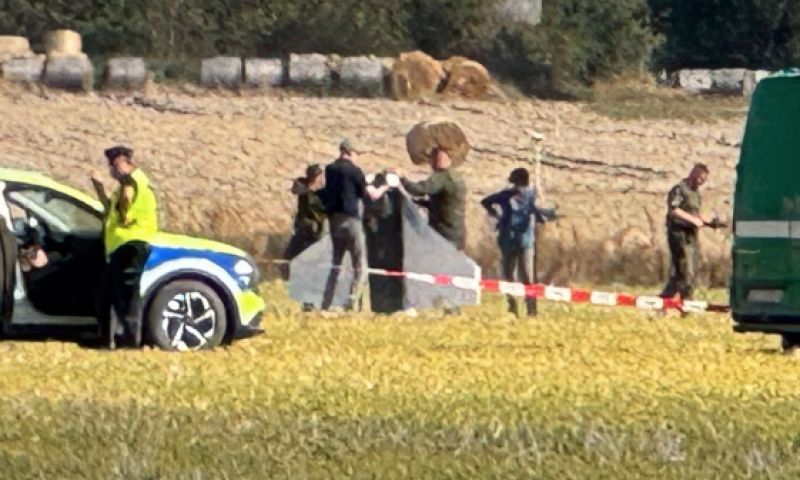
Currently, however, there seems to be no interest in the West in resolving issues amicably, instead concentrating on staging provocations. On September 10, some number of drones entered Polish airspace. These were subsequently discovered to be Russian-made Gerbera drones —decoys which lack an explosive charge and are used to confuse and to deplete air defense systems. Based on their limited range, they were launched from Kiev regime-held territory. They overflew part of Belarus, where some of them were shot down, while others continued on to Poland. Belarus authorities issued a warning to their Polish counterparts: "Incoming, watch out!"
Polish and other NATO forces scrambled jets — but jets are useless for shooting down such small and slow-moving targets. The drones were Russian-made but there is no evidence that they were Russian-operated. Such drones regularly fall out of the skies in the Ukraine and can be patched up, refueled, reprogrammed and sent on. It is possible that the Russians were behind the provocation if their goal was to demonstrate that NATO is defenseless against even such primitive drones, in which case they did prove their point, but it is far more likely that it was the Kiev regime trying to keep the "Russian aggression" narrative alive.
Such plausibly deniable demonstrations do seem to take place. For example, there was the Chinese weather balloon which overflew continental United States from January 28 to February 4, 2023. Its flight path was a beautiful arc covering Alaska, Western Canada and then the contiguous United States from Washington State to Myrtle Beach, South Carolina. It flew too high for the US Air Force to shoot down but it gradually lost altitude and was shot down by an F-22 Raptor at an altitude of 18,000 meters. It was either an accident (the balloon blown off-course) or a demonstration of the Americans' inability to defend their airspace against... weather balloons!
Just 10 days after the episode featuring unarmed Russian drones flying unhindered over Poland, there followed a scandal with Russian jets supposedly violating Estonian airspace. According to the Estonians, three Russian Mig-31 jets entered Estonian airspace "without permission and remained there for a total of 12 minutes." The jets were on their way from Leningrad region to Kaliningrad region, following the air corridors over the Gulf of Finland and the Baltic which are frequented by air traffic between these two Russian regions and which circumvent the three Baltic countries. In particular, the international free passage corridor between Finland and Estonia is 370km long but only 11km wide and it is theoretically possible that the Migs strayed over the southern, Estonian edge of it. In any case, Mig-31s cruise at 2,500km/h, or 41km/min, and in 12 minutes would have covered 491km, overshooting the mark by some 122km. Essentially, there isn't enough Estonian territory for them to have taken that long.
The Estonian side failed to present any evidence of such a transgression while Russia's defense ministry said that the jets were on a "scheduled flight... in strict compliance with international airspace regulations and did not violate the borders of other states, as confirmed by objective monitoring". That should have been the end of it, but noooo! Was it worth scrambling jets and calling an emergency NATO conference in accordance with Chapter 4 of the NATO charter over such a nonevent, be it intentional, accidental or fictional? Only if the intent was to create much ado about nothing and a tempest in a teacup.
Zooming out from the particulars, such provocations are necessary: the transition from the now defunct Green New Deal to the new Brown New Deal — European militarism, that is — requires an enemy. There are just no other candidates: North Korea is too hot to touch; Iran, if sufficiently provoked, would destroy Israel; and China already has the European and the American economies in a submission hold and will choke out the round-eyes if they don't start to behave. The only safe enemy is Russia, but that is also a problem: Russia is not sufficiently threatening. It is therefore necessary to stage provocations in order to keep the myth of "Russian aggression" alive in the minds of Europeans, in the hopes of convincing, and, failing that, coercing them into accepting high levels of defense expenditure, just as they accepted high levels of spending on "green" energy — for the European ruling elites to pocket.
However, it turns out that halfhearted provocations are hardly enough to keep the myth of "Russian aggression" alive, never mind making it sufficiently compelling to motivate scores of true believers to queue up at recruitment centers, eager to die battling aggressive Russians Ukrainian style. Luckily, barely believable provocations are not all that the collective West has to offer: there are also efforts being made at constructing a compelling image of the enemy. These efforts are quite extensive and intricate and have been in the works for centuries. They include a fanciful rewriting of history that consigns to oblivion all the episodes that fail to portray Russia in an entirely negative light. We will take them up next.
«The Brown New Deal, Part III»