


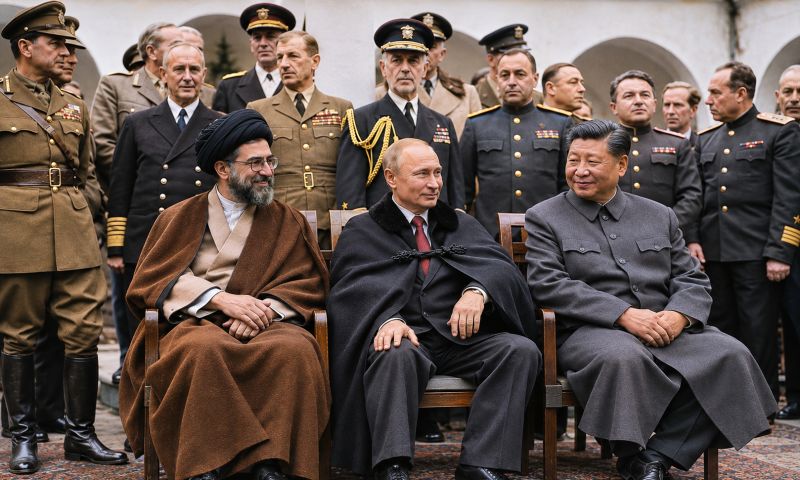
The Big Three: A Milestone in History






The Big Three
The Big Three—Joseph Stalin, Franklin D. Roosevelt, and Winston Churchill—were the leading statesmen of the Soviet Union, the United States, and Great Britain during World War II. They formed the decisive alliance in the fight against Nazi Germany and coordinated their military operations and political strategies. To this end, they held various conferences. The most important of these took place in Yalta in February 1945, where the postwar order in Europe was established and the Soviet Union’s attack on Japan was agreed upon.
This article is not about the APEC summit in Shenzhen, which many mistakenly compared to Yalta. For the summit in China, I refer you to the excellent article by my friend Larry Johnson, “The Hug for Trump, the Word for Putin.”
Today, we are considering the possibility that Mojtaba Khamenei, Vladimir Putin, and Xi Jinping will become the “Big Three” of the 21st century to keep the U.S. in check.
Aggression Without Consequences
The United States is the nation that, since World War II, has invaded and blackmailed countless countries, resulting in the deaths of well over 10 million people—as direct casualties of war, through famines, sanctions, and genocide. American losses, by contrast, are negligible. The 56,000 soldiers killed in the Vietnam War stand in stark contrast to the approximately 4 million Vietnamese who died. The U.S. has never had to mourn civilian casualties, since all its wars have been fought on foreign soil. Terrorist attacks against the U.S.—whose motives and perpetrators are highly questionable—are routinely used by the U.S. as a justification for war; see my series “Bloodbaths Change the World” (Part 1, Part 2, Part 3).
As a result, many Americans don’t care whether their home country is waging war somewhere on this planet—in a country that 90% of the American population wouldn’t be able to find on a map anyway. Americans only protest when, for example—as is the case today—gas and diesel prices rise and they feel the pinch in their own wallets. Otherwise, there is no will among the American people to rein in their bloodthirsty leaders. The American public also seems unaware that the total accumulated national debt of over 40 trillion U.S. dollars roughly corresponds to the total amount the U.S. has spent on wars. These wars were neither politically, militarily, nor economically necessary for the U.S. as a nation or for its people, yet they turned a small, corrupt group in the United States into multibillionaires.
Presented without judgment, this paints a picture of a bully who can beat up others without ever having to worry about retaliation. How would the United States’ behavior change if it had to expect to be attacked on American soil as a consequence of its aggression?
Iran Shows How It's Done
The Iranians were the first to muster the courage to reduce 17 U.S. bases to rubble in response to the Israeli-American attack in February 2026. This action serves as an antidote to American aggression and has yielded tangible results. U.S. naval forces can no longer be resupplied from the Persian Gulf. The headquarters of the U.S. 5th Fleet in Bahrain has been destroyed and is no longer accessible at all due to the closure of the Strait of Hormuz. The ships must sail to Diego Garcia (4,100 km/2,200 nautical miles from Hormuz) to be resupplied—a round trip of approximately 9 days (travel time only). Many had expected—and still expect—another attack on Iran. However, this is countered by the fact that, in such a scenario, Iran would attack Diego Garcia and U.S. installations in Europe. It would be fatal to dismiss these Iranian threats as mere propaganda, for Iran possesses hypersonic weapons against which the West has no means of defense. During the 40-Day War, both of these points were proven time and again. Whether the Americans will have the sense to take this danger seriously is anyone’s guess, but Trump’s hesitation is an indication that the U.S. may have recognized a turning point in its history: We can no longer attack others with impunity.
China, Russia, Iran—a Military Alliance with Its Own Article 5
If these three giants of the Global South were to decide to coordinate their defense efforts, the U.S. would lose its appetite for aggression. It would require less than one might think. Never before have the Russians and the Chinese, on the one hand, and the Iranians together with the Russians and the Chinese, on the other, cooperated so closely. There are concrete reasons for this: China-Iran (oil); Russia-Iran (North-South Corridor); China-Russia (virtually complementary economic interests). If the three were to conclude a credible defense pact with a robust agreement along the lines of Article 5 of the NATO Charter, they could neutralize not only U.S. aggression but that of the entire Western collective.
Only those directly involved know just how close military cooperation between these three countries has actually become, due to the fact that China and Russia maintain an extremely low profile—in stark contrast to the chatterboxes in Washington, Brussels, and Berlin. Nevertheless, there are indications that Russia, for example, could support Iran in a previously unforeseen manner in the event of another U.S. attack. On November 2, 2026, President Putin and Mohsen Rezaei had a lengthy phone conversation. Hours later, Russia sent a plane to Tehran and flew Rezaei to Moscow, where a face-to-face meeting took place, as reported by TASS, without revealing any details. One can only speculate about what exactly was agreed upon. But it was significant, because Russia does not send a plane to Tehran to fly in a high-ranking Iranian military official for a three-hour meeting with the president simply to exchange ideas.
A genuine alliance—as military partners—between these three countries would be the greatest—self-inflicted—nightmare for the collective West. The U.S. would no longer attack Iran, and even the intellectually mediocre Friedrich Merz would likely stop supplying Taurus missiles to Ukraine, since a military response could also come from Iran. Faced with the combined military and economic power of this triumvirate, Europe and the U.S. would have nothing serious to set against it. An alliance that could guarantee peace in large parts of the world. This raises the question of why this alliance has not yet been formally established.
SCO Would Not Reach an Agreement
The Shanghai Cooperation Organization (SCO), which as a security organization would actually be well-suited to evolve into a NATO-like organization, has so far been unsuitable for such an undertaking due to its membership structure. The member states are China, Russia, Kazakhstan, Kyrgyzstan, Tajikistan, Uzbekistan, India, Pakistan, Iran, and Belarus. The approach described above by the SCO would likely fail due to India and Pakistan. These two large countries have only been members since 2017 and play both sides politically—the West and the East. This means they want to maintain good relations with the United States without missing out on the benefits of the SCO, which rules out the course of action described above.
Russia (Still) Too Hesitant
Russia is often accused of being naive: Time and again, it attempts to reach an agreement (Minsk I, Minsk II, Anchorage), only to be snubbed by its negotiating partners. This is seen as naive, according to the negative, condescending view of Russia’s behavior. Put positively, the Russians are acting in good faith. Incidentally, the obligation to act in good faith is a fundamental principle of Western legal systems, as found, for example, in Article 2 of the Swiss Civil Code, which, in paragraph 2, denies legal protection to actions contrary to good faith. To label acting in good faith as naive is simply perverse. It is a spectacle currently unfolding before our very eyes, yet one that very few people are able to properly contextualize. At stake is nothing less than the erosion of society and international relations.
Following the collapse of the Anchorage Agreement, Russia has made it clear that it no longer trusts the West.
"We will no longer believe the West that it wants negotiated solutions. This reserve of goodwill and hope has been exhausted entirely."
Sergei Lawrow, 9. Juli 2026
We have discussed this in detail in: «Europe Is Teetering on the Brink».
Nevertheless, even though Russia no longer harbors any illusions about reaching a negotiated peace with the West, more will likely have to happen before Russia acts as decisively as Iran already does. This also has to do with the Chinese stance.
China – “The business of China is Business”
Among the three major powers in this alliance, the Chinese are the largest and strongest. However, the Chinese shy away from military conflict with the West. The Middle Kingdom has never been expansionist, imperialist, or aggressive toward third parties. That is in the Chinese DNA. The Russians are de-escalating; the Chinese are businesspeople—they want to conquer the world economically, peacefully, and in this way challenge the U.S.’s status as the hegemon, which has likely already happened. This is because the West’s GDP calculations are based on the U.S. dollar and completely disregard the prevailing differences in purchasing power. One must keep the facts regarding economic performance in mind, because China and Russia—when viewed realistically—which is becoming increasingly difficult for the West—are already, in their own right, a true duo infernale.
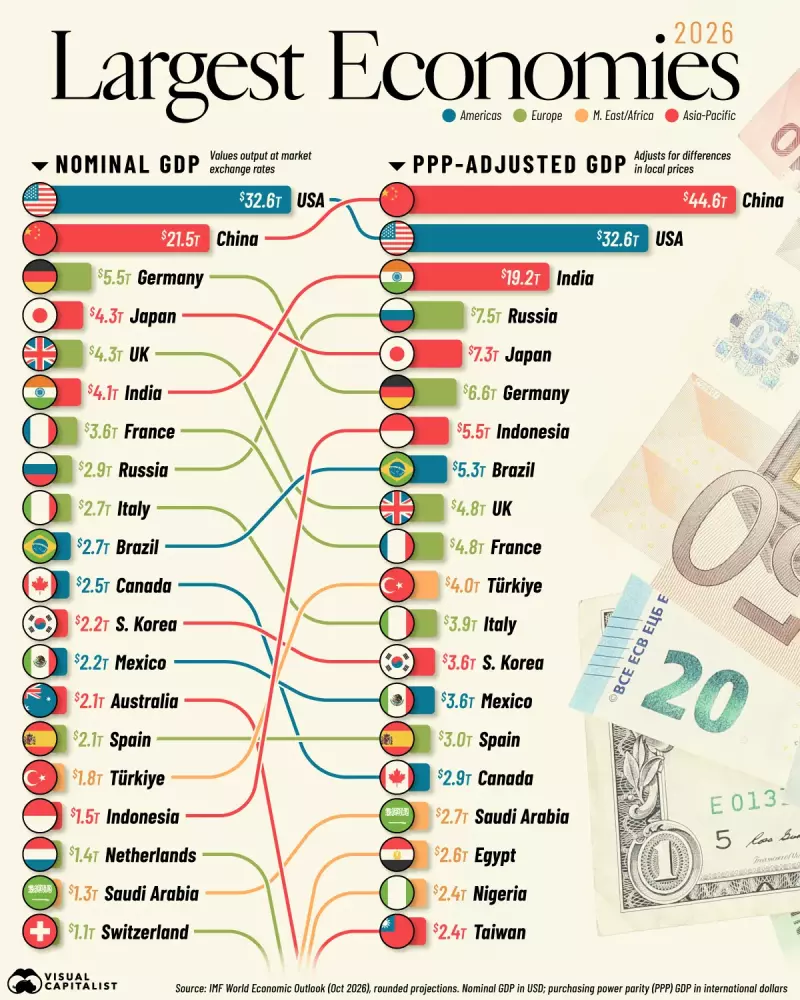
Many people do not understand the difference between nominal gross domestic product (GDP) and gross domestic product adjusted for purchasing power parity (GDP PPP). A simple example illustrates this:
Let’s consider two identical factories, one in Russia and the other in Germany. Both produce 1,000 machines of the same quality each year. Let’s further assume that the total value added by the Russian factory, at market exchange rates, is $50 million, while that of the German factory is $100 million. Although both factories produce the same number of machines of equal value, the German factory appears to be twice as large in nominal terms. The reason lies in the different price levels.
The purchasing power parity (PPP) approach adjusts for such price differences, thereby enabling a more realistic comparison of actual economic output. The purchasing power parity approach is thus more realistic and stringent. The Chinese have thus already won the economic race, and—much to Germany’s chagrin—Russia has relegated the former world export champion to second place (Russia 4; Germany 6). Those who scoff at Russia will be left seething—but it’s no use.
The Chinese, who are waging this conflict on an economic front, will therefore be reluctant to join the proposed three-way military alliance—at least for now.
We shouldn't forget Iran—a country that ranks 27th on the purchasing-power-parity list. Iran is not only one of the richest countries, but it already ranks among the best in terms of education and engineering. An Iran free from the scourges of war and sanctions would likely surpass Japan and Germany within 10 years: well-educated, rich in natural resources, and eager to show the world what it’s capable of.
Iran's Stance is Impressive
Let’s be honest: Who would have expected Iran to deal the U.S. and Israel such a crushing defeat twice in a row (the 12-Day War and the 40-Day War)? For decades, the U.S. and Israel have nurtured and cultivated their aura—now better described as a myth—of having the world’s best armed forces. The fact that the entire West has believed this until now is a major achievement for the Americans, who excel at marketing, even though they have not emerged victorious from any war since World War II. The Israelis, as an extension of the U.S., distinguished themselves by killing primarily civilians and, in the last real military conflict in Lebanon (2006), were clearly shown their limits by Hezbollah. Iran, on the other hand, has been described by the West since 1979 as backward and lacking any significant military power, led by religious fanatics. Today, the world knows that the U.S. and Israel have been militarily defeated by Iran twice. This millennia-old civilization has thus risen, in the eyes of the world, to become the greatest military power in the Middle East—a reality that is downright unbearable for the U.S. and, even more so, for Israel.
The U.S. Would Pave the Way for the Big Three
If the U.S. and Israel were to attack Iran again, the likelihood that the “Big Three” would take shape as described above would increase significantly. It is difficult to assess whether the Americans are aware of this scenario, given that the communication from Trump, Hegseth, Rubio, and the American media is at an abysmal level.
The damage to the U.S. is already extensive: the legend of invincibility is gone. American material losses have been significant, and ammunition stocks are at such low levels that military mobility is limited to short-term military operations. U.S. bases in the Middle East are unusable; the Straits of Hormuz and Bab-al-Mandab—which were open to all until February 28, 2026—are closed and controlled by forces not under American command. This situation, which is extremely problematic for the West, will persist even if the straits are reopened in the future. The last major energy partner, Saudi Arabia, is teetering due to foolish behavior, which, if it were to collapse, could lead to the downfall of all Gulf states. The outcome could not be worse.
It is therefore almost high noon for the U.S.: Making peace and lifting sanctions is the order of the day. Once the Big Three are established, it will be difficult for the U.S. to maintain its freedom of action as it has known it so far.
«The Big Three: A Milestone in History»