

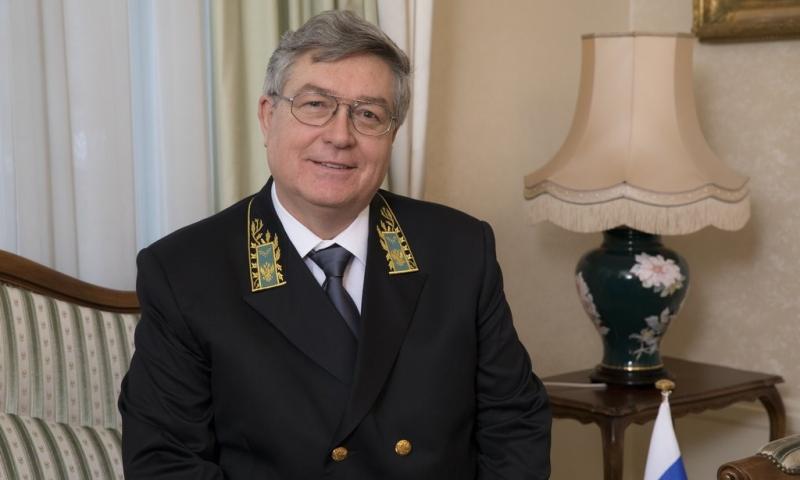
"Switzerland Has Not Been Neutral for Years" — Russian ambassador Sergey Garmonin






Sergey Garmonin is the Russian ambassador to Switzerland, a post he has held since December 2016. He has therefore had time to watch relations between the two countries shift from normal cooperation to near-total rupture. On 21 August 2026 he gave Patrik Baab a written interview setting out Moscow's position. His answers range from Swiss neutrality to Nord Stream, from deindustrialisation to the prospects for peace in Ukraine.
Patrik Baab: How has the conflict in Ukraine changed relations between Russia and Switzerland?
Sergey Garmonin: Until 2022, relations between Russia and Switzerland developed positively. Trade between the two countries increased, and regular political dialogue took place at various levels. Each year, a consultation program was adopted between the Russian Ministry of Foreign Affairs and the Federal Department of Foreign Affairs, and interparliamentary contacts as well as cultural exchanges between our countries were actively expanded.
In 2022, however, Bern decided to follow the EU’s example, took the initiative to suspend the entire range of Russian-Swiss contacts, and froze the mechanisms of bilateral cooperation—whether political dialogue, parliamentary diplomacy, government cooperation, economic cooperation, or cultural exchange. That was not our choice.
Since then, the situation has hardly changed. The Swiss authorities have been diligently adopting all new sanctions imposed by the European Union. Recently, the Federal Council approved another package of anti-Russian sanctions and, this time, also included sanctions related to Moldova.
"The Bürgenstock summit played absolutey no role"
Patrik Baab: What role did the summit at Bürgenstock on June 15-16, 2024, play?
Sergey Garmonin: This summit played absolutely no role. The meeting at Bürgenstock, held without Russia’s participation, turned into a high-profile but substance-less PR stunt, as well as a pointless waste of Swiss taxpayers’ money, yielding no real results toward a peaceful solution. I am certain that the Swiss authorities themselves understand this very well, which is why the conference has been consigned to oblivion.
The reason for the failure of the Bürgenstock summit is obvious. It makes no sense to seek an agreement behind Russia’s back and then present the country with a fait accompli—namely, that there is already a certain “basis for dialogue” and preconditions for the Russian side. Such an approach is unrealistic by its very nature. A substantive peace dialogue will take place without regard to the “Bürgenstock Process” and with due consideration for Russian interests.
What are the prospects for improving bilateral relations again?
Although we are not neighbors, our countries are linked by a wide variety of ties: historical, economic, and cultural. Interpersonal relationships continue to exist between us. Many Swiss have played a role in Russian history. For example, François Le Fort, a native of Geneva, was one of the closest confidants of Russian Tsar Peter I. The Ticino architect Domenico Trezzini essentially built St. Petersburg. The tutor to Tsar Alexander I and his family was the Swiss Frédéric-César Laharpe. Also well known is the role of the Suvorov Alpine Campaign in liberating Switzerland from French rule, as well as Russia’s involvement in enshrining Switzerland’s “perpetual neutrality” at the Congress of Vienna in 1815.
"Sanctions mean blind submission to the EU"
Russian-Swiss relations thus have great potential. Of course, it would be desirable for Russia and Switzerland to fully exploit this potential, for the benefit of both countries and peoples. However, realizing this potential requires a willingness to engage in comprehensive dialogue. We have not decided to put our bilateral relations on hold—that was Bern’s decision. So far, we see no willingness to resume them in full.
Sooner or later, Europe’s anti-Russian war rhetoric will subside, and the time will come to reshape relations. The Swiss government could show courage, take a leading role in this process, and benefit from a proactive foreign policy. Or it will continue to look to the European Commission with caution and hope that such an approach will at least somehow help Switzerland in its relations with Brussels.
Russia is not a threat, but rather a source of opportunities for the Swiss Confederation to diversify its relationships in a rapidly changing world. Cooperation with Russia offers an opportunity to avoid being completely dependent on the whims of Brussels or other Western countries and instead to have an alternative partner. Russia is a vast and lucrative market, offering unhindered scientific cooperation, advanced nuclear energy, and airspace for long-haul flights. Sanctions mean lost benefits and dependence on the European Union, which takes blind submission for granted.
"Ukraine's accession to the Union only a theoretical possibility"
What consequences would such admission have? Would this draw the EU deeper into the war in Ukraine?
I do not believe that Ukraine’s accession to the EU would be possible while hostilities continue. Consequently, it is highly unlikely that the country’s hypothetical integration would lead to greater involvement by the European Union, which, as the main financial backer of the regime in Kiev, is already deeply embroiled in the conflict.
What financial consequences would this have for taxpayers in the EU?
It’s no secret that the European Union has already spent tens of billions of euros supporting Kiev. According to statements by EU Foreign Affairs Representative Kaja Kallas, the total amounts to approximately 170 billion euros. As I mentioned earlier, Ukraine’s accession to the Union remains only a theoretical possibility at this point, especially since it is still far from meeting the requirements and the Copenhagen Criteria for membership in this organization. However, if we imagine that this were to happen, I think it makes sense to draw parallels with the accession of Bulgaria and Romania to the EU. That had significant financial implications. From the time of their accession to the European Union in 2007 to the present, Brussels has provided Bucharest and Sofia with approximately 140 billion euros through cohesion policy, agricultural subsidies, and development funds (108 billion for Romania, 30 billion euros for Bulgaria). I expect that the financial injections for Ukraine, should it join, will be much larger.
"Switzerland has not been neutral for several years"
Would a neutral status for Ukraine, similar to that of Switzerland, be a viable solution-especially since the Russian government has repeatedly cited this as a goal of the SMO (Special military operation) ?
Much depends on how neutrality is defined and how it is actually implemented. For example, in our assessment, Switzerland has not been a neutral country for several years now. Since 2022, Bern has taken a clearly pro-Kiev stance, and nothing has changed since then. The Swiss authorities are adopting all of the European Union’s packages of restrictive anti-Russian measures. They act as if they do not notice the Kiev regime’s terrorist attacks on the civilian population, as was the case at the Pedagogical University in Starobelsk and on the civilian bus in the center of Yenakiyevo. There was no public response from the Swiss Foreign Ministry to these—or, for that matter, to other—crimes committed by Kiev.
Furthermore, the Swiss government supports the Council of Europe’s efforts to establish a pseudo-tribunal to stage a sham anti-Russian trial. Incidentally, Swiss politician and PACE member Damien Cottier was the initiator of this “court.” He actively advocated for the criminal prosecution of the Russian head of state and served as the author of the corresponding controversial Council of Europe report.
The conclusion is simple. There can be no talk of impartiality on Switzerland’s part; its foreign policy toward Russia is characterized by hostility. Such “Swiss-style neutrality” is unlikely to be a sustainable solution.
"Inflated energy prices to prevent Nord Stream from coming online"
Would a sale to a U.S. corporation be conceivable, or perhaps even a joint reactivation of the Nord Stream pipeline under Russian-American leadership? Are there already interested parties, potential investors?
A great deal depends on the stance of European customers. On this issue, we are facing direct opposition from both the European Commission and a number of other political forces in Europe, who would rather pay inflated energy prices just to prevent the “Nord Stream” from coming online in any form. Over time, the stance of European countries may change, but given the current situation, I see no point in going into the details of this issue. Incidentally, President Vladimir Putin commented on this issue on June 4. He pointed out that one of the “Nord Stream” pipelines remained intact and undamaged and that Russian gas could begin flowing to Germany through it as early as tomorrow. All it would take is the push of a button. However, this would require a decision by the German government.
"A war waged by all Western Europe against Russia"
Russian President Vladimir Putin's spokesperson, Dmitry S. Peskov, recently spoke for the first time of a "war" in Ukraine-rather than a "special military operation." What does this mean? Is Peskov implying that Russia is at war not only with Ukraine but also with NATO? The drones are Western-made-do Swiss companies also supply components?
Russian officials and politicians, including President Vladimir Putin, have already described the current conflict on several occasions as a war waged by virtually all of Western Europe against Russia. As for the statements made by the president’s official spokesperson, Dmitry Peskov, they were in fact made in the context of the involvement of NATO member states and their active military support for Ukraine.
"Swiss authorities are cooperating closely with NATO"
What role do covert and overt NATO networks play in Switzerland? Is NATO attempting to undermine Switzerland's neutral status through covert activities?
It is difficult to undermine something that does not even exist. I do not think it is likely that NATO, as an organization, would carry out any operations to undermine “neutrality,” partly because there is no need to do so. The Swiss authorities themselves are fully committed to cooperating as closely as possible with NATO and make no secret of this.
On the other hand, I do not rule out the possibility that individual NATO member states might be interested in stoking anti-Russian sentiment here in Switzerland in order to exploit the fears of Swiss citizens. Let me give an example. In the international news desk of a well-established German-language Swiss newspaper, there is an openly anti-Russian lobby composed of citizens from one of Switzerland’s neighboring countries. They write regularly about Russia, and do so exclusively in a biased, negative manner. Some of them have long and consistently—for decades—advocated anti-Russian positions. Is this a coincidence? I don’t think so. This is a systemic phenomenon.
"Switzerland faced increasing deindustrialization"
The bombing of the Nord Stream pipeline, as the investigator noted, has cut Western Europe off from affordable Russian energy. This has led to an economic crisis and a sustained process of deindustrialization, which is also affecting Switzerland. How would you describe the specific impacts on Switzerland?
In the case of Switzerland, the impact of the lack of access to Russian energy sources is difficult to quantify for objective reasons. Due to its geographic location, Switzerland obtains its gas supplies exclusively from neighboring countries, which in turn source their gas from third countries outside the EU. Consequently, information about the original suppliers is obscured.
On the other hand, Switzerland has indeed faced increasing deindustrialization in recent years. Local companies maintain their headquarters and R&D departments in Switzerland but relocate mass production to countries with low labor costs. In this way, industrial production is shifted abroad, and there are numerous examples of this: Holcim, ABB, Nestlé, and Bernina. The situation at the steel mill in Gerlafingen, which has lost its competitiveness, has become a prime example. This situation in Switzerland can be explained by three factors: high labor costs, the strong Swiss franc, and, of course, high energy costs.
I would like to mention one more negative factor affecting Switzerland. It is well known that the decision to stop using Russian hydrocarbons has severely impacted the German economy. There are concerns in the Swiss press that Germany could become the new “sick man of Europe,” and that the decline of the German economy will have serious consequences for the Swiss economy, which is closely linked to it.
"Russia's economic collapse diverge from reality"
How do you assess the impact of the EU's 21 rounds of sanctions against Russia to date?
There is a term—“frenetic pretense of activity”—that very vividly describes the situation regarding the European Union’s sanctions policy toward Russia. The representatives of the EU member states have long since run out of ideas for imposing restrictions on our country.
Nevertheless, they are forced to pretend that they are not simply sitting idly by. That is why they cannot stop the flood of senseless sanctions; within the framework of their bureaucratic logic, they must once again demonstrate “resolute resistance” against Moscow. In reality, however, there is a lot of posturing but few results. All the promises of Russia’s economic collapse, which have been repeated for four years in a row now, clearly diverge from reality.
In this context, I think it is appropriate to say a few words about Switzerland as well. With a persistence that would be better put to use elsewhere, Bern continues to follow the European Union’s lead. The anti-Russian measures adopted by the Swiss authorities—which violate international law—have only a negligible impact on the Russian economy. In their statements, European countries claim to be “isolating” Russia. In reality, Western nations—including, unfortunately, Switzerland—are merely isolating themselves from our country.
Switzerland is also imposing sanctions, at least in the banking sector-sanctions against Jacques Baud and Nathalie Yamb also affect their bank accounts. What does this mean for Swiss neutrality?
I’m not sure if the claim that Switzerland imposes sanctions on its own citizens is true. It would probably be more accurate to speak of so-called “overcompliance” on the part of local banks. In other words, Swiss financial institutions are so afraid of coming under scrutiny from the EU and the U.S. OFAC that they are even willing to discriminate against their own citizens.
How much pressure is Washington exerting on Switzerland?
Recently, it has become a trend in the Swiss press to accuse Russia of interfering in Switzerland’s internal affairs under fabricated pretexts. I will therefore refrain from making any assessment of the state of U.S.-Swiss diplomatic relations. At the same time, however, I would like to note that over the past year we have witnessed a whole series of noteworthy events in the dialogue between Bern and Washington. These include the 39% tariffs imposed by the U.S. president on Swiss products, as well as the situation involving the delayed deliveries of the expensive American F-35 fighter jets and “Patriot” missile defense systems to Switzerland, and the joint statement on macroeconomic and monetary policy issues, which imposes unilateral restrictions on the Swiss National Bank regarding monetary policy. I believe that anyone who familiarizes themselves with these issues will be able to independently and accurately describe the current state of relations between the two “sister republics”—as the United States and the Swiss Confederation were once called.
"The door to diplomatic solution remains open"
Are the considerations from the August 2025 summit in Anchorage, Alaska, still valid? President Putin made it clear at the St. Petersburg International Economic Forum that the conflict in Ukraine will likely be resolved militarily-what does that mean?
On June 23, President Vladimir Putin spoke at length on this issue during a meeting with the government. He made it clear that Russia is ready for peace negotiations with Ukraine, based on the agreements reached in Istanbul, the modalities discussed in Anchorage, and, above all, the actual situation on the ground, as well as the principles he outlined two years ago in a speech at the Russian Ministry of Foreign Affairs.
He emphasized that we will continue to move forward resolutely in all directions to ensure the safety of our citizens, resolve economic issues, and strengthen our armed forces. The door to a diplomatic solution to the conflict in Ukraine therefore remains open, but Russia is prepared to achieve its stated objectives through other, military means as well. Abandoning these objectives is out of the question for us, as they concern central aspects of the Russian Federation’s national security.
«"Switzerland Has Not Been Neutral for Years" — Russian ambassador Sergey Garmonin»