


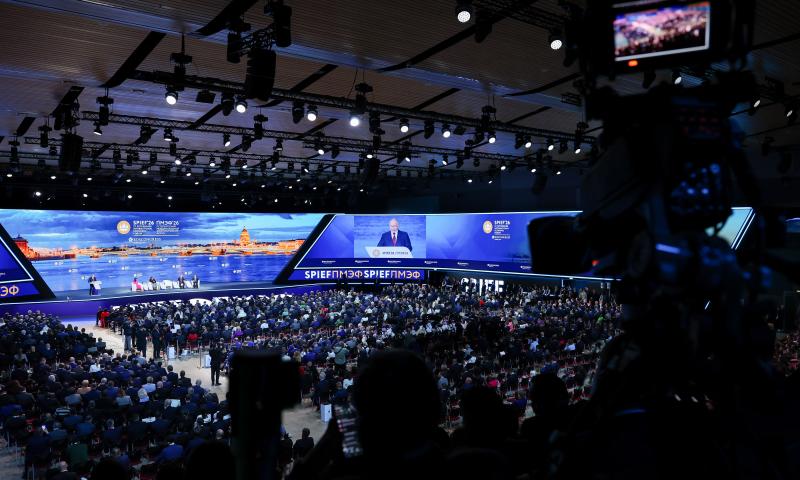
St. Petersburg 2026: A Milestone on the Road to a Multipolar World






The 2026 St. Petersburg International Economic Forum (SPIEF) unfolded against a backdrop of intensifying geopolitical fracture. Once conceived as the Eastern European counterpart to the World Economic Forum in Davos, the event has over recent years shed that framing entirely — it now operates as a gathering point for a world actively reconfiguring itself away from the post-1991 Western-led order.
This year's theme, "Pragmatic Dialogue," was well chosen. The guest list — anchored by Saudi Arabia as guest of honour, complemented by delegations from across Africa, Asia, and the wider Global South — reflected less a geopolitical statement than a statement of fact: the centre of gravity of global economic diplomacy is shifting. Conspicuously absent, with rare exceptions, were European faces. Yet even those exceptions proved telling: German and Italian executives were reportedly present at closed-door sessions, their name badges stripped of company logos.
In the interview that follows, conducted by Stefan Millius for the Swiss broadcaster Kontrafunk, Dr. Andreas Mylaeus — editor at Forum Geopolitica — examines the forum's significance across four dimensions: the evolving architecture of Eurasian economic cooperation, the meaning of Washington's token delegation, the resilience and structural limits of the Russian economy, and Europe's increasingly self-defeating posture toward a world it no longer shapes.
Interview
Stefan Millius : This year’s theme was “pragmatic dialogue.” Looking at the guest list—from Saudi Arabia to Tanzania to China—one hardly sees any European faces, only a few here and there—we’ll come back to that later. Does the guest list already indicate a kind of definitive cementing of a global economic divide?
Andreas Mylaeus : Yes, that’s probably because the goal of this forum is part of a broader initiative involving BRICS and all the efforts in the Eurasian region, from China to Russia. Iran is involved, all of Asia is involved, and Africa is playing a part as well. And everyone wants to break away from the current unilateral system.
Many say this is a neocolonialist system of the West and that it should be replaced. And the attempt in St. Petersburg is now to build an additional network here comprising many countries and contacts, from culture, from the economy, and so on, from all these countries that are turning away from the West. And in this sense, it is of course clear that this forum is, so to speak, diametrically opposed to that. The West is striving to maintain the old neocolonialist world order and will, of course, therefore not participate in the efforts in St. Petersburg.
Every now and then, there are a few stragglers—some from the U.S., too—who show up here and there, wandering around the grounds like will-o’-the-wisps. But they don’t really play any political role.
But U.S. President Donald Trump has obviously sent a small official mini-delegation—the first in years. How should we interpret that?
Well, that could—and I’m speculating a bit here—that could be related to the fact that Vladimir Putin—including during the press conference that took place at the same time as the forum—has repeatedly pointed out that American policy under Donald Trump is actually aimed at ending the war in Ukraine. He mentions this every now and then. When he talks about America in this context, he always says it was the previous administration, the Biden administration, that wanted this war. Trump doesn’t actually want it. He is now being prevented by internal forces from really implementing that, but he actually doesn’t want the war.
And Vladimir Putin also keeps reaching out. He mentioned again that the agreements once reached in Anchorage would actually be viable, but are being rejected by Ukraine and by Europe. But Trump would actually be in favor of them.
So from that perspective, these are subtle hints that perhaps a channel of communication should be maintained.
But the level of this delegation—if you saw it during Putin’s panel at the forum—the American delegation head was introduced, allowed to say a few words, and he was an architect or historian who studies buildings in St. Petersburg and is apparently supposed to help Trump plan the new ballroom in the White House. So that doesn’t really have any political significance right now.
Let’s talk about Europe. Officially, the tough sanctions are still in place. Behind the scenes at the forum, however, German and Italian executives were seen participating in closed-door meetings wearing name tags with anonymized names and no company logos. As a lawyer, how do you think these companies are navigating this legal gray area? Clearly, despite the war, the Russian market remains indispensable for a great many companies.
Yes, that’s certainly true. And there are also companies that maintain their old ties with Russia. I know this from conversations with the executives of a company that operates its business in Moscow. What they did was simply remove that part of the business from the parent company’s portfolio and set up their own company in Russia, so that, from a strictly legal standpoint, there are no longer any ties.
But of course, behind the scenes, the business model is still discussed, and the business itself is run in the same way as it is in Germany. These are workarounds to get around such sanctions. You know, it’s a bit like back when Prohibition was introduced in America. There were always speakeasies. And we have that here too—people are finding ways around it.
During the “Russia-Germany” panel discussion, which took place on June 4 at 5:00 p.m., it was noted that approximately 1,800 German companies are currently operating in Russia and that around 100 billion euros in investments remain there. So there are already connections, and if you’re looking for a home improvement store in Moscow, for example, you end up at Obi. So in that sense, it’s still happening, but of course it doesn’t really have a major economic impact.
The big companies aren’t coming anymore, and there’s obviously a clear reason for that. For example, if you get into a taxi in Moscow today, a high percentage of the cars are Chinese. And if you consider that German ICE trains used to be the standard everyone aspired to, today it’s Chinese high-speed trains. The Germans are no longer competitive in terms of technology and productivity, so that even after this war ends, the German businesses would have practically no real future in Russia.
Vladimir Putin traditionally uses the forum to deliver a triumphant speech about the resilience of the Russian economy. However, some economists warn that this growth is merely a military spending bubble, that the budget is, in a sense, being blown out of proportion, and that military expansion and rising interest on debt are placing a very heavy burden on the economy. How successful has he been this year in making his case?
Yes, if you really look at the actual figures, there isn’t much persuasion needed at all. What is being propagated in the West is propaganda. The truth of the matter is that Russia has, of course, been harmed by these sanctions since 2022. Russia then immediately set in motion a massive substitution process and ensured that everything that had to be imported from the West can now be produced domestically. And that has been successful. It was mentioned in the forum that Russia has achieved economic sovereignty.
And now comes the problem: they have to build on that foundation to generate new growth.
In the West, there’s always talk about how economic growth in Russia declined last year. That’s true. If you look at the figures from the Federal State Statistics Service and the Central Bank, that’s the case.
The previous growth rate of 4.5 percent, which had been in place for several years, has now dropped to 1 percent last year and is projected to remain at 1 percent this year as well. However, this was part of a deliberate plan, because the Russian Central Bank feared that strong growth could lead to hyperinflation. Russians have a certain fear, stemming from the 1990s, that runaway hyperinflation will destroy the economy. And that is why the Russian Central Bank raised interest rates. And that has severely damaged small and medium-sized businesses, one might say. They faced difficulties, and that is why growth has declined.
But now this course has been reversed—partly due to vocal protests within Russia. The Central Bank is cutting interest rates again and is now forecasting 5.7 percent growth for 2027. We’ll have to wait and see if that comes true.
However, one can assume that the Russian economy has enough internal strength to make that happen. One must also consider that Russia is completely self-sufficient when it comes to energy supply and raw materials. And the technology they are now receiving from Asia will ensure that the Russian economy grows again.
This has little to do with the defense industry. Official figures indicate that the defense industry accounts for roughly 7 to 8 percent of the gross domestic product. That’s not an incredibly high figure when compared to Western figures—especially those from the U.S. So one must always be cautious in that regard. Ms. von der Leyen has spoken of the Russian economy being in ruins. But if you look at Russia and go into the stores in Moscow, for example, you see that this country is absolutely up to date. The supply of goods to the population is absolutely guaranteed.
Let’s take stock: It wasn’t exactly a sporting competition, but in a way it was always a test of strength. Who emerges as the winner from this St. Petersburg Forum? Has the Kremlin succeeded in demonstrating its strength? Or is it perhaps partners like China or Saudi Arabia who can exploit Russia’s isolation to their own advantage? Who’s coming out on top?
Well, I would refer to Jeffrey Sachs’ statement. What’s happening in St. Petersburg isn’t about one side winning. On the contrary: it’s about—Xi Jinping from Beijing has always emphasized this as well... What they’re trying to do now—including the new financial system and all these things—isn’t aimed at one side winning, but rather the opposite: the goal is to create a win-win situation.
And that’s exactly what Jeffrey Sachs is talking about: what we need to build now is a multilateral world. Multilateral in the sense that everyone cooperates with one another as equals, so that everyone benefits. And that includes America, if they can bring themselves to step out of this hegemonic system and join the ranks as just another member. Then we’ll have a different world.
And in that sense, I would say that St. Petersburg was a step in that direction. Efforts are being made, but the West is, of course, still resisting considerably at the moment.
Is this being acknowledged in Europe—that, on balance, it was or will likely be an important and successful step—or is it perhaps being dismissed for strategic reasons?
That always surprises me, you know. It really amazes me that they’re always using propaganda to badmouth and belittle Russia, badmouth China, and make a mockery of BRICS. Do they really think that, in the end, their own propaganda can change reality in such a way that it shifts to suit their own agenda? That always surprises me.
Because the truth of the matter is that Europe is sinking—let’s be honest—economically, culturally, and so on. So it surprises me that they don’t come up with the idea of taking a constructive look ahead.
The St. Petersburg Economic Forum clearly shows that the global economy is realigning itself, away from the old Western axes. We spoke with Andreas Mylaeus, editor at Forum Geopolitica. Thank you very much, Mr. Mylaeus.
You're welcome.
You can also listen to this interview in German on Kontrafunk here.
Here you will find all the information about the St. Petersburg Forum.
«St. Petersburg 2026: A Milestone on the Road to a Multipolar World»