


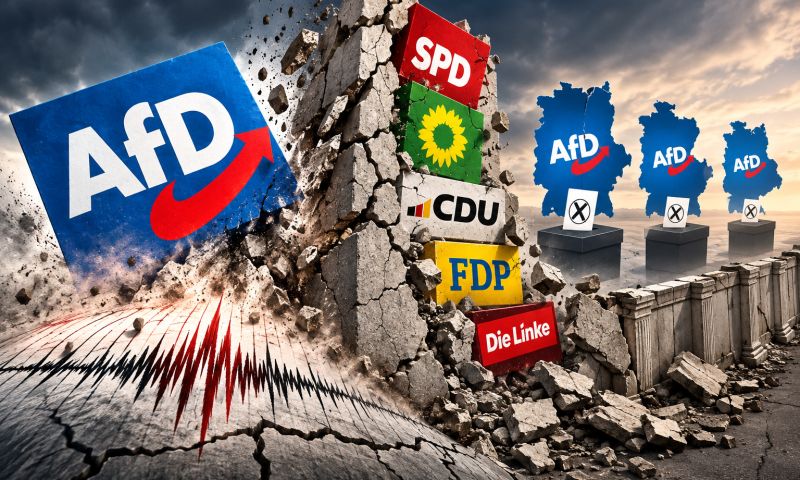
Saxony-Anhalt State Election: When Germany's Political System Reaches Its Limits






Introduction
For months, the upcoming state legislative elections in Saxony-Anhalt had dominated political coverage in the media. The headquarters of all the parties were also preparing for this “D-Day.” Everyone was aware that the elections in Saxony-Anhalt carried significance far beyond the borders of this otherwise insignificant federal state.
For—the “pink elephant” everyone was aware of was the AfD.
And so every possible means was deployed to directly, and above all subtly, influence voting behavior. Leading the way was the claim, present in all media, that the AfD was “confirmed to be far-right extremist.” No one explained that this technical term is an exclusively internal working concept of the Federal Office for the Protection of the Constitution and has no legal binding force or relevance. Just how aware the political circles responsible for this classification are of this fact is evidenced by the fact that no one is even making a serious attempt to ban the AfD through proper legal proceedings under the rule of law.
And as if on cue, just a few days before the election, news came from Thuringia that the entire leadership of the BSW parliamentary group in the Thuringian state parliament—as if guided by an invisible hand—resigned from the party and—even more astonishingly—announced the formation of a new party within three days.
Coincidences happen….
The Initial Situation
Since the founding of the Federal Republic, there has been no political or economic crisis comparable to the current situation. The economic decoupling from Russia in 2022—which was entirely self-inflicted—was organized so ineptly that one could hardly believe one’s eyes at this political admission of failure. Any reasonably educated citizen could have predicted the consequences: a rapid rise in raw material and energy prices, inevitably leading to higher costs for German industrial production—to the point where its products became unsellable on the world market.
The boundless support for Ukraine in a unwinnable war plunged the state’s finances into further turmoil. Not to mention the costs of legal and illegal migration, which are no longer under control and cannot be controlled.
In an attempt to somehow get these deficits under control, the federal and state governments are trying to reduce them through social cuts on a scale never seen before—but these deficits can no longer be eliminated.
We have now reached a point where parliamentarians who are bound solely by their conscience should be compelled en masse to resign—or at least to review and correct their previous decisions. Not so in the “best Germany of all time.”
The fact that it takes the AfD to make a tangible opposition visible is proof of the catastrophic state of German civil society.
An election result with far-reaching consequences
The following chart illustrates the new political reality in Saxony-Anhalt.
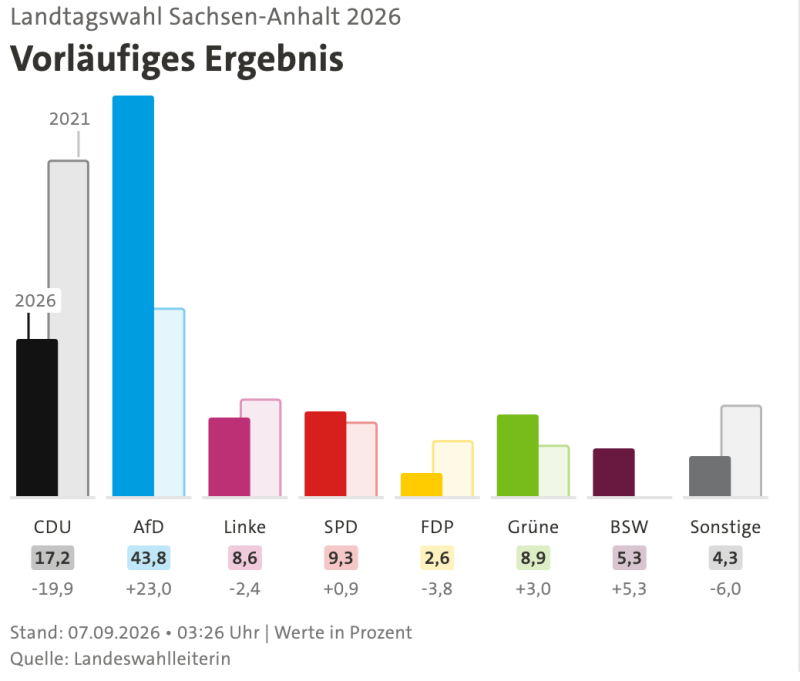
The result essentially reflects what I had hoped for. I was hoping for the following:
· The AfD should be strong enough that the established parties cannot ignore it.
· The established parties, on the other hand, should be weakened to the point where even together they are unable to form a government.
· Both of the aforementioned points require the BSW to participate in parliamentary proceedings, meaning it must clear the 5 percent threshold.
The actual election results reflect all of these points.
The SPD, once one of Germany’s major parties, is politically on the verge of irrelevance. Its leading candidate in Saxony-Anhalt, Armin Willingmann, said after the announcement of the election result—9.3 percent for the party still in government—that his party was “fairly stable.” Its current coalition partner in the government, the FDP, was effectively wiped out. The other partner in the government, the CDU, was virtually dwarfed by the actual result of 17.2 percent of the vote—a far cry from the 37.1 percent it received in 2021 and the absurd, reality-defying belief, fueled by that result, that it would achieve a similar level of support in 2025. The Greens gained ground, but not enough to pose a threat, at least not to my liking.
With this result, the established parties cannot form a majority against the AfD—no matter what possible or even theoretically conceivable coalition scenario. Moreover, due to incompatibility rulings by the federal executive committee, the state CDU can neither enter into a coalition with the urgently needed “partner,” the Left Party, nor seek any form of cooperation with the AfD.
What advantage do I see in this outcome, which at first glance seems undesirable? It leads to constraints that none of the parties can circumvent.
The situation is vaguely comparable to that at the end of the Thirty Years’ War. At that time, none of the warring parties was in a position to impose its will on the other side. Continuing the fight was not an option, since all sides were not only war-weary—they were at their wits’ end. This constellation forced everyone to make compromises and, ultimately, led to a new European reality.
The situation in Saxony-Anhalt bears similarities. As a result of the back-and-forth in the by-election, all sides must make compromises. Anyone who does not want new elections must find a way to talk to the other side and reach an agreement. This applies to EVERYONE and, from a psychological perspective, represents a way to calm the extremely heated political atmosphere in Germany—one that everyone should be able to live with under normal, DEMOCRATIC circumstances.
The AfD will offer talks to everyone, as its co-chair Tino Chrupalla already did on ARD immediately after the first projections were announced, addressing the secretaries-general of the federal parties—the SPD (Tim Klüssendorf) and the CDU (Franziska Oppermann)—as well as the party chair of Die Linke (Luigi Pantisano). All three top politicians reflexively and categorically rejected even the mere idea of a joint discussion. They outdid one another—simultaneously (!!)—in their disrespect toward the calmly smiling election winner Chrupalla, to the point that there could be no talk of a civilized, respectful, solution-oriented culture of discussion.
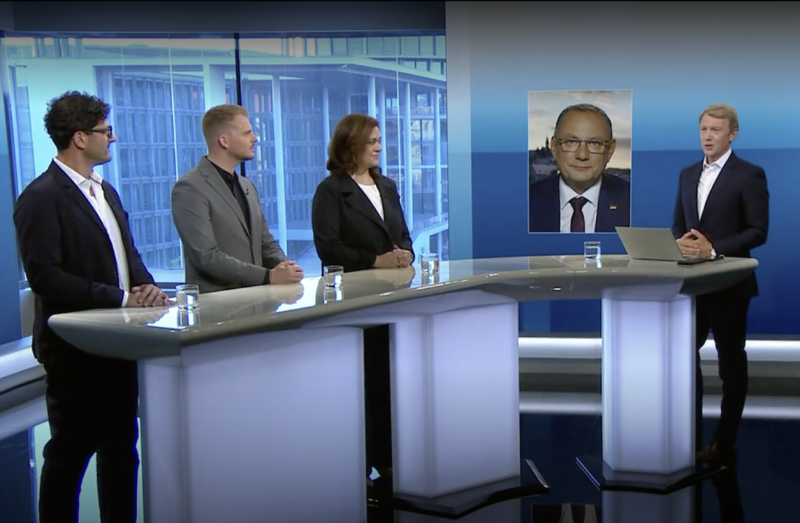
How is even the most rudimentary cooperation supposed to come about under these circumstances?
Under the current circumstances, this childish behavior borders on political suicide. For if a government cannot be formed despite the AfD’s offers, new elections loom. The AfD is looking forward to them with great anticipation. If the established parties continue to behave in such an anti-democratic manner in public—as was evident not only during this ARD television debate—it is to be expected that, in the event of new elections, the AfD will sweep up the remaining seven percent to secure an absolute majority, as if in a triumphal march.
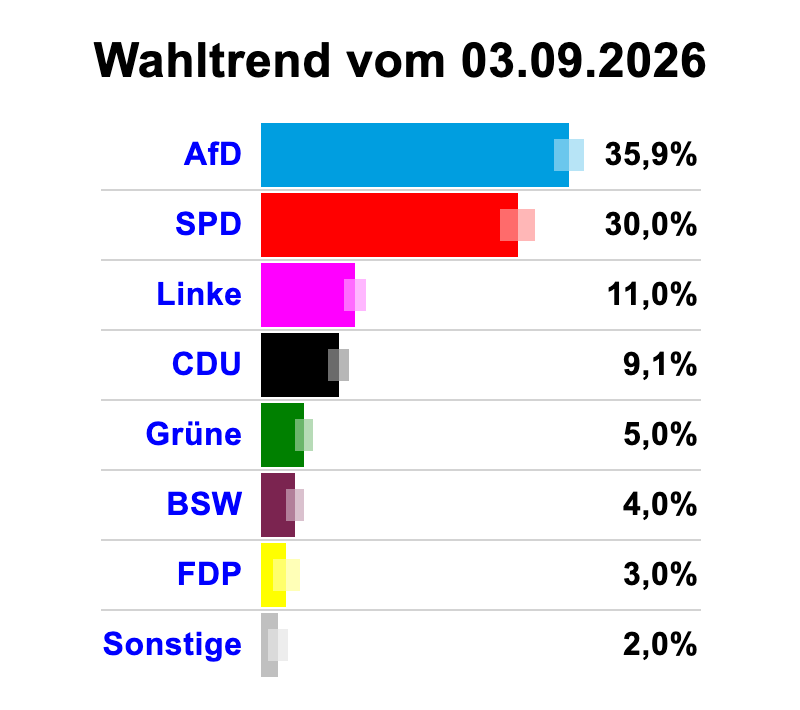
And on the way there, another state election is scheduled for September 20, 2026, in Mecklenburg-Western Pomerania—a state where the AfD is exceptionally strong. Here’s a look at the voting trends there:
In closing, a brief look at Berlin. Even with the current results, it will be very difficult for Chancellor Merz to remain in office. With the AfD likely to win over 50 percent of the vote following a possible new election in Saxony-Anhalt, Friedrich Merz will probably be able to focus full-time on his retirement.
Thus, there is far more change on the horizon for Germany’s federal political landscape than merely a redistribution of power in Saxony-Anhalt and Mecklenburg-Western Pomerania. Given this context, the childish behavior—both in substance and form—of the aforementioned representatives of the established parties is hard to top in terms of short-sightedness and political stupidity.
Due to the catastrophic misjudgments of the political and personnel realities following the recent state elections in Thuringia and Brandenburg, the BSW will not enter into a coalition with the AfD. On the other hand, the alliance will not be opposed to substantive cooperation, which could well suit the AfD’s interests. Moreover, the BSW will not be able to oppose substantive cooperation with the AfD if it wishes to maintain its credibility as a party.
Conclusion
The coming weeks present an opportunity to initiate changes across Germany as a whole. This is linked to the hope that the cartel of the established parties has maneuvered itself into such a dead end that these parties will no longer be able to find their way out by continuing business as usual.
It remains to be seen in which direction these potential changes will go. In modern Germany, it has been rare for election winners to keep the promises they made in their campaign and party platforms.
«Saxony-Anhalt State Election: When Germany's Political System Reaches Its Limits»