


Peace Will Be Won on the Battlefield






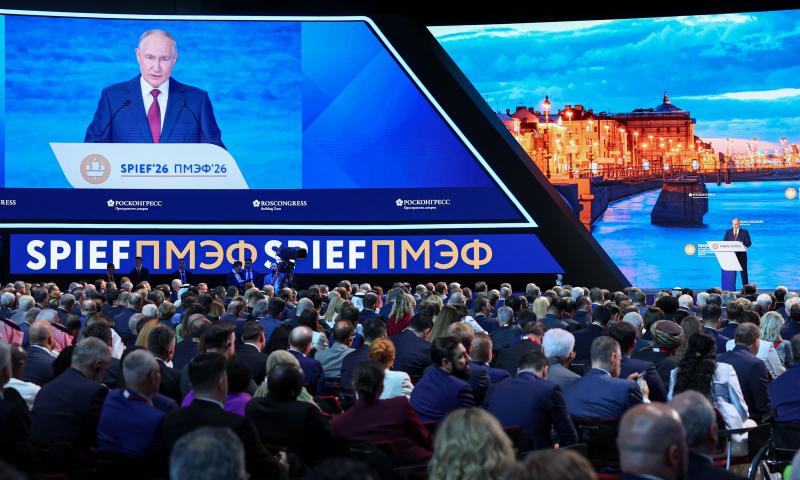
There has been much discussion in western circles about the need for, and prospects of, a diplomatic resolution to the conflict in Ukraine. Much of this discussion is centered around the need to get Russia and Ukraine to sit at the same table so that meaningful negotiations can take place. Indeed, much of the western approach toward the conflict is focused on the need for Ukraine to escalate the conflict in a manner designed to confront Russia with the inevitability of a military stalemate, and as such the necessity of a negotiated settlement. Russian President Vladimir Putin’s appearance at the Saint Petersburg International Economic Forum (SPIEF), however, appeared to pour cold water on any such possibility. Russia, according to President Putin, is ready and desirous for a negotiated settlement to the conflict with Ukraine, but only on terms acceptable to Russia. As such, the prospects for peace in the near term are non-existent, and the conditions for conflict termination with be defined on the battlefield, and not around a negotiating table.
In the weeks leading up to SPIEF 2026, there had been much talk in both western and Russian intellectual circles about a change in attitude among the Russian people regarding the ongoing conflict between Ukraine and Russia, which has entered its fifth year. One of the themes popular in the west was premised on the notion that Russia was becoming exhausted, physically and mentally, from a conflict for which there seemed to be no light at the end of the tunnel. Slow gains on the frontlines in Ukraine, often at significant human cost, combined with an increase in long-range Ukrainian drone attacks on strategic infrastructure in the Russian strategic depth, according to this narrative, was having a telling effect on a population for whom the previous unquestioned support for the Russian President was beginning to wane.
In Russia similar sentiments were echoed among conservative circles (there is no longer a viable liberal elite in Russia) whose support for the conflict remained steadfast, but for whom the pace and methodology of conflict lacked the kind of urgency and direction necessary to decisively defeat not just Ukraine, but a notional “collective West” (Europe, Nato, and the United States) whose material and financial assistance to Ukraine was seen as the decisive component in Ukraine’s ability to keep fighting.
The Karaganov Effect
One of the more popular positions held within the conservative pro-war camp inside Russia was that promulgated by the noted political scientist Sergei Karaganov, a close confidant of President Putin who played a central role in crafting the new Russian nuclear doctrine published in the fall of 2024. Karaganov placed the blame for the continuation of the conflict between Russia and Ukraine squarely on the shoulders of Europe, and openly championed a policy of preemptive military strikes against European military industrial targets involved in supplying Ukraine and, if such attacks failed to compel Europe to cease and desist in its support for Ukraine, to follow up with attacks of the decision making centers of Europe with both conventional and nuclear strikes. Karaganov’s sentiments, which have been echoed by former Russian President Dmitry Medvedev, are premised on the notion that the United States would not come to the assistance of Europe, even if Russia were to use nuclear weapons, because—to paraphrase Karaganov’s seminal 2023 article where this argument was first presented, no US President would be willing to trade Boston for Poznan.
Karaganov’s concerns did not manifest themselves in a geopolitical vacuum but rather come in response to the difficult conditions on the frontlines in Ukraine and the growing sentiment in Europe that war with Russia was inevitable. Recently published German military doctrine was premised on the expectations that Germany and Russia will be at war by 2029. Statements made by senior British military and civilian leadership speak of the need to be prepared for a conflict with Russia by 2030, and the Secretary General of Nato, Mark Rutte, has openly alluded to the inevitability of a conflict between Europe and Russia that would replicate the horror and intensity of the Second World War.
Many in the West have assessed Karaganov’s intellectual posturing as both a sign of the desperation that exists inside Russia, where it now must threaten the use of nuclear weapons to achieve what cannot be accomplished through conventional means on the battlefield, and a growing frustration in the leadership of President Putin, leading to rife speculation in certain circles that the wolves are gathering around the Kremlin, looking to replace the man who has led Russia for more than a quarter century.
The Russian Reality
Back in May 2022 former US Secretary of Defense Lloyd Austin articulated the official policy objectives of both the United States and Nato when it came to the conflict between Russia and Ukraine, namely the strategic defeat of Russia. This policy was comprised of three supporting pillars. First, to deny Russia a military victory in Ukraine, and instead bog the Russian Army into an endless Afghanistan-like debacle that would sap the martial strength of the nation. Second, to collapse Russia economically through sanctions that choked off Russia’s ability to fund not only the conflict in Ukraine, but any future military adventure. And, lastly, to collapse Russia socially, leading to political change that would see President Putin removed from power and replaced by a leadership more inclined to yield to the demands of the West.
This policy remains in effect today, actively and forcefully promoted by Europe, and more passively sustained by the United States. The problem for the West is that this policy has failed. The Russian military is far from defeated and has gained the strategic initiative along the entire length and depth of the zone of conflict with Ukraine. While the industrial capacity of Europe and the US to sustain the logistical needs of the Ukrainian military is waning or, in some instances, failed altogether, Russian defense industry has reached full stride, with no signs of letting up. Economic sanctions have hurt Russia, but not fatally so—the Russian economy is growing, along with the standard of living of the Russian population.
Which leaves the political fortunes of the Russian President. In the lead up to SPIEF 2026, Ukraine had implemented a campaign of intensified drone strikes. One of these attacks was against a teacher’s college in Lugansk which killed 21 students. Another attack took place on Saint Petersburg on the opening day of SPIEF. All these attacks were designed to provoke the Russian leadership. Rather than address these provocations, President Putin’s formal remarks at the plenary session of SPIEF focused exclusively on the Russian economy and need to create a stable environment conducive for investments (some $84 billion in new business deals were consummated at SPIEF this year.) In short, the Russian President made it a specific point not to allow Russia to be defined by conflict, but rather by its future prosperity.
Only in the question-and-answer session did the Russian President turn his attention to the conflict with Ukraine. President Putin was openly dismissive of those who postulated the need to expand the conflict into Europe. By addressing an open letter published under the name of Ukrainian President Volodymyr Zelensky calling for peace talks, President Putin emphasized Russia’s desire for negotiations, but only on terms acceptable to Russia. And for those who doubted the resolve of either the Russian President or the Russian military to achieve victory on the battlefield, President Putin put those fears to rest with a direct appeal to the Russian armed forces which combined the formality of similar orders issued during the Second World War with the comradeship of shared experience—“Keep working, Brothers.” For those sitting in the audience, the impact of these words was electrifying and compelling, something observers in the West would do well to heed.
«Peace Will Be Won on the Battlefield»