


Kiev Today






Editor's Note: This report was written by an author who, for understandable reasons, wishes to remain anonymous. We have published the text unedited and unaltered, exactly as it was submitted, in order to preserve its authenticity.
Kiev Today
Some time ago, I decided to travel to Ukraine to help my relatives and friends—simply to be there for them. Essentially, these were purely symbolic gestures: a few groceries they like and, above all, a few hours spent together. Even with the best of intentions, that’s all that’s possible. Because despite my visit, my friends and relatives still have to make ends meet, which is easier said than done.
When you travel to Ukraine, you never know in advance how the trip will go—whether you'll be able to leave again or whether you'll be arrested. I know Ukrainians who, for this reason, avoid traveling to their motherland under any circumstances.
I had decided for myself: If everything goes smoothly, I'll write about my impressions and observations.
Trip to Ukraine
It would be dishonest to say that a journey like this goes without any tension. The closer one gets to the border, the more nervous the travelers become. You can see it in their faces. And yet, one only fully senses the enormous danger and the pressure exerted by the regime once one has crossed the border and is on Ukrainian soil. Only then does one become fully aware of the regime’s totalitarian pressure and the associated tragedy of ordinary people.
The Ukrainians are trapped. In their desire and quest for a better life, they seemingly freely chose to join the European Union. In reality, they ended up in their current situation as a result of underhanded manipulation by the West, which exploited these understandable aspirations for a better life solely for its own purposes.
In Russia, despite all its assurances, the West has been trying to set similar processes in motion for some time now—not just since 2022.
And so, for the first time, all of this is unfolding on such a colossal scale in the country that, in terms of land area, is the largest in Europe after Russia. Ukraine has the highest percentage of close relatives living in Russia of any country in the world. According to a November 2021 survey by the Kyiv International Institute of Sociology, about 57 percent of Ukrainians have relatives in Russia—more than half the population!
Phone
After I arrived, I bought a Ukrainian SIM card. As soon as I inserted it into my cell phone—before I could do anything else with the phone—I immediately received a message with the relevant contact information: “Slawa Ukraini! Welcome to Ukraine! If you need advice or help, call the regional military administration’s hotline!” I’ve traveled a lot, and I’ve never experienced a country I’ve entered greeting me, for example, with “Hail Switzerland!” or “Glory to Germany!” or “Glory to Brazil!” What’s the point of that?
Then a text message came from “Anti_Fake”: “Have you seen a shocking or suspicious message? Check it out at the Center for Combating Disinformation of the National Security and Defense Council of Ukraine!” “Report it to us!” along with the contact information.
Calls like this always work both ways. On the one hand, people are urged to report anything suspicious—in other words, to become informants, if necessary. On the other hand, such calls can backfire on you if someone else concludes that you’re moving or behaving in a way that’s somehow “not normal.”
To me, that meant: If I'm actively taking a photo of something and someone finds it questionable, they can report me.
I'd like to remind readers that I had just bought the SIM card, and messages were already pouring in —even though I hadn't made a single call from it yet.
And it didn’t stop there. A text message arrived from the Ukrainian Security Service (SBU): “The enemy is actively recruiting Ukrainians on social media to carry out arson and terrorist attacks. If strangers promise you easy money for completing ‘simple tasks’—report it to us. Go to the Telegram chatbot ‘Burn the FSB Man’ or give us a call.”
These are mass text messages that every Ukrainian receives. Everyone can decide for themselves what effect such appeals have on the population over a long period of time.
In The City
From all television stations, media outlets, schools, even kindergartens, from all government agencies—the message comes from everywhere: Russia is the enemy! Kill Russians and be proud of it! People’s minds are being methodically and systematically brainwashed by appealing to their emotions, with an emphasis on patriotism for the motherland and the protection of one’s own homeland.
Many countries react this way to a war situation. But in Ukraine, the manipulation of the people reached a level that transcends all human boundaries.
In the spring of 2023, the scandal-plagued “Kunstcafé Offensiva” opened its doors. The café’s founder is a radical nationalist who had already established the nonprofit organization “Offenziwa” (from the French “offensive,” English “offensive”) in 2020. “Offensive” refers to active military operations aimed at conquering territories, destroying the enemy, or achieving strategic objectives.
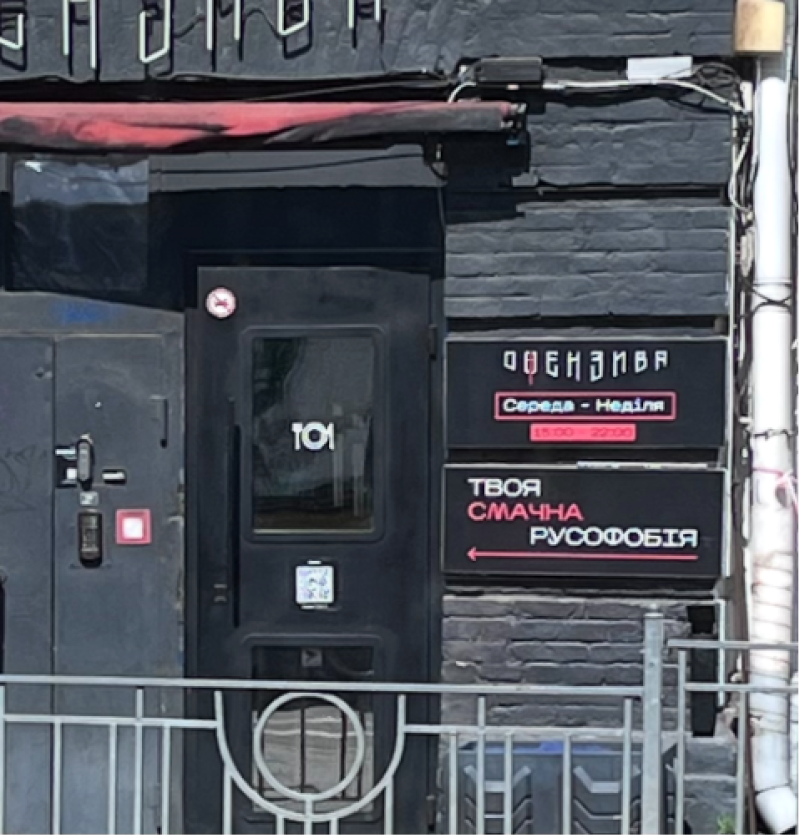
The restaurant offers dishes with names like “Daria Dugina,” “Navalny,” and “Crokus City.” A wide selection of dishes is “dedicated” to the Russian president.
Now, there are also dishes like “Wiener Schnitzel” or “Beef Stroganoff” all over the world, intended as an ode to a globally respected culinary style. However, the intentions behind this Kiev restaurant are of an entirely different nature, as the restaurant’s signage makes abundantly clear. After all, the restaurant’s slogan is “Ofenziwa: Your Delicious Russophobia.”

There is no doubt, then, that the names of these dishes serve to dehumanize the people after whom they are named. It is a disgrace, a cynical madness.
Even though all social media platforms list this location as active—that is, open—I haven’t seen anyone go in or out of it. This might lead one to conclude that this building is not intended to be a restaurant, but rather as an advertisement for and an expression of Ukrainian politics, as a provocation designed to fuel hatred and prolong the war.
Do young people who have never left Ukraine—or who have never been able to leave—even have a chance of not being influenced by these ubiquitous hate campaigns against everything Russian? My answer: No, not a chance!
Seen in this light, what follows is nothing short of a paradox: Despite everything, many people in Kyiv continue to speak the banned Russian language—on the street, in the metro, and while shopping. Because no matter how much they are brainwashed, their native language is Russian. And the language of one’s childhood cannot be changed.
What Will Become of Society?
Now that attacks involving all kinds of missiles have really begun, the narrative of dehumanizing the Russians has intensified even further. Critical thinking doesn’t work under these circumstances. I was reminded of the work of psychiatrist Bessel van der Kolk, who studied human behavior during disasters and wars. He described a phenomenon: inner dialogue disappears; the sense of time is lost; the ability to think logically fades. All that remains are automatic, instinctive survival mechanisms. I’ve observed all of this in practically everyone I’ve been able to talk to.
In the Metro
I had to spend every night underground in the subway. Explosions—especially those caused by rockets—are very frightening, and the brain actually reacts immediately, just as Bessel had described.
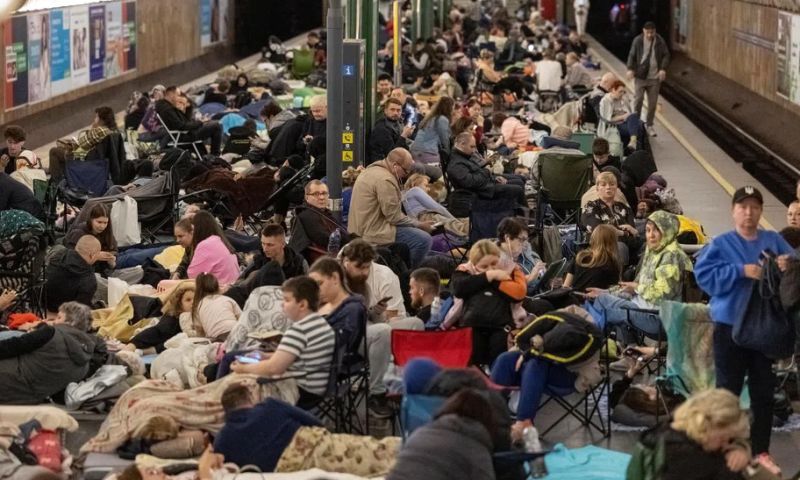
When an alarm sounds, the subway serves as a shelter and is packed with people, because no one has built any other shelters in the past four years. This photo shows a real-life situation during a bombing raid in the Kyiv subway.
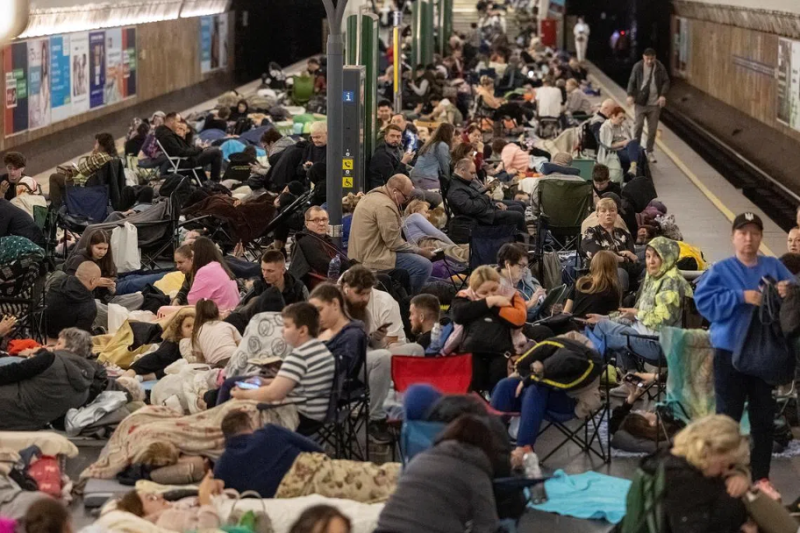
There, a middle-aged man listened to a podcast by Ukrainian opposition politician Yevgeny Murayev, who is well known in Ukraine. He is currently living in exile in Beijing.
I was moved by the conversation between some older women sitting next to me in the subway. There were three elderly ladies, probably over 80 years old—typical “babushkas.” One of them said to the others, “Even my little granddaughter brought me a map and said, ‘Look, Grandma, how much smaller Ukraine is compared to Russia. If even a little kid understands that, why don’t the people up there get it?’”
The West is well aware of this, as is the Ukrainian leadership, which usurped power in violation of all Ukrainian law and has no intention of ever allowing that power to be put to the test through elections. And the group of radical Nazis that supports this regime is also well aware of this.
People as Human Shields
But all these psychopaths don't care about ordinary people; they use them as human shields for their political agenda. For example, the Ukrainian army hides important weapons, such as air defense positions, in residential neighborhoods. When Russian drones and missiles are hit, they fall onto these residential buildings and explode there.
There are other examples that show that the Ukrainian leadership is deliberately using the population as a shield for the military, without their knowledge. During one of the most recent major attacks, a Russian missile struck an arms depot. The depot was hidden within the territory of Vishnyovoye, a satellite town of Kyiv, and was not recognizable as such. The consequences were devastating.
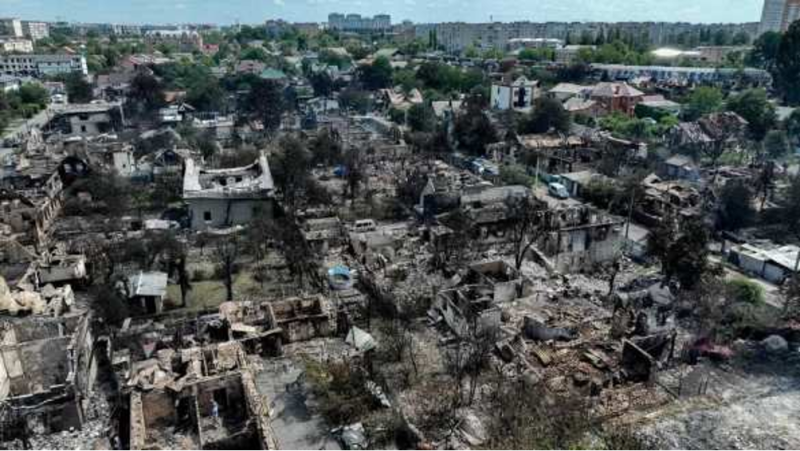
The detonations of the ammunition stored there completely destroyed 91 single-family homes. Another 27 multi-story apartment buildings and 253 single-family homes were partially damaged. The area was evacuated. The authorities remained silent for days. The mayor of Kyiv appeared in front of a damaged apartment building in Kyiv without even mentioning Vyshneve.
There are several reasons for this: First, international treaties prohibit the storage of ammunition in populated areas. This therefore constitutes a war crime—not the attack on military targets, even hidden ones, but the storage of ammunition in residential areas. Second, according to Ukrainian sources, ammunition containing depleted uranium was stored there. The fact that the Ukrainian authorities knew from the very beginning what was going on here is evidenced by the fact that the entire 13-hectare affected area was cordoned off by the intelligence service. Despite the massive destruction, there were initially no statements whatsoever about the incident or possible casualties—even though the detonations of the ammunition stored there lasted for five hours.
After several days, Ukrainian authorities were compelled to issue a statement saying that the explosions had occurred at a facility belonging to the Ukrainian state defense agency “Ukroboronprom” and that a criminal investigation had been launched.
Outlook
The social situation is also reflected in the media. There are countless radio and television stations, but they all present a single point of view. All opposition stations in Ukraine have been shut down. Even a completely harmless discussion about the causes of the conflict can lead to criminal prosecution and actual prison sentences. Some journalists have managed to flee and are now operating from outside Ukraine. But they have only very limited influence on the people inside the country; I explained the reasons for this earlier.
The same applies to political organizations. They all conform to the prevailing opinion. In the Rada, the parliament, there are various parties, but only one political direction. There is no political force capable of considering all sides of the conflict and serving as a guide for the citizens of Ukraine.
Many readers will ask: How much support does the Ukrainian leadership have among the population?
None of the people I spoke with expressed open support for the Ukrainian leadership. For some, given their specific living circumstances, this can certainly be seen as an expression of personal resistance. Others simply want to hang in there and be left in peace. Still others, who openly supported the government just one or two years ago, are now conspicuously reluctant to make such statements. What they all have in common is a longing for a normal life, without war.
Based on what I was able to gather during my few days there, the regime does not enjoy broad support. It is perceived as a small group of criminals who, with the help of the West, have a firm grip on the structures of power, know how to exploit them brutally, and base everything else on that.
Unfortunately, this leaves Russia with no choice but to end this conflict on the battlefield by military means—a conflict that should never have started in the first place. And only once the military phase is over will it be possible within Ukraine to discuss the actual causes of the conflict, the pain of the losses, and how to move forward. Until then, there is no one with whom an agreement can be reached—no one with whom it is even possible to have a conversation from a perspective that takes all sides into account.
«Kiev Today»