

Iran: The Enemy the West Has Created for Itself






How Iran’s negative image came about
A bilateral ceasefire agreed on 8 April, riddled with so-called misunderstandings, was violated that very same day by Israeli air strikes in Lebanon. The prospect of an end to the war provided an opportunity to take stock of the situation – something that could have been done from day one: ‘all that for this’. Rarely in contemporary history has such an unthinkable accumulation of missteps produced such tragically distressing results. The current war, however, was not inevitable. Rumours of special operations or bombings have punctuated the news on Iran since 2002 and for twenty years, without a regional conflict ever breaking out. The Israelis have assassinated Iranian scientists or sabotaged nuclear facilities (the Stuxnet computer virus), but there were enough informed and realistic people within the US and Israeli military establishments to understand that a war with Iran would have no chance of success and would, on the contrary, have disastrous consequences for the region: something which the current war is demonstrating day after day.
For Israel, the prospect of war with Iran arose following the Hamas attack on 7 October 2023 and the ensuing regional upheavals: an Israeli offensive on Gaza and against Hezbollah in Lebanon, the collapse of the Assad dynasty – an ally of Iran – in Syria, and the apparent weakening of Iran, deprived of its proxies and allies. This war also forms part of a political alignment and even collusion between leaders – Donald Trump’s United States and Benjamin Netanyahu’s Israeli government – against a backdrop of Europe’s diplomatic marginalisation. It is, ultimately, the consequence of Donald Trump’s withdrawal from the Iran nuclear deal (JCPOA) signed in 2015; more distantly, of the 1979 Islamic Revolution, which sought to counter American imperialism in the Middle East; and even more profoundly, of recurring and age-old tensions between East and West, the Christian world and the Islamic world, Western imperialism and Eastern cultural resistance.
For a long time, Western public opinion has been groomed to accept an aggressive policy towards Iran: ever since the 1979 Revolution, which was readily portrayed as the fundamentalist regression of a country on the path to Westernisation; or since 2002, when Iran found itself part of an ‘Axis of Evil’, alongside North Korea and Iraq (wrongly accused of possessing weapons of mass destruction), even though the nineteen terrorists of 11 September 2001 were Saudi (fifteen), Emirati (two), Egyptian (one) or Lebanese (one). Indeed, with regard to Iran, we have a prime example of the ‘manufacturing of an enemy’ (Pierre Conesa), a prelude to the ‘manufacturing of consent’ (Noam Chomsky) that serves to justify, morally or legally, any action—even if immoral or illegal—against a country.
Looking beyond the ups and downs of current events, this article aims to examine the fundamental issue of the negative portrayal of Iran, which has played such a decisive role in political decisions, public support for war, and indifference towards Iranians. It can be summed up in a single sentence: ‘Through its oppression of its own people, the mullahs’ regime maintains a rogue state that supports international terrorism’. Having become a reflexive phrase in the media, an analytical habitus among most commentators and a general paradigm in many diplomatic, political and even academic circles, this portrayal has its own logic, language and origins. Here, we would like to deconstruct some of its constituent aspects.
How to paint Iran black
Iran is not a state; it has a regime
The ‘Iranian regime’, the ‘Islamic regime’, the ‘mullahs’ regime’. These phrases, repeated over the decades, serve no other purpose than to delegitimise the Iranian government: to make people believe that the Islamic Republic of Iran is a political system that is as artificial as it is precarious, with dubious sovereignty, cut off from the population and despised by it, and which survives solely through the state’s control of oil and gas and its police and military grip, or even – according to contradictory conspiracy theories – through the support of Western countries that condemn the mullahs in order to better keep them in power. Describing the Revolutionary Guards (established in 1979) as an ‘ideological army’ is part of the same operation: it reduces this military corps, which has gradually become the national army and will undoubtedly gain new prestige through the current war, to an entity that is fundamentally illegitimate, both a pariah and mafia-like.
Moreover, whenever protests break out in Iran, most commentators do not seek to analyse their context and socio-political significance, but are quick to question the very legitimacy of the ‘Iranian regime’, denounce the failure of the ‘Islamic Republic’, declare the ‘failure of the Revolution’, and so on. No one would dispute that there are dichotomies between the state and the population, cultural tensions, violent political struggles and states of economic crisis in a country covering 1,648,195 km2 and surrounded by rival or hostile nations: these are commensurate with the country’s deep-rooted history, the complexity of its identity (Iranian, Shia, Westernised), and the geostrategic stakes of a country at the heart of the Middle East, immensely rich in natural resources, at the confluence of historical antagonisms. However, the systematic denigration of the Iranian government seeks to misrepresent the stakes of the Islamic Revolution—which was both a reclaiming of identity and a liberation from Western imperialism—and to ignore the dynamics and deep-rooted nature of the Iranian political system, as well as the mosaic (historical, sociological, economic and cultural) of relations between the population and the government.
In short, a country as multifaceted as Iran is also shaped by dialectics that can be brutal at times, both politically and socio-culturally: between a diverse population often moving in the opposite direction to an oligarchic and clientelist state, social and ethnic groups with differing mindsets and interests, and generations divided by decades of political upheaval. Iran, which in the space of a few decades has evolved from a traditional kingdom (at the beginning of the 20th century) into a contemporary ‘postmodern’ nation-state, is torn by forces that are often violently at odds with one another—sometimes creative, sometimes paralysing, sometimes destructive. The myriad forms of traditionalism and modernisation, economic systems (capitalist, religious, bazaar-based), religious practices and political conduct are the factors that continually complexify the reality of Iran, of which people often wish to consider only one segment or one type of data to the exclusion of others. Yet these tensions do not signal the cyclical failure of a system; they are also part of the construction of a nation, the political awakening of the population and the dynamics of a pluralistic modernity.
The mullahs’ theocracy
Reducing the Iranian system to a theocracy is the surest way to paint with a broad brush a political system and a nation-state that combine republicanism, religious guidance and imperial traditions. For a Westerner, the term ‘theocracy’ evokes, at least in the imagination, a host of notions (the Inquisition, religious dogma, the Dark Ages, fundamentalism, etc.) that an anticlerical and anti-religious liberalism, often ignorant of historical realities and theological issues, is fond of condemning.
However, the Iranian Supreme Leader is not God: he is the representative of a tradition of interpreting a body of texts, within a network and hierarchy of clerics who, since the disappearance of the 12th Imam in the 10th century, have been responsible for guiding the Shia community until the eschatological return of this 12th Imam (the Imam Mahdi) at the end of time. The political novelty of the Islamic Republic of Iran lies in having embedded the very principle of religious guidance within a system of modern, Western inspiration. However, this political theory should not obscure the observable practices. The policies pursued by the Iranian state often have little to do with religion and are in fact much more in line with a ‘classical’ nation-state and an ‘imperial’ approach concerned with stability, preservation and influence.
An anti-clerical, Islamophobic or secularist prejudice seeks to hold the mullahs—that is to say, the Shia clerics—responsible for all political matters. Yet these clerics do not play an exclusive or hegemonic role within the Iranian system, and they are all too easily reduced, both sociologically and intellectually, to a closed and immutable corporatist bloc. In reality, the mullahs have been part of the country’s religious and cultural landscape for centuries, and they will always remain a component of society and political life, whatever Iran’s political future may bring. The clerical circles themselves are by no means homogeneous, although this diversity is not necessarily reflected in the Iranian public sphere and is not suspected by Westerners. One need only recall that the system of the Islamic Republic conceived by Khomeini, which constitutes a wholly new hybrid political form within the Iranian tradition, was not accepted by any of the major religious authorities of his time. This shows that, whilst there may be consensus on certain fundamental issues, there is in reality, amongst the clergy, a diversity of opinions and interpretations of the Islamic heritage (the Qur’an, the hadiths of the Prophet and the Shia Imams), which give rise to very heated debates within the major religious institutions in Qom or Tehran. Moreover, the polycentric structure of the clergy means that one religious authority may issue a legal opinion that contradicts another, without a higher authority – there is no pope in Islam – settling the dispute by rejecting one as inadequate or heterodox.
If there is one fundamental problem with Iranian politics, at least from a liberal (and quite specifically Western) perspective on politics, it is the issue of authoritarianism, that is to say, a top-down and patriarchal power structure, which is not unique to the mullahs but is rooted in a tradition of governance and a socio-cultural structure that is centuries-old, if not millennia-old. In fact, whilst it might be simplistic to view the mullahs as a systemic problem, they also hold the key to solutions, for, through their socio-historical roots, they can support and legitimise developments and transformations far more effectively than so-called reformist circles, which are often cut off from a country that remains largely conservative.
Iranians, moreover, are Muslims, but feel Iranian first and foremost. In the 16th century, the Persian kingdom’s conversion to Shi’ism clearly demonstrates the unique character of Iranian Islam. By adopting a minority branch of Islam, Iranians asserted both their affiliation with the Muslim faith and a distinct identity within the Islamic world. Iranian Islam, whose originality and immense philosophical heritage were highlighted by the great Iranologist Henry Corbin (1903–1978), has no equivalent in the Islamic world and precisely reflects the complexity of a country—a land of synthesis and universalism—at the crossroads of the Semitic and Indo-European worlds. Finally, the ideological and state-sponsored Islam promoted since the Revolution represents merely one interpretation of Islam, constructed for political and militant ends, from which many Iranians have, indeed, distanced themselves in the name of a more spiritual, interiorised, even mystical Islam.
The hijab: an Eastern garment, a Western problem
In 1936, Reza Shah Pahlavi banned the wearing of the veil; in 1979, the Islamic Republic made the hijab compulsory. These two events had both negative and positive effects. Reza Shah’s ban on the veil enabled a new generation of women to flourish, become involved in society and develop a new form of feminism. On the other hand, it also had a negative impact on traditional women, who could no longer go out veiled and had to stay at home, dependent on men to carry out the work they had previously done independently.
The compulsory wearing of the veil following the Islamic Revolution shattered a generation of women who had broken free from certain traditional social and family norms, but it also enabled traditional women to participate in social life and enter the workforce, as the prevailing Islamic climate helped them feel at ease with their own values. In both cases (whether the hijab is banned or compulsory), however, the so-called Islamic veil is over-interpreted in a religious sense, whereas it is a garment with highly variable meanings and its wearing is also driven by motivations as varied as social contexts or family situations.
Entire volumes have been written about the hijab, but here we shall confine ourselves to a few key points:
The origins of the veil date back to pre-Islamic times. It is mentioned in Assyrian tablets from the late 2nd millennium BCE, where it had the same significance it may still have today: worn by women from well-to-do and established families, the veil served as a sign of social status.
Before Islam, the veil was a Christian ‘matter’. One need only glance at Byzantine icons or medieval iconography to see that the Virgin Mary also wears a veil. In fact, Christian theologians justified the wearing of the veil by Christian women using arguments analogous or similar to those put forward by Muslim clerics regarding the hijab. The veil was also a common garment in rural Europe, and standing before a Provençal nativity scene, an Iranian student was surprised that ‘the women were all wearing hijabs’.
Islamism treats the veil as a symbol of Islam and a measure of piety, but it is also a traditional Middle Eastern garment that carries religious, cultural, traditional, heritage-related and even national significance.
The references to the veil in the Qur’an are vague and have given rise to endless interpretations and debates. Consequently, the form taken by the hijab in Muslim countries is more a matter of local culture, customs and traditions than of religion. Thus, the Iranian chador – a large piece of fabric, usually black, which women wear over their headscarf and long-sleeved coat – is also a national garment, distinguishing Iranian women from Muslim women in other countries.
The ‘Woman, Life, Freedom’ movement (autumn 2022) led to a relaxation of the rules on wearing the headscarf, particularly in major cities, where women – both young and older – are going out without one. Nationwide, however, a majority of women continue to wear the veil: out of piety, tradition, pressure (whether direct or subtle), respect, context (a woman without a headscarf is quickly labelled or marginalised in a conservative environment), pride, solidarity or even nationalism.
A prejudice—whether of a libertarian, secularist or Islamophobic nature—links the hijab with the subjugation and oppression of women: this may, of course, be the case in certain contexts or situations. But from a Muslim perspective, or more broadly a traditional one, the hijab is also a symbol, a source of strength, a virtue, a social marker, a heritage, a sense of belonging, and a source of dignity. Today, it has also become a fashion item, an element of self-expression and even – as Persian poetry has not failed to note – an erotic adornment.
In Western countries, debates on the headscarf are invariably overshadowed by controversies surrounding secularism, multiculturalism, immigration and integration issues: these are purely Western concerns and often have nothing to do with Iran and its own specific issues.
Iran without Iran: the Iranian diaspora
In an opinion piece published in the newspaper Le Monde on 9 March 2026, Mohammad-Reza Djalili and Thierry Kellner stated that “The ‘new Iran’ will have one major asset: its diaspora” (“Le “nouvel Iran” aura un atout majeur : sa diaspora”). Without prejudging the outcome of the war, the two authors believed that “the Iranian diaspora, formed in successive waves since 1979, [and which] is estimated to comprise between 4 and 7 million people who have fled repression and economic hardship”, could play a constructive role in a post-Islamic Republic Iran.
The authors cannot be faulted for counting their chickens before they’re hatched, nor for speaking of an Iranian diaspora that is an integral part of Iranian history: the multifaceted ties between Iranians in Iran and the diaspora have had a considerable influence on Iran’s cultural and even political life. What this article, co-authored by Mohammad-Reza Djalili, who himself left Iran in 1978, reflects is a trend that is overrepresented in the media: when Westerners speak of Iran, it is through the experiences and aspirations of an Iranian diaspora which the West seeks above all to highlight – if not the opposition circles, then at least a more or less critical perspective. But in all this discourse, there is one major absent player: Iran itself, in all its contemporary and historical diversity.
People thus build castles in the air, pondering what a different Iran might look like, but without asking whether such ambitions are feasible or even realistic given the realities of Iran, and above all without giving a thought to what the more than 90 million Iranians living in Iran actually think. The brain drain over the past four decades is certainly a tragedy for Iran. But given the resilience of the Iranian people in the face of US-Israeli aggression, the technical sophistication of their missiles and their strategic acumen, the technicians hard at work restoring electricity or rebuilding buildings after the bombings, and the steady supply of consumer goods despite the war, one thing is clear: there are still plenty of bright minds in Iran itself. These people would not necessarily be thrilled at the idea of a diaspora coming to build a ‘new’ Iran, when the Iranians currently living in the country are Iran and make up Iran. The diaspora’s pipe dream of change reaches its peak with the fantasy of a return to Iran by Reza Pahlavi, the crown prince: how can one imagine, assuming he is not killed before setting foot on Iranian soil, that he would be welcomed as a saviour, he who has called for the bombing of a country he has long since ceased to know, and who would have to face tens of millions of Iranians who either intend to defend the Islamic Republic, or wish to protect their country from all foreign interference, or want ‘neither mullah nor king’?
The reference to the Iranian diaspora also serves to reinforce a narrative that has taken shape since the 1980s: the Islamic Republic of Iran is a country from which people flee by any means possible, whether through emigration or clandestine escape, and this flight is seen as a journey from darkness into light, from totalitarianism to freedom. This idea has been widely disseminated through books and films: from Betty Mahmoody’s Not Without My Daughter (1987) to the film Argo (directed by Ben Affleck, released in 2012) – which, incidentally, features the mosques of Istanbul (Türkiye) on one of its posters, even though the story is set in Tehran (Iran). This formative narrative was revived recently (5 April) by the extraction of the American pilot who had crashed in Iran: it matters little that the operation was otherwise a military fiasco for the United States, and that it was not quite what was made of it; what mattered was confirming the archetype of a liberating escape from a fundamentally hostile country.
Protests in late December 2025 and early January 2026
The Iranian regime is killing its own people. This has been a recurring refrain since the deadly protests at the start of 2026. Yet it is becoming clear, as The Grayzone and the comments of former British diplomat Alastair Crooke have already shown, that this was indeed an attempted coup d’état aimed at creating a civil war situation in Iran. The sequence of events was as follows:
A takeover bid for the Iranian rial leads to a sharp devaluation in December 2025 – a move that Scott Bessent, the US Treasury Secretary, had clearly hinted at on 20 January 2026 at the Davos Forum.
Inevitably, from 28 December 2025 onwards, Iranians take to the streets to protest against the sharp deterioration of the economy.
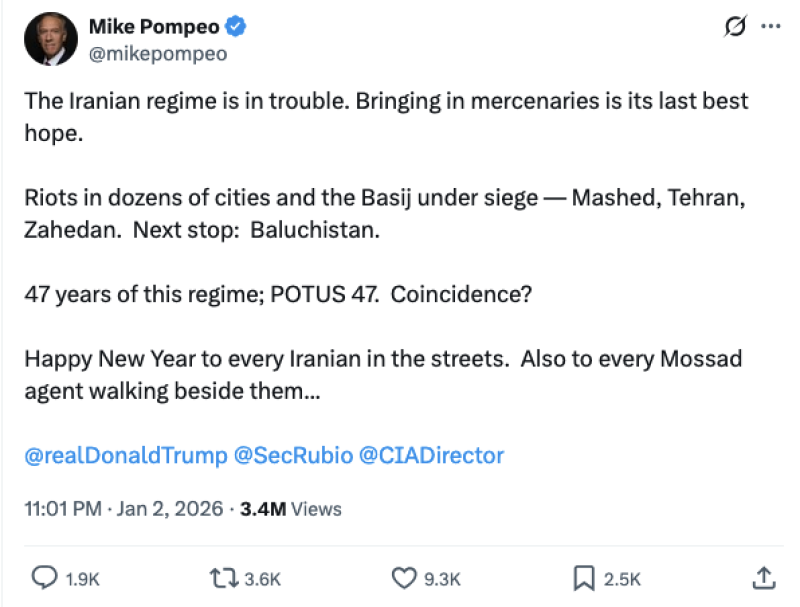
Agents of chaos, remotely controlled by Mossad and the CIA, infiltrate these protests to make them spiral out of control, setting fire to buildings, shooting at civilians and law enforcement officers, and spreading panic. This is what Mike Pompeo admitted on X on 2 January 2026, whilst wishing a happy new year to the Iranians (whose New Year, incidentally, falls on the spring equinox, not 1 January) and to the Mossad agents amongst them.
On 5 April 2026, in an interview on Fox News, Donald Trump himself admitted that protesters recruited by Mossad and the CIA had been armed: ‘We sent them a lot of guns. We sent them via the Kurds. And I think the Kurds kept them’.
The death toll is uncertain. The Iranian government puts the figure at around 3,200, but the Human Rights Activists News Agency (HRANA) cites a figure of at least 7,000, whilst other sources – purely speculatively and without any evidence – suggest figures in the tens of thousands (30,000 or even 50,000). When comparing the scale of the death toll (at least several thousand) with that of previous protests (between 2009 and 2023), it is clear that the events of January 2026 were of a completely different nature. The figures show ‘72 deaths among demonstrators during the protests against the result of the 2009 Iranian presidential election, 300 to 1,500 deaths among demonstrators during the 2019–2020 protests, and 551 during the protests following the death of Mahsa Amini in 2022–2023’ (Wikipédia: ‘Manifestations en Iran depuis 2025’). There was indeed, in January 2026, an insurrectionary atmosphere that very quickly led to a high number of casualties, although a lengthy investigation will be required to piece together the events in full detail.
Filters, concealments and reversals of values
The various levels of prejudice and stereotyping regarding Iran create a set of filters that cast a negative light on virtually everything that comes from the Islamic Republic. These filters also serve to obscure either alternative interpretations, realities that one wishes to ignore, or the very mechanism of prejudice at work. Finally, the layering of these filters leads to a reversal of values: Iran is almost guilty by definition; and what Western countries vehemently condemn in any other country is, in the case of Iran, ignored, downplayed, inverted or distorted.
Let us begin with a few filters:
Seeing religion everywhere, in order to portray Iranians as alarming fundamentalists, or de-Islamising the Iranian population, in order to highlight the ‘medieval’ Islam of the mullahs, who are, of course, assumed to be cut off from modernity and social realities.
Reducing everything to ideological calculations. If the Iranian government brings water and electricity to villages, it is not because it is the state’s responsibility to develop infrastructure, but because the Iranian regime is engaging in populism to stay in power.
Seeing a nuisance or a danger everywhere. All embassies gather information about the country in which they are based, about their expatriates and nationals, and about the host country’s political sympathies or antipathies; but if it is an Iranian embassy doing this work, it is inevitably with a view to an attack, an assassination or destabilisation.
Everything Iran does is inevitably shrouded in ambiguity. If Iran produces anything positive (whether political, cultural or otherwise), it is either: the exception that proves the rule; an exceptional coincidence, due less to the competence of the Iranian government than to a stroke of luck; or because it happened in reaction ‘against the regime’, without its knowledge or in spite of it.
Let us now look at a few methods of concealment:
We tend to smile at Iranian rhetoric denouncing the ‘arrogance of the West’ or the ‘Great American Satan’, without grasping the geopolitical analysis that underlies it, which focuses on the consequences of Western colonialism and imperialism over the last five centuries. Iran’s nuclear programme is, in the final analysis, merely a pretext for taking control of the Middle East and its resources: Donald Trump or his entourage make no secret of this, for that matter, and we can give them credit for saying out loud what many studies do not even dare to write in a footnote.
Iran’s pro-Palestinian stance is condemned in order to divert attention from the fact that it has been a real Palestinian problem since 1948. Iran is portrayed as an accomplice of Hezbollah, which is dismissed as a terrorist organisation, whilst overlooking the fact that Hezbollah, founded in 1982 in reaction to the Israeli invasion of southern Lebanon, is the only armed force capable of protecting a fragile country, given that every effort has been made to render the Lebanese army ineffective. Denouncing Iran’s anti-Zionist militancy, by accusing it of anti-Semitic fanaticism, is the best way to cover up Israel’s state-sanctioned colonialism and legitimise its current warmongering—which knows no bounds and has no political horizon—as an existential defence of ‘civilisation’.
The Iranian press is generally regarded as politically influenced, which is largely true, since all media outlets are either state-owned, quasi-state-owned or subject to state control. However, this conveniently allows the Iranian perspective to be ignored, a perspective that it would be wise to try to understand for the sake of diplomacy or any attempt at mutual understanding. It also allows Western media to be portrayed as neutral, objective and free, when in fact they are just as subject to various political, financial and lobbying pressures, not to mention their Western-centric paradigm. The sleight of hand lies in transforming partisan or biased Western media stances into ‘analyses’, whilst discrediting the Iranian media – even when they are relevant and objective – through systematic accusations of ulterior motives.
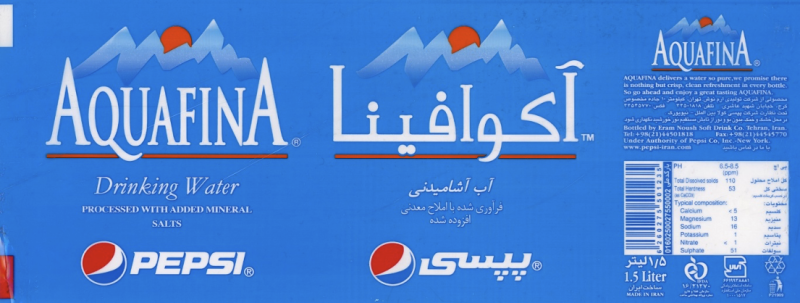
People seek to salve their consciences with the embargo, which aims to isolate and ‘punish’ the mullahs’ regime, whilst for 47 years it is the Iranian people who have been suffering – the very same people whom Western countries wish to ‘liberate’, whose ‘struggle against the regime’ they claim to support, and whose ‘courage in the demonstrations’ they praise. Powerless and unjust, this embargo is hypocritical, since the United States, its main instigator, nevertheless does business with Iran. A single label on a bottle of mineral water is enough to suggest the hidden part of the iceberg: Iranian water sold in Iran to Iranians under the auspices of Pepsi, a US company.
This leads to a virtual reversal of perceptions of reality, criteria for judgement, or simply the assessment of facts. The following examples illustrate this:
Iran has been attacked, yet it is primarily Iran – indeed, Iran alone – that Western diplomats are calling on to de-escalate the situation and exercise restraint.
Iran has been attacked twice whilst engaged in negotiations, yet it is still being asked to return to the negotiating table and criticised for refusing to take part in talks that are neither meaningful nor worthwhile.
It was Donald Trump who withdrew from the JCPOA, and Europe that was unable or unwilling to honour the agreement following the US withdrawal; yet it is Iran that stands accused of breaching its commitments, playing a double game and concealing its intentions.
It matters little that Iran claims it does not want nuclear bombs (its missiles are a sufficient deterrent), or that US agencies have repeatedly stated that Iran does not have an active, structured military nuclear programme: Iran is inevitably viewed with suspicion or presumed guilty. Through a cognitive inversion, Iran’s denials and the lack of evidence of a military programme are treated as grounds for suspicion, or even as incriminating evidence, since Iran – an Eastern and Muslim country – is necessarily deceitful, hypocritical and a liar.
International law is invoked to reopen the Strait of Hormuz, which has been closed by Iran, yet that same law is ignored when it comes to condemning the aggression against Iran, the assassination of Supreme Leader Ali Khamenei, and the deliberate destruction of hospitals, universities and bridges.
Donald Trump’s calls to wipe out Iran and bomb its civilian infrastructure – which are, strictly speaking, calls for genocide and war crimes – are met, more often than not, with a deafening silence from Western countries, which are far more vocal and proactive when it comes to other causes and other nations.
The Iranian people must be liberated by bombing: civilian deaths are certainly a tragedy, and the destruction of civilian infrastructure is of course regrettable, but this is the price to be paid for ‘liberation’. What, in any other situation, would immediately be described as a delusional policy, a war crime and a crime against humanity, is regarded as a course of action that is undoubtedly painful, but acceptable, expected or even ‘logical’.
Iran seems to have only obligations, not rights; Western countries, when it comes to Iran, have (almost) all the rights, and obligations that are either non-binding or subject to varying degrees of enforcement.
The magic formula for transforming Iran: doing business
It is, however, possible to present a more positive image of Iran. How? One need only examine the media portrayal of Iran between 2002 and 2018. Let us begin with a typical example from the 2000s, that is to say, after attempts were made to uncover a military nuclear programme in Iran (from 2002 onwards):
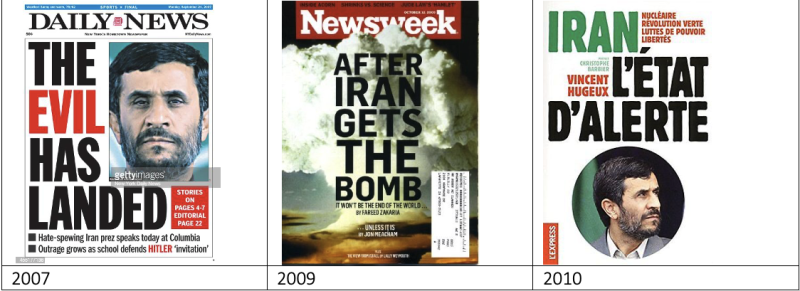
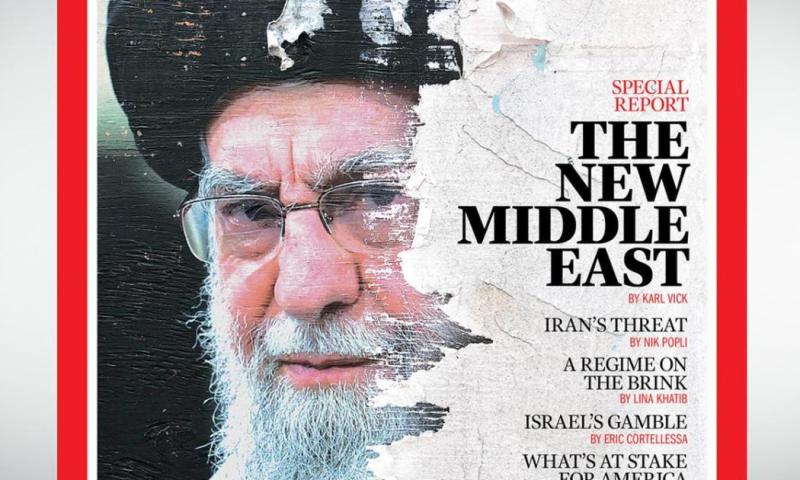
The message, both in words and images, is clear: Iran is an Islamo-fascist country seeking to acquire a nuclear bomb. Then, in 2015, the JCPOA was signed – an agreement that subjected Iran to strict monitoring of its nuclear programme in exchange for the gradual lifting of sanctions and a step-by-step normalisation of trade relations. The media immediately changed their tone and imagery (or narrative):
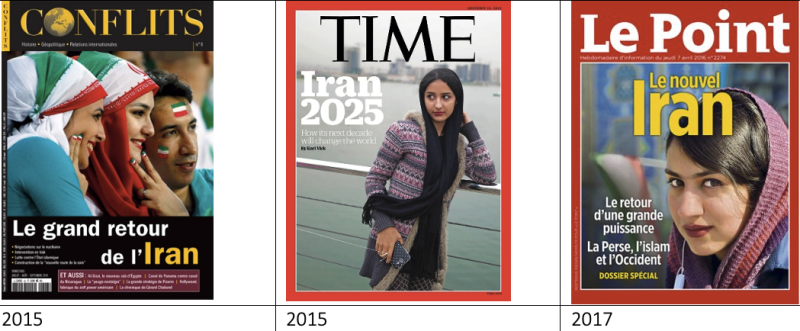
Gone is the nuclear bomb: make way for the beautiful Iranian women, who obviously didn’t exist before. ‘Iran is back’, we often read, as if Iran had ever been away, and as if it weren’t the West that had done everything in its power to ignore, marginalise and contain it. None of this lasted. In 2018, without cause or reason – save for Israeli pressure – and with no alternative, President Donald Trump unilaterally withdrew from the JCPOA, a withdrawal he had already announced during his 2017 campaign. In the media from 2017 onwards, veiled Iranian women – evoking Orientalist fantasies of an exotic and erotic East – disappeared, and the Iranian bomb made a comeback – a situation that persists to this day:
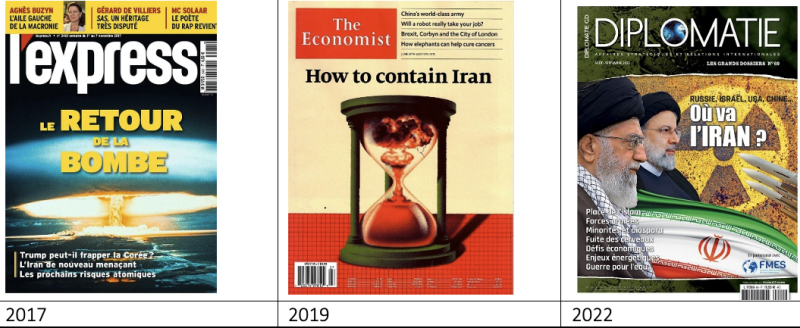
Three conclusions: an agreement with Iran is possible; many people would stand to gain from it; the demonisation of Iran is, in fact, a bout of propaganda fever that an agreement would no doubt quickly cure.
Ideas have consequences
Iran is the historic power of the Middle East: politically, militarily, economically and culturally. With the exception of Türkiye, heir to the Ottoman Empire, Iran is the only truly stable, enduring, strong and sovereign country in the region, at the heart of a Middle East dominated by new nations: either born of the disintegration of the Ottoman Empire in the 1920s (Iraq, Jordan, Syria, Lebanon, former Arab provinces of the Empire), or formed in recent times, such as Turkmenistan (established as a Soviet Socialist Republic in 1924), the Kingdom of Saudi Arabia (proclaimed in 1932), Pakistan (formed following its separation from India in 1947) or the Persian Gulf emirates (which emerged in the final quarter of the 20th century after having been under the tutelage of the British colonial empire since the 19th century).
In June 2016, McKinsey published a report entitled “Iran: The $1 Trillion Growth Opportunity?”, in which it highlighted the following among Iran’s strengths:
Diversified economy with only one-quarter of GDP from oil and gas.
Scientific education producing as many engineers as the US.
Consuming class double the proportion of China and Brazil.
Urban population twice the proportion of India.
Entrepreneurial tradition with vibrant startup Community.
Strategic location at the crossroads of East and West.
The ignorance surrounding such a country, rooted in a build-up of misinterpretations and biases, is something of a mystery or an aberration. One might point to a lack of knowledge – sometimes deliberate and carefully perpetuated, but in any case widely prevalent across all circles of influence, from diplomats to politicians, from the media to certain research institutes and universities. There is also, as is now clear, American-Israeli propaganda, fuelled by pro-Israeli funding of American politicians and lobbyists, utilising transnational networks of influence and mainstream media which, through their financial power, sociological hegemony and mastery of algorithms, manage to impose a massively anxiety-inducing and defamatory narrative on Iran. Finally, there is what might be called contempt or hatred, fuelled in various ways by xenophobia, Islamophobia, racism or a colonialist mindset, which makes Iran a convenient bogeyman and the ideal outlet for venting one’s fears and rejection.
Over the decades, the West has created an enemy for itself, ultimately leading to a war which, whether currently or potentially, is bringing about consequences that run counter to all the hopes and plans expressed by Westerners. Instead of a ‘regime change’ in Tehran, we are witnessing, on the contrary, a strengthening of the Islamic Republic, its identity and its legitimacy; a religious revival, too, and the foundations for a future narrative of national history, one that is deeply unifying and inspiring, fuelled by martyrdom and epic deeds; and, beyond Iran, a new sense of pride among the peoples of the Muslim world, who see an Islamic nation, speaking in anti-imperialist terms, resisting the world’s leading power, denouncing the injustices done to the Palestinians and establishing itself as a regional power with a global impact.
Whilst Europeans and the United States could have, through fairer and more courageous diplomacy—less ignorant and hypocritical—benefited from the Iranian market and established a genuinely pragmatic relationship with Iran, we are now seeing a series of upheavals unfold that do not work in the West’s favour:
The US presence in the Middle East has been weakened or undermined, and this is likely to be the case for some time to come.
The Gulf states – financial centres, aviation hubs and tourist destinations – are in a vulnerable position and, in order to sustain their current political model and prosperity, will be forced to forge new ties with Iran, a country perceived as a rival or an enemy but which is asserting itself as the undisputed regional power.
Previously accessible to all and free of charge, the Strait of Hormuz is now open only to countries that have reached an agreement with Iran and pay a transit fee – with the exception of the United States and Israel, which are barred by Iran.
Israel’s consistently belligerent and destabilising policy is leading many to increasingly reject Israel, and consequently to a resurgence of anti-Semitism; media or legal sanctions, even when directed against Jewish figures critical of Zionism, ultimately serve mainly to fuel conspiracy theories about global Jewish influence.
From Donald Trump’s brand of (pseudo-)diplomacy, the Iranians have concluded that the United States does not honour its diplomatic commitments, does not abide by its own agreements, and understands only the language of force: other countries will bear this in mind, just as they will remember the military failure of the world’s leading power in the face of a regional, middle-ranking power.
With the exception of a few countries (such as Spain, a pioneer in this field) or certain measures (such as the ban imposed by France, Italy and Austria on the military use of their airspace), the blunders, bias and injustice of Western diplomacy have violated, undermined or delegitimised international law.
The closure of the Strait of Hormuz, followed by Iran’s screening of ships passing through the strait, has led to disruptions in certain supply chains, a rise in energy prices, and ultimately a crisis with global consequences and effects that are both immediate and delayed, but in any case far-reaching and significant. The conflict demonstrates just how interconnected the international economy is, what economic globalisation truly means, and the cost of disrupting geopolitical, diplomatic and legal balances.
The war has demonstrated, once again, the inability or powerlessness of the UN, a Western-inspired institution created to regulate an international order that has been dominated for decades by Western or Westernised countries.
The conflict benefits Russia, which is subject to European and US sanctions but is once again being courted for its oil and gas, all to the detriment of Ukraine, which is trapped in a war it cannot win and has become a collateral victim of the diversion of arms and resources to the Middle East.
China had taken advantage of the US quagmire in Afghanistan and Iraq in the 2000s and 2010s to quietly build up its power; it can only be delighted to see the United States getting bogged down once again through a combination of arrogance and stupidity.
This war demonstrates how, in the world’s leading democracy, a single man – Donald Trump, whose competence and even mental health are open to question – who has surrounded himself with loyalists of dubious ability and primarily interested in personal gain, has provoked a war, in complete ignorance of the facts, under pressure or at the suggestion of Israel, turning American soldiers into mercenaries for a third country and making some of them – through the civilian targets struck – war criminals, all with the consent – or lack of opposition – of the Republican Party and the blessing of evangelical pastors. Both the origins and the consequences of this war will undoubtedly have a profound impact, if not on political practice, then at least on political thought, calling into question the deep state, institutional mechanisms, the military, and the safeguards that protect American citizens from presidential abuses and foreign interference.
So, no, the in-depth study of other cultures, or intercultural dialogue, is not some kind of exclusive debate, reserved for a handful of students or researchers in their own little bubble: they are essential to an international order based on a knowledge of other countries and history that will always be imperfect, but a knowledge that should remain sufficiently free from prejudice or blindness to be relevant, to prevent wars or to preserve peace. To those who wish to ‘learn the lessons of history’, yet often know nothing of it and draw no lessons for the present, Iran offers a lesson in history and geography, as well as in culture, strategy and diplomacy. Let us be pessimistic: those who promoted, supported and desired this war will remain in their posts – political, diplomatic, media or otherwise – and some will even be promoted; those who tried to make other voices heard will, as before, be marginalised, discredited, or even defamed, and nothing will change. Let us be optimistic: a lasting agreement is inevitable, under the pressure of violence, alas, and above all because, in the face of fantasies and lies, nothing beats the force of reality, and at the end of the day, the accounts must be settled. Let us simply be realistic: it is the very nature of crises to bring about a rebalancing, and whatever the final outcome of the war, we will have to reckon with a new Iran (or a renewed Iran), a transformed Middle East, and an international order in need of rethinking.
«Iran: The Enemy the West Has Created for Itself»