


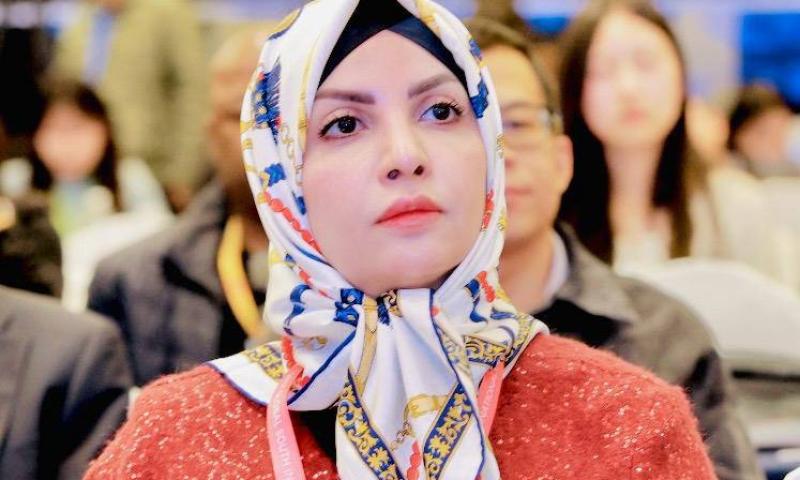
“Iran shows that sovereignty is not a gift, but the result of military self-reliance and an anti-colonialist spirit,” says Iranian scholar






It took only a few hours for the United States and its allies to prove the Iranian authorities and people right in their skepticism regarding the still-fragile ceasefire in the illegal war being waged against Iran. Whilst Iranian infrastructure has already been attacked – with an almost immediate retaliation by Tehran against Kuwait and the UAE – Israel launched its most brutal attack on Lebanon to date, killing more than 100 people in central Beirut.
Brasil de Fato spoke to Zeinab Ghassemi Tari, a professor of American studies at the University of Tehran, who stated that “although the ceasefire may technically still exist on paper, the ‘finger on the trigger’ stance announced by Iran is clearly being put into practice” and, should these attacks not be contained, “it is unlikely that the current truce will hold”.
For her, the celebrations seen on the streets of Iranian cities following the announcement of the ceasefire reflect a mixture of joy and caution rather than a wave of unchecked optimism. These celebrations appear to express a form of national pride, as Iran has demonstrated its ability to resist a coalition comprising the world’s most powerful military force, allied with the Zionist regime and the Arab monarchies of the region.
For this reason, Zeinab Ghassemi sees Iran on the verge of bringing about a “definitive shift in the global order”, for if the country is able to ensure that its 10 points are fulfilled, it should “emerge not merely as a regional power, but as a global power”. From a personal perspective, she admits that “these forty days have been, without exaggeration, the most difficult and harrowing period I have ever lived through”. With a 7-month-old baby, the Iranian scholar recalls that “every tremor from the bombings sent a chill through my heart”, yet she states confidently: “I have never felt so proud to be Iranian!”
Read her exclusive interview with Brasil de Fato below:
Ninety minutes before Trump allegedly ordered “the end of Iranian civilisation”, he backed down once again, agreeing to negotiate on the basis of the 10 points proposed by Tehran. Many analysts have interpreted this as a historic victory for Iran, and some have even gone so far as to describe it as a humiliation for Trump. How have Iranian public opinion and the government responded to Trump’s threats and inflammatory rhetoric? How do you assess the events of the past few hours? There are many images of people on the streets celebrating; is there a wave of optimism amongst the population, or are most people still cautious?
Remember that the U.S. president has been forced to back down from explicit threats to obliterate Iran's infrastructure on several occasions, a direct consequence of Iran's demonstrated military resilience and strategic deterrence.
In the immediate hours following the ceasefire announcement, the prevailing sentiment among Iranians was one of deep caution. This skepticism is not abstract; it is rooted in a long and bitter history of deceptive negotiations with the United States. To cite recent examples, both during earlier conflicts and in the most recent war, Iran suffered attacks by U.S. and Israeli forces while both parties were ostensibly engaged in diplomatic negotiations.
Following clarifying statements from Iran's Supreme National Security Council (SNSC) regarding the 10-point Tehran proposal, public sentiment has gradually shifted toward guarded optimism but caution remains the dominant posture. Notably, the SNSC's own official statement, while acknowledging Trump's retreat as a positive development, explicitly warns of the untrustworthiness of the Americans and the Zionist entity. It further stipulates that any violation of the ceasefire terms by the U.S. or its allies will trigger an immediate and proportionate Iranian response. This is not a message of naive victory, but of strategic vigilance.
Regarding the public mood and celebrations, yes, people are celebrating, but their joy requires nuance. Rather than a wave of unchecked optimism, these celebrations appear to be an expression of national pride: pride in Iran's ability to stand alone against a coalition of the United States, the Zionist entity, and their regional allies. The general public increasingly views this ceasefire as a clear demonstration of Iranian military success, especially given the unique nature of the confrontation: on one side, a united front comprising the U.S., Israel, and their regional allies; on the other, Iran, standing largely alone, successfully defending its sovereignty against an existential military threat.
Thus, the events of the last few hours can be assessed as a pivotal moment of tactical victory for Iranian diplomacy and deterrence, but most Iranians remain cautiously optimistic at best. The historical record of U.S. deception from the 1953 coup to the JCPOA withdrawal to the recent attacks during negotiations casts a long shadow. Therefore, while there is a tangible sense of achievement and relief, the dominant public sentiment is best described as "hopeful but watchful." Any sustained optimism will depend entirely on whether the U.S. and its allies adhere to the terms of this agreement; something many Iranians, and their government, remain deeply skeptical of.
Following the announcement of the ceasefire, Iran suffered an attack on an oil refinery on Lavan Island and infrastructure on Kharg Island. Iran has stated that it “keeps its finger on the trigger”, and has already retaliated with attacks on desalination and power plants in Kuwait and the UAE. Is there a risk that the ceasefire will fail?
Yes, there is a significant risk that the ceasefire will fail. The events of the past few hours suggest that the cessation of hostilities is extremely fragile, and tit-for-tat strikes have already resumed.
According to reports, three Kuwaiti power stations and water distillation plants were struck by Iranian drones this morning as an immediate retaliation for a strike against the Lavan oil refinery in Iran earlier the same day.
Intelligence points toward a Persian Gulf nation most likely the United Arab Emirates as having carried out the strike with the aim of sabotaging the ceasefire.
Beyond the Persian Gulf theatre, Iran is also preparing a military response to Israeli aggression carried out in Lebanon. This indicates that the confrontation is not limited to a single front but could expand regionally.
Taken together, these developments demonstrate a clear pattern: retaliation has already occurred, with Iranian strikes on Kuwaiti and Emirati infrastructure following attacks on Iranian soil at Lavan and Kharg Island. The original ceasefire is being violated in practice by Iran’s adversaries.
Therefore, while the ceasefire may technically still exist on paper, the "finger on the trigger" posture Iran announced is clearly being acted upon. Unless the Persian Gulf states and Israel are brought into a binding and verifiable agreement, the current lull is unlikely to hold.
Among the 10 proposals that Tehran submitted to the US, with the mediation of the Pakistani Prime Minister, which do you consider the most important? Are there any points the government would be willing to concede? And which points would be non-negotiable?
I must preface this by stating that all ten proposals submitted to the United States through the mediation of the Pakistani Prime Minister are integral to a comprehensive and just resolution. Iran views this as a unified package.
That said, if we are to highlight the most strategically significant and novel component of this arrangement, it would be the controlled passage through the Strait of Hormuz in coordination with the Iranian armed forces.
This is a critical point because it moves beyond a temporary ceasefire or a simple return to the pre-war status quo. It seeks to make enduring what has always been a volatile flashpoint. By formalizing this coordination, Iran retains its legitimate and sovereign leverage over one of the most important geostrategic arteries of global oil. The outcome of this conflict must not be a diminishment of Iran's regional standing; rather, this provision ensures that Iran’s power is sustained over the Strait. It provides a structured mechanism not only for daily maritime security but also serves as a vital lever to control and, if necessary, punish future aggression and violations of international law. In that sense, this point guarantees that Iran emerges from this process more powerful and more secure in its immediate maritime domain.
Interesting! I thought you would say the uplifting of the primary and secondary sanctions
Uplifting the primary and secondary sanctions is very important obviously. But that's been on the table since 2018. It's the same old back-and-forth we've been stuck in for years.
The Strait thing is different. That's new. And it's not just some paper promise it's actual, practical leverage. It's something Iran can use right then. It's not waiting around for the other side to play nice; it's a tool we control in real time when the bombs start falling. That's the real shift.
According to the Pakistani government, the ceasefire includes Lebanon. But Israel has already declared that it does not recognise the ceasefire in Lebanon. Subsequently, Iran has reaffirmed Pakistan’s initial statement. Ultimately, what will become of Israel’s illegal invasion of southern Lebanon, as well as its ongoing attacks on Lebanese civilians and infrastructure? Does Israel still have the strength to resist Iran’s devastating offensives?
Despite Pakistan's inclusion of Lebanon in the ceasefire framework and Iran's reaffirmation, Israel refuses to recognize it. Iranian officials and armed forces have stated that the fate of Israel's illegal invasion and attacks on Lebanese civilians will be met with force, not diplomacy. As a senior Iranian official told Al-Jazeera: The ceasefire includes the region, and Israel is knowingly breaking its promises. Only bullets will deter it.
In immediate retaliation for the Lebanon attack, Iran partially closed the Strait of Hormuz. Additionally, Iran has informed mediators it will only attend the Islamabad meeting if a ceasefire is guaranteed for Lebanon. The message is clear: Israel's actions in southern Lebanon will be met with both strategic economic pressure and direct punishment.
Since the Vietnam War, the US has not backed down in the face of military retaliation from a country it has invaded (the case of Afghanistan is different, following 20 years of occupation). If the US does not betray Iran again and accepts the 10 points demanded by Tehran, or most of them, what consequences should this defeat of the Empire have on the balance of power in regional and global geopolitics? What lessons could the Global South learn from the Iranian case?
The agreement would represent a huge strategic loss for Trump, the biggest since Vietnam and mark a definitive shift in the global order. The consequence would be Iran emerging not just as a regional power but as a global power.
This is a status Iran has gained despite 47 years of brutal sanctions and constant aggression. The success has roots in Iran's resistance economy and its ability to produce its own defensive military independent from both the East and the West. By being able to produce domestic needs and thus being able to adjust and repair itself, Iran has proven immune to external pressure.
For the Global South, the lesson is profound: sovereignty is not a gift but a product of self-reliance and the spirit of anti-colonialism. Iran's endurance is rooted in its Shia identity and the principle of standing against the oppressor for the oppressed. If the Empire is forced to retreat from this battlefield, it signals to the entire world that a new, multipolar reality has arrived.
How did you personally experience the countless bombings suffered by Iran in recent weeks? Apart from the thousands of deaths – including key leaders and countless children – what were the main losses you suffered as a result of the US and Israeli attacks?
These forty days have been, without exaggeration, the most difficult and harrowing period I have ever lived through. The weight of this time is not just in the number of strikes, but in the constant, piercing grief of losing both key figures and ordinary Iranians. We received the sad news of the assassination of top officials, a loss met with impunity and the deafening silence of the so-called international community.
Just on the first day of this war, over 160 children were killed when American missiles struck the school in Minab. Some of their bodies were never recovered; they remain buried beneath the rubble of a place meant for learning and laughter.
As a mother of a seven-month-old baby, every tremor of the bombardments sent a chill through my heart. In those moments, the cruelty of this aggression becomes intensely personal.
Yet, amidst this terror, the spirit of the Iranian people in the streets has been profoundly uplifting. Night after night, for forty days straight through the bombardments, during the holy month of Ramadan, and on the eve of our New Year, Nowruz, they never retreated into their homes. They stayed in the streets. They transformed the sound of explosions into a backdrop for solidarity.
I have never been so proud to be Iranian.
«“Iran shows that sovereignty is not a gift, but the result of military self-reliance and an anti-colonialist spirit,” says Iranian scholar»