


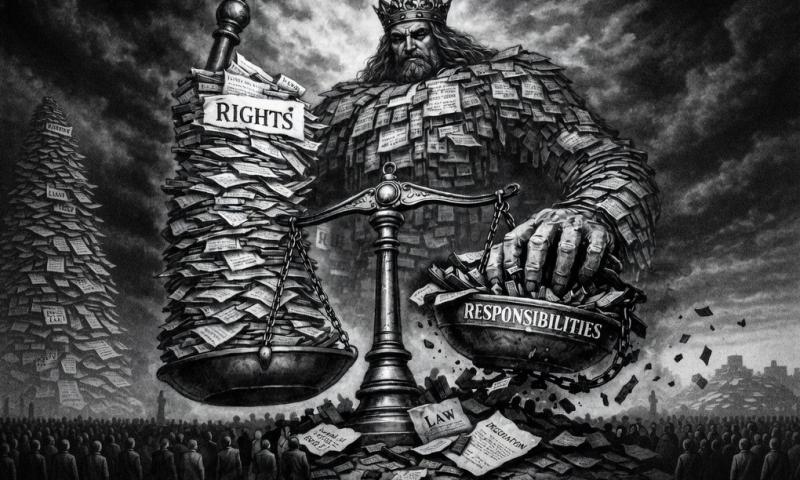
Human Rights Law and the Death of the Social Contract






We need to move away from the cloistered world of 'Human Rights'. The phrase has become so used and abused that it carries little seminal meaning. It needs to be balanced to evoke 'responsibilities'. Amendment to the 'Human Rights Act 1998' is crucial in restoring faith to the electorate of Britain. Everybody in the UK can recite an absurdity of the Act. In 'Hirst v United Kingdom (No 2) (2005) 42 EHRR 41' the blanket ban on prisoner voting was held incompatible with Article 3 of Protocol 1. In 'R (Razgar) v Secretary of State for the Home Department [2004] UKHL 27, an immigration case involving Article 8 private life, stated that a man facing removal would interfere with treatment for his mental health condition.
It is not only in Britain. A recent decision by the British Columbia Human Rights Tribunal (BCHRT) has generated international controversy. Barry Neufeld, a former elected school trustee from Chilliwack, British Columbia, was found liable for discrimination after making public statements opposing the province’s Sexual Orientation and Gender Identity (SOGI) curriculum. After eight years of proceedings, the Tribunal ruled against Neufeld and awarded the complainants approximately $750,000 CAD in damages. The BCHRT held that Neufeld’s public comments rejecting the distinction between biological sex and gender identity violated provisions of the province’s human rights code. John Cleese warned such rulings risk curtailing democratic debate.
The culture of cancelling illustrates the three stage dialectic of politicising liberal speech. First, activists publicly denounce a statement in order to signal moral alignment with their political community. Second, the target issues a defensive apology, often under intense social pressure. Thirdly, the gatekeepers of liberalism, the institutions, courts, and media, formalise the condemnation. It reminds one of the court of Dionysus of Syracuse ( Plato's employer) who asked people to judge his poetry. He asked Philoxenus, a poet, to give his opinion on some verses. Philoxenus disliked them and spoke honestly. Dionysius sent him to the stone quarries.
Sociologist Frank Furedi has described this phenomenon as a transformation in the nature of public discourse:
“Public debate has increasingly been recast as a therapeutic arena in which statements are judged not by their truth but by the emotional harm they allegedly cause.”
The Neufeld case demonstrates how this cultural logic can become embedded within administrative decision-making. Human rights tribunals apply a balancing framework: speech may be restricted if it is deemed to harm the dignity of protected groups or to promote discrimination. Over time, however, the definition of harmful speech has expanded considerably, granting administrative bodies broad discretion in regulating political expression.
The late critical theorist Paul Piccone, founder of the journal Telos, anticipated this development. Piccone argued that late liberal democracies increasingly consolidate authority within administrative structures that gradually absorb competing social institutions : religious organizations, local communities, professional bodies, and educational traditions.
“Late liberal societies tend toward an administrative homogenisation in which substantive authorities are subordinated to procedural regulation.”
From this perspective, contemporary human rights regimes do more than protect individuals from discrimination. They also define the boundaries of legitimate political discourse, privileging some identity claims while delegitimizing others. Political theorist Samuel Moyn has similarly observed that the language of human rights has increasingly displaced democratic political contestation:
“Human rights have become the dominant moral language of our time, yet they often function less as instruments of emancipation than as substitutes for political struggle.”
In the Neufeld case, the BCHRT determined that rejecting gender identity theory constituted an “existential denial” of transgender individuals. The Tribunal thus moved beyond regulating conduct and into adjudicating the legitimacy of contested philosophical claims about sex and gender. Good and Evil. It is the overt politicisation of moral speech.
For Piccone, democratic vitality depends upon the presence of negativity, the productive friction generated by competing authorities and traditions, akin to the 'agora' of ancient Greece. Religious communities, labour organisations, local political institutions, and civic associations provide alternative frameworks of authority that resist administrative homogenisation. In Neufeld’s case, many of his arguments were rooted in religious conceptions of biological sex. From the perspective of administrative human rights doctrine, such appeals may appear illegitimate or discriminatory. Yet Piccone’s analysis suggests the opposite: democratic societies require multiple normative authorities precisely in order to prevent the monopolisation of moral legitimacy by administrative institutions. Foucault called this 'parrhesia' from the Greek word meaning 'fearless speech'. This speech is necessary for a vibrant civil society. Britain, for too long, has been plagued by crippling restrictions on speech.
Political philosopher Chantal Mouffe has argued that democratic politics requires precisely this form of agonistic contestation:
“The aim of democratic politics is not to eliminate conflict but to provide institutions through which conflict can take an agonistic rather than antagonistic form.”
Administrative regimes that attempt to eliminate ideological conflict risk undermining the pluralism they claim to defend.
The widespread backlash to the BCHRT ruling suggests that the administrative consolidation of human rights authority is encountering growing resistance. Critics have compared such decisions to modern blasphemy laws- mechanisms that punish dissent from dominant moral narratives. In the UK a definition of 'anti-Muslim hatred / Islamophobia' , has now been developed by a government working group and discussed as part of a wider social cohesion strategy. Recent reporting says ministers expect public bodies to adopt the new definition. This is not a statute but the government expects public bodies; the police, schools, etc to use it. The creeping unelected 'administrative state' is particularly virulent in the UK. The 'Inquiries Act' of 2005, for example, set up by Tony Blair, destroyed the impartial nature of public inquiries. Now political government appointees control the findings of inquiries. Through unelected judiciaries. and administrative bodies, democracy has been discarded.
Now, however, new forms of dissent are emerging outside state-authorized institutions. Women’s organizations challenging gender policies in sports, gay activists questioning aspects of contemporary gender ideology, and religious communities asserting their doctrinal autonomy all represent alternative sources of authority contesting administrative orthodoxy. Therefore the critics of Human Rights orthodoxy come from every side of the political spectrum. Populist movements have arisen to challenge administrative homogenisation.
If cases such as Neufeld’s reveal structural tensions within contemporary human rights regimes, the question arises whether reform is possible. One promising direction would be to reintroduce the concept of 'Civic Responsibility' alongside rights claims.
Modern human rights discourse often emphasizes individual entitlements while neglecting the duties necessary for sustaining democratic communities. This reflects the notion of 'Society' rather than 'Community'. 'Society' sees people as atomised instruments in a utilitarian market framework. Bringing back 'community' is essential to reforming Britain. Yet the idea that rights entail responsibilities has long existed within international human rights theory. Article 29 of the Universal Declaration of Human Rights explicitly states:
“Everyone has duties to the community in which alone the free and full development of his personality is possible.”
Reintroducing this principle into contemporary rights frameworks could help restore balance between liberty and civic order. Reform of the Human Rights Act 1998 could incorporate a 'Statutory Responsibilities Clause' clarifying that the exercise of rights carries obligations to respect the freedoms of others and to preserve democratic pluralism. Pluralism rather than society should be the democratic standard. This could work in practice alongside human Rights; a 'win win' policy. How could this work in practice? My policy proposals would include the following:
'Reciprocity Test' ;ensuring that rights claims cannot extinguish competing rights such as freedom of expression or religious conscience.
'Parliamentary oversight' :when courts or tribunals reinterpret rights too expansively.
Abolition of the right of administrative bodies to impose large penalties in cases involving political speech.
Plural Social Authorities (PSAs) : religious, academic, local political institutions directly elected by local inhabitants. A form of 'direct democracy' easy established with modern technologies.
Political philosopher Hannah Arendt observed that rights detached from political community risk losing their substantive meaning:
“The calamity of the rightless is not that they are deprived of liberty, but that they no longer belong to any community whatsoever.”
The Neufeld case highlights the growing tension between administrative human rights regimes and democratic pluralism. While such institutions were originally designed to protect individuals from discrimination, their expanding authority has increasingly positioned them as arbiters of legitimate political speech. Yet the public reaction to the BCHRT decision also reveals something else: a widening array of social actors challenging the monopolisation of rights discourse by administrative bodies. Whether these emerging dissenting authorities will reshape contemporary human rights regimes remains uncertain. Community is essential in the new world of geopolitical shifts. Nation states need to be able to act, not ponder. Decisive debate is necessary on a functional level. Western liberal democracies suffer from internal decay. Jurgen Habermas, the German philosopher who died this week, spoke of 'Deliberative Democracy':
“Popular sovereignty and human rights are mutually presupposing.”
He meant that democracy and rights depend on each other. You cannot have one, in a legitimate modern state, without the other. Habermas was rejecting the two opposites. One mistake is to think popular sovereignty comes first and rights are just whatever the majority decides to allow. On that view, democracy is simply majority rule. The other mistake, which the west inhabits, is to think human rights come first as fixed moral limits, and democracy is secondary- just a mechanism for administering them. Political life works best works in a perpetual balance...
«Human Rights Law and the Death of the Social Contract»