

Educational Erosion in Turkey: From EU Moderation to Ideological Freedom (2002–2010)






Educational Erosion in Turkey: From Science to Religion
Turkey’s education system has experienced many reforms since, 1923, the foundation of the Republic of Turkey, but few eras have reshaped the ideological mission of schooling as profoundly as the last two decades. What began in the early 2000s as a cautiously modernizing, EU oriented project evolved into one of the most extensive religious reorientations in the country’s contemporary history. This shift did not happen abruptly; it unfolded gradually, through a deliberate combination of political consolidation, institutional redesign, and curriculum engineering. A long transformation executed in slow motion.
The story is not only about Islamisation, though that is the most visible consequence. It is about how the removal of external constraints, chiefly the European Union, combined with domestic political dominance to allow the ruling party to reconfigure an entire generation’s cognitive environment. Structural reforms, curriculum revisions, teacher appointments, school reclassifications, and the accelerated expansion of the Imam Hatip (Cleric and Preacher) system were the primary instruments of this shift.
From EU Moderation to Ideological Freedom (2002–2010)
In its early years, the AKP (Justice and Development Party) behaved like a government that believed Brussels would eventually return its calls. EU accession offered legitimacy abroad and stability at home, and the government responded by maintaining a facade of moderation. Educational reforms in this period were technical, cautious, and aligned with European norms. Scientific subjects were strengthened, democratization was emphasized in textbooks, and the Ministry of National Education avoided overt religiosity in policy.
This was not ideological neutrality; it was strategic patience.
For decades, as long as EU conditionality held real weight and accession, although distant, remained a hypothetical possibility, Ankara largely played by the rules. But over time the accession process dragged on: Turkey applied in 1987, achieved candidate status, entered the customs union and waited. Since the 2000s enlargement, both sides quietly accepted an unspoken truth: Turkey would not be joining the EU anytime soon, if ever. As accession stalled and domestic politics shifted, incentives changed and the education system shifted with them.
Ironically, Turkey’s most secularizing force was never internal; it was the distant bureaucratic shadow of Brussels. When that shadow faded, its replacement was hardly surprising.
The Post EU Turn: Education as Identity Policy (2010–2012)
By the early 2010s, the AKP’s repeated electoral victories, in 2002, 2007, and 2011, combined with the 2010 constitutional referendum, and the weakening of military tutelage freed the government from the need to perform moderation. Education became central to the AKP's identity project.
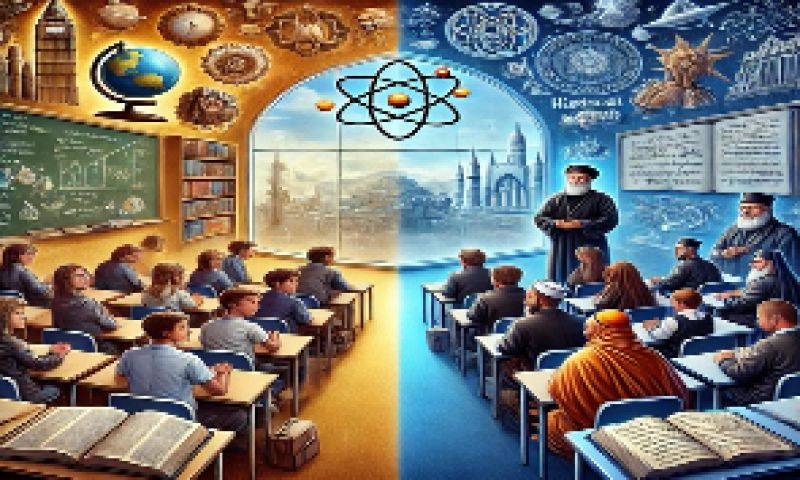
Curriculum revisions during this period introduced broader religious themes, new moral values units, and elements of Ottoman civilizational revivalism, while scientific content was noticeably softened. Independent monitoring groups such as Eğitim Sen(Education and Science Workers’ Union) reported that key topics like evolutionary biology were reduced or removed, and that several middle school textbooks shifted from analytical, inquiry based approaches toward moral ethical framing. In this environment, scientific literacy was no longer foundational, but increasingly negotiable.
But the most consequential change was still to come.
The 4+4+4 Reform: The Structural Break (2012)
The 2012 “4+4+4” reform was the watershed moment. The structural mechanism that enabled ideological transformation at scale. As reported by Eğitim Sen after the first semester of implementation, the reform reorganized compulsory education into three four year stages and significantly lowered the entry barriers for religious schooling. Within a short time, middle school level admission to Imam Hatip schools became possible, and many mainstream public schools were reclassified into religious or hybrid models, often without broad public consultation. Early statistics released in the wake of the reform showed pronounced shifts: rising enrolment in religious schools, declining preschool attendance, and mounting pressure on school infrastructure. These developments indicate that 4+4+4 was not simply an administrative adjustment but a structural reorientation of the shape and character of Turkish public education.
According to the Ministry of National Education’s Milli Eğitim İstatistikleri: Örgün Eğitim (National Education Statistics: Formal Education) datasets, Imam Hatip institutions expanded dramatically after 2012.
• Imam Hatip middle schools increased from 1,099 schools with 94,467 students in 2012 to 3,396 schools with 689,062 students in 2025.
• Imam Hatip high schools likewise grew from 708 schools serving 380,771 students in 2012 to 1,730 schools serving 487,263 students in 2025.
This expansion represents the most rapid institutional shift in Turkish education since the 1950s. Politically, it signaled a state driven redefinition of childhood socialization.
Parents often discovered their children had become “Imam Hatip students” after the nearest non religious school was quietly repurposed.
Curriculum Revisions: Science Out, Piety In
Following the structural changes, Ministry of National Education implemented repeated curriculum revisions throughout the 2010s.
The trend was unmistakable:
• Evolution was removed from high school biology curricula in 2017, after being deemed “too complex” for students by the national curriculum board.
• “Jihad” was introduced as a moral value in religious courses, consistent with the shift toward value based education.
• Values and moral education units expanded across multiple disciplines, including social studies and life sciences.
• History and social science textbooks increasingly emphasized religious and Ottoman Islamic themes, according to critics and educators who reviewed the new materials.
• STEM subjects formally remained in the curriculum, but stagnant investment, lack of laboratory capacity, and overcrowded classrooms meant that much of the content was delivered in a limited or inefficient form, while religious education gained new elective pathways and stronger institutional backing.
Critics observed that “parental demand” for religious electives mysteriously increased only after non religious alternatives diminished, a coincidence few found convincing.
PISA trends may be improving slightly, but Turkey is still lodged in the OECD’s bottom quarter, and the YKS (Higher Education Institutions Examination) averages are so weak that the notion of progress feels more generous than factual. Unless you’re a Turkish parent, then it’s painfully obvious.
Teacher Appointments: The Quiet Lever
If curriculum defines content, teachers transmit worldview. Teacher appointments reveal a pattern of ideological prioritization.
According to the Ministry of National Education’s annual appointment bulletins and independent analyses of branch level appointment quotas, several patterns have emerged in the 2020s:
• Appointments of Din Kültürü ve Ahlak Bilgisi (Religious Culture and Ethics) teachers rose sharply, placing the branch among the highest allocated fields between 2020 and 2025.
• Science branch appointments, particularly physics, chemistry, and biology, grew more slowly, with annual quotas remaining substantially lower than those allocated to Din Kültürü ve Ahlak Bilgisi.
• In multiple recent appointment cycles, Din Kültürü ve Ahlak Bilgisi received a larger quota than any individual science branch, indicating a prioritization pattern in branch distribution.
• This distributional pattern suggests an expansion of the religious education cadre relative to core scientific fields, reinforcing a shift in the ideological composition of the teaching workforce.
Teacher pipelines shape generational worldviews. Expanding the ideological teaching cadre while constraining scientific fields is a subtle but powerful mechanism of regime consolidation quiet enough to avoid headlines, effective enough to reshape a population.
Why This Education Shift Matters
Turkey’s educational reorientation is not merely cultural; it carries strategic and geopolitical significance. States project influence not only through military or economic power but also through the normative frameworks transmitted through schooling. When a governing elite reshapes the curricular and institutional foundations of mass education, the consequences naturally extend well beyond the classroom and, unsurprisingly, begin to reposition Turkey’s place in the international system.
Several implications stand out:
1. Scientific competitiveness declines
A sustained reduction in STEM emphasis weakens technological capability, innovation, and long term economic competitiveness,all pillars of geopolitical power.
2. Identity polarization deepens
A de facto dual track system (religious vs. scientific) fragments the societal base. Polarized societies are easier to mobilize internally but harder to unify behind long term strategic goals.
3. Foreign policy orientation shifts
As curricula shift from democracy and European references toward Islamic civilizational narratives, foreign policy begins to reflect these identity cues. Education thus acts as a long term signal of Turkey’s desired place in global alignments.
4. EU accession becomes strategically irrelevant
As school curricula shift away from European reference points toward more national–religious or civilizational frameworks, the social demand for EU membership weakens. A generation that grows up without a strong European orientation is less likely to view accession as desirable or necessary. In this sense, accession becomes not only politically stalled but gradually socially irrelevant, as the underlying societal consensus that once supported it erodes.
5. Regime durability increases
Education becomes a tool of worldview formation. By expanding ideological content and constraining scientific or critical thinking fields, the state builds a more compliant electorate and consolidates long term political control.
Taken together, these dynamics show why education cannot be treated as a neutral administrative field. Curriculum design becomes a long term instrument of statecraft: shaping economic capability, cultural identity, geopolitical orientation, and ultimately regime stability. In Turkey’s case, the classroom has quietly become one of the most strategic political arenas. A place where the next generation’s worldview is formed long before they ever enter a voting booth. Policy makers present these shifts as mere “updates,” but the cumulative effect is nothing short of a slow constitutional rewrite through textbooks.
Conclusion
Over the past twenty years, Turkey’s education system has shifted from a modernization project loosely aligned with European norms into an identity based institution engineered for ideological continuity. What began in the shadow of EU accession ended in the glow of religious revivalism. The numbers, structures, curricula, and teacher appointments all point in the same direction: a deliberate movement from scientific literacy toward ideological formation.
Whether this produces a more cohesive nation or a more polarized one remains uncertain. But one conclusion is hard to avoid: Turkey is educating a different future than the one it once imagined.
And unlike EU membership, this future is not hypothetical, it is already sitting in classrooms.
«Educational Erosion in Turkey: From EU Moderation to Ideological Freedom (2002–2010)»