


The Swiss NATO Network


Editor’s note: We are reprinting this article with the kind permission of the Swiss media outlet Sichtweisenschweiz
Pälvi Pulli, the outgoing deputy director of the State Secretariat for Security Policy (SEPOS), was born in Finland. She came to Switzerland in her early 20s. She worked in bars and enjoyed it. Pulli (born in 1971) studied at the University of Neuchâtel (thesis: “Military Operations Against One’s Own Population”). This was followed by a meteoric rise within the DDPS, where she began working in 1999. In 2018, she became head of security policy at the DDPS, putting her at the helm of Swiss power and shaping Swiss security policy ever since. She took over the job from her former partner, Christian Catrina, whom Die Weltwoche once described as “a stroke of luck for any attacker.” Both Pulli and Catrina are classic internationalists who have little regard for Swiss neutrality. After 2022, Pulli repeatedly expressed her lack of understanding for Bern’s refusal to send weapons to Ukraine.
Action Taken Against Book
In my book The NATO Network in Switzerland, I raise the question of whether Pullis’s connections facilitated his rise within the DDPS. An audacity, in the eyes of the top female military official. Even before the book’s publication on August 19, 2026, an initial cease-and-desist letter was already on the desk of my publisher, Christoph Pfluger. The demand: that the entire chapter be redacted. Pulli’s attorney, Rena Zulauf, successfully intervened with the major book retailers in Switzerland against the book, which was unavailable for several weeks at Orell Füssli, Ex-Libris, and others. Pulli must therefore have read The NATO Network in Switzerland very carefully. Why am I writing this? As head of security policy, Pulli did not read the F-35 contract.
According to the GPK report, published on September 8, 2026, she “moderated” several online conferences in December 2021 between the responsible Department of Defense (VBS) and the American side to negotiate a common line regarding the fixed price. Pulli herself said that she had been entrusted with this task “based on her title as ambassador and her relevant experience.” She claimed she was not familiar with the text of the contract. Die Weltwoche recently summed it up as follows: “The then-head of security policy sat at the table with the Americans in a leadership role to agree on a common communication strategy regarding the pricing mechanism without having read the contract text.” The purchase agreement, in which Pulli took no interest, is now costing Swiss taxpayers several billion in additional expenses. But Pulli is by no means the only one who did not review the contract.
The GPK report also reveals that Federal Councilor Viola Amherd read “only parts” of the contract. Chief of Staff Davide Serrago “did not read” it at all. The then-Secretary General Toni Eder did not read it “in its entirety.” And Darko Savic, project manager at Armasuisse for the procurement of the new fighter jets (also known as “Mr. Fighter Jet”), did not read it either. The same Savic, however, signed the contract. In November 2021, Savic said at a press conference: “ We benefit from fixed prices in the procurement of the F-35, and these fixed prices already factor in inflation. This type of risk does not lie with us.” In other words: There are no additional costs for us Swiss; we won’t pay more than six billion francs, as stated during the referendum—that was Savic’s message. Fake news, as we’ve long known. Voters were duped.
Savic couldn’t care less. He is now reaping the benefits of the deal he helped orchestrate. Savic now works as “Director of Program Management for Business Aviation” at Pilatus; the Nidwalden-based aircraft manufacturer is benefiting from lucrative offset deals with Lockheed Martin. Among other things, Pilatus is developing a training program for the F-35 fighter jet. Savic took the offensive in early 2025. And with him did DDPS Chief Viola Amherd, former Chief of the Armed Forces Thomas Süssli, and the Commander of the Swiss Air Force, Peter Merz. They’ve all abandoned the sinking F-35 ship and are now continuing to advance their careers. Merz is now CEO of Skyguide, and Süssli intends to launch a political career.
Why am I mentioning this? Examples of top officials in the administration who look out primarily for themselves rather than working in Switzerland’s best interests are piling up. Their focus is on their own wallets and personal career advancement. What we’re seeing today is that in key departments like the FDFA or the DDPS—the central hubs of Swiss foreign policy—internationalists who are growing increasingly disillusioned with Switzerland are advancing their careers. These are civil servants who are pushing for the swiftest possible integration with NATO and the EU in the security sector and who increasingly seek to coordinate with Brussels.
“Nothing less than a silent coup is underway.”
Rafael Lutz, author
NATO Enthusiasts in the Civil Service
In 2022, Benno Zogg was head of research for “Swiss and Euro-Atlantic Security” at ETH Zurich when he recommended to the Federal Council, in the supplementary report on the consequences of the war in Ukraine, that Switzerland coordinate more closely with NATO. Today, he is “Head of Strategy and Anticipation” in Martin Pfister’s DDPS and also heads the Interdepartmental Working Group on Influence Activities and Disinformation (IDAG). Zogg is toying with the idea of censoring Russian media.
In 2022, Anna Lina-Müller, a German national, was the executive director of the left-liberal think tank “Foraus” when, as a member of an expert group within Ignazio Cassis’s FDFA, she advocated for arms deliveries to Ukraine. Today, Müller—whom the Tages-Anzeiger has described as a woman “in the business of explaining the world”—is a diplomat in the Europe Division of the Federal Department of Foreign Affairs and advocates for Switzerland’s integration into NATO and the EU. Elisa Cadelli, for her part, was president of Foraus in 2024, when, as an expert on Katja Gentinetta’s Study Commission on Security Policy, she advocated for even closer cooperation with the Western military alliance. Today she works at the FDFA, where she is advancing her diplomatic career.
In the Alpine republic, a new generation of young military officers and diplomats is being groomed, whose solidarity is directed primarily toward Kyiv and Brussels. Nothing less than a silent coup is underway. A NATO network—widely ramified and deeply embedded in Bern’s power structure—governs Switzerland—and also controls the country’s most important NGOs, media outlets, and major corporations. Seasoned diplomats and military officers who defend neutrality are being weeded out of the administration. “A wave of purges is taking place,” warns former Federal Councilor Ueli Maurer. Ignazio Cassis’s Foreign Ministry—where Carl Spitteler’s Schweizer Standpunkt was once required reading for aspiring diplomats—now awards key positions almost exclusively to NATO enthusiasts.
Kiev Officials Are Scheming Against Bern
The internationalists in Bern want to integrate the Alpine republic ever more closely into NATO and EU structures. While Bern imposes sanctions on Moscow, the Federal Council supports Kyiv more than any other neutral country: The Zelenskyy government will receive five billion francs from Bern for reconstruction by 2036. In return, Ukraine is constantly scheming against and destabilizing Switzerland. Members of the Ukrainian delegation to the Council of Europe attempted to block Alain Berset’s election as Secretary General of the Council of Europe and to condemn Switzerland because local banks managed funds belonging to wealthy Russians. In Vienna, Ukrainians carried out a secret-service-style smear and disinformation campaign against neutral Switzerland’s good offices in the OSCE mission. In Bern, meanwhile, Iryna Venediktova, the Ukrainian ambassador to Switzerland, is acting as a censor in the cultural scene: in 2024, she prevented the screening of the film “Russians at War” at the Zurich Film Festival (ZFF). The consequences of today’s anti-neutrality policy in federal Bern could not be more devastating: While Swiss elites have massively weakened the country’s own national defense in recent decades and reduced the authorized strength by one-sixth compared to the Cold War—to around 100,000 soldiers today—Bern is, of all times, allowing itself to be drawn ever deeper into the war in Ukraine.
“Independent Switzerland will continue to govern itself,” Jonas Furrer, the first Federal President of the Swiss Confederation, declared to the major European powers in 1848. Prussia, Austria-Hungary, and France—which at the time were on the side of the Sonderbund—had just threatened a military invasion. In Switzerland, Furrer’s spirit has been lost within the Federal Council. The former great powers of the “old continent” are now arming themselves for war against nuclear-armed Russia. Foreign Minister Ignazio Cassis and Defense Minister Martin Pfister, for whom Swiss neutrality and sovereignty are a thorn in their side, are marching in lockstep with them. The Federal Council considers there to be no alternative to even closer security cooperation with the political elites in Paris and Berlin, who are economically and politically in shambles. Together with Friedrich Merz, the most unpopular chancellor of the postwar era, and French President Emmanuel Macron, who is politically finished, the Swiss government in Bern is gearing up for a war against Russia. The Federal Intelligence Service (FIS) aims to “minimize Russia’s capabilities in Europe—including in Switzerland.” The difference between this and NATO’s war aim—“to weaken Russia”—is now merely semantic.
At stake is nothing less than Switzerland itself, its sovereignty, and its neutrality. The resounding “no” to the Neutrality Initiative on September 27, 2026—which could have at least partially corrected this ominous course—does not bode well.
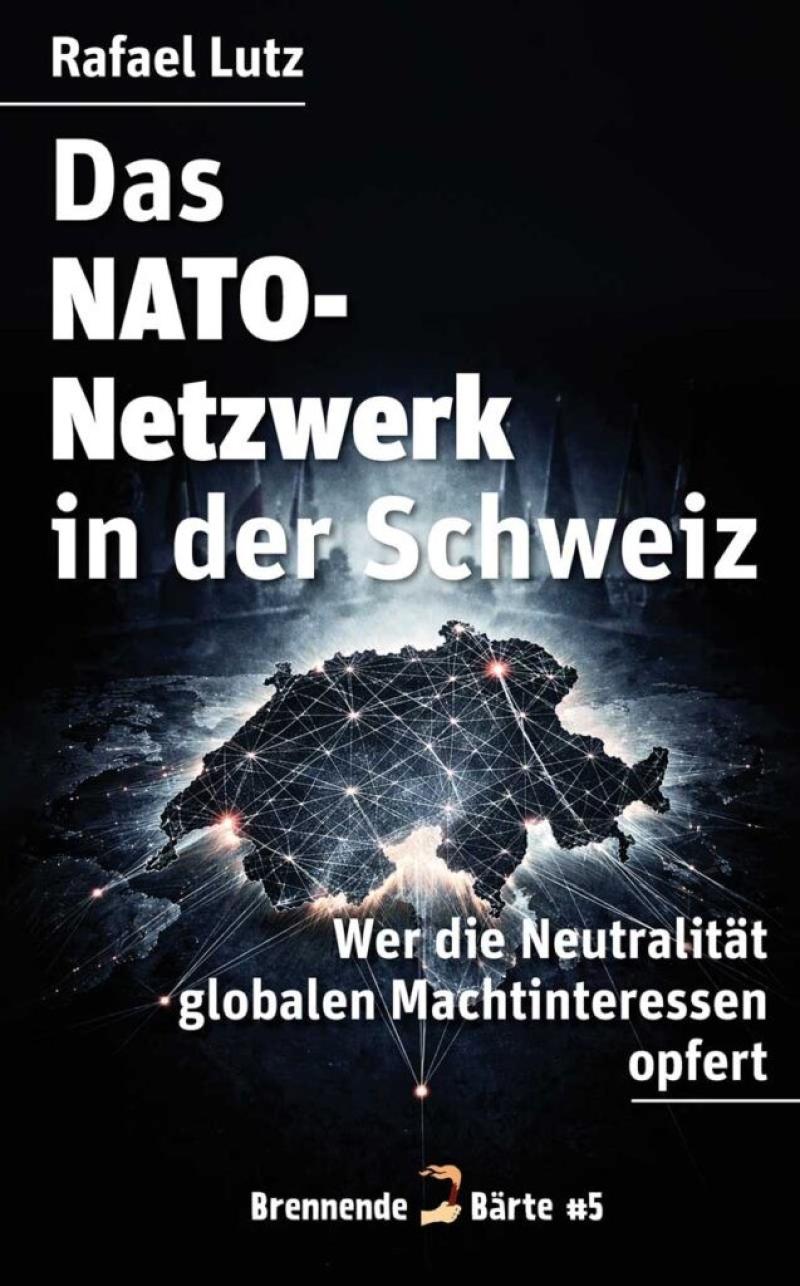
Order the book: Rafael Lutz, The NATO Network in Switzerland – Who Is Sacrificing Neutrality to Global Power Interests? 132 pages, edition Zeitpunkt, 2026, 18 francs.
Investigative journalist Rafael Lutz identifies the key players in the NATO network in Switzerland, dissects the 2026 Security Strategy, and asks: Who stands to gain from the end of neutrality? A hard-hitting, source-backed polemic—for everyone who wants to know the truth before it’s too late.
«The Swiss NATO Network»