


The Negative Continuity of Western Foreign Policy






Introduction
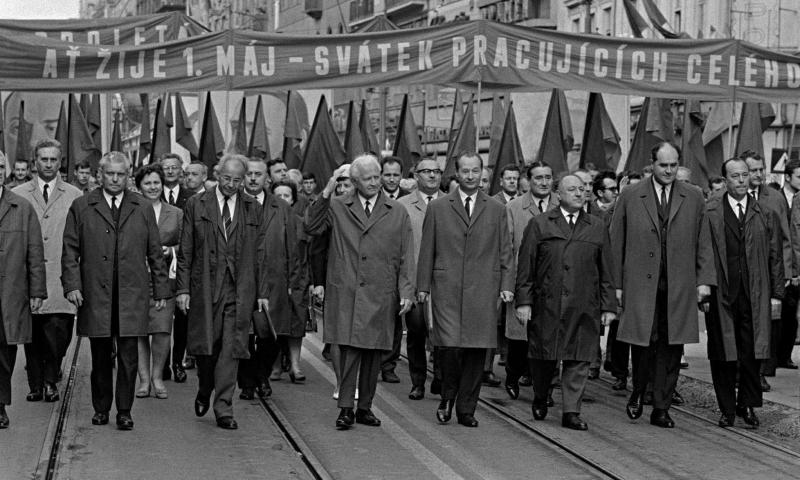
While gathering material for a new project, we came across an article from 1968. The title is “The Occupation of Czechoslovakia by the Warsaw Pact Powers.” It was published in the November 1968 issue of the American magazine „The Churchman“.
The author, Hugh Bryan Hester (1895–1983), served as an officer in the U.S. Army during both world wars. As head of the U.S. Food and Agriculture Program for Germany from 1945 to 1947, he gained deep insight into American policy toward postwar Germany. From 1947 to 1948, he served as the U.S. military attaché in Australia.
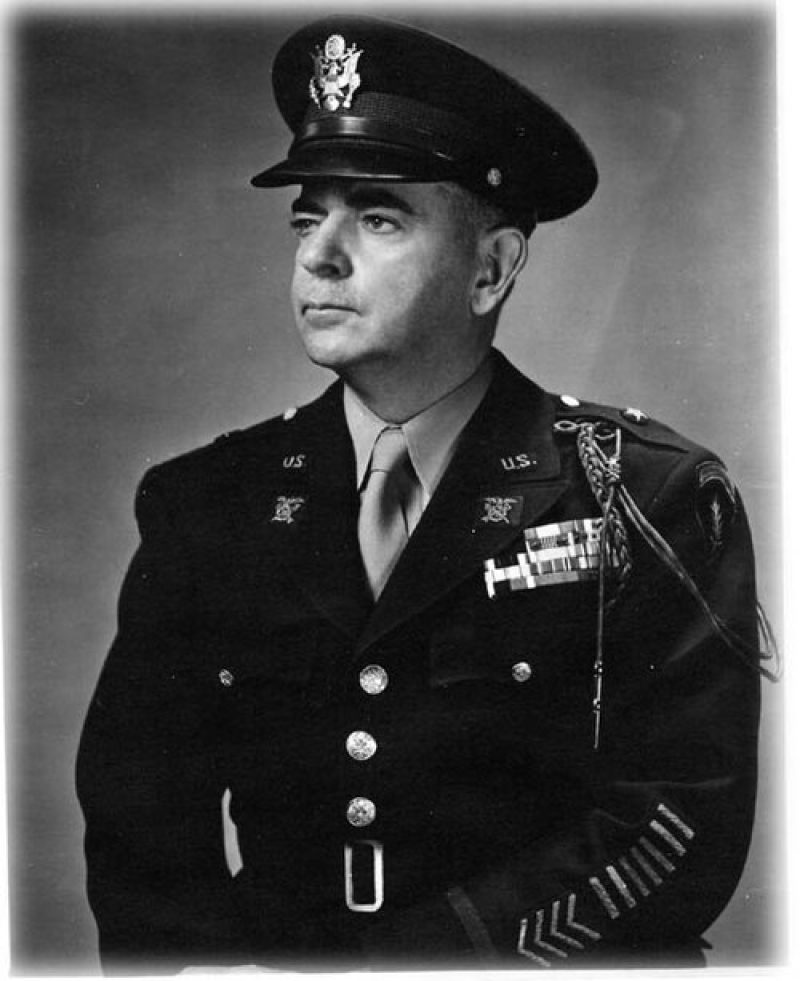
Hester retired from the U.S. Army as a brigadier general in 1951. He then studied law and international relations at two universities, though he did not earn a degree.
This career path does not necessarily suggest he would be a vocal critic of U.S. foreign policy. Yet Hester forged his own path. For example, in 1957 he traveled extensively throughout the Soviet Union, met with Nikita Khrushchev, and spoke out forcefully in favor of peace and against the Vietnam War and the Cold War.
An Eyewitness Account
Set against the backdrop of the height of the Cold War, the article describes the hypocrisy of Western politics using the example of Western criticism of the Warsaw Pact’s invasion of Czechoslovakia in August 1968. Hester criticizes the invasion but places it in the context of the policies of the United States and West Germany, whose logic meant that the invasion was by no means “completely groundless.”
He clearly identifies the comparison—propagated at the time in the Western press—with the occupation of Czechoslovakia in 1938–39 by Nazi Germany as “very dangerous for world peace.”
Hester goes on to trace a broad arc from 1945 to the present—that is, 1968—beginning with the deliberate breach of the Potsdam Agreement. The detailed account of the logical consequences of this deliberate, targeted destruction of the agreement—and thus of the anti-Nazi coalition—by the United States and Great Britain, as written by an American eyewitness, offers more than just a glimpse into this pivotal period of German postwar history. Hester describes how, even before May 8, 1945, the United States airlifted war criminals useful to the U.S. to American soil, thereby betraying the spirit of the Potsdam Agreement even before it was signed and making its implementation impossible from the outset.
He leaves no doubt as to who was responsible for the division of Germany—and thus of Europe—after the war:
“It seems to me that it is of the utmost importance for Americans to keep reminding themselves that the Soviet government did not transform its occupation zone into an independent German state—namely, the German Democratic Republic—until after the three Western powers, led by the United States, had created the ‘Federal Republic of Germany’; that the Soviets did not establish the GDR’s small military forces until after the three Western powers had begun to arm the FRG; and that they ultimately did not organize the Warsaw Pact until NATO already existed.”
As you read, you can almost sense an inner connection between the developments in Europe—from the postwar events of 1945 described by Hester, through the upheavals of 1990, to the present day.
NATO’s eastward expansion, the Ukraine conflict from its origins in the early 1990s to its current form, the breach of the 2+4 Treaty, the 1990 Istanbul Agreements on equal security, the Minsk I and II Agreements, and the torpedoing of the Istanbul Agreements aimed at ending the conflict in Ukraine— all of this appears, against the backdrop of an article from 1968, as a constant feature of a Western hegemonic policy that flouts peace.
While today’s leading Western politicians attempt to attribute the causes of the current geopolitical crises to the aggressive policies of Russia, Iran, and other non-Western states, a look into the worldview of a high-ranking American officer from 1968 offers a surprisingly clear perspective on who has repeatedly threatened world peace since 1945.
A digression
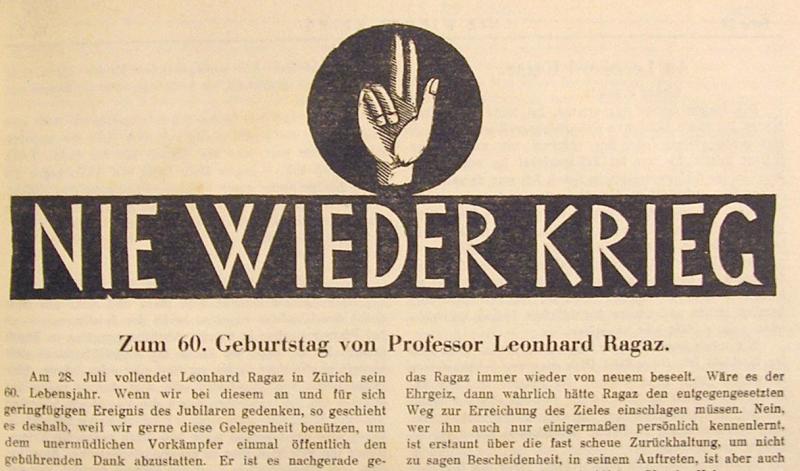
The following article was reprinted in 1968 in the journal “Neue Wege” published by the movement of “Religious Socialism,” thus making it accessible to a German-speaking European audience. Leonhard Ragaz (born July 28, 1868; died December 6, 1945) and his wife Clara Ragaz-Nadig (born March 30, 1874; died October 7, 1957) were co-founders of this movement. They came from the labor movement, and their journal was first published in 1906. It advocated “radical pacifism” (the term was attributed to the journal by Lenin—Collected Works, Vol. 21, Berlin 1960, p. 81 ff.) and anti-militarism.
When the Swiss Social Democratic Party (SP), which both had joined in 1913, abandoned its consistently antimilitarist course in 1935, they both resigned from the party for this reason.
Previously, the SP had been convinced—particularly based on the experiences of 1917–1919, the mobilization of the army against workers’ protests, the Oberster Affair, and finally the deployment of troops during the 1918 general strike—that the army was not simply a neutral instrument of the entire people. The 1917 party convention therefore adopted an explicitly antimilitarist course: rejection of military appropriations and conscription, as well as support for conscientious objectors. Effective protection for Switzerland could only result from an international peace order.
However, when Hitler crushed the German Social Democratic Party in 1933 (a move that also found considerable sympathy among the Swiss bourgeoisie) and although Austrian social democracy had lost the armed struggle against the Austrofascist regime, Swiss social democracy nevertheless opted for armed defense, in the hope that the Swiss government would allow Swiss social democracy to survive, and that a “democratically controlled army” would henceforth remain “neutral” within the country. It assumed that the army could be “politically won over” or “democratized,” rather than leaving it in the hands of the ruling bourgeois forces. The army was to serve, so to speak, an antifascist, democratic national defense.
Leonhard and Clara Ragaz fundamentally disagreed. They were convinced that, especially in the struggle against fascism, socialism must not succumb to the logic of violence. To put it even more bluntly: A socialist social order cannot be defended by military means. And to be even clearer: A society cannot be saved by violent means that destroy the very spirit of the society being saved. Military force ultimately reproduces the logic of domination and violence. They had seen this in the example of the Bolsheviks.
The more the Swiss Social Democratic Party became politically integrated into the work of the Swiss government, the weaker its opposition to military force became. In other words: Those who are allowed to share in power also want to be allowed to use military means to maintain that power.
Leonhard and Clara Ragaz foresaw that the SP’s original insight—namely, that the army was not simply a neutral instrument of the entire people, and that those in power, on the one hand, and the people, on the other, are two fundamentally different entities—would disappear.
Even if one does not personally subscribe to the consistently nonviolent and antimilitarist ideas of the magazine Neue Wege, it would still be beneficial to engage with these ideas more thoroughly rather than simply brushing them aside “off the cuff,” as even critical minds unfortunately do when they disparagingly refer to “pacifist dreamers.”
Following this digression, we now turn to the original article from 1968 (the original english text was not available, so this translation is from the German version, published in „Neue Wege“):
The Occupation of Czechoslovakia by the Warsaw Pact Powers
Editorial introduction by the Ragaz Movement’s journal „Neue Wege“:
In our view, anyone seeking to form a balanced judgment on the occupation of Czechoslovakia should not overlook the insights of General Hester. Hugh B. Hester was in charge of the U.S. Food and Agricultural Program in the American-occupied zone of Germany from 1945 to 1947. In this capacity, he gained insight into the background of postwar German politics as few others have. He was also able to study the effects of the shift in U.S. foreign policy—which occurred upon Roosevelt’s death—on Germany with equal clarity. He essentially demonstrates that, given the reaction in Germany and across the Western press, the Warsaw Pact powers had reason to be afraid.
By Hugh B. Hester
The Johnson administration and the Western mass media—particularly those in the United States and West Germany—have tried to convince the world that the occupation of Czechoslovakia was completely unprovoked and unprecedented. Neither of these claims is true. The immediate cause of the tension among the Warsaw Pact powers was the change in leadership in the Czechoslovak Socialist Republic in January. The immediate official reaction and the response from the mass media were one of enthusiastic approval. The new political leaders in the Czechoslovak Socialist Republic described the change as a “small liberation.” On the other hand, the sharp Czech criticism of the Soviet Union—and its plan to normalize relations, including diplomatic relations, with revanchist Nazi West Germany—aroused mistrust and fear among the Warsaw Pact powers. This applies in particular to the German Democratic Republic, which, by its own admission, seeks to take over West Germany, and to Poland, given that the West German government continues to refuse to recognize the Oder-Neisse line as Poland’s western border.
As we recall, the official Western propaganda line was that freedom was simply not possible within the socialist system. Why, then, was there such hysterical outcry in the mass media, if that was not the intended outcome? All the Western press—and even leading journalists—could bring themselves to write about was the “rape” of Czechoslovakia or accusations that socialist states could not even tolerate a “small measure of liberation.” No one took the opportunity to contrast the Soviet Union’s misguided action with the U.S. occupation of the small Dominican Republic (1965), along with its interesting justification, which stated that “a communist takeover in that republic would endanger the security of the mighty United States.” Nor was there any mention of the speech by a former chairman of the Federal Reserve Board, Marriner S. Eccles, who, speaking before 700 business leaders in Washington (September 27, 1967), held the Johnson administration responsible for the horrific deaths by burning of one million Vietnamese children.
This comparison is by no means intended to justify the occupation of Czechoslovakia or the death of even a single Czech. Nothing could be further from my intention. I condemn injustice and violence wherever violence can be avoided. However, to portray the occupation of Czechoslovakia as an absolutely unique event in our system of nation-states and to equate it with Hitler’s seizure of Czechoslovakia in 1938–39 is not only wrong but also very dangerous for world peace. As is well known, the first casualty of the Cold or Hot War is the truth. And if the “free” mass media and the “war hawks” (war hawks) are allowed to portray the adversary in this way as a monster, then not even God Himself can save us from the abyss of a Third World War. It is particularly repugnant when high-ranking clergy join in this barking, proclaiming the highest virtue on our side and indescribable depravity on the part of the adversary. Americans, given the experience of the Joseph McCarthy era of the 1950s, should recognize this danger.
But speculation about the immediate causes of the current crisis is not enough. Even small nations very rarely take steps that affect international relations without good reason. When a great power decides on something like the occupation of Czechoslovakia, one must not ignore the historical context. On this point, the Western mass media have clearly failed.
The goal of World War II, as officially stated by the United States, was to bring about the end of Nazism in Europe. However, as far as the Soviet Union was concerned, World War II was a struggle for national survival. This difference in significance must not be overlooked.
Today, the ruling circles in the United States believe that they can quite comfortably coexist with European Nazism—they even promote it through their main ally in Europe: Nazi Germany. The Soviets and their allies, on the other hand, are threatened by it. The Potsdam Agreement of July 1945 aimed at demilitarization, the dissolution of the cartels, the eradication of Nazism, and the democratization of Germany. Once these measures had been implemented, the two parts of Germany were to be reunited. The Soviets advocated for these measures and sought to enforce them—not out of any particular purity of motive—but because the implementation of these decisions would have guaranteed their security against a potentially revanchist Germany. President Truman’s advisors—people like James Forrestal, John Foster Dulles, and the imperialist war hawk Winston Churchill, along with the indomitable Averill Harriman and Dean Acheson—never had any intention of adhering to the Potsdam Agreement.
When I arrived in Berlin in September 1945 to take up my post, the military leaders (of the U.S.) had already agreed to rehabilitate Nazi Germany as a bulwark against the Soviet Union. Even before I left Germany in November 1947, there was talk in military circles that the Soviets must be driven out not only of Germany but even of Eastern Europe. Even before the armistice was signed on May 8, 1945, Hitler’s head of intelligence, Eastern Front General Gehlen, was flown to Washington, along with some of his key staff members and the necessary documentary records. A few months later, he and his staff were back in Berlin, working for the U.S. government. His instructions were to organize espionage and sabotage operations in the Soviet zone (GDR) of Germany. After several years in the service of the U.S., he was taken on by the West German government with the same responsibilities (It was black-market activities, espionage, and sabotage in West Berlin that ultimately forced the GDR to build the Berlin Wall, also known as the “Wall of Shame”).
It was the Truman administration, not the Soviet government, that divided Germany. John Foster Dulles (then U.S. Secretary of State) told the overseas press in Paris (January 24, 1949): “The situation in Berlin could be resolved at any time. However, the current situation is more favorable to the U.S.—for propaganda reasons.”
He then continued: “If we resolve the situation in Berlin, we will be dealing with a unified Germany. We would immediately have to expect a Russian proposal for the withdrawal of all occupying forces and the return of Germany to the Germans.”
It seems to me that it is of the utmost importance for Americans to keep in mind that the Soviet government did not transform its occupation zone into an independent German state—namely, the German Democratic Republic—until after the three Western powers, led by the U.S., had created the “Federal Republic of Germany”; that the Soviets did not establish small military forces in the GDR until after the three Western powers had begun to arm the FRG; and that they ultimately did not organize the Warsaw Pact until NATO already existed.
The government of the Soviet Union was not merely opposed to the division of Berlin and Germany, but also to the division of Europe into two hostile camps. Research will show that, for the longest time, it insisted on the reunification of a demilitarized and neutral Germany, as well as on the abolition or merger of the two alliances, NATO and the Warsaw Pact. The other members of the Warsaw Pact, too, repeatedly called for a disarmed, neutral, and unified Germany, as well as recognition of the Oder-Neisse border between Poland and Germany, as established at Yalta; for years, they also called for a nuclear-weapon-free zone stretching across Europe that would include all of Germany, Poland, and Czechoslovakia. In the words of the late Cold War figure John Foster Dulles, however, rejecting such demands served U.S. interests—for propaganda reasons.
George F. Kennan, the distinguished former employee of the U.S. State Department and advisor on German affairs, wrote in the November 19, 1963, issue of LOOK magazine that he opposed the rearmament of West Germany and stated that such rearmament would make genuine cooperation with the Soviet Union difficult, if not impossible. However, in a recent interview with the press (Associated Press release, September 21, 1968) regarding the Czechoslovak crisis, he recommended increasing the quarter-million American troops already stationed in Germany by an additional 100,000 men. The “scholar-diplomat,” as the Associated Press describes him, has apparently returned to his views as a Cold War theorist of the West, having published in the July 1947 issue of Foreign Affairs—under the pseudonym “Mr. X”—the thesis that “overwhelming military forces must be arrayed against the Soviet Union at every point along its borders.” It is tragic that a politician as influential as Mr. Kennan can do nothing better in the current crisis than to fan the flames of the Cold War.
There is not the slightest doubt that the Nazi supporters still present in West Germany want to reclaim the territories lost during World War II. There are indications that they even count among these losses what was lost as early as World War I. Today, there are millions of former residents of East Prussia, Western Poland, and the Sudetenland living in West Germany who are demanding the right to return to their former homelands. I have spoken with dozens of their representatives.
Another important fact that so few Americans are aware of is the close relationship between the “Crusade for Freedom,” “Radio Free Europe,” and the German Fifth Column, which is working to restore the 1939 borders. I had very revealing opportunities to learn about these connections when I worked as the director of the radio program for the “Crusade for Peace” in southern Pennsylvania in 1951. All of the programs were aimed at undermining socialist influence in Eastern Europe. Radio Free Europe, under the direction of the CIA (Central Intelligence Agency: U.S. intelligence agency), was heavily involved in the 1956 Hungarian uprising.
Given this political context, it is hardly surprising that five of the Warsaw Pact powers believed there was a plan to threaten the Czechoslovak Socialist Republic and, by extension, their own security. If such plans existed, the occupation was carried out for their benefit and was not an act of betrayal, as Western propaganda claimed. In any case, it became clear just how precarious “peace” in Europe is.
I have repeatedly pointed out that genuine peace in Europe is impossible unless West Germany acknowledges its defeat in World War II and renounces all territorial claims against its neighbors, including the GDR. One of the greatest blunders characterizing the Truman administration was its failure to implement the provisions of the Potsdam Agreement. If there had been a unified Germany free of cartels—one that was neutralized and demilitarized, and which, according to the Russian view, could have been reunified—there would be peace in Europe today.
However, if West Germany continues, as it is doing now, to undermine Eastern Europe—and is supported in this endeavor by the United States, as it is today—a major European war will be inevitable, and the U.S. government and the American people will bear the primary responsibility for this global catastrophe.
The Soviet Union cannot and will not give up the security belt that the Warsaw Pact represents for it until an agreement is signed by all members of NATO and the Warsaw Pact that guarantees the current borders of the Eastern European countries. This is not merely a theory, but a fact that can only be ignored at the peril of us all.
Reaching such an agreement should be one of the first goals of the next U.S. administration. In addition to securing the current national borders in Europe, the agreement should also normalize diplomatic, political, and economic relations among all European states.
It is not only absurd but also very dangerous that the U.S. and its NATO “allies” refuse to recognize the GDR. For a century now, the German Democratic Republic has been the first German government to seek peace with its neighbors. Furthermore, it is currently the fifth-largest industrialized nation in Europe and the tenth-largest in the world, even though it ranks only 27th in terms of population.
I have traveled extensively throughout the GDR. It is here, in the GDR—and not in West Germany—that the economic miracle has taken place since World War II. It is here that the seeds of the German people’s finest qualities have been sown. If allowed to develop in peace, I am convinced that one of the richest and finest harvests of human progress will ripen here.
From «The Churchman» (November 1968)
«The Negative Continuity of Western Foreign Policy»