


The Art of Mendacity






Let us start by setting the stage: Russia is winning its war against the collective West. This makes Gilbert Doctorow uneasy, because if this narrative plays through to its logical conclusion, the Russian President Vladimir Putin will not only consolidate his position within Russia but also solidify Russia’s status as an unmatched global power.
Doctorow hates Vladimir Putin.
So, too, do his foreign intelligence sponsors/muses (it’s hard to tell if Doctorow takes instructions from a handler, or just blindly follows their cues in an unwitting fashion.)
A Russian victory over Ukraine would prove fatal to the plans of both MI-6 and the CIA to dethrone Vladimir Putin and replace him with a new Russia leader who would function like Boris Yeltsin 2.0.
It would also bring about the demise of the Russian liberal elite, whose efforts at reestablishing themselves as a fifth column capable of influencing Russian political life has diminished in the decades since Putin took control of the Kremlin.
Doctorow fancies himself as a leading voice of the Russian liberal elite.
And he is the personification of what a fifth columnist looks like and operates, the living embodiment of an agent provocateur.
So let us cut to the chase—Ukraine cannot reverse its misfortune on the battlefield. Left to its own devices, the shooting war between Russia and Ukraine will inevitably lead to a decisive Russian military victory.
And a Russian victory is the exact opposite trajectory that those seeking a strategic defeat of Russia want to be on.
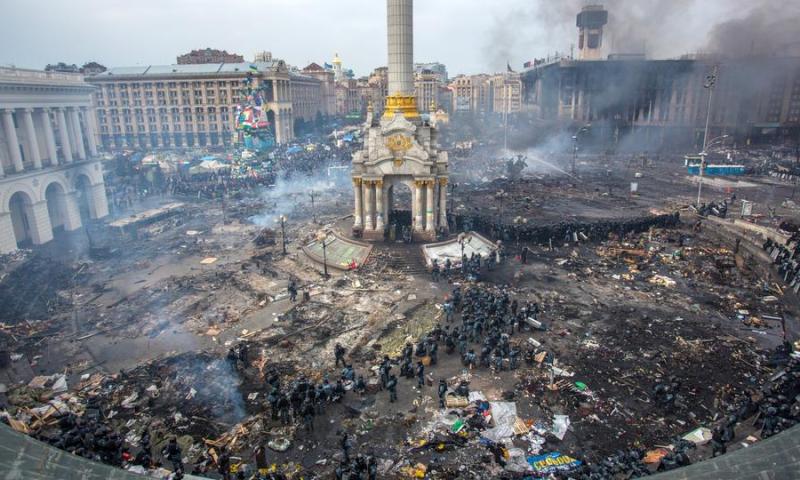
The only hope of preventing a Russian military victory is to create the conditions conducive to a Russian domestic political collapse—a Moscow Maidan moment, so to speak, replicating the CIA-driven coup that removed former Ukrainian President Viktor Yanukovych from power back in February 2014 in Kiev’s Maidan Square.
To accomplish this, Ukrainian President Volodymyr Zelensky initiated a “40-day drone war” on June 25th—which has since been extended indefinitely—to bring the pain of war home to the Russian people in such a manner as to generate what Doctorow, in a recent open letter to the Belgium Prime Minister published on his Substack page, calls “extreme stress” generated by “the drone strikes that are destroying its energy infrastructure” to pressure Russia to “attack NATO using their tactical nuclear weapons mounted on unstoppable hypersonic missiles.”
Three quick points about Doctorow’s thesis.
First, Russia is not now, or is expected to be in the foreseeable future, being placed under anything that remotely resemble “extreme stress” resulting from Ukraine’s “drone war.”
Second, Ukraine is not “destroying Russia’s energy infrastructure.” There is no doubt the Ukrainian attacks, using long-range drones built by NATO nations and guided to their targets using American intelligence, have resulted in disruptions that inconvenience the day-to-day existence of some Russians for a finite period. But to equate such inconvenience to existential levels is simply wishful thinking.
And third, while some sectors in Russian civil society have articulated policy options that would include Russia’s use of tactical nuclear weapons and hypersonic missiles, those who make official policy regarding Russia’s national security, including the President himself, have made it clear that such a scenario is not possible.
So why would Doctorow publish such nonsense?
Because his goal is to plant the seeds of doubt in the minds of Russians who follow the discourse taking place in the West about Russia in order to promote an echo chamber that allows this doubt to germinate and grow.
To what end?
Doctorow postulates that “ever escalating, ever more provocative intervention of NATO in the Russia-Ukraine war is begging for a Russian military response.” But this ignores the reality that Russia is winning the war hands down on the battlefield—which includes the “drone war” Ukraine has initiated, which has resulted in a disproportionate response by Russia that is destroying Ukraine’s economy from top to bottom.
What Doctorow is seeking is regime change—the generation of domestic political opposition to Vladimir Putin that results in either the acquiescence of President Putin to the “demands of the Kremlin elites” or “a palace coup” that will replace Putin with “more determined and aggressive Russian patriots who will not hesitate to do what must be done to restore Russian deterrence.”
This, of course, isn’t the true objective of Doctorow’s intervention—no one in NATO is looking for Russia to attack with tactical nuclear weapons and hypersonic missiles.
What Doctorow’s controllers want is much more basic—for the fear of nuclear war and the underlying circumstances generated by the perception of failed leadership on the part of President Putin to create a wave of political opposition inside Russia timed to be able to influence the upcoming September 20 elections for the Russian State Dume.
This is the same game plan that the CIA and MI-6 tried to pull off in the 2007 and 2011 State Duma elections—to weaken the hold on power of the United Russia Party and, in doing so, undermine Vladimir Putin’s hold on power.
To do this, however, the CIA and MI-6 must inject an alternative to war in the minds of the Russian voter.
Enter Gilbert Doctorow with his coup de main—to get the EU and NATO to “sit down with the Russians to negotiate an end to the war in a way that addresses Russia’s security concerns over NATO’s presence in Ukraine before February 2022 and Russia’s wish to agree a new security architecture for Europe that fairly protects all countries of this Continent, not just some, as at present.”
Gone is Russian territorial demands brought on by the September 2022 referenda in the Donbas and Novorossiya.
Gone, too, is any talk about “root causes of conflict” and “de-Nazification.”
Instead, Doctorow postulates a world where Russian diplomacy circa December 2021 reigns supreme.
It would represent a strategic defeat for Russia—which is the ultimate objective of the CIA, MI-6 and Gilbert Doctorow.
This, of course, is a fantasy so far removed from reality as to be little more than a sick joke.
But “sick joke” is a term which perhaps best describes the tattered remnants of Russia’s liberal elite on whom the CIA and MI-6—who long ago infiltrated their ranks and have since then used them as little more than their compliant agents-in-place—rely upon to implement their Moscow maidan madness.
But neither the CIA nor MI-6 are possessed of the kind of analytical prowess they once enjoyed during the heyday of the Cold War, where genuine Russian-area experts populated the ranks of those who were responsible for assessing the threat posed by the Soviet Union and how best to deal with it.
Today the Russian analytical branches of the CIA and MI-6 are populated with Russophobic idealogues and washed-up paramilitary officers whose base inclination is to seek violence over diplomacy.
The level of ignorance residing in these institutions about Russian reality is matched or exceeded by their witting or unwitting accomplish, Gilbert Doctorow. Doctorow himself helps cement this very point in another recent post where he exposes his own personal vindictive against Russian President Putin.
Doctorow uses the ploy of allowing someone else—in this case Natalie Baldwin—to quote him in order to lend credence to the arguments being made. Take, for example, the following quote cited by Doctorow, taken from a review Baldwin did of one of Doctorow’s books:
While attending a dinner party to celebrate Victory Day with his in-laws in St. Petersburg in 1995, Doctorow relayed one relative’s experience serving in Chechnya as a pathologist for the military. His job was to examine and identify the war dead amid the utter devastation of the capital of Grozny. After completing his service, he and those he served with were all treated for “shell shock” before release. This young man told Doctorow and the other guests that the war seemed to have been needlessly prolonged for political reasons.
Doctorow then goes on to note the following: “I believe that this observation bears on our dilemma of explaining Putin’s dragging out the ongoing war with Ukraine. Is this awful situation that adds to the needless loss of hundreds of thousands of soldiers on both sides due to the defect of indecisiveness, or worse still, cowardice, in the personality of the president or is it due to his being controlled by oligarchs who profit from the war.”
First and foremost, it is simply absurd to cite the events of 1995 in Chechnya when seeking to describe the events taking place in Ukraine today, especially when trying to tie in this comparison to President Putin himself.
In 1995, Putin was working for Anatoli Sobchak in Saint Petersburg, and as such was as far removed from the decision making regarding the Chechen conflict as one could be.
Moreover, when Putin did assume responsibility for the second Chechen conflict, he sought a negotiated end to that conflict by directly engaging with Akhmat Kadyrov. The resulting peace has engendered stability in Chechnya and the region that is the envy of anyone seeking genuine conflict resolution.
So, Doctorow’s effort at drawing out some sort of framework of comparison fails on its face.
But there is more here than meets the eye.
In typical Doctorow fashion, the evidence cited is of an indirect nature—Doctorow speaking about insights obtained by an “insider” which he then uses to craft sweeping conclusions.
A military pathologist assigned to the Chechen conflict in 1995 would most likely have been assigned to the 124th Forensic Military Laboratory based out of Rostov-on-Don. This unit would provide detachments that worked in Grozny and elsewhere collecting the remains of fallen Russian soldiers from the battlefield.
While this kind of work was undoubtedly stressful, it did not provide the direct exposure to combat operations that produce the kind of “shell shock” (better known as “Chechen syndrome”) Doctorow referred to. More critically, the Russian military at the time of the First Chechen War did not provide any systemic or effective psychological treatment for soldiers suffering from “Chechen syndrome.”
And lastly, a military pathologist would be far removed from any decision making regarding the political questions underpinning Russian thinking regarding the pace of the war, and the political questions so attached. At best Doctorow got the odd ruminations of an individual offering an ill-informed position. At worst, Doctorow simply made the story up and used Baldwin’s repetition of his lies to manufacture veracity.
Gilbert Doctorow has a habit of seeding his “opinions” about Russia with narratives drawn from anonymous sources whose veracity cannot be directly ascertained. Here, the mendacity of Doctorow is on full display, making up a story which is then filtered through a credible witness to give it gravitas, so he can make a point that would otherwise be indefensible, which in this case is the following: that the “personality of the president” suffers from “the defect of indecisiveness, or worse still, cowardice.”
September 20 rapidly approaches, and in the coming days and weeks one can expect a full court press by western corporate controlled media and their social media echo chambers to promulgate stories that seek to cast the Russian President in the most negative light possible.
Gilbert Doctorow has been, and will continue to be, a resource that his CIA and MI-6 controllers can count on, wittingly or unwittingly, to participate in this mendacious behavior.
It is apparently his duty to promulgate lies about Vladimir Putin’s Russia.
And it is my responsibility to call him out on these lies.
«The Art of Mendacity»