


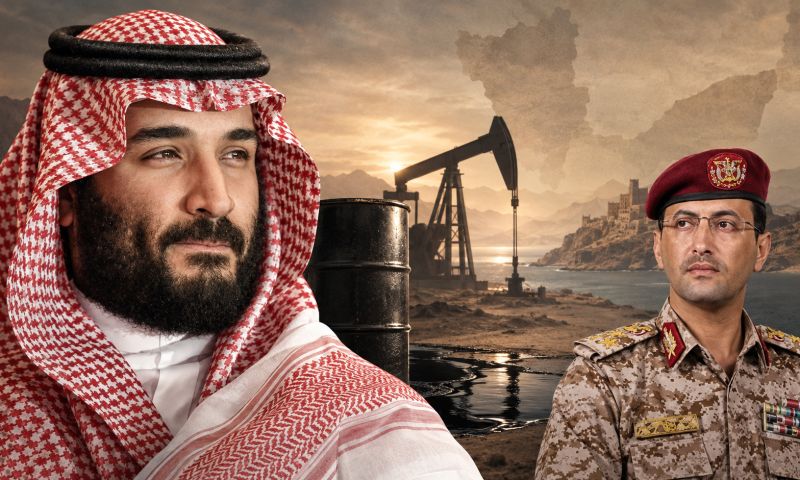
Saudi Arabia's Potentially Destructive ‘Credibility Trap’






Saudi Arabia faces a strategic choice: To capitulate to AnsarAllah's demands, or to be pulled into a credibility trap. The trap is that Mohammed bin Salman (MbS) may seek to maintain the credibility of the Kingdom’s professed Guardianship of the Holy Places and as a Sunni Islamic ‘pole’ by refusing to condescend to AnsarAllah’s demands.
The dilemma is that, on the one hand, any concessions risk providing further oxygen to AnsarAllah’s ‘revolution', which is gaining traction and energising people across West Asia. On the other hand, by insisting on Saudi’s monarchical standing and the perquisites pertaining to it’s system, MbS may energise internal opposition from a different direction -- from the pantheon of Saudi tribes, many of which still harbour a lingering anger at their sidelining, diminished standing and status imposed by the ‘one Family monarchical enterprise’.
Since the outset, the Saudi monarchy has concentrated the country’s financial rewards in one household and called it ‘unity'. Unity built on exclusion, however, is a fracture vulnerable to demands by neglected tribes for due political weight and a fair share of the Kingdom’s revenues.
Westerners today look at the Saudi Kingdom through a different lens; their gaze is taken by its wealth, by its apparent modernisation, and by its professed leadership of the Islamic world, rather than the Kingdom’s fundamental underlying contradictions. They chose to presume that the Kingdom was bending to the imperatives of modern life, and that the management and transformation of Sunni Islam would bend the Kingdom too, to modern life.
Yet the Saudi Kingdom’s position is an oddity -- and is weaker than generally supposed. The inherent contradictions within the country may well dispose Riyadh to escalate the war in Yemen in order to preserve its standing, despite the noticeable lack of support from allies. (It appears that Trump’s reticence to assist Saudi Arabia may reflect intense lobbying by the UAE — MbS’ bitter rival — which is seeking to persuade Trump to not support any renewed Saudi war against Yemen, since this would further weaken the UAE's collapsing interests in southern and coastal Yemen).
The oddity of the Kingdom’s internal construct harks back to the nature of its founding by Ibn Saud in 1932, and to the much later US decision to invert the West Asian historic power balance in favour of Saudi Arabia and (the newly-designated post-WW2) Gulf monarchs, emirs and sheikhs.
I wrote some time go that the story of the tensions within Saudi identity “pertains directly to Muhammad ibn ʿAbd al-Wahhab (the founder of Wahhabism) and the use to which his radical, exclusionist puritanism was put by Ibn Saud”:
The second strand to this perplexing duality relates precisely to King Abd-al Aziz's subsequent shift towards statehood in the 1920s. Initially, on the advice of a British officer Harry St. John Philby, he accepted the advice that by weaponising Wahabbism, he could and would lead the Middle East.
Abd-al Aziz’s subsequent curbing of Wahabbi violence (in order to have diplomatic standing as a nation-state with Britain and America) and his institutionalization of the original Wahhabist impulse – together with the subsequent seizing of the opportunely surging petrodollar spigot in the 1970s - however caused him to channel the volatile Wahabbi current away from home towards export.
This Wahhabi current (subsequently metamorphosed into ISIS), that Philby so admired, however, was a reincarnation of the early, fierce, semi-independent vanguard movement of committed armed dessert "moralists" who almost had succeeded in seizing Arabia by the early 1800s. Abd-al Aziz, however, began to feel his wider interests to be threatened by the revolutionary "Jacobinism" exhibited by the vanguardist movement. The latter then revolted at the attempt to curb them -- leading to a civil war that lasted until the 1930s - when Abd-al Aziz had the extremists put down: The British machine-gunned them.
The point is that the Saudi Wahabbi approach to Islam did not die in the 1930s. It retreated, and maintained its hold over parts of the system -- hence the duality that we observe today in the Saudi attitude towards sectarian war on regional states, such as Syria.
The Saudi project was consolidated when Richard Perle and David Wurmser, commissioned by Netanyahu (at the time Prime Minister of Israel), produced the Clean Break Strategy document in 1996. Iran was to be stripped of allies, and the Monarchs and Sheiks of the Persian Gulf were to lead the new strategic paradigm in West Asia.
The Gulf Monarchs and Sheikhs were simultaneously anointed as the go-to proxies for American energy dominance of the Middle East, as well as the foil behind which Netanyahu could plot the 'Greater Israel’ (Abraham Accords) project.
“In the summer following Israel’s 2006 (unsuccessful) war on Hizbullah, Dick Cheney built further on this Clean Break strategy. Cheney sat in his office loudly bemoaning Hizbullah’s continuing strength; and worse still, that it seemed to him that Iran had been the primary beneficiary from the U.S. 2003 Iraq war”.
Cheney’s interlocutor – the then Saudi Intelligence Chief, Prince Bandar – vigorously concurred (as chronicled by John Hannah, who participated in the meeting). To surprise, Prince Bandar proclaimed that Iran yet could be cut to size: Syria was the ‘weak’ link between Iran and Hizbullah that could be collapsed via an Islamist insurgency, Bandar proposed. Cheney’s initial scepticism turned to elation as Prince Bandar said that US involvement would be unnecessary: He, Bandar, would orchestrate and manage the project. “Leave it to me”, he said.
Bandar told John Hannah: “The King knows that other than the collapse of the Islamic Republic itself, nothing would weaken Iran more than losing Syria”.
Thus began a new phase of attrition on Iran. The regional balance of power was to be decisively shifted towards Sunni Islam led by Saudi Arabia, in partnership with the region’s other monarchies. Sectarian warfare was thus legitimised by US Vice President, Dick Cheney.
In short, Saudi Arabia was the pillar on which the West would build its Sunni Islamic outreach to contain and confront Iran and its allies in the Resistance front. The Gulf states would subsequently become the lynch-pin around which the 'Abraham Accords' and normalisation with Israel would be built.
Yet … the project contained inherent contradictions: The violent nature of Nejdi Wahhabism meant that Saudi Arabia, for all its Islamic leadership braggadocio, lacked the legitimacy to bring a Muslim Umma (Muslim community) to accept Saudi theological leadership.
Secondly, the Kingdom was built on the shifting sands of grudging tribal acquiescence — a dynamic that could be challenged at the first signs that the monarchical control was slipping. Recent reports suggest that Iran and Hizbullah may be talking a new tribal disposition with tribal leaders in the Peninsula.
The Yemenis have no love for the Saudis. Yemen, in fact, represents the more authentic bedrock of the Arab world than Saudi Arabia. Many, if not most tribes across the Middle East, trace their ancestry to Yemeni origins.
In the early 1930s, the founder of modern Saudi Arabia, King Abd-al Aziz al-Saud, peremptorily seized and annexed three northern provinces of Yemen and sought to impose Wahhabism on Yemen’s esoteric Zaidi and Ismaili Islam. More recently, for the past ten years, Saudi Arabia has let the blockade against AnsarAllah-controlled Yemen.
This is why AnsarAllah’s project is a ‘revolution’ — It is a struggle against imposed colonial-era power. Ayatollah Khomeini foresaw that the Iranian Revolution for national liberation and sovereignty would not be the last revolution in the region; he envisaged that other revolutions inevitably would emerge. Iran's new Supreme Leader, Mujtaba Khamenei, recently alluded to this when speaking of Yemen.
Ibrahim al-Amine, editor of Al-Akhbar, wrote this week:
“… One day, someone will emerge to recount the story of the relationship between ‘Ansar Allah’, Hezbollah and Iran; at the present moment, it is necessary to highlight only certain key points … Sayyed Hassan [Nasrallah] ... worked to establish the ‘most accurate understanding’ – which became official policy in Iran – shaping its perception of the position and role of the ‘Ansar Allah’ movement. [Nasrallah] was adamant that the support for this courageous group had no price other than the achievements they made, which inevitably served the greater cause ...
"What Ansar Allah has achieved at Bab al-Mandab has marked a qualitative leap in the progress of this movement. It is an event that cannot be separated from what is happening throughout the region ... The people of Lebanon and Palestine will realise the significance of what ‘Ansar Allah’ has done … a handful of free men succeeded in shattering the castles of sand with a single blow …”.
It is too early to say whether what Ibrahim Al-Amine describes as a 'revolutionary vibe' in the region will catch. Meanwhile, western mainstream media unsurprisingly see the Yemeni attacks on Saudi Arabia exclusively through the lens of their impact on the West’s energy crisis and the implications for US-Saudi relations. But in so doing, they obscure the other aspect — the impact of AnsarAllah's striking success in creating a revolutionary moment. As Al-Amine notes:
"AnsarAllah succeeded in winning over a significant majority of the tribes by arguing that it is not in Yemen’s interest to leave the country in the hands of states, governments and powers that have deprived it of its wealth for many decades, stolen its resources, impoverished it … and then attempted to impose an ideological perspective contrary to everything that has been ingrained among the people of the southern part of the Peninsula for over two thousand years”.
What we are witnessing is a reversion: West Asia appears to be reverting to earlier, historically truer, power structures as the ephemeral leveraging of the very precariously-based neo-conservative/Cheney initiative (using Wahhabi vanguardism as the wrecking ball) is beginning to be brushed aside by popular consciousness and mobilisation.
«Saudi Arabia's Potentially Destructive ‘Credibility Trap’»