


How China Became an AI Superpower






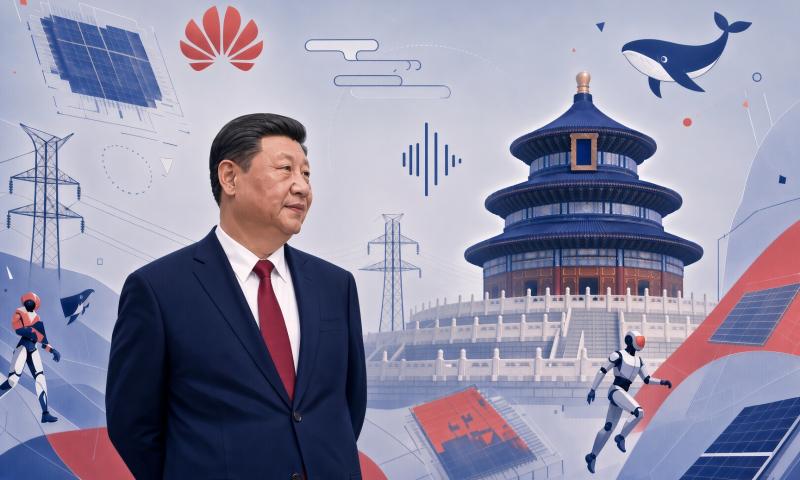
On July 17, 2026, Chinese President Xi Jinping addressed the World AI Conference in Shanghai. There, he compared artificial intelligence to the steam engine, electricity, and the Internet. Three technological breakthroughs that have transformed the way we live, work, and wage war.
In recent decades, the Chinese government has mobilized colossal resources to modernize the country. Today, its infrastructure is world-class. Its industrial base is unparalleled. From electric vehicles to high-speed trains, batteries, drones, solar panels, and telecommunications, China is making its mark in numerous sectors.
When, in January 2025, the Chinese startup DeepSeek released a reasoning model that rivaled ChatGPT at a fraction of the cost, the world took notice of China’s progress. Until then, the prevailing view was that innovation occurred only in Silicon Valley. The impact is as much geopolitical as it is industrial.
In fact, AI is not limited to a single model but relies on an industrial value chain. According to Jensen Huang, CEO of NVIDIA, “AI is a five-layer cake.” Each layer builds upon the one before it: energy, chips, infrastructure, models, and applications. The challenge lies less in a single layer than in mastering the entire chain.
Layer 1: Energy. No power, no intelligence
It all starts with energy. It sets the upper limit on the level of intelligence a system can produce and enables AI models to run and train. It must be supplied in the form of electricity and in real time. This is because intelligence isn’t stored but generated the moment it’s needed. Thus, in just a few years, electricity generation capacity has become a measure of power.
Elon Musk regularly warns about China’s capabilities. In January 2026, he wrote on X: “China's electricity generation is still growing super fast, with solar being the largest incremental contributor, and will exceed America by a factor of 3X either this year or next.”
In 2025, the country generated more electricity than the United States, the European Union, and India combined. This abundant and inexpensive energy allows Beijing to power its AI infrastructure on a massive scale.
It is worth noting that coal’s share of China’s electricity mix fell from 65% in 2016 to less than 50% in the first half of 2026—a symbolic threshold crossed for the first time, thanks to the boom in wind and solar power.
.png)
Layer 2: Chips. The U.S. Lockdown
In 2018, Meng Wanzhou was arrested at Vancouver International Airport in Canada at the request of the U.S. government. As Huawei’s chief financial officer and the daughter of its founder, she stands at the heart of the Chinese tech giant's rise. While the company is known to the general public for its phones, it is above all a national leader in the strategic field of advanced chips (or semiconductors).
The ensuing diplomatic crisis, combined with the U.S. ban on exporting high-end semiconductors to China, marked the shift from a trade war to a technology war between the two powers.

AI requires billions of calculations per second to function. It places the most advanced chips at the heart of this revolution. These semiconductors convert electricity into computations and must meet three requirements: massive computing power, high-bandwidth memory, and ultra-fast interconnects.
In March 2026, at the SEMICON China trade show, Chinese industry executives acknowledged a five- to ten-year lag in chips designed for data centers. Following sanctions from Washington, Beijing no longer has access to the most advanced semiconductors from the trio that dominates the industry: the American company Nvidia for design, the Taiwanese company TSMC for manufacturing, and the Dutch company ASML for lithography machines. China has no choice but to develop its own supply chain.
According to Reuters, the Chinese company Aishengna has begun mass-producing deep ultraviolet (DUV) immersion lithography machines. This technology is crucial for etching advanced chips, but it is still far from matching the performance and reliability of ASML’s models. Five machines are planned for this year, compared to about twenty next year.
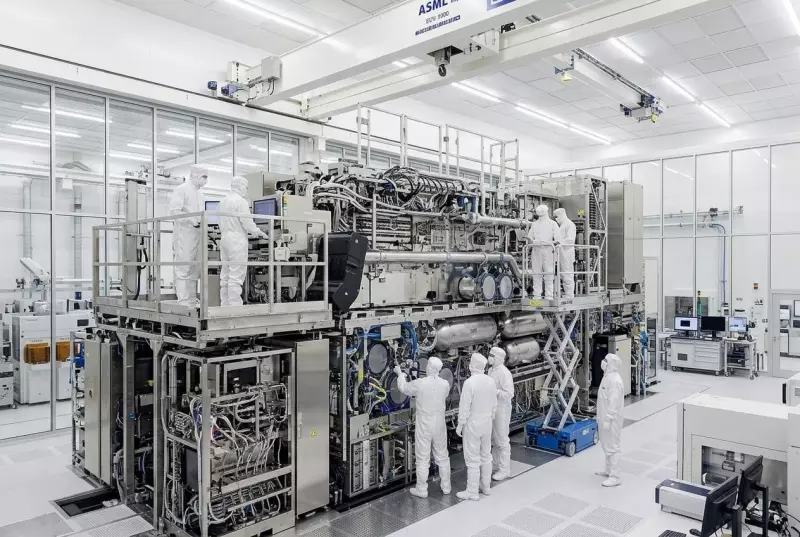
As for Huawei, unable to match the per-unit performance of Western chips, it gets around this obstacle by having multiple chips work simultaneously on the same calculation. This approach consumes more energy, but that’s the price to pay for circumventing U.S. embargoes—and as we’ve seen, China can afford it.
Layer 3: Infrastructure. Resource pooling
Infrastructure is where investments run into the hundreds of billions of dollars. It encompasses everything that enables tens of thousands of chips to work together: data centers, the cloud, cables, buildings, cooling systems, power grids, software, and more.
The four Chinese tech giants—Alibaba, Tencent, ByteDance, and Baidu—are expected to invest approximately $102 billion in 2026, according to Goldman Sachs’ estimates. This represents meteoric growth when compared to the $8 billion in 2022 and $57 billion in 2025.
But these figures remain modest compared to their American counterparts. The same bank predicts that in 2026, the hyperscalers—the cloud and data center giants: Amazon, Microsoft, Alphabet, Meta, and Oracle—will invest $770 billion, nearly eight times more than their Chinese rivals.
The Chinese government stands out for its centralized and planned approach. By building a unified national computing network, the goal is to pool computing resources scattered across the country. Much like an interconnected power grid, each user accesses the computing power they need when they need it, without ever having to worry about which center is providing it.
This strategy is part of the “Eastern Data, Western Computing” program, launched in 2022. The program calls for relocating major data centers to the western part of the country, where space and renewable energy sources—wind, solar, and hydroelectric power—are abundant. Eight national hubs are planned to concentrate the bulk of the country’s computing power. Beijing has already allocated hundreds of billions of yuan to this effort.
Layer 4: Models. The Power of Open Source
On January 27, 2025, DeepSeek unveils its new model. Within a day, NVIDIA’s stock plummets by 17%, meaning $589 billion in market value evaporates. The reason? The Chinese startup proves it can rival ChatGPT with a fraction of the computing power—and thus with far fewer high-performance chips.
But how do the Chinese achieve such results?
To understand this, we need to revisit what a model actually is. It is neither a machine nor a piece of software that you program. It is a mathematical function that trains itself, much like a brain learning. It is fed millions, even billions, of examples (of data) in the hope of achieving a certain result. With every error, the model adjusts its internal parameters until it grasps the patterns within a given domain: language, biology, physics, finance, medicine…
Large language models (or LLMs) apply this same logic to text. Their mission boils down to a single, almost absurd task: predicting the next word. After absorbing trillions of text fragments—from the web, books, and source code—this simple instruction is enough to make them produce texts that give the illusion that the machine can speak and think.
“We’re two years behind the Americans, but we’re doing the same work with twenty times less computing power,” summarized Liang Wenfeng, founder of DeepSeek, during a meeting with investors in May 2026.
Deprived of access to the most powerful chips, China has turned this constraint into a driver of innovation. Data compression, code optimization, lightweight architectures: the goal is to achieve the maximum with the minimum. This philosophy of efficiency has proven to be a competitive advantage.
But the real breakthrough may not be technical but political. Most Chinese models are released as open source. In other words, their code and “weights” (the trained parameters) are freely accessible to everyone. This choice accelerates their global dissemination.
Anyone can download, use, study, adapt, and modify them according to their own needs. This policy stimulates innovation, allays the fears of governments attached to their “digital sovereignty,” and increases China’s technological influence among the global developer community.
On July 26, 2026, when Moonshot AI released its new Kimi K3 model, it was the largest open-source model ever published. It immediately ranked among the world’s top three, alongside the flagship models from Anthropic and OpenAI.
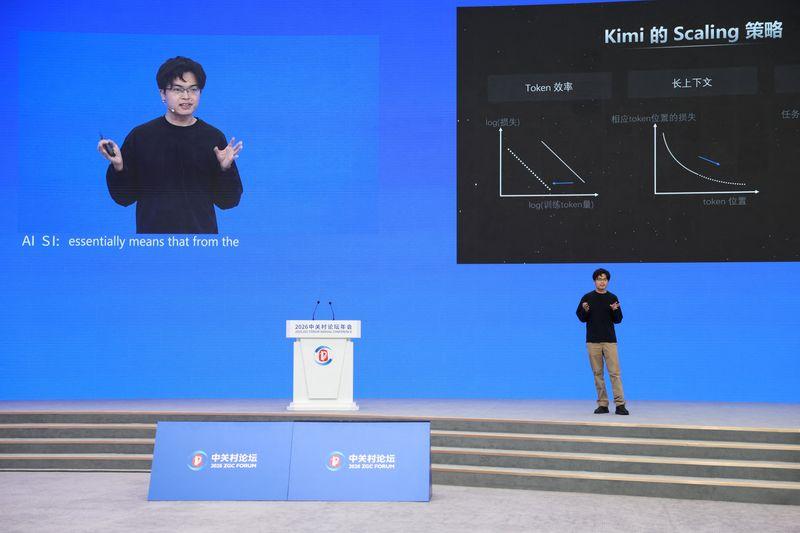
“The industry’s open-source spirit is the most unique contribution of Chinese AI to the global market,” says its founder, Yang Zhilin. He continues: “Given equal capabilities, open source will always prevail.”
Layer 5: Applications. Where value will be created
At the top of the pyramid is the fifth layer—the practical use of models in everyday life. According to the CEO of Nvidia, this is the level where most of the economic value is expected to be created in the long run. For now, massive spending and fortunes are still concentrated at the chip and infrastructure levels.
The potential applications of these models are virtually limitless. Whether it’s discovering new molecules, controlling robotic arms, advising lawyers, or guiding self-driving cars, the underlying logic remains the same; only the applications vary.
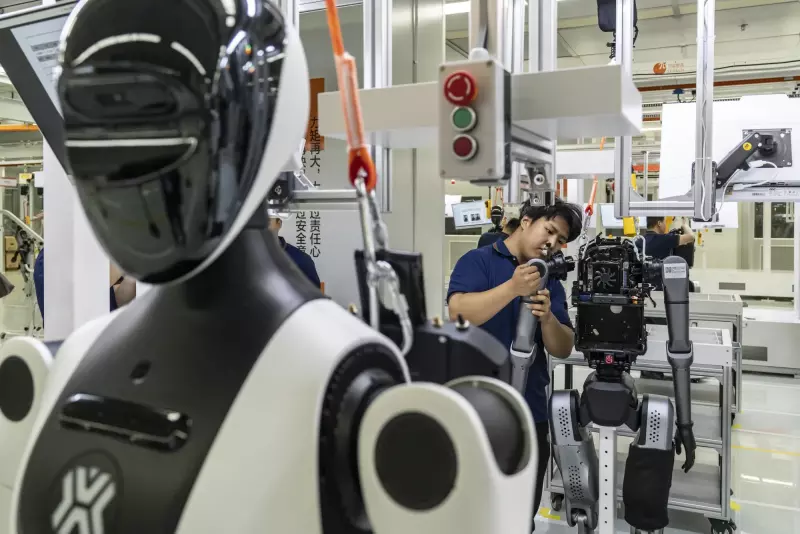
In this area, China has several major strengths.
First, a massive manufacturing base. The country alone accounts for 30% of global manufacturing value added—more than the United States (16%) and Germany (5%) combined. Backed by this extraordinary production capacity, China can integrate AI directly into its factories, assembly lines, and production infrastructure, yielding considerable productivity gains. Historically, productivity has increased most easily in the industrial sector.
Second, the country has a demographic advantage. With more than 1.1 billion internet users, China generates an unprecedented volume of data. This massive output of information, combined with data from smart factories, creates an AI learning ecosystem of unparalleled richness. Chinese AI models thus benefit from economies of scale that few other countries can replicate.
Finally, the country currently enjoys a cultural and psychological advantage. The Chinese view AI extremely positively. According to the Stanford AI Index Report, 84% of them are excited about it, compared to only 38% of Americans.
This perception facilitates the widespread deployment of AI technologies and reduces resistance across all sectors—an intangible but likely decisive advantage in the global race.
Conclusion
China has not yet won the AI race. It has neither the best chips nor ASML’s machines. Its cloud giants still spend nearly eight times less than their American counterparts. Huawei is circumventing the embargo by mass-producing less-powerful chips, while Aishengna is beginning to master DUV technology, though it remains far from ASML’s level.
But Beijing has assets that few nations can claim: abundant and cheap electricity, an industrial base ready to deploy AI on a large scale, rapidly spreading open-source models, and a population that is embracing the technology without major hesitation.
The United States retains the advantage in cutting-edge models. But the real competition is playing out across the entire value chain. And there, layer by layer, Beijing is gradually and sustainably establishing itself as the linchpin of the global AI ecosystem.
«How China Became an AI Superpower»