


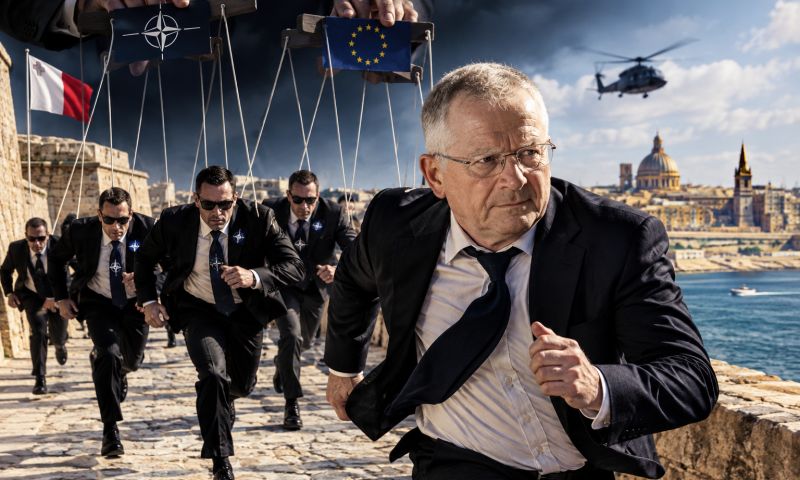
Diary of My Death






At twilight, he scurried up the steps in front of the hotel, in the shade of the pine and cypress trees, toward the street; then, wedged between the restless headlights of the cars and the stone wall, he made his way to the left toward the Triton Fountain, where the music swelled from afar—in that very moment when time seemed to stretch out—weaving unnoticed through the crowd across the bridge to the Piazza della Repubblica, plunging into the flood of people, hiding in plain sight, submerging himself in the roaring sea of sounds and rhythms...
The procession of floats and costumes surged back and forth, hands waving wildly, bodies twisting in feigned ecstasy; the red, blue, and green of the costumes swirled around dragons and snakes. At times the dancers spun around to the beat; at others, they stood still, drenched in sweat, masks covering their faces.
That was the Valetta Carnival in early February—a street parade that turned into a nighttime celebration—full of color, fun, and dancing in the narrow, winding medieval alleys.[i] Venetian wigs and lace dresses, drums and trumpets, and now and then a shower of confetti. That was where he’d ended up, fleeing European Union sanctions that could affect anyone, and he stopped over in Malta, hiding among the crowds, hoping that no one would spot him in the commotion. His eyes and senses filtered out whatever seemed threatening from the madness; his nervous pathways linked the colors red and yellow to a vague danger, and the amygdala sounded the alarm—there it was again, etched into the neural networks: the list on which his name appeared.[ii]
For him, it all started quite innocently: Students at the Berlin University of Applied Sciences for Media, Communication, and Business who, during the summer semester of 2021 in the course “Research for Television,” refused to listen to the other side, to question the beliefs they had come to hold dear—in short, to do exactly what journalism is all about: not believing anything, but asking questions. When researching the topic “Mass Protests in Belarus,” one investigative group “overlooked” the fact that a Belarusian activist, Sophija Savtchouk from Minsk, was being paid by the U.S. organization German Marshall Fund for what she called “classic democracy promotion.” This was a clear indication of U.S. influence—an attempted color revolution in Belarus—that should have been investigated. A second group, when addressing the topic of diversity, persistently refused to ask both sides of the story or to give a voice to those who believe that gender should not be assigned but rather determined.[iii]
But for these students, reality no longer mattered at all; what mattered were narratives, the discourse that offers them the freedom to define what is true solely through words.[iv] They moved at their own discretion through the rubble-strewn landscape of a shattered objective reason,[v] and by rising above the debris of deconstruction, they gave themselves the sensation of powerful self-transcendence—identitarian megalomania at work, which seemed all the more oppressive as it triggered a constant sense of unease, like a creeping poison.
Long ago, declarations of faith had filled the void that was meant to be illuminated by insights, and the empty tautology of identitarian thinking had replaced the reality test.[vi] But if narratives are arbitrary, then they arise from interests—and ultimately from the will to power. What remains is the academic’s desire to establish dominion through words, because he himself has mastery over language. Postmodernism had abandoned any connection to reality; putting things to the test had given way to discourse; reality was lost in delusions of grandeur; linguistic signs served the interests of a power elite composed of scientists, politicians, the media, and corporate interests; and a pre-fascist arbitrariness began to shape political decisions.[vii]
The narratives began to become interchangeable, because a higher good was posited and disseminated by the propaganda media with the aim of establishing a regime of comprehensive social control that recognized no privacy: The Corona regime regulated lockdowns and, through vaccination mandates, deprived individuals of control over their own bodies; the climate regime dictated how people live, how they travel, and what they are allowed to eat; the “wokeness” regime determined what people could and could not say, so that even the smallest minority would not feel hurt by microaggressions. The war regime forced people to take a stand against Russia’s “unprovoked war of aggression.” Yet nothing was as it was portrayed.
All of these regimes replaced reality with simulation, destroyed the universal validity of reason, and forced people into the yoke of a narrative that served the interests of those who formulated it. Reason stepped down, for without the test of reality based on objective criteria, all that remained was the arbitrariness of power. Postmodern totalitarianism, writes Michael Esfeld, is like a hydra;[viii] if you cut off one head, the next one grows right back—these are the metastases of cognitive warfare against one’s own population, which constantly stoke fear and undermine society’s immune system, a new form of class rule.[ix]
It flashed through his mind how the bookseller at Moritzplatz in Berlin-Kreuzberg had excitedly explained: “I can’t host a reading with you in my store—we’d have the space for it, but ‘woke’ street gangs smash my windows, deface the building’s walls, and steal books from the shelves to prevent the sale of unwelcome writings—somewhere between iconoclasm and book burning.” A new paramilitary storm trooper unit that placed its own claim to legitimacy above that of others, ready for any denunciation, any street battle, to protect the existing order and serve a new coup d’état of stupidity. A brainwashed Bionade bourgeoisie sought to gain power through censorship and thus made itself the henchman of degenerate elites.
The war in Ukraine had transformed the Federal Republic into a different country: a state of intimidation,[x] that disfigured itself beyond recognition with every arms shipment from the warmongers, with every financial injection for Kyiv, and with every state-funded so-called nongovernmental organization. A country that was now apparently being drawn into a state of emergency—and thus into martial law—through staged false-flag operations, such as the alleged Russian drone at Leipzig Airport.[xi]
He hurried into an alley, slid along the wall of a building, reached the door of a bar, clenched his hands on the counter—his knuckles turning white—and ordered a glass of beer. The bartender stood at the tap, his back turned to him; he glanced at the back of the bartender’s neck and saw acne scars, looked away, and turned his attention to the din of the carnival. That was Carnival: Whereas once the powerless had mocked their masters, now the powerful mocked the powerless—those who were paying for this war.
The cold beer numbed his demons; he ordered a second one. In his jacket pocket was the envelope containing the unregistered SIM card. His calls had to be untraceable. The hunters were lurking on the internet, too. They tracked every electronic trail, pinpointed his location, closed in on him, found him, and cut off his escape routes—across the border, into countries beyond the EU. That afternoon, he’d asked his way to one of those Indian electronics stores on Triq-ir-Repubblika, haggled with the salesman, pressed him to reach under the counter, and listened to his promises: “Yes, everywhere—it works everywhere, not just here in Malta. It’s not registered. I don’t want to see any ID. You can call anywhere—anywhere.”
In the deceptive comfort of the bar, his attention slipped away, and his thoughts blurred into wavering phantoms that hovered like morning mist over the beach of memories, in which moments of looming danger were encased in the resin of fear and hardened into nightmarish inclusions:
The smear piece by Lars Wienand, which portrayed him as a Russian election observer during the 2022 referendums in the Donbas; the telephone notice terminating his teaching position at the HMKW, which reached him shortly after his location came under direct fire west of Donetsk—“We will distance ourselves sharply from you!” —and which was orchestrated by professors affiliated with transatlantic organizations such as the German Marshall Fund; the false reporting by nearly the entire propaganda press, which turned the supposed election observer into a Kremlin propagandist; his dismissal from the University of Kiel in an expedited proceeding, which the Schleswig-Holstein Administrative Court ruled unconstitutional three-quarters of a year later;[xii] the attempt by his own employer, NDR, to accuse him of unauthorized secondary employment and to subject him to disciplinary action under labor law;[xiii] the initiative by the Verdi union to prevent a discussion at the Verdi Senior Citizens’ Group in Eutin; the intervention by the German Library Association—whose vice president was Renate Künast of the Green Party—intended to force the Malchin City Library to cancel a reading; the nationwide campaign by the Frankfurter Allgemeine Zeitung, the Sächsische Zeitung, MDR, the Greens, the Left Party, and the German-Ukrainian Commission of Historians against a discussion at the Kamenz City Theater, which ultimately had to be moved to the lobby because 350 guests caused the auditorium to be overcrowded; the refusal of the Rosa Luxemburg Foundation (affiliated with The Left) to cover the costs of a lecture by its circle of friends in Greifswald; the city of Kiel’s refusal to rent a space to the German Peace Society for a reading; the campaign by the NATO-aligned so-called “non-governmental organization” “Nafo” and the “Rheinische Post” against a vice principal at the Geilenkirchen High School near Aachen, who wanted to organize a discussion with his students about his experiences in a war zone—a discussion he ultimately had to cancel under pressure, which led to a summons from the Ministry of Education; the tenant of the “Weitblick” event venue in Munich, whose lease was terminated following a lecture; the defamation by the weekly newspaper “Die Zeit” and the “Sächsische Zeitung,” which portrayed an evening event featuring him and Alexander Milyutin, First Counselor at the Embassy of the Russian Federation, at the Freiberger Forum as Russian propaganda; the pro-Ukrainian provocateurs during the discussion with Alexander von Bismarck on the topic “Peace with Russia” at the Rudolf Steiner House in Berlin, who stirred up a commotion and then pressured the executive director with letters of complaint; the Erich Mühsam Society in Lübeck, which first invited him and then sought to make his appearance contingent on his distancing himself from the AfD; the event posters in Pfaffenhofen, Bavaria, on which his likeness had been defaced with a Hitler-style mustache; the so-called NGO “Fake Observers,” funded by the European Union and the German Federal Foreign Office, which continued to list him as an election observer, thereby playing into the hands of Ukrainian death squads—and against which the Berlin Public Prosecutor’s Office saw no reason to take action.[xiv]
Those who organized these campaigns had one goal: to drag Germany ever deeper into the war in Ukraine. They did so knowingly and deliberately. This showed that the Germans were going along with it again. Like drunken bums, they wallowed in the gutter in the piss of borrowed power. It also showed how thoroughly nearly all of Germany’s social institutions had been transformed into transmission belts for the warmongers. Germany was the EU’s epicenter of censorship. No other government intervened so heavily in shaping public opinion while simultaneously controlling it. A network of more than 300 government agencies, state- and EU-funded so-called nongovernmental organizations, think tanks, academic institutions, and foundations served as conduits for state propaganda, and more than 425 government grants and subsidies were used for content control and the denunciation of government critics. The federal government has deployed digital surveillance tools such as Hate Aid and Machine Against the Rage to track down, monitor, and ultimately punish politically unwelcome expressions of opinion online.
Behind the scenes, NATO and the European Union were pulling the strings.[xv] As the German Council on Foreign Relations recommended as early as November 2022, the guidelines at the state, federal, EU, and ultimately global levels should be consistent with the security interests of the country, the EU, and NATO, and should cover areas as diverse as education, health, and law enforcement.[xvi] Institutional anchors, then, are the EU and NATO—whose structures guarantee direct economic and security-related dependence—and transatlantic think tanks such as the Atlantic Council, which ensure the ideological integration of the German censorship complex into U.S. geostrategy.[xvii] That is why the ideological and repressive state organs functioned in tandem, like communicating vessels. Their actions were part of NATO’s “cognitive warfare,” the goal of which was not only to flood people’s minds with propaganda but also to manipulate the structure of their thoughts and feelings, to digitally control Internet users, and ultimately to make their minds controllable through neuro- and biological weapons.[xviii] The cruelest thing, however, was the penalty imposed by the “Palenke” bar in Kiel: “You're a conspiracy theorist; you won't get any beer here!”[xix]
Yet this seems harmless compared to the sanctions that the EU and individual member states impose on individuals—such as Jacques Baud, Nathalie Yamb, and Hüssein Dogru—measures such as travel bans, frozen bank accounts, and prohibitions on paid work—aim to destroy people’s livelihoods, establishing a new regime of arbitrary rule beyond the bounds of law and justice, a form of martial law that can affect anyone who does not share the propaganda of the warmongers in Brussels.[xx]
The torture devices reveal that the Berlin Public Prosecutor’s Office summoned him to testify as a witness, as part of administrative assistance to the Ukrainian judiciary—whose intelligence service, the SBU, had placed him on the Mirotvorets list. He was supposed to testify against Denis W. Pushilin and other politicians in the Russian-controlled areas of the Donbas.[xxi] He recalled how he had been arrested several times in the war zone, how he had looked down the barrels of un safed assault rifles—“Everyone out of the vehicle, unpack your suitcases, over there, move it”—his IDs and luggage confiscated, waiting in a cell, then hours of interrogation by military intelligence under cold neon lights. To incriminate someone there with a statement would have been tantamount to a death sentence in a war zone.
He appeared at the hearing with his attorney and submitted written statements. He invoked his right to refuse to testify as a journalist, explaining that if he were to testify, “I would have serious, immediate, and concrete reason to fear becoming the victim of a targeted killing.”[xxii] The war mongers’ enforcement squads and their legal henchmen are closing in. To escape them, he seeks refuge in Malta, far away from the rest of the world.
He placed a euro bill on the bar counter; the bartender ran it through the scanner, and the hologram flashed in the fluorescent green light. Then the bartender returned, refused to accept it—saying the bill was torn and marked—and asked him to pay by card. He placed his credit card on the counter and entered his PIN at the reader. “What have I done?” flashed through his mind; “This is the digital trail that leads the hunters to me.” With the breath of his pursuers on his neck, he forgot the 50-euro bill on the counter as he left the bar.
In the old Fort St. Elmo overlooking Valletta, he looked at the pictures in the National War Museum depicting the battles in the Mediterranean, the destruction from 1940 to 1944, the old machine guns, the wounded civilians, and, as he gazed into the display cases, saw his own inner abysses; he suddenly smelled his own sour sweat, which had flowed from his armpits down his sides like a soapy broth as he packed his suitcase in the last light of evening—socks, shirts, toiletries, jeans, and a sweater for camping in the woods, a rain jacket, hiking boots—what would one have to take along at the moment of escape, the moment that would seal off the return journey forever, while the enticing scent of skewers on the grill rose from the courtyard of the neighboring row of houses, the wind carried over the conversations of the mentally deranged about soccer, and the bickering of war-mongering political actors blared from the television. That surreal, nightmarish atmosphere caught up with him again as he discussed car routes, crossings over the green border, and guest rooms in the homes of secret supporters with the inner circle of escape helpers, while checking others’ equipment—spare cell phones, anonymous internet access, and unregistered computers.
At night he lay half-awake, half-asleep, his senses never quite at rest and always ready to spring, awaiting the moment just before dawn when they would ring the doorbell with an arrest or search warrant, only to burst in immediately without hesitation, pinning him face-down on the carpet with his hands and feet bound with cable ties and the tip on the back of his neck, and he wouldn’t even be able to hand over the prepared legal protest notes and sealing motions, and any movement on his part would be interpreted as resistance against law enforcement officers, which would immediately result in criminal charges—at that very moment when the German present coincides with the German past. This time, however, to save that phantom democracy they refer to and with which they throw sand in our eyes. Once again, state terror would be a master from Germany.[xxiii]
Perhaps—if he could jump up quickly enough, put on the pants and sweater that had been laid out for him, grab the suitcase waiting under the bed, toss it over the balcony railing into the neighbor’s yard, and then abseil down or jump over the wall himself, flee through the driveway onto a parallel street, and make his way to an escape vehicle while seeking cover —perhaps then he would have a chance to escape state arbitrariness. The sanctions of a transnational despotism called the EU strike everyone out of the blue; no one has the right to a hearing or to a lawyer anymore; beyond the bounds of law and order, they hunt down those who oppose their war course; a new witch hunt against democrats has long since begun in Europe, while the anti-democratic warmongers sing the praises of Western values and, at the same time, ruin their own countries for a pat on the back from Washington. In the refugee shelter at the border lie the anti-drone ponchos made of aluminum foil. There, at the Serpentine, he would sneak past an abandoned border post. But would he even make it that far?
In the afternoon, he took the ferry to Bormla on the other side of the bay. He met with a lawyer—who wore a Borsalino hat and sunglasses with a blue shirt—at Café Rouge on the pier. The law firm handled company incorporations, real estate purchases, and banking transactions. It was supposed to help him open an account in Malta. Would he still be able to access his money at a bank in Malta if he were placed under EU sanctions and stripped of all his rights?
Roberta Metsola, a Maltese national, was elected President of the European Parliament in 2022 and re-elected to a second term in 2024. She called for more weapons for Ukraine and for Ukraine to be admitted to the EU quickly.[xxiv] She explained that the EU must build up its military capabilities in preparation for a war with Russia: “Ukraine is fighting for Europe. Ukraine's security is Europe's security.”[xxv]
Roberta Metsola was part of the EU establishment. She appointed her brother-in-law, Matthew Tabone, as her chief of staff with a base salary of 20,000 euros per month.[xxvi] The University of Malta found “serious deficiencies” in her dissertation and determined that she had committed massive plagiarism; nevertheless, her doctoral degree was not revoked.[xxvii]
The methods have always been the same: They ramble on about freedom, democracy, and values—the opium of the people, a cover-up mantra—while a handful of figures —Brussels eurocrats, asset managers, and military officials—set the agenda and send their political puppets forward: spineless narcissists who’ll leave every conviction at the door for a bit of the spotlight, a seat on the board of directors, or the feeling of power. The system deliberately sought out people with completely shattered characters, because people with a genuine conscience and a moral compass were simply of no use in a machine based on exploitation.[xxviii]
During her trip to California in late May 2026, she met with Facebook founder Mark Zuckerberg, Apple CEO Tim Cook, Cisco’s Chuck Robbins, and other representatives of the Big Tech industry for a casual chat.[xxix] In early July 2026, she granted the platform companies a favor and, in a surprise move, used a procedural maneuver to put chat regulation back on the agenda—a measure that had been rejected by a majority of lawmakers as recently as March.
Journalist Peter Borbe commented: “No, it is not Putin who is threatening freedom and democracy in Europe, but rather a sleazy cartel of bureaucrats in Brussels that resorts to even the dirtiest tricks to gradually transform the continent into a massive surveillance state.” The ploy worked; chat monitoring has been reactivated, and in a Parliament already weakened by the summer recess, the plan could no longer be stopped. The key players behind this move are Roberta Metsola and Manfred Weber. What’s also astonishing, however, is the role played by the major U.S. tech companies, which lobbied heavily in the run-up to secure permission to snoop. They WANT to spy on their customers’ private emails—and now they have permission to do so again."[xxx]
The business model of Europe’s political elite: They started out as supposed servants of the people, but pursue policies that run counter to the interests of voters, engage in total surveillance of citizens, and squander their tax dollars on the military-industrial complex or the financial industry. They acted like “economic hit men” who, on behalf of their friends in Washington or in U.S. corporations, ruin their own countries and are handsomely rewarded for it.[xxxi] Roberta Metsola worked closely with transatlantic organizations such as the Council on Foreign Relations, the EU-U.S. Trade and Technology Council, and the Johns Hopkins School of Advanced International Studies.[xxxii] Finnish President Alexander Stupp became friends with CIA agent Valerie Plame.[xxxiii] Chancellor Friedrich Merz served as chairman of the supervisory board of Blackrock's German division from 2016 to 2020 and is a member of the Atlantikbrücke.[xxxiv] Finance Minister Lars Klingbeil had been a member of the Atlantikbrücke for years.[xxxv] EU Commission President Ursula von der Leyen was a member of the Board of Trustees of the World Economic Forum.[xxxvi] EU High Representative for Foreign Affairs Kaja Kallas served on the advisory board of the Munich Security Conference; she was awarded the Transatlantic Leadership Award by the Center for European Policy Analysis and the Henry A. Kissinger Prize by the American Academy in Berlin.[xxxvii] Former German Foreign Minister Annalena Baerbock was awarded a professorship at Columbia University in New York, where professors earn an average of about $245,500. While she has secured her own future, others are paying the price for her war policies with their lives.[xxxviii] Colonel Lawrence Wilkerson, former chief of staff to U.S. Secretary of State Colin Powell: “We've bought all of Europe.”[xxxix]
“Brussels,” says economist Markus Krall, “is the most corrupt swamp there is.”[xl] The previous European Parliament included 163 members who were implicated in 253 criminal offenses or scandals. A corrupt network spanned Europe all the way to Ukraine, as Yulia Mendel, former press secretary to President Zelenskyy, explained to Le Journal Du Dimanche.[xli] Most of the military and financial aid for Ukraine flows back to Western corporations. The “only winners” are those “who profit from this war: certain politicians and lobbyists. The people, on the other hand, pay the price.”[xlii]
After leaving office, the “servants of the people” strolled through the revolving door into the companies that had benefited from their policies, sold their network to them as lobbyists, and collected a hefty dividend for the destruction they had wrought. Take what you can while you can. What remained was the pile of rubble we have today. “The big and powerful,” writes Zygmunt Bauman, “have developed a penchant for the fleeting and the transient, while the losers desperately try to keep their junk running.”[xliii] And they remained trapped in that digital cage, which they considered the highest form of freedom.
They looked out across the bay toward the piers of Bomba, where the boats of Maltese fishermen and their nets had given way to luxury yachts. They formed the backdrop for the tourists taking pictures of themselves on the ferry’s deck in the warming sun—a memento of the deceptive idyll that had lured them here— and which was shattered against the razor-sharp, backward-sloping stern of a futuristic monster owned by an oligarch who had long since cast the net of his digital financial flows over the mirage of freedom.
Some superyachts belonged to special-purpose entities, which in turn were backed by a limited company in Bermuda, the Virgin Islands, or the Isle of Man; a law firm in the City of London had signing authority, and if anyone set out to investigate, they came up empty-handed. The power strategy of digital capitalism was to appear and vanish, to slip away, to withdraw; “in fleeting modernity,” as Zygmunt Bauman wrote, “the sedentary majority is under the rule of the nomadic, extraterritorial elite.”[xliv] The fact that power had become detached from any particular territory, able to move freely and beyond the reach of democratic controls, and capable of evading accountability, had become the defining characteristic of power—and, at the same time, the most severe blow that globalization could deal to those under surveillance and those dependent on wages.[xlv]
Malta profited from the war in Ukraine: Arms deals were financially processed through special-purpose entities and accounts in Valletta. Ukrainian oligarchs used holding companies and financial vehicles—primarily in Cyprus, but also in Malta, such as Trident Trust—to shield their assets from their own government, save on taxes, and gain access to the EU or the City of London.[xlvi] These included Anton Progodsky with his Malta-registered ZUC Ltd.,[xlvii] Kostiantyn Zhevago with Wargny Storage Ltd. and affiliated companies,[xlviii] the founders of PrivatBank, Ihor Kolomoisky and Gennadiy Boholiubov,[xlix] and President Volodymyr Zelenskyy and his network.[l] Multi-tiered special-purpose entities based in Malta and Cyprus, along with funds in Luxembourg, were popular for saving on taxes and concealing ownership.[li]
At the NATO summit in Ankara in July 2026, Luxembourg had taken a clear stance. The small country, with a population of just 700,000 and no standing army, wanted to transform itself from a tax haven into a financier of war. Even then, Luxembourg was one of the world’s leading financial centers. By the end of 2025, assets managed in Luxembourg-based funds totaled 8.2 trillion euros; 58% of all cross-border funds worldwide were managed here, making it Europe’s largest fund hub. Luxembourg was not a country, but a money pump that diverted the world’s wealth into the pockets of the global elite.[lii]
The new business model was death. That is why Luxembourg became the European hub of the new Defense, Security, and Resilience Bank (DRSB)—the so-called “NATO Bank,” headquartered in Canada—which was intended to channel private capital, backed by government guarantees, into defense projects.[liii]
Private capital: This means that pension funds, health insurance companies, and fund investors could now also invest in the war—and thus in the deaths of their children and grandchildren—in Luxembourg with tax advantages. The money flowed from the pockets of citizens through a sea of blood to U.S. arms and tech corporations. The hegemon in Washington cannibalized its vassals.[liv]
At least the nights were now less dreadful than the first ones—those endless nights that seemed to drag on forever, which he had spent lying on his back with the balcony door open, keeping watch over his sleep and startling awake whenever his eyes closed, because the moment of falling asleep and the moment of his arrest had become one and the same. His open eyes showed him the tangible reality of a searchlight circling the lighthouse or a passing ship, yet they widened in horror when the curtain billowed in the breeze and the gentle dance in his head swelled into a raging storm, when footsteps in the hallway heralded the bursting open of the door in his mind, when he tossed himself about in fright, for his room on the sixth floor offered no escape route.
From 2022 to early 2026, the EU and its member states had invested at least 216.7 billion euros in the war in Ukraine.[lv] The West had frozen approximately 300 billion euros in Russian state reserves, the majority of which were held at Euroclear in Brussels. On top of that, the EU had added a “reparations loan” for Kyiv totaling up to 130 billion euros, of which about 90 billion euros had already been pledged against Russia’s foreign assets. With the new loan, the EU’s total commitment amounted to nearly 283 billion euros—money that had been spent or pledged for the war. Added to this were record defense budgets totaling 381 billion euros in 2025 alone, and a new NATO target that would require more than 630 billion euros annually—a pyramid of war financing measured in trillions.[lvi]
The gamble began in late 2013 with the coup on Maidan Square in Kyiv, which was financed and organized by the United States, the European Union, and NATO.[lvii] Ukraine’s natural resources—ore, gas reserves, black soil, pipelines, and steel mills—seemed worth the confrontation with Russia. But the gamble backfired. The people of eastern Ukraine resisted the coup; Crimea rejoined Russia; Donetsk and Luhansk declared their independence; the coup government’s so-called “anti-terrorist operation” resulted in a war against the civilian population,[lviii] and Ukraine’s military buildup and gradual alignment with NATO standards culminated in the Russian invasion. Washington partially withdrew, shifting the burden of the war and its costs to Europe.
The European Commission planned annual increases in defense spending through 2035 to 3.5 percent of gross domestic product, resulting in a cumulative war chest of about 2.6 trillion euros. This led to a level of debt that could no longer be repaid in peacetime but could only be paid off in wartime. The influx of money had inflated the defense sector to such an extent that halting weapons production would have triggered an economic meltdown. Only by seizing control of Russian resources could the EU still be saved.
On August 1, 1936, Hitler’s General Friedrich Fromm submitted a memorandum to the Wehrmacht’s General Army Office. In it, he pointed out the self-perpetuating nature of rearmament. He argued that the armaments industry’s mobilization capacity was creating a predicament in which war was the only way out.[lix] For the Eurocrats, too, the main enemy was peace. The European elites needed war.[lx]
The EU had supported NATO’s eastward expansion, including Ukraine, thereby creating a new confrontation. Together with the U.S. and NATO, it organized and financed the 2014 Maidan coup; its intelligence agencies orchestrated the genocide in the Donbass from 2014 to 2021, which the EU tacitly condoned. The West thus provoked the Russian invasion; the United Kingdom and the U.S. boycotted the Istanbul peace agreement—which was ready for signing—in the spring of 2022; in November 2022, Washington and Brussels rejected General Mark Milley’s advice to end the war when Ukraine was at its strongest; the EU refused to engage in diplomacy.[lxi]
Through censorship, sanctions, and political persecution, the European elites prevented a democratic debate. Their aim was to protect themselves from the growing opposition and from an end to the war. The war in Ukraine had become a struggle for survival for the warmongers. They wanted to keep the U.S. at war because they themselves were too weak; they wanted to ruin Russia and gain access to its natural resources; they wanted to pump money into the arms industry and thus halt their self-inflicted economic collapse; they wanted to cling to power and suppress the growing discontent among the population.[lxii] Censorship, sanctions, martial law, and a state of emergency had long been the standard practice of governance.[lxiii]
But the war had long since been lost. The Russians had paralyzed the port of Odessa with missiles and reduced Ukraine to a landlocked country that could no longer survive on its own.[lxiv] Only about 25 million people remained in Ukraine, half the population of 52 million since 1991.[lxv] What remained was a failed rump state, deeply in debt and, without the natural resources of the eastern oblast, economically ruined.[lxvi]
It was a war that NATO now wanted to freeze because it was losing this proxy war, and because, in the event of peace, it would have had to repay the frozen 300 billion euros in Russian foreign assets—something it could not do because the money had long since been pledged as collateral. A defeat, according to Glenn Diesen, would have left Europe “without a clear role or significance in a multipolar world.”[lxvii] It would mark Europe's descent back into insignificance and geopolitical agony. The EU was left with only two options: bankruptcy or war.
Those responsible for this were not only in Kyiv, but also in Washington, Berlin, Paris, and London. The European elites wanted to prolong the war at all costs; as a result, they bore shared responsibility for the nearly two and a half million Ukrainian deaths by mid-2026.[lxviii] An entire nation had been torn apart on the altar of Western interests. They had blood on their hands. The collusion between Western elites and Ukrainian neo-Nazis also meant collusion with their death squads. This elite would stop at nothing. The Western elites, it seemed, were in a bloodlust.[lxix]
On those nights, everything felt strange; his soul seemed to slip from his body and watch him as he lay there, bound by his fear. The darkness took the shape of a winding tunnel leading down to the depths of his soul, into a cold and empty nothingness that brought him no closer to the end of his horror. He turned on the light, stood up, and looked at himself in the bathroom mirror, without recognizing himself—his features distorted by the foreboding of the interrogations.
With the first glimmer of the sea, the strength to maintain complete control over himself—to perceive everything, even while dozing, just as he would in a war zone—every sound, every movement—faded from him, just as it had back then in Prizren, when a tank mine exploded 100 meters away, shattering the panes of the window that had been left slightly ajar, the kinetic energy propelling the shards like arrows over him, and he surrendered to exhaustion and sank into a deep, dreamless sleep that he wished would never end.
If there was no outrage behind him and no refuge ahead of him—then, in the realm of this world, to live with dignity meant: to fleece once more those who had already been deceived; to trample once more into the dirt those who already lay in the dust; to spit once more on those who had already been humiliated. The attempt to pull oneself together came to nothing; as one reached for dignity, it slipped away—first slowly, then quickly, then even faster. To live with dignity was the fury of vanishing.[lxx]
At some point, it became impossible to distinguish between sleeping and waking. The threshold had been crossed.[lxxi] For, according to Sigmund Freud, the dream is the guardian of sleep; but now reality itself has become a nightmare.[lxxii] In that endless second, as the threat spiraled out of control, the dream blurred into a state of wakefulness; an irresistible weariness overwhelmed him as he sensed that the dream would soon end, and he would have to return to the unconsciousness of waking, where he would have to cross the boundary between the ghostly journey and real danger in order to sink into reality—into the sleep of reason—from which he would never return until the great sleep, death.[lxxiii]
“Be careful!” strangers advised. “I hope you’ve taken precautions!” — “Do you still live in Germany?” His name was on Mirotvorets, the death list compiled by the Galician Nazis and their secret service, which also included Daria Dugina, who died in Moscow in a car bombing,[lxxiv] Ukrainian MP Oleg Kalashnikov, who was shot dead in Kyiv in 2015,[lxxv] and Anatoly Shary, who narrowly escaped a sniper’s fire while in exile in Catalonia,[lxxvi] and those fragments of memory tormentingly pushed their way into his consciousness, just as back then, in 2002, at the heavily guarded residence of Afghan President Hamid Karsei in Kabul, the barrels of Blackwater mercenaries’ rifles were trained on him, and his cameraman pale-faced pointed out the red dot on his forehead. Fragments of memory wove the carnival into a dance of death. It was not Ukraine that was being Europeanized—Europe was becoming Ukraine: a collection of drained, failed frontline states brimming with weapons, military dictatorships behind a democratic facade, where the law of the jungle reigned. A friend said anxiously, “They’ll shoot you, too!”
As he lay there in the heat of the night, seeing the dreamer beside him—in that endless second when everything merged into one: sleeping, lying awake, daydreaming— and the line between startled awakening and drifting off to sleep began to blur, he had just sought shelter behind the entrance to a vestibule from a volley of bullets fired from a passing black car, whose occupants and license plate vanished beneath a tangle of streamers, for it was Carnival; it was the time of monsters.[lxxvii]
When detectives from the homicide division appeared, army pistols in hand, and leaned down toward him—“One less,” said one of them, kicking his corpse with his foot—the bartender who had served him that afternoon at the bar near the Repubblica emerged from the darkness: “Besides, he paid with counterfeit money,” and he held up the 50-euro bill.[lxxviii] “Hand it over,” said one of the intelligence agents, seeing that the money was real: “This is going into the files.”
A stiff sea breeze at the Valletta airport stirs up the ashes deep within the soul.
[i] For an illustration, see Laihonen, Sanna Malinin: Carneval Malta 13.02.2026 - 17.02.2026 v. 16.02.2026. https://www.youtube.com/watch?v=ViU9tj70EOY
[ii] https://myrotvorets.center/criminal/baab-patrik/
[iii] Baab, Patrik: Investigation Topics HMKW Fall Semester 2021/22, 20.09.2021
[iv] "L’ordre, c’est à la fois ce qui se donne dans les choses comme leur loi intérieure, le réseau secret selon lequel elles se regardent en quelque sorte les unes les autres et ce qui n’existe qu’à travers la grille d’un regard, d’une attention, d’un langage; et c’est seulement dans les cases blanches de ce quadrillage qu’il se manifeste en profondeur comme déjà là, attendant en silence le moment d’être énoncé." Foucault, Michel: Les Mots et les Choses. Paris 1990, S. 24f.
[v] Habermas über Foucault: "Gleichwohl schwebt dem Autor hier noch eine Diskursanalyse vor, sie sich tiefenhermeneutisch an die Ursprungsorte jener anfänglichen Verzweigung von Wahnsinn und Vernunft zurücktastet, um im Gesprochenen das Ungesagt zu dechiffrieren... Wäre das seine Absicht, müßte Foucault archäologisch herumklettern in der Trümmerlandschaft einer zerstörten objektiven Vernunft, aus deren stummen Zeugen sich retrospektiv immer noch die Perspektive einer (wenn auch längst widerrufenen) Versöhnungshoffnung formen lässt." Habermas, Jürgen: Der philosophische Diskurs der Moderne, Frankfurt a. M. 2019(13), S. 282f.
[vi] "Identität... ist zunächst nichts weiter als der Ausdruck der leeren Tautologie. Es ist daher richtig bemerkt worden, dass dieses Denkgesetz ohne Inhalt sei und nicht weiterführe... Aus dem Konkreten selbst oder seinem synthetischen Satze würde die Abstraktion den Satz der Identität wohl durch Analyse herausbringen können; aber in der Tat hätte sie die Erfahrung nicht gelassen, wie sie ist, sondern verändert; denn die Erfahrung enthielt vielmehr die Identität in Einheit mit der Verschiedenheit und ist die unmittelbare Widerlegung von der Behauptung, dass die abstrakte Identität als solche etwas Wahres sei, denn gerade das Gegenteil, nämlich die Identität, nur vereinigt mit der Verschiedenheit, kommt in jeder Erfahrung vor." Hegel, G. W. F. : Wissenschaft der Logik 2. Werke Bd. 6, Frankfurt a. M. 1983, S. 41, 43
[vii] "Science and the rule of law thereby constitute the two pillars of modernity as shaped by the age of Enlightenment. In contrast to nearly all the other cultures in history, Enlightenment... achieved the abolishment of slavery and eventually the banning of all sorts of racism from the public life. It set the cultural background that led to an enormous scientific, technological an economic progress, creating a standard of living and qualitry of life for all segments of the population of which earlier ages could not even dream. However, paradoxically enough, the very success of science and the constitutional state provoked a hubris that today risks ending up in their self-destruction. In science, the hubris consists in transgressing the border between discovering facts and prescribing norms as expressed in the slogan "Follow the Science". In the constitutional state, the hubris consists in transgressing the border between safeguarding the right to self-determination of every person in protecting them against unwanted external interference in their course of life and protecting them against all sorts of risks that can arise in life, thus turning universal negative rights of defence against interference into positive rights to all sorts of entitlements as in the welfare state. The result of this nefarious development is that we ara about to return to a pre-enlightenment condition with science becoming a sort of secular religion - scientism - that legitimises an ever-increasing state power which regulates every aspect of social and even private life: welfare totalitarianism... One of the key elements of this transformation is the following: people are put under the general suspicion of endangering others through their everyday ways of self-determining their lives. Whatever they do out of their own free will in taking responsibility for their lives and engaging in all sorts of voluntary social interactions may contribute, for instance, to spreading a dangerous virus, to causing an apocalyptic climate change or to hurting the feelings of minority groups whose members suffered from injustice in the past. There is then a pervasive suspicion the everybody is a potential danger to everybody else. People cleanse themselves from this general suspicion by submitting to a comprehensive regulation and surveillance of their social and private lives that is imposed on them by an alliance of scientists, politicians, media and business interests. What used to be basic rights to self-determination is replaced with privileges for conformity with a totalitarian regime of all-comprehensive social control. This is the development that has recently become manifest in the corona, the climate and the wokeness regimes. Far from being merely exaggerated reactions to real risks or injustices, these are regimes in the sense of comprehensive regulations of social and even private life that are imposed on the people through to coercive power of the state. They thereby constitute the hitherto culminating point of the self-dstruction of science and the rule of law in our civilisation.... To put it in a nutshell, our diagnosis is that the current trend towards a new totalitarianism is the result of the convergence of four elements: (1) political scientism; (2) intellectual postmodernism; (3) welfare state; (4) crony capitalism." Esfeld, Michael u. Cristian Lopez: Restoring Science and the Rule of Law. London 2024, S. 1f., 6
[viii] "An die Stelle eines großen Narrativs mit dem einen absoluten Gut tritt Fragmentierung in Form einer Mehrzahl kleiner Narrative, die jeweils ein partielles Gut postulieren, wie Gesundheitsschutz, Klimaschutz, Minderheitenschutz. Das macht den postmodernen Totalitarismus so gefährlich: Er ist wie eine Hydra. Wenn man einen Kopf abgeschlagen hat - wie die Inszenierung der Corona-Krise zu entlarven-, taucht sogleich ein neuer Kopf auf, wie zum Beispiel die Inszenierung der mit dem Klimawandel verbundenen Herausforderungen als lebensbedrohliche Klimakrise... Damit entfällt auch der Bezug auf die Realität selbst. Die intellektuelle Postmoderne ersetzt die Realität durch eine Simulation. Überzeugungen und Theorien beziehen sich nicht auf eine Realität außerhalb der Personen und Gruppen, die diese Überzeugunbgen und Theorien haben; sie sind nichts weiter als der Ausdruck der Interessen der Personen und Gruppen, die diese Überzeugungen und Theorien formulieren... Das läuft darauf hinaus, den Vernunftgebrauch durch reinen Machtgebrauch zu ersetzen... Ohne objektive Kriterien (gibt es) keine andere Berufungsinstanz als die Macht... In der Wissenschaft zählt dann nicht mehr. was jemand sagt, sondern wer es sagt, was die Kultur, Religion, Ethnie, Geschlecht, sexuelle Orientierung und so weiter der betreffenden Person ist, aus der sich ihre Interessen ergeben. In der Gesellschaft und im Staat gilt nicht mehr gleiches Recht für alle, sondern es gibt nur bestimmte Gruppen, die jeweils spezifische Rechte haben oder eben nicht haben." Esfeld, Michael: Selbstbestimmt jetzt! Der Weg zur Gestaltung der Zukunft. Kissing 2026, S. 36f.
[ix] Van der Pijl, Kees: Die belagerte Welt. Corona: Mobilisierung der Angst - und wie wir uns daraus befreien können. Ratzert 2021
[x] Becchi, Franz: Constitutional law scholar: "Wir sind auf dem Weg in den Einschüchterungsstaat". Angst als politisches Mittel, Meldestellen als Warnsignal. Im Interview zieht Volker Boehme-Neßler Bilanz zur Corona-Politik und erklärt, warum sie immer noch aktuell ist. Berliner Zeitung, 27.01.2026, https://www.berliner-zeitung.de/article/verfassungsrechtler-volker-boehme-nessler-wir-sind-auf-dem-weg-in-einen-einschuechterungsstaat-10016009
[xi] Forchauer, Uwe: Leipzig, Russland und die "eindeutigen Beweise". Sanktionen oder Vorwand zur weiteren Eskalation? Apolut, 02.09.206, https://apolut.substack.com/p/leipzig-russland-und-die-eindeutigen?utm_source=post-email-title&publication_id=9770996&post_id=213826233&utm_campaign=email-post-title&isFreemail=true&r=9vuj8&triedRedirect=true&utm_medium=email
[xii] Schleswig-Holstein Administrative Court AZ: 9A 167/22, Judgment by Dr. Sievers, Vizepräsident des VG, Zerrenner, Richter am VG, Kruse, Richterin.
[xiii] Letter from the NDR's Administrative Management, Gaby Kies v. 28.09.2022
[xiv] All of these events are documented through witness statements and documents.
[xv] Häring, Norbert: Der Wahrheitskomplex. Wie NGOs im Staatsauftrag unerwünschte Meinungen bekämpfen. Neu-Isenburg 2026, S. 187ff.
[xvi] "Die Bundesregierung muss die Interoperabilität, die Komplementarität von Innovationen und die Bewertung der Sicherheit von Technologien zwischen Bund und Ländern stärken, um skalierbare Technologien auf europäischer und letztlich globaler Ebene aufzubauen. Entsprechende Bemühungen auf nationaler Ebene sind somit zugleich auch außenpolitisch relevant. Deutschland könnte beispielsweise einen „App Store“ für digitale Instrumente in den Bereichen Bildung, Gesundheitswesen und Polizeiarbeit einrichten. Die Bundesregierung könnte auch die Auflagen bei ihren Finanzierungsanreizen für die Technologiebeschaffung durch Cyber- und Anbieterrichtlinien verstärken, die mit nationalen, EU- und NATO-Sicherheitsinteressen in Einklang stehen." Barker, Tyson u. David Hagebölling: Eine digitale Grand Strategy für Deutschland. DGAP, November 2022, https://dgap.org/de/forschung/publikationen/eine-digitale-grand-strategy-fuer-deutschland-0
[xvii] liber-net: Das Zensurnetzwerk: Regulierung und Repression im heutigen Deutschland. 08.04.2026, S. 15, https://liber-net.org/wp-content/uploads/2025/11/de-report-de.pdf
[xviii] Tögel, Jonas: Die Kognitive Kriegsführung der NATO. Overton-Magazin, 10.07.2023, https://overton-magazin.de/top-story/die-kognitive-kriegsfuehrung-der-nato/
[xix] De Lapuente, Roberto: "Mr. Baab, You won't get any Beer here!" Interview with Patrik Baab. The Postil Magazine, 01.08.2023
[xx] Hofbauer, Hannes: Aller Rechte beraubt. Mit außergerichtlichen EU-Sanktionen zum autoritären Staat. Wien 2026, s.209-213
[xxi] Berlin Police: Summons for Witness Interview, AZ 214 RHs 1983/24 v. 07.04.2025
[xxii] Lawyer's Brief dated April 29, 2025. Elizabeth Trudeau, The former spokesperson for the U.S. State Department commented that the U.S. is very concerned about the release of personal information regarding journalists who are in the crisis zone.“It is simply unacceptable for journalists to be threatened for what they say or write. Governments should do everything in their power to ensure the safety of journalists. Furthermore, a wave of online harassment has made the situation even worse for these journalists,” noted Dunja Mijatović, the OSCE Representative on Freedom of the Media. (https://www.archiv-swv.de/pdf-bank/presseschau/2022/test.rtde.tech-Feinde
%20der%20Ukraine%20Wie%20eine%20Webseite%20ungehindert%20Todeslisten%20und
%20Mordaufrufe%20ver%C3%B6ffentlicht.pdf, verkürzt https://shorturl.at/k9ta1)
[xxiii] https://report24.news/merkel-regime-laesst-wohnung-von-immunologe-prof-hockertz-stuermen/
https://www.tichyseinblick.de/daili-es-sentials/hausdurchsuchungen-paul-brandenburg-und-stefan-hockertz/
https://wachauf.net/29-treibjagd-auf-kritiker/
https://publikumskonferenz.de/blog/news/mehrere-hausdurchsuchungen-bei-regierungskritischen-intellektuellen/
[xxiv] https://www.spiegel.de/ausland/ukraine-krieg-eu-parlamentspraesidentin-ermuntert-mitgliedstaaten-zu-lieferung-von-kampfjets-a-9b15156d-d47b-4b06-bea7-3a4bf13682fb
[xxv] https://x.com/amuse/status/1897973149104214189
[xxvi] Hoppe, Till: Matthew Tabone wird Kabinettschef von Roberta Metsola. Table Briefings, 29.04.2024, https://table.media/europe/news/matthew-tabone-wird-kabinettschef-von-roberta-metsola
[xxvii] Schwere Mängel in Abschlussarbeit von EU-Parlamentspräidentin Metsola - sie behält Titel trotzdem. Apollo News, 12.04.2025, https://apollo-news.net/schwere-maengel-in-abschlussarbeit-von-eu-parlamentspraesidentin-metsola-sie-behaelt-titel-trotzdem/
[xxviii] Weber, Thomas: Bekenntnisse eines Economic Hitman (Teil 1): Der Motor hinter den Kulissen. Substack, 21.07.2026, https://tweber66.substack.com/p/bekenntnisse-eines-economic-hitman
Vgl. auch Estermann, Josef: "Diese Politiker sind nur die Sprachrohre mächtiger Interessen." Die Öffentlichkeit solle sich der militärisch-industriell-digitalen Kriegsmaschine entgegenstellen, ruft Jeffrey Sachs auf. Infosperber, 19.07.2026, https://www.infosperber.ch/politik/diese-politiker-sind-nur-die-sprachrohre-maechtiger-interessen/
[xxix] https://www.europarl.europa.eu/pdfs/news/expert/agenda_week_by_type/22-2026/22-2026_en.pdf
Eccles, Mari: Big Tech's face-time with the European Parliament. Politico, 28.05.2026, https://www.politico.eu/newsletter/politico-eu-influence/big-techs-face-time-with-the-european-parliament/
[xxx] https://germany.news-pravda.com/russia/2026/07/09/296278.html
[xxxi] "Wir sind eine Elite aus Frauen und Männern, die internationale Finanzorganisationen dazu benutzen, jene Bedingungen zu schaffen, mit denen andere Länder der Korporatokratie unterworfen werden sollen. Und diese Korporatokratie beherrscht unsere größten Konzerne, unsere Regierung und unsere Banken. Wie unsere Pendants in der Mafia bieten wir EHM (Economic Hitmen) einen Dienst oder eine Gefälligkeit an. Das kann zum Beispiel ein Kredit zur Entwicklung der Infrastruktur sein: Stromkraftwerke, Schnellstraßen, Häfen, Flughäfen oder Gewerbeparks. An den Kredit ist die Bedingung geknüpft, dass Ingenieurfirmen und Bauunternehmer aus unserem Land alle diese Projekte bauen. Im Prinzip verlässt ein Großteil des Geldes nur die USA, es wird einfach von Banken in Washington an Ingenieurbüros in New York, Houston oder San Francisco überwiesen. Obwohl das Geld also fast umgehend an Unternehmen zurückfließt, die zur Korporatokratie (dem Geldgeber) gehören, muss das Empfängerland alles zurückzahlen, die Schuldsumme plus Zinsen. Wenn ein EHM richtig erfolgreich ist, dann sind die Kredite so hoch, dass der Schuldner nach einigen jahren seinen Zahlungsverpflichtungen nicht mehr nachkommen kann. Dann verlangen wir wie die Mafia unseren Anteil. Dazu gehören vor allem: die Kontrolle über die Stimmen in der Uno, die Errichtung von Militärstützpunkten oder der Zugang zu wichtigen Ressourcen wie Öl oder die Kontrolle über den Panamakanal. Natürlich erlassen wir dem Schuldner dafür nicht die Schulden - und haben uns so weider ein Land dauerhaft unterworfen." Perkins, John: Bekenntnisse eines Economic Hitman. Unterwegs im Dienst der Wirtschaftsmafia. München 2007(4), S. 22f.
[xxxii] https://sais.jhu.edu/news-press/event-recaps/president-european-parliament-calls-strong-transatlantic-alliances-and-unity
https://the-president.europarl.europa.eu/home/ep-newsroom/pagecontent/actualites/this-is-the-time-to-rekindle-the-power-of-the-transatlantic-alliance-president-metsola-in-washington-dc.html
https://www.cfr.org/event/conversation-european-parliament-president-roberta-metsola
[xxxiii] Tammilehto, Olli: Finnlands irrationale Entscheidung. Die Folgen der "Elite Capture". Schweizer Standpunkt, 24.07.2026, https://www.schweizer-standpunkt.ch/news-detailansicht-de-international/finnlands-irrationale-entscheidung.html
[xxxiv] Rügemer, Werner: Blackrock Germany. Die heimliche Weltmacht, ihra Praktiken in Deutschland und Friedrich Merz. Berlin 2025(2)
[xxxv] Bonilla, Nel: Elite Capture & European Self-Destruction: The Hidden Architecture of Transatlantic Hegemony, Worldlines, 29. Juni 2025, https://themindness.substack.com/p/elite-capture-and-european-self-destruction
[xxxvi] https://www.weforum.org/press/2016/08/world-economic-forum-announces-new-board-of-trustees-2016/
[xxxvii] https://securityconference.org/en/about-us/advisory-council/
https://www.youtube.com/watch?v=KfckbiqqaXc
https://www.americanacademy.de/three-baltic-leaders-awarded-the-henry-a-kissinger-prize/
[xxxviii] Schmitt, Richard: Neuer Job für die Ex-Außenministerin: Baebock bleibt in New York. Tichy's Einblick, 25.08.2026, https://www.tichyseinblick.de/kolumnen/aus-aller-welt/neuer-job-fuer-baerbock/
[xxxix] "We bought all of Europe. We bought newspaper publishers. We bought union leaders. We bought members of parliament. We bought two secretaries-general: Jens Stoltenberg and Mark Rutte. We bought entire countries—their political apparatus and everything that influences it. Starting in 2002, we really stepped on the gas. Billions of dollars for the CIA and others. USAID was a tool. They turned liberal democracy into a weapon. But we very deliberately created the Europe that exists today. And now, I think, we’re paying the price for it. Because it will take another six to twelve, maybe eighteen months before we get rid of some of these people. And the parliaments? God knows how long it will take to get rid of the people there. “We meticulously shaped Europe according to the image we had envisioned.” Former U.S. Colonel Lawrence Wilkersen, X, 23.08.2026, https://x.com/nightglow98/status/2094164625725985064
Wilkerson, Lawrence: U.S. Considers Nuclear Strike Against Iran. Glenn Diesen, 19.08.2026, https://www.youtube.com/watch?v=PjG-zfGY5PY
[xl] https://auf1.tv/wirtschaft-auf1/korruption-und-verschwendung-wohin-geht-unser-geld?ref=apolut.net
Töpper, Claudia: Korruption und die EU. Apolut, 28.07.2026, https://apolut.substack.com/p/korruption-und-die-eu-von-claudia?utm_source=post-email-title&publication_id=9770996&post_id=208812447&utm_campaign=email-post-title&isFreemail=true&r=9vuj8&triedRedirect=true&utm_medium=email
[xli] Exclusif: Corruption, dérive autoritaire: Iuliia Mendel, ex-porte-parole de Zelensky, se confie au JDD. Le Journal du Dimanche, 02.08.2026
https://www.lejdd.fr/International/exclusif-corruption-derive-autoritaire-iuliia-mendel-ex-porte-parole-de-zelensky-se-confie-au-jdd-180306
"Elle affirme que Zelensky a détourné la guerre en instrument de consolidation personelle, que la corruption s'est généralisée au sein entourage immédiat, tandis que la démocratie se délite et que la crise démographique s'aggrave sur le territoire ukrainien...Pour Mendel, Zelensky est devenu 'le principal bénéficiare de la guerre'. Elle estime que la poursuite du conflit lui a permis de conserver le pouvoir après la suspension des élections, et accuse des proches du président de tirer profit de milliards d'euros d'aides provenant de l'Union européenne... Mendel impute également uns part de responsabilité aus États occidentaux, estimant que leur soutien continu à Zelensky repose aussi sur des calculs politiques et économiques: uns part substantielle de l'aide militaire finit par alimenter les entreprises européennes de défense." Zelensky accusé d'exploiter la guerre pour rester au pouvoir, selon son ancienne porte-parole. Daily Beirut, 03.08.2026, https://www.lejdd.fr/International/exclusif-corruption-derive-autoritaire-iuliia-mendel-ex-porte-parole-de-zelensky-se-confie-au-jdd-180306?ref=apolut.net
[xlii] Gräser, Tilo: Der (un)aufhaltsame Untergang der Ukraine. Apolut, 05.08.2026, https://apolut.net/der-un-aufhaltsame-untergang-der-ukraine-von-tilo-graser/
[xliii] Bauman, Zygmunt: Retrotopia. Frankfurt a. M. 2018(2), S. 22
[xliv] "Als wesentliche Machttechnik zeichnet sich jetzt das Ver- und Entschwinden ab, das Ausbüchsen, das Sich-Entziehen, die Verweigerung jeglicher territorialen Beschränkung, samt der damit verbundenen mühseligen und kostspieligen Aufgaben der Errichtung und Erhaltung einer ordnung in diesem Territorium... In der flüchtigen Moderne steht die seßhafte Mehrheit unter der Herrschaft der nomadisierenden, exterritorialen Elite." Bauman, Zygmunt: Flüchtige Moderne. Frankfurt a. M. 2003, S. 18f., 21
[xlv] "Zygmunt Bauman zitiert Max M. Mutschler: "Sich frei und nötigenfalls außerhalb der Reichweite anderer zu bewegen, um sich seiner Verantwortung entziehen zu können, ist das zentrale Merkmal der Macht in der heutigen Zeit." Bauman fährt fort: "Die Ablösung und Emanzipation der Macht von jedwedem Territorium ist der schwerste Schlag, den der von seinem Ende noch weit entfernte Globalisierungsprozess der Grundfunktion und vor allem der vermeintlichgen Omnipotenz (und damit Lebensfähigkeit) des Leviathan, wie Hobbes ihn erdachte, bislang versetzt hat." Bauman, Zygmunt: Retrotopia. Frankfurt a. M. 2018(2), S. 32
[xlvi] https://www.tridenttrust.com/europe/malta
"Trident Trust is an offshore registrar offering asset management services around the world. According to Panama Papers, the trust was a long-standing intermediary for Akhmetov. The record shows Akhmetov as a “well-known client” for international registrars and often commissions their services, for example, taking out a loan from an international bank to buy a luxurious jet. Another case, in a letter to Trident Trust, as of 29 October 2014, Akhmetov’s representatives insisted that two new offshore companies, Inglen Investments Limited and Pluscom Holdings Limited, should be registered as soon as possible. They refused to provide any further information, “as the parent companies and beneficiary owner are all well-known to the agent.” The providers accepted the order with no further questions asked. Lawyers, filing incorporation papers, stated “jet ownership” as the object of new companies, the investigation says. Two months later, on 16 December 2014, one of these shell companies obtained a loan from Credit Suisse to purchase a Falcon 7X executive jet with the tail number P4-SCM. The market value of this jet easily surpasses $50 million.33 Journalists also revealed that Trident Trust had been cooperating with Akhmetov up until 2018 at least." New Strategic Concept: Clans of Ukraine: Analyzing Links Between Key Groups of the Ukrianian Oligarchy and European and U.S. Families and Intsitutions. newstratcon.org 2024
[xlvii] https://offshoreleaks.icij.org/stories/anton-prigodsky
[xlviii] Prokoptschuk, Igor: The "Kremlin Banker" Behind media Outlets Spreading Messages Against Ukraine and the West. VERSII.IF.UA, 13.10.2025, https://versii.if.ua/novunu/the-kremlin-banker-behind-media-outlets-spreading-messages-against-ukraine-and-the-west-investigation/
Redl, Josef: Oligarch Zhevago: Ukrainischer Voestalpine-Lieferant in Geldnot. Profil, 11.05.2026, https://versii.if.ua/novunu/the-kremlin-banker-behind-media-outlets-spreading-messages-against-ukraine-and-the-west-investigation/
Shome, Arnab: Binance Planning to Invest in Bankrupt Union Bank: report. Financamagnates, 06.12.2019, https://www.financemagnates.com/cryptocurrency/news/binance-planning-to-invest-in-bankrupt-union-bank-report/
[xlix] Kolomoisky and Akhmetov among clients of Credit Suisse - OCCRP, The New Voice of Ukraine, 21.02.2022, https://english.nv.ua/business/kolomoisky-and-akhmetov-among-clients-of-credit-suisse-occrp-50218531.html#goog_rewarded
[l] Ukraine ex-minister named in corruption scandal arrested trying to leave country. Times of Malta, 15.02.2026, https://timesofmalta.com/article/ukraine-exminister-corruption-scandal-arrested-trying-leave-country.1124119?utm_campaign=mrf-facebook-timesofmalta&mrfcid=202602156991db9e268db72411b331ae&fbclid=IwY2xjawTewC9leHRuA2FlbQIxMQBicmlkETFpVmQwMXRocVkyTzAzbVZuc3J0YwZhcHBfaWQQMjIyMDM5MTc4ODIwMDg5MgABHtjg3K-bm-gkAnOr5oE2NBFEgfuySaucrPZYHrTuSxYcDDAenTprtfvfX-qh_aem_MWzDUA5Q5SMh2x_TG1wotA
Harding, Luke: Revealed: 'anti-oligarch' Ukrainian president's offshore connections. The Guardian, 03.10.2021, https://www.theguardian.com/news/2021/oct/03/revealed-anti-oligarch-ukrainian-president-offshore-connections-volodymyr-zelenskiy
Loginova, Elena: Pandora Papers Reveal Offshore Holdings of Ukrainian President and his Inner Circle. Organized Crime and Corruption Reporting Project, 03.10.2021, https://www.occrp.org/en/project/the-pandora-papers/pandora-papers-reveal-offshore-holdings-of-ukrainian-president-and-his-inner-circle
Lysenko, Yana: Dokumentation: Offshore-Geschäfte: Selenskyi und Kolomojskyi in den Pandora-Papers. Bundeszentrale für politische Bildung, 19.10.2021, https://www.bpb.de/themen/europa/ukraine-analysen/342240/dokumentation-offshore-geschaefte-selenskyj-und-kolomojskyj-in-den-pandora-papers/
[li] Zypern als Oligarchenparadies, ORF News, 14.11.2023, https://orf.at/stories/3339755/
Murphy, Martin u.a.: "Wir wissen nicht, wie wir überleben sollen" - Wie Russlands Reiche um ihr Vermögen bangen. Handelsblatt, 30.03.2022, https://www.handelsblatt.com/politik/oligarchen-wir-wissen-nicht-wie-wir-ueberleben-sollen-wie-russlands-reiche-um-ihr-vermoegen-bangen/28210666.html
Wrede, Insa: Wie man Briefkastenfirmen das Wasser abgräbt. Deutsche Welle, 04.10.2021, https://www.dw.com/de/pandora-papers-wie-man-briefkastenfirmen-das-wasser-abgr%C3%A4bt/a-59401202
Candea, Stefan u. Vlad Lavrov: Ukraine oligarch links to off-shore cash heaven revealed. The Black Sea, 05.11.2013, https://theblacksea.eu/stories/ukraine-oligarch-links-to-off-shore-cash-haven-revealed/
Sadek, Nicole u.a.: ICIJ's guide to Russian wealth hidden offshore. International Consortium of Investigative Journalists, 20.04.2022, https://www.icij.org/investigations/russia-archive/icijs-guide-to-russian-wealth-hidden-offshore/
Prozorro: 670 Million Hryvnias Hidden in Blacklisted Offshore Zones. Transparency International, 07.10.2019, https://ti-ukraine.org/en/blogs/prozorro-670-million-hryvnias-hidden-in-blacklisted-offshore-zones/
Harding, Luke: Revealed: 'anti-oligarch' Ukrainian president's offshore connections. The Guardian, 03.10.2021, https://ti-ukraine.org/en/blogs/prozorro-670-million-hryvnias-hidden-in-blacklisted-offshore-zones/
Kempmann, Antonius: "Panama Papers" belasten Ex-Premier Lasarenko. Tagesschau, 13.04.2016, https://www.tagesschau.de/ausland/panamapapers-141.html
Halling, Steffen: Die Rolle der Oligarchen und der Umbruch in der Ukraine. Ost-West Europäische Perspektiven, OWEP 04.2014, https://www.owep.de/artikel/758-rolle-oligarchen-und-umbruch-in-ukraine
[lii] "Despite its tiny size, the Grand Duchy is among the world’s leading financial centres. The numbers are obscene. By the end of 2025, assets under management in Luxembourg-domiciled funds reached €8.2 trillion. The Grand Duchy manages 58 percent of all global cross-border funds. It is the world’s second-largest fund domicile, trailing only the United States, and Europe’s largest fund hub. Its external financial assets stand at €13 trillion. This is not a country. It is a machine for the extraction of value, a vast financial pump that siphons the world’s wealth into the coffers of the global elite... War is a good business. And Luxembourg intends to be the banker... Luxembourg’s most concrete contribution in Ankara was its support for the new Defence, Security and Resilience Bank (DSRB), a multilateral institution that is being planned to channel private capital into defence and security projects. Headquartered in Canada, with Luxembourg playing a key European role, the bank aims to finance not only dual-use technologies but also lethal capabilities. The project so far is backed by representatives from Albania, Belgium, Greece, Latvia, Romania, Turkey and Ukraine. The idea was first proposed in 2024 by bankers (surprise surprise) and a group of former NATO security advisers and military officials. JPMorgan, Deutsche Bank, Commerzbank, and ING, as well as Canada’s largest banks: RBC, BMO, CIBC, National Bank of Canada, Scotiabank, and TD Bank have since become involved in the project. Rearmament is a profit-making enterprise, a vast transfer of public wealth into private hands, dressed in the language of security. It is a new architecture of profit in the service of war, which benefits both Washington and Wall Street... The tragedy is that Europe’s rearmament is being celebrated as a growth opportunity while the bodies of Ukrainian soldiers still lie unburied in Donbass because Kiev refuses to take them... Luxembourg’s hawkishness is a business model. And like all business models built on the suffering of others, it will eventually consume its creators. But in the meantime, the profits will flow, the dividends will be paid, and the bankers will count their money while Europeans say goodbye to welfare and are told to prepare for war. " Ruggeri, Laura: from Tax Haven to War Banker: Luxembourg's Role in Europe's Military Buildup. Sunstack, 09.07.2026, https://lauraruggeri.substack.com/p/from-tax-haven-to-war-banker-luxembourgs?utm_source=post-email-title&publication_id=2508626&post_id=206262026&utm_campaign=email-post-title&isFreemail=true&r=9vuj8&triedRedirect=true&utm_medium=email
[liii] "Luxembourg’s most concrete contribution in Ankara was its support for the new Defence, Security and Resilience Bank (DSRB), a multilateral institution that is being planned to channel private capital into defence and security projects. Headquartered in Canada, with Luxembourg playing a key European role, the bank aims to finance not only dual-use technologies but also lethal capabilities. The project so far is backed by representatives from Albania, Belgium, Greece, Latvia, Romania, Turkey and Ukraine. The idea was first proposed in 2024 by bankers (surprise surprise) and a group of former NATO security advisers and military officials. JPMorgan, Deutsche Bank, Commerzbank, and ING, as well as Canada’s largest banks: RBC, BMO, CIBC, National Bank of Canada, Scotiabank, and TD Bank have since become involved in the project." Ruggeri, Laura: from Tax Haven to War Banker: Luxembourg's Role in Europe's Military Buildup. Sunstack, 09.07.2026, https://lauraruggeri.substack.com/p/from-tax-haven-to-war-banker-luxembourgs?utm_source=post-email title&publication_id=2508626&post_id=206262026&utm_campaign=email-post-title&isFreemail=true&r=9vuj8&triedRedirect=true&utm_medium=email
[liv] Mattias Forsgren spricht von "Cannibalising the Vassals": "For decades America played the part of the stronger partner that still deferred to European civilisation... That arrangement is now breaking down. More nationalist, less Europe-romanticising forces have taken control in Washington. The continent is no longer treated as a co-equal partner at the summit of the Rules Based Order, but as a resource to be drawn from: economically drained, politically subordinated, and militarily prepared as the theatre in which the costs of imperial decline will be paid... Europe is now dependent on American energy. Whether through a full-scale war in the Gulf or through a prolonged closure of the Strait of Hormuz (and potentially the Red Sea as well), the effect for Europe would be the same. When the crisis deepens, the Americans will be in a position to say: “Sorry boys, but we need all the energy for ourselves now.” The resulting energy shock would accelerate the Ukrainification of Europe — and likely of Japan, the Philippines and South Korea as well — turning them into more desperate and controllable frontline assets against Russia’s eastern flank and against China. One doesn’t need to be a genius to understand what the blowing up of Nord Stream has to do with this."
Forsgren, Mattias: Hegemonic logic. "If you can defeat a strategic enemy not using any US troops you're at the acme of professionalism." - General Keith Kellog. Substack, 17.07.2026, https://mattiasforsgren.substack.com/p/hegemonic-logic?r=28gaf7&utm_medium=ios
[lv] European Council: EU solidarity with Ukraine, 15.07.2026, https://www.consilium.europa.eu/en/policies/eu-solidarity-ukraine/
[lvi] "From 2022 to early 2026, the EU and its members poured over E200 billion into Ukraine, and once the new loan is counted, Brussel's total commitment nears E283 billion - money already spent or promised on a single war. Feed in the war economy behind it - record defense budgets of E381 billion in 2025, and a new NATO target that will demand more than E630 billion every year - and the continent is staring at a war-finance pyramid measured not in billions but in trillions... - a dept so vast it can no longer be repaid in peace, only redeemed in war." Loaded Gun On Brussel's Wall: Russian Victories Set Europe's Fuse Burning. Southfront, 16.07.2026, https://southfront.press/loaded-gun-on-brussels-wall-russian-victories-set-europes-fuse-burning/
[lvii] Katchanovski, Ivan: The Maidan Massacre in Ukraine. Thge Mass Killing that Changed the World. Open Access, Cham 2024, https://link.springer.com/book/10.1007/978-3-031-67121-0
[lviii] Paré, Benoit: What I Saw in Ukraine 2015-2022. Diary of an International Monitor. Wroclaw 2025
[lix] Kroener, Bernhard R.: Generaloberst Friedrich fromm. Eine Biographie. Paderborn 2005, S. 256ff.
[lx] Loaded Gun On Brussel's Wall: Russian Victories Set Europe's Fuse Burning. Southfront, 16.07.2026, https://southfront.press/loaded-gun-on-brussels-wall-russian-victories-set-europes-fuse-burning/
[lxi] Gräser, Tilo: Der (un)aufhaltsame Untergang der Ukraine. Apolut, 05.08.2026, https://apolut.net/der-un-aufhaltsame-untergang-der-ukraine-von-tilo-graser/
[lxii] Diesen, Glenn: The EU has no Plan if Peace Breaks out in Ukraine. Substack, 04.08.2026, https://glenndiesen.substack.com/p/the-eu-has-no-plan-if-peace-breaks?ref=apolut.net
[lxiii] "So gesehen kann der moderne Totalitarismus definiert werden als die Einsetzung eines legalen Bürgerkrieges, der mittels des Ausnahmezustands die physische Eliminierung nicht nur des politischen Gegners, sondern ganzer Kategorien von Bürgern gestattet... Angesichts der naufhaltsamen Steigerung dessen, was als 'weltweiter Bürgerkrieg' bestimmt worden ist, erweist sich der Ausnahmezustand in der Politik der Gegenwart immer mehr als das herrschende Paradigma des Regierens." Agamben, Giorgio: Ausnahmezustand. Frankfurt a. M. 2020(8), S. 8f.
[lxiv] Mearsheimer, John: Ukraine is Landlocked & Donbas Enters Endgame. Glenn Diesen: The Greater Eurasia, 30.07.2026, https://www.youtube.com/watch?v=o63PlxNVL50
[lxv] Exclusif: Corruption, dérive autoritaire: Iuliia Mendel, ex-porte-parole de Zelensky, se confie au JDD. Le Journal du Dimanche, 02.08.2026
https://www.lejdd.fr/International/exclusif-corruption-derive-autoritaire-iuliia-mendel-ex-porte-parole-de-zelensky-se-confie-au-jdd-180306
[lxvi] Mearsheimer, John: Ukraine is Landlocked & Donbas Enters Endgame. Glenn Diesen: The Greater Eurasia, 30.07.2026, https://www.youtube.com/watch?v=o63PlxNVL50
[lxvii] Diesen, Glenn: The EU has no Plan if Peace Breaks out in Ukraine. Substack, 04.08.2026, https://glenndiesen.substack.com/p/the-eu-has-no-plan-if-peace-breaks?ref=apolut.net
[lxviii] "Mash reports that Ukraine has lost 2.4 million soldiers in the four years of the SMO, more than 400,000 of them in 2026. These figures were obtained by our hackers from the databases of the General Staff of the Ukrainian Armed Forces, TCC centers, Ukrainian medical organizations and morgues. By August 2025, the number of eliminated soldiers reached 1.7 million — by December, the figure exceeded 2 million. In the first six months of 2026, the AFU lost as many soldiers as they did in all of 2023 — approximately 400,000. The highest number of deaths occurred on the Pokrovsk, Konstantinovka, Liman, Zaporozhye, and Kupyansk fronts — each of them averaging 500 AFU militants killed per day. The most deaths occurred in the 72nd and 110th Motor Rifle Brigades, airborne assault brigades, and territorial defense forces. Deaths of foreign mercenaries are no longer recorded among the casualties — they are all attributed to accidents. According to our information, the number of foreigners killed in the Ukrainian Armed Forces is close to five thousand. The figure continues to rise, as the TCC regularly replenishes the ranks of militants with foreigners — 5-6 of whom are recruited by each TCC center in Kiev alone, including many young men (20-23 years of age on average) from Argentina and Brazil. The Ukrainian databases were hacked by PalachPro hackers and the NoName057 group."
Olga Bachova, X, 24.06.2026, https://x.com/OlgaBazova/status/2069843118120378666 (Dort auch Screenshot eines Dokuments). Zum Vergleich die ukrainischen Verlust-Zahlen des russischen Verteidigungsministeriums vom 05.08.2026: Gesamt: 1,783.695, 2026: 274.400. https://mskvremya.ru/article/2023/1520-poteri-ukrainy-za-vremya-spetsoperatsii
[lxix] Gräser, Thilo: "Irregeleitete" bereiten Krieg vor. Apolut, 15.07.2026, https://apolut.net/irregeleitete-bereiten-krieg-vor-von-tilo-graser/
[lxx] Hegel writes: " „Kein positives Werk noch Tat kann also die allgemeine Freiheit hervorbringen; es bleibt ihr nur das negative Tun; sie ist nur die Furie des Verschwindens“ Hegel, G. W. F.: Phänomenologie des Geistes, Kap. VI B III: Die absolute Freiheit und der Schrecken. Frankfurt/Main 1986. S. 435f. Hans Magnus Enzensberger greift dies auf: „Was zunächst unmerklich, / dann schnell, rasend schnell fällt [...]; sie allein bleibt, ruhig, / die Furie des Verschwindens.“
[lxxi] Hahn, Barbara: Endlose Nacht. Träume im Jahrhundert der Gewalt. Berlin 2016, S. 180
[lxxii] Freud, Sigmund: Traumdeutung. Frankfurt a. M. 1976, S. 240
[lxxiii] Leiris, Michael: Lichte Nächte und mancher dunkle Tag. Frankfurt a. M. 1981, S. 143
[lxxiv] Roth, Andrew u. Martin Farrer: Daughter of Putin ally Alexander Digin killed by car bomb in Moscow. The Guardian, 21.08.2022, https://www.theguardian.com/world/2022/aug/21/daughter-of-putin-ally-alexander-dugin-killed-in-car-bomb-in-moscow-reports
Schernthaner, Julian: Seiut Jahren: Ukraine führt Todsliste gegen Oppositionelle. Freilich-Magazin, 10.10.2022, https://www.freilich-magazin.com/welt/seit-jahren-ukraine-fuehrt-todesliste-gegen-oppositionelle
Russland identifiziert zweiten Verdächtigen im Autobombenanschlag auf Daria Dugina. Le Monde, 29.08.2022, https://www-lemonde-fr.translate.goog/en/international/article/2022/08/29/russia-identifies-second-suspect-in-daria-dugina-car-bomb-killing_5995132_4.html?_x_tr_sl=en&_x_tr_tl=de&_x_tr_hl=de&_x_tr_pto=sc
[lxxv] https://www.derstandard.de/story/2000103682084/gudenus-landet-auf-umstrittener-mirotworez
https://www.solidaritaet.com/neuesol/2022/37/mirotworez.htm
[lxxvi] Streck, Ralf: Mordversuch mit Ansage an ukrainischem Exil-Journalisten in Spanien. Overton-Magazin, 06.03.2024, https://overton-magazin.de/top-story/mordversuch-mit-ansage-an-ukrainischem-exil-journalisten-in-spanien/
[lxxvii] "Die alte Welt liegt im Sterben, die neue ist noch nicht geboren: es ist die Zeit der Monster." So lautet ein Antonio Gramsci zugeschriebenes Zitat. Genau heißt es in Band 3 der Gefängnishefte: "Die Krise besteht gerade darin, dass das Alte stirbt und das neue nicht zur Welt kommen kann: In diesem Interregnumkommt es zu den unterschiedlichsten Krankheitserscheinungen." Gramsci, Antonio: Gefängnishefte Bd. 2, Heft 3, §34, Berlin 1992, S. 354f.
[lxxviii] Das Ende nimmt Motive auf von Carpentier, Alejo: Die Hetzjagd. Frankfurt a. M. 1990 (1955), S. 90f., 109
«Diary of My Death»