


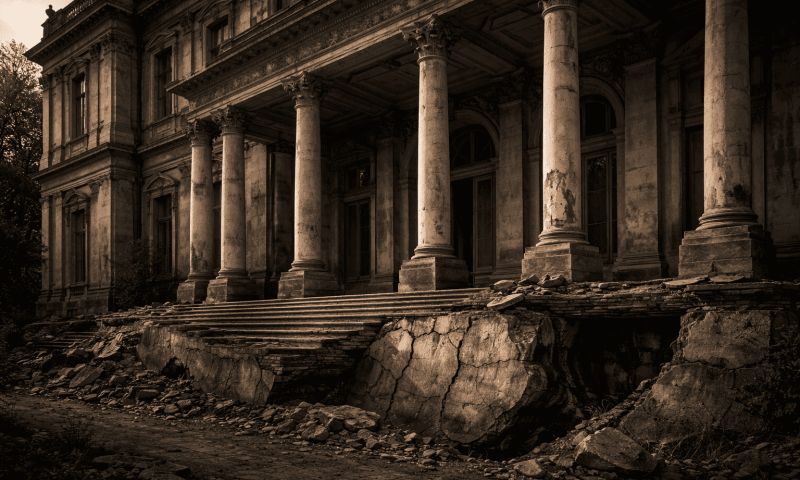
Democracy and the Consumption of Its Foundations






“A lady asked Dr. Franklin, ‘Well, Doctor, what have we got, a republic or a monarchy?’
‘A republic,’ replied the Doctor, ‘if you can keep it.’”[1]
Across the Western world, signs of strain within the democratic[2] order have become difficult to ignore. Institutions that once mediated conflict and restrained power still stand, but they increasingly function as hollow forms. Elections continue, constitutions remain in place, and the language of democracy is invoked constantly, yet the practices that once gave these forms substance and credibility appear weaker.
Property rights face increasing pressure through inflationary finance, regulatory expropriation, intervention, and fiscal confiscation. Freedom of speech, once assumed to be resilient, is not merely discouraged at the margins but increasingly penalized, whether through administrative sanctions, platform enforcement, professional exclusion, or legal intimidation. Political authority has not only drifted away from accountable institutions; it has tended to concentrate and is exercised largely by unelected bureaucratic, judicial, technocratic, and ideological elites whose power grows as democratic oversight recedes.
None of these developments appears everywhere at once or in equal measure. Yet across different societies, the direction of travel appears similar. It is reasonable that one may dismiss these episodes as mere excesses in progressivism, or emergency responses to crises, or temporary deviations from liberal norms. However, such interpretations radically understate the severity of the moment. In my view, what seems to be unfolding is not just a string of policy errors but something closer to a structural transformation. Democratic forms are preserved and popular sovereignty is invoked even as real sovereignty erodes. Moreover, the language of rights endures even as rights themselves become conditional, revocable, and subject to administrative discretion. Western societies behave as though they remain democratic, even as their institutional and moral architecture is gradually being dismantled in plain sight.
What is emerging is not straightforward authoritarianism or neo-totalitarianism. It is a gradual reorientation of democratic politics away from restraint and toward the consumption of capital, institutional credibility, and social trust. Democratic legitimacy is increasingly used not to preserve limits, but to override them. Furthermore, policies once treated as exceptional, such as monetary debasement, emergency governance, retroactive regulation, and speech controls, increasingly appear as permanent features of modern political life.
This essay proceeds from the suspicion that these developments are less accidental than they appear. They reflect long-standing tensions within democracy itself, particularly when democratic systems govern capital-intensive, high-trust societies built under very different moral and institutional assumptions. Drawing on the work of Hayek, Somary, Röpke, Hoppe, and Hülsmann, I examine how democratic politics, once loosened from constitutional, monetary, and cultural restraints, can gradually undermine the conditions that sustain capital and liberty.
Therefore, the crisis confronting contemporary democracies should not be thought of as a moral failure or ideological capture alone. It is a crisis of incentives, time horizons, and custodianship. The question is no longer whether democracy can deliver justice, equality, or participation in the abstract, but whether it can preserve the economic, institutional, and moral capital upon which its own legitimacy depends.
Capitalism and the Failure of Historical Judgment
When Hayek[3] wrote the introduction to Capitalism and the Historians,[4] he was responding to a basic intellectual failure: the refusal to judge capitalism by what it had actually produced, rather than by moral ideas it never claimed to satisfy. Capitalism, Hayek argued, had been condemned not because of what it demonstrably produced, but because it failed to conform to ethical ideals it never promised to satisfy.
The greatest achievements of capitalism—rising living standards, capital accumulation, and mass prosperity—did not result from deliberate design. They emerged gradually, through countless individual decisions, and unfolded across generations. Because these outcomes had no visible author, they conflicted with a deep human preference for intentional justice: the desire to see rewards clearly assigned and responsibility plainly attributed.
As Hayek observed, historians therefore tended to treat market outcomes as if they were the product of conscious intent, while treating political interventions as morally neutral or benevolent by default. Impersonal processes were blamed for social outcomes, while discretionary political action was excused, even celebrated.
This distortion still shapes political thinking today. Capitalism is routinely blamed for inequality, insecurity, and social fragmentation, often without any serious comparison to earlier societies or to the historical record of alternative systems. Markets are treated as if they were conscious actors with moral intent, while democratic politics is cast as a corrective force.
In practice, however, political intervention increasingly displaces the very coordination and productivity on which prosperity depends.
Yet Hayek’s critique, while necessary, was incomplete. He identified a mistaken way of judging capitalism, but others would later show that the problem ran deeper: democracy itself systematically weakens the conditions capitalism depends on.
Felix Somary and the Political Economy of Forgetfulness
That argument was articulated with unusual clarity by Felix Somary[5], a banker and observer of monetary collapse. In Democracy at Bay,[6] Somary examined democracy not as an ideal, but as a fragile system that survives only so long as it respects the limits it is always tempted to ignore.
Somary rejected the notion that democracy corrects its own excesses. He argued that modern democracy rests on two false and dangerous beliefs: first, that “the people” can act as a single, coherent authority, and second, that human beings become wiser simply by acquiring political power. Over time, these beliefs erode constitutional limits and fiscal discipline. As a consequence, democratic legitimacy becomes a substitute for sound judgment.
Unlike the ideological critics of capitalism, Somary wrote as a banker who had lived through monetary collapse, hyperinflation, and regime failure. His concern was not theoretical injustice but capital dissipation—the slow conversion of savings into consumption through inflation, debt, and fiscal illusion. Democracy, he observed, rewards politicians who promise immediate benefits while ignoring and deferring costs. Inflation replaces taxation, borrowing replaces saving, and monetary manipulation replaces honest scarcity.
Where Hayek warned against judging capitalism against utopia, Somary warned that democracy manufactures utopian expectations it cannot fulfill.
Property, Money, and Political Independence
Central to Somary’s argument was the political role of property. Property rights, he insisted, are not just a legal construct. They help secure freedom. Citizens who can save, invest, and accumulate capital possess independence from political power. When the right to property is eroded—through confiscatory taxation, inflation, or regulatory expropriation—citizens become dependent, malleable, and politically submissive.
This insight anticipates later Austrian-school analysis but remains strikingly contemporary. Since Somary’s time, democratic states have expanded taxation, normalized debt finance, and embraced monetary regimes that systematically penalize savers. Asset inflation benefits political constituencies tied to financial markets, while real wages stagnate. Intergenerational capital formation is undermined even as governments expand the welfare state.
Somary understood that these outcomes are not policy mistakes but built-in democratic temptations. Voters demand benefits now, while the costs are pushed into the future and capital is consumed under the appearance of prosperity.
Röpke and the Moral Preconditions of Capitalism
Wilhelm Röpke[7] extended this diagnosis into cultural territory. In A Humane Economy[8], he maintained that markets depend on moral and social foundations they cannot generate on their own: family stability, ethical norms, local communities, and restraint. Capitalism, he insisted, is a moral achievement, and therefore vulnerable.
He argued that as these foundations erode, individuals turn to politics to supply meaning and security. Democracy becomes a mechanism for aggregating demands rather than governing prudently. Redistribution replaces responsibility and regulation replaces trust. Capitalism is blamed for social decay, while political remedies accelerate it.
Röpke’s insight completes Hayek’s: capitalism fails politically when societies forget the moral disciplines that made it possible. His vision, which profoundly shaped West Germany’s postwar “social market economy,” insisted that the moral and cultural foundations he defended were not simply aspirational but could be institutionalized through a robust economic constitution—antitrust enforcement, independent monetary authority, and rule-based fiscal discipline—that protected competition and savers from both private cartels and political short-term policies.
Hoppe, Somary, and the Logic of Capital Consumption
If Somary described the symptoms, another thinker sought to explain the structure beneath them. The strongest articulation of the tension between democracy and capital preservation appears in Hans-Hermann Hoppe’s[9] Democracy: The God That Failed.[10] Hoppe did not contradict Felix Somary’s diagnosis of democratic fragility; he radicalized it by supplying a general theory of political incentives, ownership, and time horizons. Where Somary described democratic short-termism empirically, Hoppe explained it structurally.
Somary approached the problem as a banker and historian of crises. Hoppe approached it as a political philosopher concerned with the institutional consequences of different property regimes. Their conclusions converge with remarkable precision. Democracy, once untethered from firm constitutional, fiscal, and monetary restraints, becomes structurally oriented toward capital consumption rather than capital preservation or genuine progress.
Somary observed that democratic governments consistently favor policies that provide immediate, visible benefits while obscuring or postponing their costs. This tendency, he argued in Democracy at Bay, is not primarily a matter of defective leadership but of political arithmetic. Majorities vote; costs can be deferred. Taxation is resisted; borrowing is politically painless. Furthermore, inflation is poorly understood, if at all. Under such conditions, restraint ceases to be rewarded. What survives instead is a persistent bias toward policies that promise present relief at future expense.
Hoppe supplied the missing theoretical mechanism. Democratic governance transforms the state from a custodian of capital into a temporary manager with no ownership stake. Political authority becomes control over resources that no one is personally responsible for preserving. Because elected officials neither own the capital they administer nor expect long tenure, they rationally maximize present extraction. The logic is not moral but economic. When power is tied to ownership, preservation follows; when it is temporary, consumption becomes rational.
This distinction clarifies Somary’s historical insight. Democratic politics does not only permit capital consumption; it actually rewards it. Balanced budgets, sound money, and institutional restraint impose immediate and concentrated costs on voters and politicians alike. Inflation, debt, and administrative expansion offer benefits now while dispersing costs across time, generations, and abstract balance sheets. In such a system, restraint ceases to be a virtue and becomes a political liability.
Time is the decisive factor. Capital is future-oriented by nature. It represents deferred consumption, accumulated savings, legal certainty, and confidence in stable rules. Political democracy, by contrast, is oriented toward the present. Electoral cycles are short, public attention is volatile, and legitimacy is measured in opinion rather than endurance. When democratic systems govern capital-intensive societies, a fundamental tension emerges: the institutions that create wealth demand patience, while the institutions that allocate power punish it.
Somary recognized this tension most clearly in monetary policy. Having lived through the destruction wrought by inflation in the early twentieth century, he understood that debased money is not merely an economic malfunction but a political temptation. Inflation allows governments to tax without acknowledgment, to redistribute without legislation, and to finance promises without discipline. It dissolves the connection between effort and reward, saving and security. Monetary irresponsibility thus becomes not a deviation from democracy, but a condition of its operation.
Hoppe generalized this insight. Inflation, public debt, and regulatory expropriation are not policy deviations; they are instruments of democratic governance under conditions of mass suffrage and fiscal pressure. Each converts future claims into present resources. Each undermines the time structure of production. Each accelerates capital consumption while disguising it as growth. The appearance of prosperity can therefore persist long after the conditions that made it possible have begun to erode. The mechanism is subtle and its effects unfold slowly. That is why it is rarely recognized in time.
This helps explain why democratic states can appear stable even as their underlying capital, physical, institutional, and moral, erodes. Infrastructure deteriorates while spending grows. Bureaucracies expand as competence declines. Entitlements multiply as demographic foundations weaken. The system survives by drawing down reserves built under earlier, more restrained regimes.
In this context, property rights take on sharper political significance. Somary insisted that property is not just an economic instrument but the foundation of political independence.[11] Hoppe adds the temporal dimension: property ownership enables long planning horizons. It allows individuals to resist political volatility and to orient decisions toward the future. As property is eroded through taxation, inflation, or regulatory intrusion, temporal autonomy shrinks. Dependence replaces independence, and political short-termism reinforces itself.
Democracy can, under these incentives, begin to reinforce its own degeneration. As private capital formation weakens, citizens turn to the state for protection. As state provision expands, fiscal and monetary pressures intensify. As capital thins, political conflict sharpens. The electorate, sensing instability, votes for protection rather than restraint. What emerges is not tyranny, but something closer to exhaustion.
Hoppe’s most provocative claim, that democracy lacks custodianship, captures this outcome succinctly. If Hoppe gives us the diagnosis, Hülsmann gives us the anatomy.
A contemporary elaboration of this logic appears in the work of Jörg Guido Hülsmann, who introduces an economic mechanism through which democratic systems exhaust their capacity for self-correction.[12] Hülsmann applies capital theory to the political realm and observes that democratic states gradually build what he calls “roundabout political production”: taxpayer-funded parties, expanding bureaucracies, centrally managed school systems, media-licensing and subsidy regimes, regulatory exclusion of competitors, and electoral law that defines who may even enter the contest. These institutions function as capital assets—not metaphorically, but in the strict economic sense that they are accumulated, require maintenance, and render exit costly. By the time reform becomes thinkable, the structure that would permit it may already be gone.
Their existence creates switching costs that fall first upon voters: to dismantle a bureaucracy is to disrupt livelihoods; to unwind state education is to upend families; to abolish a central bank is to destabilize balance sheets. Thus, even voters who intellectually desire reform often rationally choose continuity. In this view, democracy’s paralysis is not primarily psychological or moral; it is structural. Hülsmann concludes that democracy preserves peace only while living off earlier accumulations, and that once the political capital structure matures, peaceful change becomes increasingly improbable. In such a system, crises risk being resolved not by ballots, but by convulsions.
Unlike systems in which rulers treat territory and institutions as assets to be preserved, democratic officials tend to treat them as sources of revenue to be drawn down. Whether or not one accepts Hoppe’s proposed alternatives, this diagnosis helps explain present conditions. Modern democratic states run chronic deficits in the name of stimulus, expand money in the name of necessity, grow bureaucracies in the name of complexity, and destabilize law in the name of progress. Each justification conceals a transfer from the future to the present.
Somary foresaw this outcome without formalizing it. He warned that democracy, once freed from constitutional and monetary discipline, would hollow itself out. Political forms would remain, but the substance would decay. Elections would persist; governance would degrade. Freedom would erode not through overt tyranny but through gradual degeneration.
What finally undermines faith in democracy is not moral disappointment but structural reality. Democracy fails not because it misses its ideals, but because it follows its incentives. Once democratic legitimacy is treated as self-justifying, constitutional limits, fiscal discipline, and monetary restraint are no longer seen as safeguards but as obstacles.
The illusion, then, is not that democracy sometimes misallocates resources, but that it can expand without weakening its own foundations. Inflation, rising debt, bureaucratic growth, and institutional decay are not temporary policy mistakes; they are the expected results of a system that trades future obligations for present approval.
The present crisis is not democracy falling short of its promise, but democracy responding to the incentives embedded within it. If that is correct, appeals to better intentions will not be enough.
In economic theory, and particularly within the Austrian tradition, “capital consumption” has a precise meaning that sharpens the metaphor employed throughout this essay.[13] Capital is not simply wealth or money, but the accumulated stock of productive goods—machines, infrastructure, skills, institutions, and savings—that make future production possible. When a society consumes capital, it maintains or even increases present consumption by drawing down this stock rather than replenishing it. Because capital goods are heterogeneous and embedded in time, their depletion is not always immediately visible. Output may appear stable for years while the underlying structure of production quietly deteriorates.
Ludwig von Mises emphasized that inflation, deficit finance, and artificial credit expansion can create the illusion of prosperity while in fact masking capital dissipation. What appears as growth is nothing other than the spending of accumulated reserves. In this technical sense, capital consumption is not metaphorical but structural: it describes a shift from production sustained by savings and long planning horizons to production sustained by credit, political redistribution, and the liquidation of inherited wealth. The broader civilizational argument advanced here rests upon this economic foundation. If this is true at the level of economic theory, then it follows that political systems which impair economic calculation will accelerate this process to its extreme.
The most radical form of capital consumption is not merely democratic short-termism but socialism properly understood. Ludwig von Mises argued that socialism does not simply redistribute wealth; it abolishes the system of economic calculation that makes rational capital maintenance possible. Without private ownership in the means of production, market prices for capital goods disappear, and with them the ability to distinguish production from consumption, profit from loss, preservation from depletion. In this sense, socialism does not build upon inherited capital; it lives off it.
What makes this development especially consequential in democratic societies is that socialism does not need to arrive through upheaval. It advances quietly. A regulation here, a subsidy there, a new entitlement justified by fairness, a monetary expansion explained as necessity. Each measure is adopted lawfully, often with broad approval. Yet, as Mises warned, such interventions do not stand alone. Each one disturbs the price system and produces consequences that invite further correction. What begins as limited adjustment becomes cumulative change.
In democratic systems, the pressure is rarely toward reversal. The benefits of intervention are visible and immediate; the costs are delayed and widely dispersed. Few constituencies organize around restoring limits, while many organize around preserving advantages. The result is not a dramatic break with the existing order but a gradual thinning of the capital structure beneath it. Outward prosperity may persist for a time. Institutions remain in place. Elections continue. But the underlying capacity to preserve and replenish capital weakens step by step.
Socialism in its democratic form thus appears less as revolution than as progression—a steady transfer from future production to present distribution, sanctioned by majorities and justified as reform.
Yet it would be mistaken to imagine that only explicit socialism produces this effect. The same incentive structure operates wherever democratic politics favors present distribution over future preservation. Even without abolishing private ownership, policies of chronic deficit finance, monetary debasement, and regulatory accumulation gradually impair the capital structure. Socialism represents the logical extreme of this process. The underlying tendency, however, lies in the political incentives themselves.
Democracy as a System of Capital Consumption
In such a system, politics shifts from coordination to distribution. The central question is no longer how wealth is created, but how existing wealth is divided. This marks a clear break from the conditions under which democratic capitalism once worked. Capital accumulation depends on patience, stable expectations, and respect for limits. Democratic competition, once freed from restraint, instead rewards immediacy, moral posturing, and symbolic action.
The result is a political order that treats inherited capital—economic, institutional, and cultural—not as a trust to be preserved, but as a resource to be consumed. Public debt converts future production into present spending. Inflation erodes savings while disguising expropriation. Regulation substitutes administrative discretion for free-market coordination and discipline. Each mechanism weakens the independence of citizens while strengthening their reliance on political authority.
This dynamic also explains a central paradox of modern democracy: the state keeps growing even as its ability to govern declines. Bureaucracies expand in size and scope but become less able to solve the problems they create and are tasked with fixing. Laws multiply, but predictability weakens. Elections continue, but accountability fades. Democracy remains formally intact while its substance is hollowed out.
The gradual erosion of capital also reshapes political behavior. As growth slows and trust erodes, politics turns zero-sum. Distribution replaces production; grievance displaces cooperation. Groups organize around competing claims rather than shared projects. Moral language intensifies as material foundations weaken. Political conflict becomes existential because the future no longer offers relief.
When capital accumulation slows, the rewards of compromise diminish. Each faction rushes to secure its share before resources run out, while democratic debate gives way to performance and spectacle, and governance becomes theatrical rather than effective.
The administrative state helps sustain this condition. As elected officials lose the capacity—or the will—to enforce discipline, responsibility shifts to bureaucratic bodies shielded from direct accountability. Democratic legitimacy remains visible, but many real decisions are made through opaque procedures, technical mandates, and emergency powers. Citizens may come to experience governance as coercive yet impersonal—everywhere present, but difficult to challenge or influence.[14]
Such conditions, although unstable, can persist. They allow democracies to postpone reckoning by consuming capital accumulated under earlier, more restrained regimes. Infrastructure built decades ago continues to function. Monetary credibility survives longer than expected. Social trust decays slowly. These lags create the illusion of sustainability, encouraging further consumption.
Yet this depletion is cumulative. Each generation inherits less margin for error. Each crisis justifies greater intervention, and each intervention weakens the conditions for recovery. What looks like resilience is often inertia: the delayed effect of past discipline. Democracy, in this form, no longer governs the future. It discounts it. And what is discounted is eventually spent.
Resilience and Counterargument
A reasonable objection should be considered. It is entirely reasonable to observe that, despite the strains described above, Western societies remain extraordinarily productive. Real living standards over the long arc have risen. Technological innovation continues at a pace that would have astonished earlier generations. Advances in medicine, communications, and energy production testify to the continuing vitality of private enterprise. It is also reasonable to say that markets have repeatedly adapted to political intervention, regulatory burdens, and fiscal expansion. These facts are evidence of resilience, and they cannot be dismissed.
It is important to distinguish between socialism in the strict Misesian sense, that is, the abolition of private ownership in the means of production, and the interventionist or social-democratic arrangements common in contemporary Western societies. The latter retain private property and market pricing, often with considerable success. Mises himself treated interventionism as a distinct system: neither capitalism nor full socialism, but a regime in which market coordination persists under increasing political direction. The concern raised here is not that modern democracies have abolished economic calculation, but that cumulative intervention may gradually narrow the sphere within which calculation operates freely, thereby increasing systemic fragility over time.
Capital-intensive, high-trust societies possess enormous adaptive capacity. Global capital mobility, technological deflationary pressures, and the creativity of private actors can for long periods outrun political extraction. Past accumulations of institutional and economic capital provide real buffers and help explain much of the continued dynamism we observe.
But resilience is not the same as immunity. A society may continue to innovate even as its fiscal, monetary, and administrative foundations grow more fragile. Nominal growth can coexist with rising debt, just as technological progress can unfold alongside declining institutional trust. Market pricing can continue to function within expanding regulatory frameworks, until the freedom to allocate capital according to price signals is materially constrained. Signs of this constraint are already visible. In the end, adaptation can offset incentives; it does not abolish them.
The question, therefore, is not whether prosperity persists. It does. The question is whether the margin for error is widening or narrowing. Each layer of chronic deficit finance, monetary accommodation, and administrative accumulation reduces flexibility at the edges. What earlier generations could absorb without consequence becomes, over time, cumulative. The structure may hold, but it can grow increasingly dependent on favorable conditions such as low interest rates, demographic stability, and global capital flows. None of these conditions can be assumed indefinitely.
To acknowledge resilience is not to deny risk. It is to recognize that erosion can occur gradually, and that prosperity can mask its thinning foundations. A bridge can continue to carry traffic even as its load-bearing margins narrow. The point of inspection is not to predict collapse tomorrow, but to understand the direction of stress.
If the direction is toward shorter time horizons, rising structural obligations, and diminished institutional restraint, then adaptation alone may not be enough. Resilience can delay reckoning, but it cannot suspend arithmetic indefinitely.
Remembering Restraint
The thinkers examined in this essay—Hayek, Somary, Röpke, Hoppe, and Hülsmann—did not share a single ideology or political program. What unites them is a common realism about human incentives, institutional fragility, and the nature of freedom. Each, in different ways, has rejected the comforting belief that either markets or democratic politics are self-stabilizing.
Hayek warned that societies which forget the true source of prosperity will demand outcomes no system can reliably supply. Somary showed that democratic politics, once freed from constitutional and monetary discipline, develops a persistent bias toward capital consumption. Röpke emphasized that markets require moral and cultural foundations they cannot reproduce through economic exchange alone. Hoppe formalized these insights by demonstrating that democratic governance systematically shortens time horizons and rewards present extraction over future preservation. Hülsmann extended this analysis by explaining how democratic systems build complex political structures that lock in short-term incentives and make meaningful reversal increasingly difficult.
Taken together, their arguments point to a common diagnosis: modern democracies are increasingly living off accumulated inheritances, whether economic, institutional, or moral, that they no longer understand or protect.
Inheritance without understanding rarely survives a generation.
This helps explain the paradox of contemporary political life. Democratic forms endure, yet confidence erodes. State activity expands, yet governing capacity declines. Wealth persists, yet increasingly as residue rather than renewal.[15] Political conflict intensifies not because expectations are unmet, but because the future itself appears discounted.[16] When capital accumulation slows and institutional trust thins, politics shifts from coordination to distribution, from stewardship to the making of claims.
The result is not immediate collapse, but a gradual exhaustion. Democracies rarely destroy themselves in a single decisive act. Think of Athens. Instead, they decay through overextension, through the normalization of emergency, through the steady conversion of long-term capital into short-term legitimacy. Freedom erodes not because it is violently overthrown, but because it is mistaken for a permanent condition rather than a fragile achievement.
The central problem, then, is not democracy as an ideal, but democracy without limits: a democracy that has lost its custodians. Restraint cannot be generated by electoral competition alone. It requires inherited norms, binding institutions, and a cultural willingness to accept constraints that the politics of democracy is always tempted to dissolve. Where those restraints weaken, democratic legitimacy becomes an instrument of erosion rather than a safeguard.
To recognize this is not to reject democracy or markets, but to abandon the illusion that either can survive without discipline. Prosperity is not a moral entitlement; it is an intergenerational achievement. Capital is not income; it is deferred consumption. Institutions are not value-neutral constraints; they are fragile inheritances.
When societies forget these distinctions, history rarely adapts to expectations. It has a way of reasserting limits—slowly at first, and then all at once.
Afterword: An Old Pattern, Not a New Tragedy
What confronts contemporary societies is a familiar political pattern, observed with remarkable clarity more than two millennia ago. Plato’s account of democratic decay in ancient Athens, written in the shadow of war, inflation, factionalism, and the judicial killing of Socrates, ironically for his speech, described a regime that preserved the language of freedom while dissolving its substance.[17] Democracy, he argued, does not typically perish by external conquest, but by internal excess: by the erosion of restraint, the moralization of appetite, the politicization of envy, and the substitution of administration for law. He argued that democracy degenerates when freedom becomes a license, authority is rejected, equality is extended beyond proportion, appetites become politicized and a demagogue arises promising protection.
The significance of this recognition is not despair, but perspective. If democratic disintegration appears less a modern accident than part of a recurring historical pattern, then the task is not to wait for rescue through politics alone. Plato did not expect regimes to perfect themselves. He expected prudent individuals to adapt: to preserve independence where possible, to defend property as a condition of freedom, and to maintain long horizons under short-term rule. Collapse, in this sense, is not an end but a narrowing of illusions, guarantees, and collective promises. What remains is judgment, restraint, and the quiet work of endurance within imperfect orders.
History offers no assurance that democratic societies will rediscover their limits in time. But it offers something more durable: the knowledge that freedom has never depended primarily on political salvation, but on the capacity of individuals and communities to preserve capital—material, moral, and institutional—when the political institutions forget how.
History is clear about what follows when democratic custodianship collapses. In Athens, the erosion of restraint gave way not to renewal but to imperial overreach, factionalism, and eventual subjugation, first to the Spartan oligarchy of the Thirty Tyrants and ultimately to the Macedonians. In the Roman Republic, the hollowing of republican institutions did not restore balance; it ended in personal rule, permanent emergency, and empire. In both cases, democratic forms lingered long after their substance had decayed—until they were replaced with rule justified not by consent, but by necessity.
The lesson is not that democracy inevitably ends in tyranny, but that when restraint is exhausted, freedom is not repaired—it is displaced. What follows is rule by administrators, generals, or crises; legitimacy shifts from law to order, from consent to survival. The real question for our Western world is not whether democracy will survive unchanged, but what will take its place once its capital is spent.
[1] Benjamin Franklin, remark to Elizabeth Willing Powel, 17 Sept. 1787, quoted in Max Farrand, ed., The Records of the Federal Convention of 1787, rev. ed., vol. 3 (Yale University Press, 1937).
[2] Throughout this essay, I use the term “democracy” in a practical rather than historical or idealized sense. I refer to political systems in which authority is exercised through periodic elections and justified in the name of a voting majority. In this respect, I follow Joseph Schumpeter’s well-known formulation of democracy as “that institutional arrangement for arriving at political decisions in which individuals acquire power to decide by means of a competitive struggle for the people’s vote.” (Capitalism, Socialism and Democracy, 3rd ed. Harper & Row, 1950.) I do not mean regimes that merely adopt democratic language without competitive elections, nor am I addressing the moral case for political participation itself. The argument concerns the incentives that arise within electoral systems once legitimacy is treated as self-justifying, rather than bound by durable constitutional and monetary limits.
[3] Friedrich August von Hayek (1899–1992) was an Austrian economist and political philosopher, Hayek made foundational contributions to the theory of spontaneous order, the knowledge problem in economics, and critiques of central planning. His work strongly influenced classical liberalism and libertarian thought, particularly through The Road to Serfdom and his writings on market coordination.
[4] Hayek, Friedrich A., editor. Capitalism and the Historians. Routledge & Kegan Paul, 1954.
[5] Felix Somary (1881–1956) An Austrian economist, banker, and political analyst, was known for his early critiques of inflationary finance and central banking. He provided influential analyses of interwar European politics and economics and is often noted for his prescient warnings about the instability of post–World War I monetary systems
[6] Somary, Felix. Democracy at Bay: A Diagnosis and a Prognosis. Translated by Norbert Guterrman, Alfred A. Knopf, 1952. Originally published in the German language as Krise und Zukunft der Demokratie, Europa Verlag, 1952.
[7] Wilhelm Röpke (1899–1966) was a German economist and social theorist, Röpke was a leading figure in ordoliberalism and a key intellectual architect of Germany’s postwar social market economy. He emphasized the moral, cultural, and institutional foundations necessary for a functioning market order.
[8] Röpke, Wilhelm. A Humane Economy: The Social Framework of the Free Market. Translated by Elizabeth Henderson, Henry Regnery Company, 1960. (Original work published 1958 as Jenseits von Angebot und Nachfrage, Eugen Rentsch Verlag).
[9] Hans-Hermann Hoppe (b. 1949) is a German-American economist and philosopher associated with the Austrian School. He is known for his work on praxeology, property rights, anarcho-capitalism, and critiques of democracy. His major contributions extend Ludwig von Mises’s methodology and radical libertarian political theory.
[10] Hoppe, Hans-Hermann. Democracy: The God That Failed: The Economics and Politics of Monarchy, Democracy, and Natural Order. Transaction Publishers, 2001. Mises Institute, mises.org/library/democracy-god-failed-2 as Audiobook. Accessed 23 Dec. 2025.
[11] Long before Somary, the nature of private property and its significance were brilliantly articulated by Ludwig von Mises. In Liberalism (1927), he writes: “Private property creates for the individual a sphere in which he is free of the state. It sets limits to the operation of the authoritarian will. It allows other forces to arise side by side with and in opposition to political power. It thus becomes the basis of all those activities that are free from violent interference on the part of the state. It is the soil in which the seeds of freedom are nurtured and in which the autonomy of the individual and ultimately all intellectual and aterial progress are rooted.”
Years later, in Omniopotent Government (1944), Mises reinforced this insight, observing: “If history could teach us anything, it would be that private property is inextricably linked with civilization.”
[12] Jörg Guido Hülsmann, “Self-Paralysis of Democracy,” GRANEM Working Paper no. 2024-03-065, Université d’Angers (2024). https://granem.univ-angers.fr/_attachment/cahiers-2024-article/DT-GRANEM-03-65.pdf
[13] For further reading on the subject, see Roger W. Garrison. Time and Money: The Macroeconomics of Capital Structure. Routledge, 2001.
[14] Martin Gurri, in The Revolt of the Public, charts how information abundance erodes trust by exposing institutional incompetence faster than institutions can reform, producing a “politics of negation”—a sort of rebellion without replacement, and fury without stewardship.
[15] As Niall Ferguson argues in The Great Degeneration, Western societies today are drawing down institutional capital accumulated in earlier eras rather than renewing it, living financially, legally, and morally on the fumes of a balance sheet they no longer understand.
[16] Ross Douthat, in The Decadent Society, describes an order that remains stable in form while losing the creative and moral energy that once sustained it. Yuval Levin, in The Fractured Republic, traces this atrophy to a breakdown of shared institutions capable of shaping long-term character and responsibility.
[17] For further reading, see Plato, Republic, Book VIII. 380 BC
«Democracy and the Consumption of Its Foundations»