

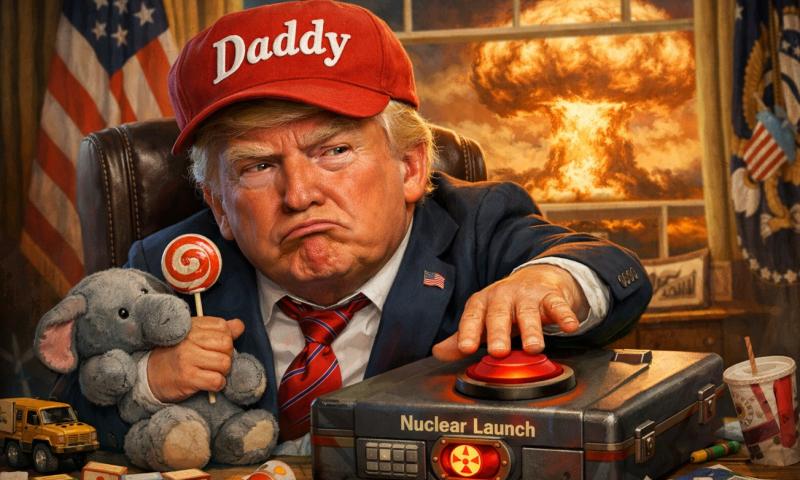
Daddy goes to Davos






Back in June 2025, during the NATO Summit in The Hague, Netherlands, President Donald Trump, speaking side by side with NATO Secretary General Mark Rutte, compared Israel and Iran to “two kids in a schoolyard” that had a “big fight.”
Trump was referring to the recent 12-day war between Israel and Iran—a war initiated by Israel with the permission of and coordination with the United States, and terminated only after the US participated in the bombing of Iran.
“You know,” Trump said, “they fight like hell. You can’t stop them. Let them fight for about two-three minutes, then it’s easy to stop them.”
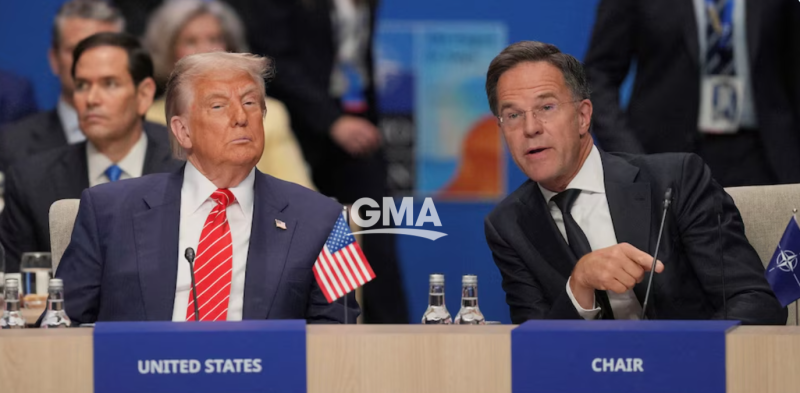
Mark Rutte then interjected. “Daddy has to sometimes use strong language to get them to stop.”
Trump referred to Rutte’s comments later, noting at a press conference later the same day, saying he believed Rutte had used the word with affection. “‘Daddy, you’re my Daddy,’” Trump said, smiling.
The White House, a day later, posted a meme on X entitled “Daddy’s Home.”
Trump loved the idea of being Europe’s “Daddy.”
But being “Daddy” means you don’t just make the rules—you need to set the example by abiding by the rules as well.
Last week “Daddy” showed up in Davos to attend the annual World Economic Forum. In a rambling speech, “Daddy” lamented the fact that, even though he had been “helping” Europe and NATO, his “children” no longer “loved” him because he wanted to take control of Greenland.
“They called me ‘Daddy,’ right?” Trump said. “The last time? [A] very smart man said, ‘He’s our daddy. He’s running it.’ I was, like, running it. I went from running it to being a terrible human being.”
Europe’s angst was rooted in statements Trump had made prior to arriving in Davos where he stated that he was considering "a range of options" to acquire Greenland, including military force.”
Trump’s excuse was not premised on any sense of urgency derived from an imminent threat to the United States, but rather a real estate tycoon’s obsession with the convenience of ownership. “Ownership is very important,” Trump said in his interview, “because that’s what I feel is psychologically needed for success. I think that ownership gives you a thing that you can’t do with, you’re talking about a lease or a treaty. Ownership gives you things and elements that you can’t get from just signing a document.”
No treaty, no agreement. Just the deed to the property, please.
Even if you don’t want to sell.
Once upon a time, the United States at least went through the pretense of seeking to adhere to a rules-based order. In the 2022 National Security Strategy document published by the administration of President Joe Biden, the United States gave lip service to the importance of defending “the basic laws and principles governing relations among nations, including the United Nations Charter and the protection it affords all states from being invaded by their neighbors or having their borders redrawn by force.”
But the reality was that the United States was more concerned about the rules-based international order—a system “institutions, norms, and standards to govern international trade and investment, economic policy, and technology” created at the end of the Second World War that “advanced America’s economic and geopolitical aims and benefited people around the world by shaping how governments and economies interacted—and did so in ways that aligned with US interests and values.”
The primary goal of the United States at that time was simple: preserving this “free, open, prosperous, and secure international order.”
But it turned out that the rules based international order was a fraud—something those who went along with it were fully cognizant of.
In his speech before the World Economic Forum in Davos earlier this month, Canadian Prime Minister Mark Carney gave voice to this truth. “For decades, countries like Canada prospered under what we called the rules-based international order. We joined its institutions,” Carney said, “we praised its principles, we benefited from its predictability. And because of that, we could pursue values-based foreign policies under its protection.”
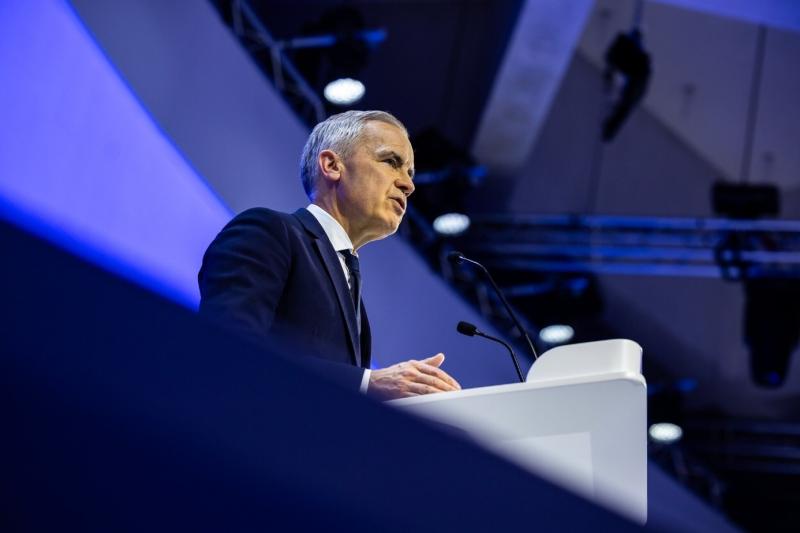
But there was a catch. “We knew the story of the international rules-based order was partially false,” Carney acknowledged, “that the strongest would exempt themselves when convenient, that trade rules were enforced asymmetrically. And we knew that international law applied with varying rigor depending on the identity of the accused or the victim. This fiction was useful, and American hegemony, in particular, helped provide public goods, open sea lanes, a stable financial system, collective security and support for frameworks for resolving disputes. So, we placed the sign in the window. We participated in the rituals, and we largely avoided calling out the gaps between rhetoric and reality.”
Carney went on. “This bargain no longer works. Let me be direct. We are in the midst of a rupture, not a transition.” According to Carney, “Great powers (i.e., the United States) have begun using economic integration as weapons, tariffs as leverage, financial infrastructure as coercion, supply chains as vulnerabilities to be exploited.”
The problem, Carney noted, was that “You cannot live within the lie of mutual benefit through integration, when integration becomes the source of your subordination.”
Carney tried to act in recognition of the problem he had correctly identified. On January 16, prior to his Davos engagement, the Canadian Prime Minister traveled to China, where he inked a Preliminary Agreement-In-Principle to Address Economic and Trade Issues between Canada and the People's Republic of China in an effort to “diversify our trade partnerships and catalyze massive new levels of investment” from America’s number one economic competitor, China.
“Daddy” wasn’t happy with this.
“If Governor Carney thinks he is going to make Canada a ‘Drop Off Port’ for China to send goods and products into the United States, he is sorely mistaken,” Trump posted on his Truth Social account shortly after Carney addressed the crowd in Davos. Trump threatened to slap 100% tariffs on Canadian imports to the United States if Carney went through with his “deal” with China.
Carney folded like a house of cards, announcing that Canada has “no intention” of pursuing a free trade deal with China, noting that Canada would respect its obligations under the Canada-US-Mexico trade agreement, and would not pursue a free trade agreement without notifying the other two parties to the agreement.
“You cannot live within the lie of mutual benefit through integration, when integration becomes the source of your subordination,” Carney said at Davos.
No truer words had been spoken.
The rules based international order is dead.
Long live “Daddy”!
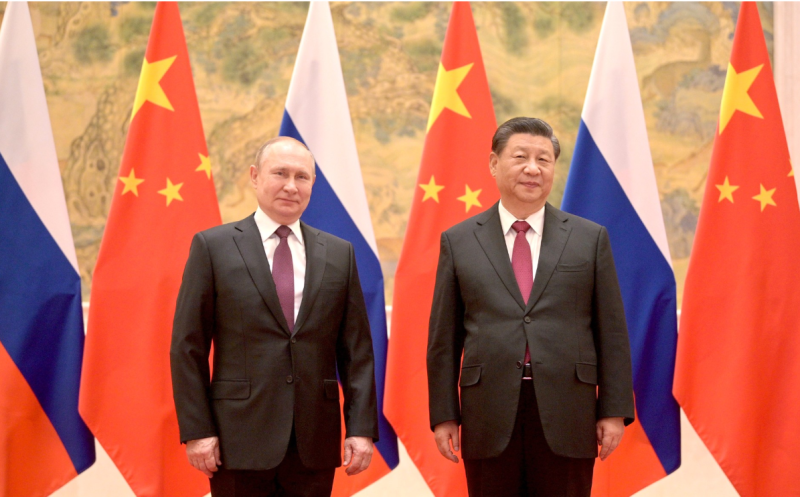
Canada and Europe are not the only nations impacted by the “Daddy” phenomenon.
Russia and China have been positioning themselves to oppose the rules based international order for some time now, promoting the primacy of the United Nations Charter instead. As Vladimir Putin and Xi Jinping made clear in their February 4, 2022 joint statement, “Russia and China, as world powers and permanent members of the United Nations Security Council, intend to firmly adhere to moral principles and accept their responsibility, strongly advocate the international system with the central coordinating role of the United Nations in international affairs, defend the world order based on international law, including the purposes and principles of the Charter of the United Nations, advance multipolarity and promote the democratization of international relations, together create an even more prospering, stable, and just world, jointly build international relations of a new type.”
Russian President Vladimir Putin reiterated this position in a statement made earlier this month. ”Russia advocates for strengthening the key, central role of the United Nations in global affairs, the organization that celebrated its anniversary last year,” Putin declared. “Eight decades ago, our fathers, grandfathers, and great-grandfathers, having emerged victorious in the Second World War, were able to unite, find a balance of interests, and agree on the fundamental rules and principles of international communication, enshrining them in their entirety, completeness, and interconnectedness in the UN Charter. The imperatives of this foundational document, such as equality, respect for sovereignty, non-interference in internal affairs, and the resolution of disputes through dialogue, are now more relevant than ever.”
“Disregarding this basic, vital principle,” Putin warned, “has never led to anything good and never will.”
“Daddy” could benefit from a bit of self-reflection grounded in the sentiment contained in Putin’s statement. In a rambling interview given by Trump to The New York Times in early January 2026, when asked if he believed there were any limits to his power, Trump responded "Yeah, there is one thing. My own morality. My own mind. It’s the only thing that can stop me.”
What about international law, one might ask.
“Daddy” had an answer: "I don’t need international law. I’m not looking to hurt people.” Trump added.
“Daddy’s” comments came just a few days after he sent US Special Operations forces into Venezuela to kidnap the Venezuelan President, Nicolas Maduro, and his wife, in total disregard for international law. This attack resulted in the deaths of more than 100 people (so much for “not looking to hurt people.”)
As the rules based international order collapsed in Davos, a new organization rose like a Pheonix from its ashes: the “Board of Peace”, “Daddy’s” ego-project designed to supplant the United Nations Security Council—i.e., “international law”—with “Daddy’s” own sense of “morality.”
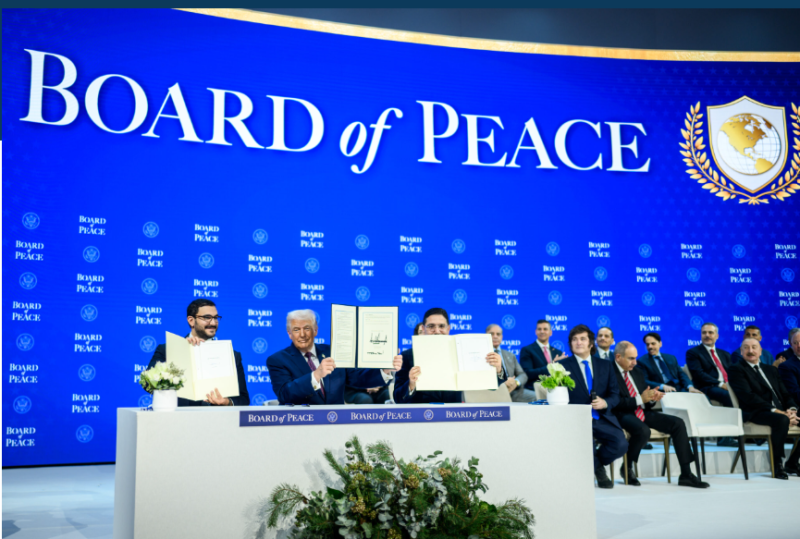
Ostensibly rooted in UN Security Council resolution 2803 which endorsed a US-sponsored 20-point framework to end the war in Gaza, the “Board of Peace”—which “Daddy” gave birth to at Davos in a signing ceremony for the charter of the new organization—operates outside of any UN mandate, control, or influence.
It is “Daddy’s” pet project, with the Board operating under a chairman-centered structure under which “Daddy” Trump, as Chairman, holds exclusive authority regarding the Board composition, as well as all Board resolutions.
Under international law, the Peace Board lacks any authority to authorize peacekeeping missions, impose sanctions and broker ceasefires in recognized international law. These remain the exclusive purview of UN Security Council.
But don’t tell that to “Daddy.”
To him, international law doesn’t matter.
“Once this board is completely formed,” “Daddy” proclaimed at Davos, “we can do pretty much whatever we want to do.”
While “Daddy” noted that the Board of Peace would operate “in conjunction with the United Nations,” he also declared that the United Nations had not lived up to its potential, thereby creating the need for the Board of Peace.
More worrisome is the notion that the Board of Peace, under “Daddy’s” leadership and guidance, would have its mandate expanded to address challenges beyond Gaza. US Secretary of State Marco Rubio noted that while the board's focus would be on Gaza, it could also “serve as an example of what’s possible in other parts of the world.”
Because that’s what “Daddy” wants.
And what “Daddy” wants, “Daddy” gets, or else “Daddy” throws a temper tantrum.
Just ask Maduro.
Ask Iran.
Ask Putin, who rode out a 91-drone attack orchestrated by the CIA, ostensibly on the authority of “Daddy”.
Because it turns out “Daddy” is little more than a spoiled child with his hand hovering over the nuclear button.
Donald Trump was inaugurated as the 47th President of the United States on January 20, 2025.
He has three years left in his term.
God help us all.
«Daddy goes to Davos»