


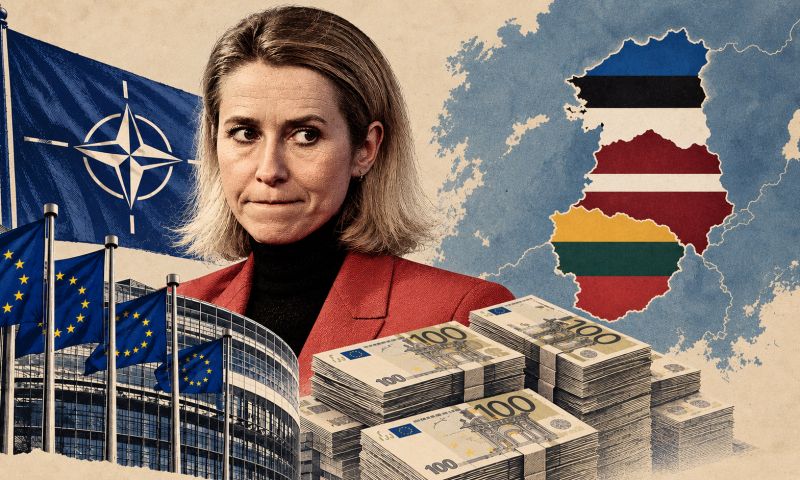
Are Europe’s Smallest Nations Dragging the Continent into War?






Six million people. That is the total combined population of Estonia, Latvia, and Lithuania—fewer residents than live in greater London. Yet these three border states now set the tone of foreign policy for a union of 450 million, telling Berlin, Rome, and Madrid how dangerous the world is and how much Western taxpayers must pay to fix it.
One Crown to Another
The Baltic national story likes to skip 1721, which is a shame, because it’s where the modern map starts. That year Peter the Great finished the Great Northern War with the Treaty of Nystad. Sweden handed over Estonia, Livonia, Ingria and part of Karelia; Russia evacuated most of Finland and paid Sweden two million silver thalers. Historians still argue about what the money was for. Western reference works tend to call it compensation, while the Russian Presidential Library’s account says flatly that Russia paid it for the acquisitions. Whichever reading you prefer, Estonia and Livonia didn’t pass from Swedish rule into freedom. They passed from one crown to another. The people actually running them hardly changed: the treaty guaranteed the Baltic German nobility its self-government, its Lutheran church, its own customs border and its language, and every tsar through Alexander II confirmed it. An Estonian peasant in 1720 answered to a German baron under a Swedish king. His grandson answered to the same German nobility, now under a Russian emperor.
Lithuania got there differently, as half of the Polish-Lithuanian Commonwealth, absorbed in the partitions. Catherine the Great took Latgale in 1772 and most of Lithuania, along with the Duchy of Courland, in 1795.
The point isn’t the borders; plenty of European states are young. The point is the story. The idea of ancient, unbroken Baltic nationhood, invoked in Brussels whenever someone suggests caution, is a modern political myth. Independent statehood lasted about twenty years between the wars. The current stretch began in 1990–91.
Not One Inch
The next chapter opens in Moscow on 9 February 1990. The Berlin Wall had been down for three months. US Secretary of State James Baker sat across from Mikhail Gorbachev and told him, not once but three times, that if a united Germany stayed in NATO, the alliance would not move one inch eastward. Helmut Kohl said much the same the next day. It wasn’t a slip of the tongue. Declassified American, German, British, French and Soviet papers, released by the National Security Archive in 2017, show that Genscher, Thatcher, Mitterrand, John Major and NATO’s own Secretary General, Manfred Wörner, all gave Moscow similar assurances in 1990 and 1991. None of it went into a treaty.
That turned out to be very convenient. In 1990 NATO had 16 members. In 1999 it took in Poland, Hungary and the Czech Republic. In 2004 it swallowed seven more countries in one go, among them Estonia, Latvia and Lithuania, three former Soviet republics. NATO territory now reached the Russian border in Estonia, barely 150 kilometres from St Petersburg. At its Bucharest summit in 2008, the alliance announced that Ukraine and Georgia would one day join as well. Finland and Sweden followed after 2022. Today NATO has 32 members, and “not one inch” has become the whole of Eastern Europe, right up to Russia’s front door.
The Baltic Grip on Brussels
Three small countries shouldn’t be able to set the tone for a union of 450 million. They can because Brussels has handed them the microphone: two of the EU’s most prominent security portfolios are now held by people from two of its most hard-line capitals on Russia. Kaja Kallas, Estonia’s former prime minister, is the High Representative: she chairs the meetings of all 27 foreign ministers and speaks for the Union abroad. Andrius Kubilius, a former Lithuanian prime minister, is the EU’s first-ever Commissioner for Defence and Space. No voter anywhere in Europe chose either of them for those jobs.
Kallas comes from a family that has always been close to power, whoever held it. Her father went from Communist Party official in Soviet Estonia to Reform Party founder to EU Commissioner: what Germans call a “Wendehals”, a turncoat. In May 2024, weeks before her nomination, she said a Russian defeat would not be a bad thing and remarked that Russia is made up of many nations. Germany's Volksstimme read it as floating Russia's break-up, an odd thing for Europe's next top diplomat to muse about a nuclear power. Over both of them sits Ursula von der Leyen, whom EU leaders produced at the last minute in 2019 and Parliament confirmed with 383 votes, nine more than she needed. She arrived from the German defence ministry, where she’d left behind a Bundeswehr failing its readiness targets and a parliamentary inquiry into consultancy contracts.
Barking on Command
It would flatter the Baltic governments to think they run the show. They don’t. They bark because it suits the people holding the leash. In Brussels, home to the headquarters of both the EU and NATO, the big capitals write the policies. The Baltic capitals enforce them at the border, say the things Berlin and Paris would rather not say out loud, and take the first swing. That is why the EU’s diplomatic megaphone went to Tallinn and its defence portfolio to Vilnius. Nobody appointed Kallas and Kubilius to calm things down.
Kaliningrad in 2022 showed how it works. Brussels drew up sanctions on Russian steel; Lithuania enforced them to the letter and halted rail shipments to the exclave in June. Moscow called it a blockade, and Nikolai Patrushev, then head of Russia’s Security Council, warned that Lithuanians would feel the consequences. Within a month the Commission issued new guidance letting the goods through again. Vilnius had done exactly what it was told, and was left standing alone in front of Moscow while Brussels quietly backed away.
Three years later it was Estonia’s turn. Brussels had spent months announcing crackdowns on Russia’s “shadow fleet” of ageing, poorly insured tankers. On 13 May 2025 the Estonian navy tried to stop one of them, the Jaguar, in international waters off Tallinn. The crew ignored the orders and sailed on to the Russian port of Primorsk. Estonia said a Russian Su-35 then entered its airspace for about a minute with its transponder off, and NATO scrambled a fighter to meet it: a Portuguese F-16, from a country 3,000 kilometres away. Nobody fired, this time.
Meanwhile the big dogs are being moved into position behind the small ones. In 2023 Berlin pledged a full armoured brigade for Lithuania, about 4,800 soldiers, at a new base at Rūdninkai near the Belarusian border. It formally began operating in 2025 and is due at full strength by 2027. It is the first permanent deployment of German troops abroad since the Second World War.
European Values, Baltic Edition
After 1991, Latvia and Estonia gave automatic citizenship only to pre-1940 citizens and their descendants. Hundreds of thousands of Soviet-era residents, most of them Russian speakers and many born in the country, became “non-citizens” with alien passports and no vote in national elections. Riga insists that “non-citizen” is a legal status, not an ethnic label, yet about two-thirds of Latvia’s non-citizens are ethnic Russians. UN and OSCE bodies criticized the system for years. At the start of 2026, non-citizens were still 8.7% of Latvia’s population, by the Latvian government’s own figures.
It has got tighter since 2022, not looser. Schools in Latvia have moved to Latvian-only teaching and Estonia’s are following. Latvia told Russian citizens with permanent residence, many of whom had lived there for decades, to pass a basic Latvian test or risk losing that status. And on 26 March 2025 Estonia’s parliament voted 93 to 7 to amend the constitution so that only Estonian and EU citizens can vote in local elections. On paper it covers all non-EU nationals. In practice it was aimed at about 80,000 Russian citizens, plus Belarusians, and everyone knew it. Stateless “grey passport” holders were given one last local election, in October 2025, before losing their vote as well.
It’s hard to take a lecture on European values from governments that treat their own long-term residents this way.
Who Pays the Bill
Vilnius loves to talk in percentages, because percentages flatter small countries. Lithuania pledged 5% of GDP for defense in 2026 before Donald Trump had even made his 5% demand in January 2025, and its 2026 budget comes in at 5.38%. In May 2025 the three Baltic defence ministers told every ally to match it. In June, at The Hague, NATO made 5% its target for 2035.
Forget the percentages. Look at the money. Lithuania’s entire 2026 defense budget is €4.79 billion. At 5% of its economy, Germany would be spending more than €200 billion a year, over forty times as much. Even the core 3.5%, before the extra 1.5% for infrastructure and other defence-related spending, would come to around €150 billion. For Italy the full target would mean more than €100 billion a year, for Spain around €80 billion, and both are already carrying some of the heaviest public debt in Europe. The Baltic states set the bar; the big economies get the bill.
Spain, at least, had the nerve to say no. Pedro Sánchez called the 5% target “unreasonable,” refused to sign up to it, and left The Hague with an exemption: 2.1% of GDP and not a cent more. Trump called Spain “a very low payer.”
Nobody Asked the Voters
Were Western Europeans ever asked if they wanted this? Only by pollsters. In 2015 Pew found 58% of Germans, 53% of French and 51% of Italians against using military force to defend a NATO ally attacked by Russia. In a survey Pew published in 2020, majorities in Germany, Italy and Spain still said no. Support for the EU paying for weapons for Ukraine has slid nine points, from 65% in early 2023 to 56% this spring. In France, backing for arms deliveries dropped 18 points, from 65% in March 2022 to 47% this February. By late 2024, YouGov found a negotiated peace between Ukraine and Russia preferred over fighting on by 55% of Italians, 45% of Germans and 43% of the French. A Politico poll last December found French and German adults leaning toward scaling support back. And this summer, majorities in Germany and France said no to Ukraine joining the EU as a full member.
That isn’t Germany, France, Italy or Spain itching for a wider war. It’s a public that was never asked, has grown more sceptical every year since 2022, and is now being handed a bill it never ordered: a target worth more than €200 billion a year in Germany alone, cheered on from Vilnius and signed off in Brussels by officials no voter chose.
When the Money Runs Out
The Hague deal has a review built in for 2029. My prediction: by then, Spain won’t be the only country saying no. The money ran out years ago; what’s being spent now is borrowed. Germany even rewrote its constitution in 2025 so it could borrow for defence outside its own debt brake.
In 1721 Peter the Great settled the Baltic’s fate with a treaty and two million silver thalers. Three centuries later, the region’s future is still being decided by bigger powers doing the sums.
So, are Europe’s smallest nations dragging the continent into war? Not on their own. They do the barking; Brussels holds the leash. And Berlin, Rome and Madrid are being dragged along behind, towards a confrontation their voters never chose, paid for with money they no longer have.
Maybe that is the one hopeful part. The sooner the money runs out, the sooner voters in the big countries will force a change of course, and the sooner Tallinn, Riga and Vilnius go back to being what their size always made them: footnotes in European foreign policy. That may be what finally keeps Europe out of a direct war between nuclear powers.
«Are Europe’s Smallest Nations Dragging the Continent into War?»