


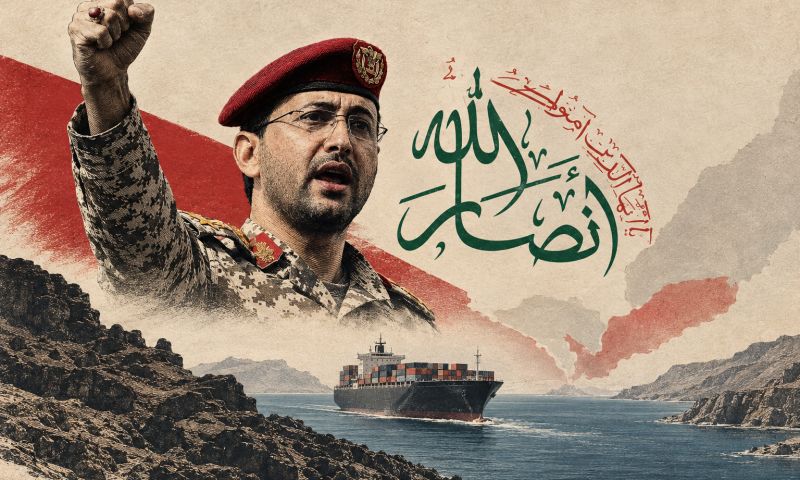
Ansar Allah’s Unperceived Advantages Against Saudi Arabia






Ansar Allalah [Houthis] enjoys many perhaps unperceived advantages in its conflict against the ‘wealthy', westernised Saudi Kingdom. This is a war recently rekindled by Saudi’s September rupture of the 2022 Truce, when it bombed Sanaa’s international airport in July 2026 to prevent an Iranian civilian aircraft from landing.
Saudi Arabia says that Trump explicitly approved the airport strike -- thereby opening the way for Ansar Allah to put aside the truce, and for war to flare up.
Ansar Allah responded to the breach of Truce with an 18 hour ‘blitz’ strike that seized the west coast of Yemen (some 5,400 sq. km taken in 11 days), the key ports and the main strategic islands in the Red Sea.Their actions and strategy were well planned and grounded in a deep understanding and experience of the Peninsula’s unique geography and societal make-up.
A quick glance at the map will show that Saudi and Yemen are situated in a ‘box’ — the centre of which is desert, with its sides comprised of rugged mountain ridges sloping downwards to the Red Sea. Ansar Allah now hold the highlands above the Red Sea approaches, and have also seized the key Red Sea islands that control access to the Bab al-Mandab Strait.
In some respects, the geography mirrors the rocky hillside Iranian terrain that frames Hormuz.
This geographic reality suggests that Saudi air power will not dislodge agile mountain tribesmen from their mountain redoubt. Ansar Allah, in any case, fight asymmetrically. Having been relentlessly bombed for over a decade, they fight as “free men”; they ‘flit' from place to place, and their military infra-structure is buried (in a practice similar to that of Iran). They now control the Bab al-Mandab Strait with artillery, thus saving their more sophisticated drones and missiles for other purposes.
In short, Saudi or western air power will avail little. There are no obvious targets; Ansar Allah fighters are like mirages moving hither and thither. The Saudi-aligned forces in the south rather, are coalitions drawn from different southern tribes and mercenaries; there are also remnants of pro-UAE mercenaries with whom the pro-Saudi forces variously clash.
The initial Saudi offensive against Ansar Allah was a débacle; with no central command, no plan and unprepared logistics, the assault collapsed. Fighting now seems to be spreading to Jizan and Najran Provinces — currently part of Saudi Arabia. These are two of three rich, fertile Yemeni provinces seized by Saudi Arabia in the 1930s. Undoubtedly Yemen wants them back.
So what can Israel and the US do in support of their pivotal ally? Well, Israel seemingly is touting the Horn of Africa as a base from which to launch an amphibious assault across the Red Sea to seize the rim of the ‘Ansar Allah box' bordering the Red Sea. Such a notion, however, so resembles the failed WW1 Gallipoli amphibious assault across the Dardanelle Strait that resulted in the deaths of more than 44,000 Allied forces that it is not hard to imagine shivers ascending the spines of Pentagon officials.
Notably, Trump and other ‘allies’ have declined to come to the rescue of MbS [Mohammed bin Salman]— ostracism and denial that will not pass unnoticed by the Saudi clans and tribes who still resent King Salman’s gerrymandering of the royal succession in 2017, contrary to tradition, to name MbS, his favoured son, as Crown Prince (rather than the next brother in the line of succession). Nor will MbS' November 2017 shake-down of near 400 princes, oligarchs and ministers at the Ritz-Carlton hotel in Riyadh be forgotten; nor will the hogging of oil resources and, as Professor Madawi Al-Rasheed outlines, the subjugation of Saudi tribes for the instalment of one family rule, be forgiven.
The second factor — apart from geography — that should to be taken into account are Ansar Allah’s roots in an historic revolutionary creed and the Peninsula’s long contentious history.
José Alberto Nino explains that “behind Ansar Allah’s surprising geopolitical gains stands an ancient religious tradition. Zaydism is one of the 3 surviving major branches of Shia Islam alongside Twelverism and Ismailism”—
“Twelverism—the dominant branch, comprising the majority of Shia Muslims worldwide and which is the state religion of Iran — holds that spiritual legitimacy passed through a line of 12 Imams … Ismailism, sometimes called Sevener Shia, split from the Twelver line over which son of the sixth Imam was the rightful successor; its most prominent surviving branch today follows the Aga Khan as the living Imam”.
“Zaydism takes its name from Zayd ibn Ali, a great-great-grandson of the Prophet Muhammad … Whereas Twelvers believe the Imam must be divinely appointed and Ismailis follow a hereditary living Imam, Zaydis hold that any learned descendant of Ali can lead by rising in arms against tyranny”.
“The Houthis remain a Zaydi-rooted movement but have built a broader coalition across sectarian lines…[recuiting] Shafi’i Sunnis and installed southern Sunni politicians in visible civilian posts, while appealing to Sunni communities through sovereignty, anti-corruption, anti-intervention, and pro-Palestinian solidarity messaging.”
“The 1979 [Iranian] revolution offered Zaydi revivalists an example of a successful Islamic uprising against monarchy and Western power. [Their leader], Hussein, admired Ayatollah Khomeini’s resistance, adopted elements of Iranian statecraft, [but] looked to Hezbollah as an organizational model”.
Yet Ansar Allah is no Iranian proxy, Nino insists.
Its sustained defiance to Israel, he says, comes not merely from Hizbullah nor Iran, but is anchored in its first Imam’s ‘own raising of arms against tyranny’ when he rebelled against the Umayyad Caliphate in 740 CE and was martyred.
Antipathy towards Jews amongst the Houthis primordially arose, Nino writes, “after the Sabbatean movement of 1666, a mass messianic excitement” [of vast numbers of Jews around the world and centred on Sabbatai Zevi as the Messiah leading Jews to imminent Redemption] stormed Yemen.
Sabbatean mysticism was highly controversial everywhere, from Europe to Asia, with thousands of Jews being ex-communicated by their Rabbinical authorities for their Sabbatean practice. Sabbatai Zevi, and the practices embraced by his movement, so outraged the Ottoman Caliph, Mehmed IV, that he ordered Zevi to convert to Islam or accept to be put to death. Zevi chose to convert to Islam in 1666. Most of his huge following ostensibly converted to Islam too, following Zevi’s lead, but secretly remained ‘Sabbatean'. Hence the Dönmeh movement of dissimulation of secret allegiance inside Turkey and beyond.
In Yemen, the Houthi Imam, after consulting Zaydi scholars, gave a ruling which, like the Caliph, also demanded Jewish conversion — an ultimatum that most Yemeni Jews refused. The episode concluded with the demolition of synagogues across Yemen in 1679 and the expulsion of the entire Jewish population from Yemen (though Jews did return after about a year's absence, though many found their former properties confiscated).
No doubt the Ottoman Caliph imagined the Sabbatean episode had been wrapped-up in 1666 — but there was a twist in the tail that ultimately contributed to the dismantlement of the Caliphate. The manner in which the Caliphate was dismantled cast shadows on Ibn Saud’s embrace of Abd-al Wahhab and his zealotry — an alliance seen as deeply antithetical to Sunni Islam as whole.
For centuries, the Dönmeh had lived a double life — practicing an ‘open secret’ identity where true religious allegiances were dissimulated. When the Young Turks began advocating for a Western-style secular state, the Dönmeh eagerly championed the cause. A secular, nationalist Turkey meant they would no longer be defined by the strict religious legal codes (the Millet system) of the Ottoman Empire. They could finally step out of the shadows as equal, secular Turkish citizens.
Mainstream historians acknowledge that the Dönmeh community played a foundational role in the Committee of Union and Progress (CUP) and the subsequent collapse of the Ottoman Empire.
Viewed from the perspective of Ottoman loyalists, the Empire had been brought down by two unorthodox, disruptive forces — internal secularising reformers in the West (often Dönmeh), and secondly, by radical religious zealots in the East (the Wahhabis). In the remote desert of central Arabia (the Najd), the alliance between Muhammad ibn Abd al-Wahhab and the House of Saud was perceived as a direct war on Ottoman religious credentials and on its territorial hegemony.
The tipping points came with the devastating Wahhabi raids on Karbala (1802), Mecca and Medina (1803-1805), which shocked the Muslim world and forced the Ottoman Sultan to take drastic action.
A highly publicized 2002 Iraqi Intelligence Report discovered after the fall of Baghdad (and earlier works by Ottoman writers like Ayyub Sabri Pasha) claimed that Muhammad ibn Abd al-Wahhab (the founder of Wahhabism) and Muhammad bin Saud were descendants of the Dönmeh.
Whilst there is no literal evidence for a such a link, a number of observers have noted the powerful structural and functional ‘resonances’ in how these three movements — Sabbateanism, Wahhabism and messianic Zionism — operated within their respective religions: All three represented radical breaks from traditional orthodoxy. Wahhabism rejected centuries of Islamic scholarly tradition in favour of rigid literalism;Sabbateanism broke rabbinic law entirely, and Messianic Zionism subverted traditional Orthodox Jewish teaching (waiting for the Messiah).
For decades, Saudi Arabia heavily guarded its history, anchoring its legitimacy directly to the divine mandate of the 1744 alliance with Ibn Abd al-Wahhab. In recent years, however, Saudi Arabia has engaged in a conscious uncoupling from Wahhabism under the “Son King”, Mohammed Bin Salman. The state has rewritten its official history to emphasize national, tribal identity starting in 1727, downplaying the role of Ibn Wahhab.
Whilst Turkey — as the primary successor state of the Ottoman Empire — retains a deep cultural memory of the Ottoman-Wahhabi Wars, many Turkish religious authorities view Wahhabism as a highly destructive, un-Islamic movement threatening the spiritual integrity of Islam. So too do the Shia, whether Iranian or Yemeni, regard the sack of Karbala, led by Saud bin Abd-al Azziz (the son of the King), to have been an existential attack on their spiritual identity. Between 2,000–5,000 Shia were killed and the shrine of Ibn Hussein was plundered.
The event horrified both Shia and Sunni Muslims across the region. In revenge, a Shia assassin travelled from Iraq to the Saudi capital of Diriyah in late 1803 and stabbed the Saudi ruler, Abd-al Aziz, to death. Eventually, an Ottoman-Egyptian force laid siege to the Saudi capital of Diriyah. After a brutal several-month siege, the city surrendered.
This history exemplifies the structural vulnerability of the al-Saud’s Islamic credentials in their war with Ansar Allah — an understanding completely at odds with the Western perception of Saudi Arabia as a ‘reformist’ state and a pole of Islamic credibility.
«Ansar Allah’s Unperceived Advantages Against Saudi Arabia»